
Antigua and Barbuda

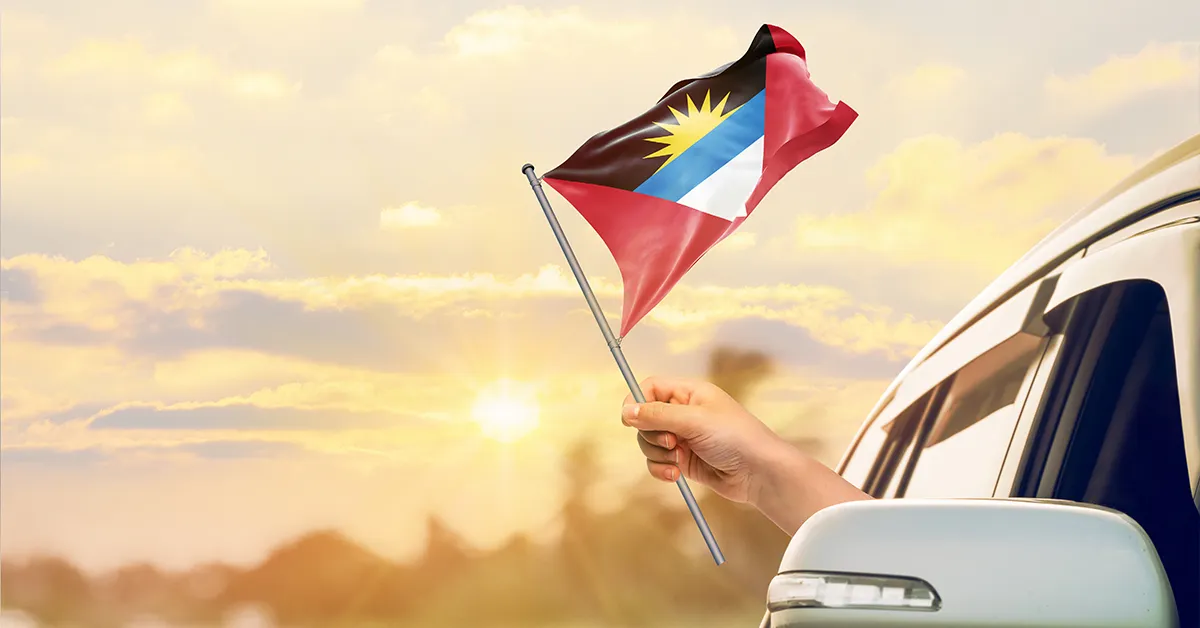
Antigua and Barbuda is a sovereign state in the Eastern Caribbean, made up of two main islands of the same names and several smaller dependent islands. The country gained independence from the United Kingdom on 01/11/1981 and is a member of the Commonwealth, the United Nations, the Organisation of Eastern Caribbean States (OECS) and the Caribbean Community (CARICOM).
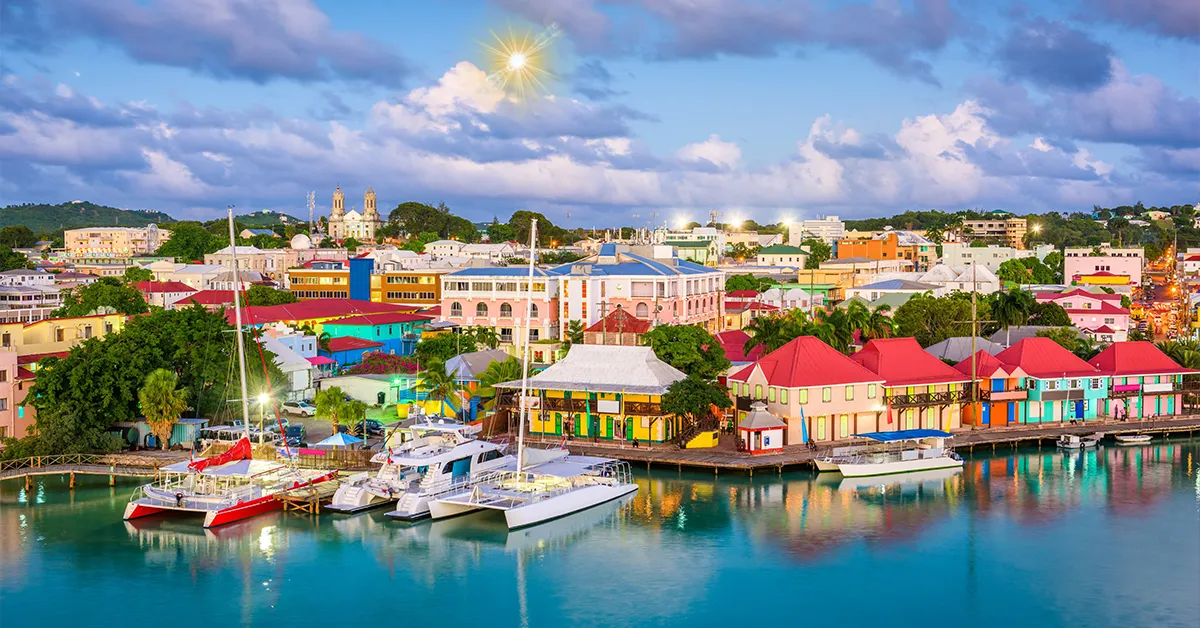
With an area of about 440 km² and an estimated population of 106,365 in 2026, Antigua and Barbuda is one of the least populous countries in the Caribbean. The capital, Saint John’s, is on the island of Antigua and is the country’s administrative, economic and tourism centre. The economy relies heavily on tourism, which contributes nearly 60% of GDP and provides most of the jobs on both islands.
The country is widely known among international investors for its Citizenship by Investment Programme, launched in 2013. With a passport offering visa-free access to more than 150 countries, a favourable tax system and political stability, Antigua and Barbuda has become one of the leading destinations for individuals seeking a second citizenship in the Caribbean.
Message
Overview
The country’s official name is Antigua and Barbuda, used in all legal documents and international agreements. Both “Antigua” and “Barbuda” come from Spanish: “antiguo” means “ancient” or “old”, while “barbuda” means “bearded” — traditionally thought to refer to the island’s bearded fig trees or the beards of its Indigenous inhabitants.
The country has a constitutional monarchy based on the Westminster model, with King Charles III as head of state. The monarch is represented locally by the Governor-General, a post held by Rodney Williams since 2014. Executive government is headed by the Prime Minister, currently Gaston Browne of the Antigua and Barbuda Labour Party (ABLP), who has been in office since 2014.
The official currency is the Eastern Caribbean dollar (XCD), issued and managed by the Eastern Caribbean Central Bank (ECCB) at a fixed rate of 1 USD = 2.7 XCD. This exchange rate, stable for decades, creates a predictable financial environment for investors and businesses.
English is the official language and is used in administration, education and the media. Antiguan Creole, an English-based creole, is spoken by many locals in everyday conversation. The legal system is inherited from English common law, in line with the judicial traditions of other Commonwealth members.
Government of Antigua and Barbuda websitehere.
Considering a residency programme? The Prosperous Living Investment team assesses your profile free of charge and advises on the pathway that fits your goals.
History
Detailed article onHistory of Antigua and Barbuda
Human history in Antigua and Barbuda began around 2400 BC with the arrival of the Siboney people. Later, the Arawak migrated from Venezuela up the Lesser Antilles chain and settled on both islands. Christopher Columbus sighted Antigua on his second voyage in 1493 and named it after the church of Santa Maria la Antigua in Seville.
The English established the first colony on Antigua in 1632. In 1674, Sir Christopher Codrington built the first large sugar plantation and leased the island of Barbuda to supply food for his plantations. For more than two centuries, the island’s economy relied heavily on enslaved labour from West Africa. Slavery in Antigua was officially abolished in 1834, earlier than in many other Caribbean colonies.
Decolonisation unfolded throughout the 20th century. Antigua and Barbuda briefly joined the West Indies Federation from 1958 to 1962, then became an associated state of the United Kingdom on 27/02/1967 with full internal self-government. After more than a decade of preparation, the country gained full independence on 01/11/1981 under the leadership of Vere Cornwall Bird Sr., its first Prime Minister. Since then, politics has been dominated by alternation between the ABLP and the United Progressive Party (UPP).
Geography
Detailed article onGeography of Antigua and Barbuda
Antigua and Barbuda lies in the Eastern Caribbean at 17°03′ North and 61°48′ West, in the Leeward Islands. The country shares maritime borders with Anguilla, Saint Barthélemy and Saint Kitts and Nevis to the west, Montserrat to the southwest, and Guadeloupe to the south. Its total land area is 440 km², with Antigua covering about 281 km² and Barbuda 161 km².
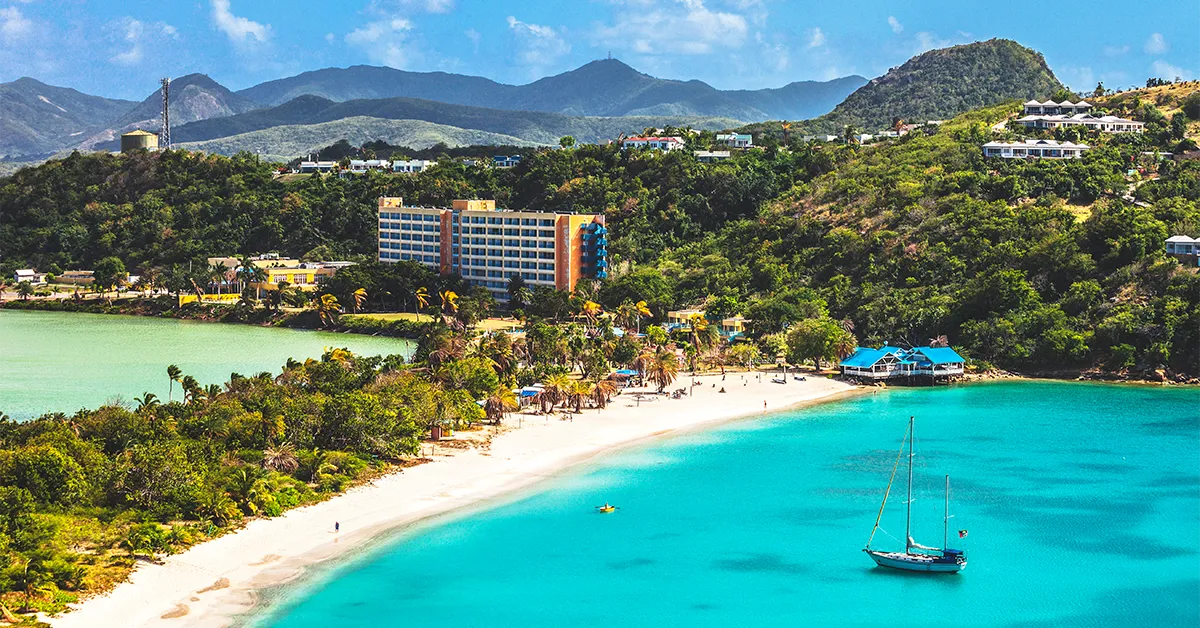
Both islands are mostly low-lying plains with some old volcanic areas. The highest point is Boggy Peak (renamed Mount Obama from 2009 to 2016) in Antigua’s Shekerley Mountains, at 402 metres. Barbuda is largely wetlands and low grassland, with its highest point at just 38 metres. Both islands have long coastlines, many natural bays and white sand beaches.
The climate is tropical savanna, with stable year-round temperatures between 23°C and 30°C. The dry season runs from December to April, the ideal time for tourism. The Atlantic hurricane season from June to November brings significant disaster risk, as seen in the severe damage from Hurricane Irma in 2017, which flattened much of Barbuda.
Freshwater resources are a long-standing challenge for the country. Average rainfall is only about 1,000 mm a year, low compared with many other Caribbean island nations. Deforestation for farming causes rainwater to run off quickly, worsening water scarcity.
Politics
Detailed article onPolitics of Antigua and Barbuda
Antigua and Barbuda is a unitary parliamentary democracy under a constitutional monarchy. The 1981 Constitution, adopted at independence, sets out three branches of government: legislative, executive and judicial. Executive power is in theory vested in the monarch but is in practice exercised by the Prime Minister and Cabinet.
The legislature is a bicameral Parliament comprising the Senate and the House of Representatives. The Senate has 17 members appointed by the Governor-General: 10 on the advice of the Prime Minister, 4 on the advice of the Leader of the Opposition, 1 Barbuda resident nominated by the Prime Minister, 1 nominated by the Barbuda Council and 1 at the Governor-General’s discretion. The House of Representatives has 17 members directly elected from constituencies, plus the Speaker. Parliament’s maximum term is 5 years.
Barbuda has been granted considerable autonomy through the Barbuda Council, established in 1976. The Council has powers over land management, natural resources and some public services on the island. Relations between the central government in Antigua and the Barbuda Council are sometimes tense, particularly after Hurricane Irma in 2017, when the Barbudan community opposed the central government’s plans for large-scale tourism development.
The two main parties in the current political system are the ruling ABLP and the opposition UPP. In the general election of 18/01/2023, Prime Minister Gaston Browne’s ABLP retained its majority in the House of Representatives. After the death of Queen Elizabeth II in 2022, Prime Minister Browne announced his intention to hold a referendum on becoming a republic, though no specific timetable has been set.
Economy
Detailed article onEconomy of Antigua and Barbuda
The economy of Antigua and Barbuda is a service economy dominated by tourism. According to World Bank data, the country’s nominal GDP is about $1.9 billion USD and GDP per capita at purchasing power parity (PPP) was about $25,337 USD in 2022, placing Antigua and Barbuda among upper-middle-income countries under the World Bank classification.
Tourism contributes, directly and indirectly, more than 60% of GDP and provides most of the jobs. Antigua is famous for its 365 beaches — as locals proudly say, one for every day of the year. Most visitors come from the United States, Canada, the UK and continental Europe. Luxury five-star resorts are densely clustered around the natural bays, catering to affluent travellers.
Besides tourism, offshore financial services are an important sector but have shrunk significantly since the late 1990s due to international anti-money laundering pressure. Agriculture accounts for only about 2% of GDP due to limited freshwater and labour, mainly serving the domestic market with products such as vegetables, sugar cane and tropical fruit. Manufacturing accounts for about 2% of GDP, focused on export assembly of bedding, handicrafts and electronic components.
The citizenship by investment programme launched in 2013 has become an important source of foreign exchange. According to data published on the official website of theAntigua and Barbuda Citizenship by Investment Unit (CIU), the programme has contributed significantly to the state budget through the National Development Fund (NDF). Interested investors can refer to the articleAntigua and Barbuda citizenship by investmentfor details of the 4 current investment options.
Demographics
Detailed article onDemographics of Antigua and Barbuda
The Antigua and Barbuda Statistics Division estimates the population at 106,365 in 2026, up 24% from the 2011 census. About 97% of the population lives on Antigua, while almost all of Barbuda’s residents live in Codrington — the only town on the island. Saint John’s is the most populous city, followed by All Saints and Bolans.
The ethnic composition according to the 2011 census is 87.3% Afro-Caribbean, 4.7% mixed, 2.7% Hispanic, 1.6% white and 2.7% other groups. The fertility rate in 2022 was 1.6 children per woman, lower than the average for small Caribbean island states. Population growth is steady, partly due to immigration from neighbouring Caribbean islands and the citizenship by investment programme.
In terms of religion, Protestant Christians are the majority at 68.3% of the population, with Anglicans the largest denomination at 17.6%. Roman Catholics account for 8.2%, other religions 12.2% and 5.9% have no religion. Freedom of religion is protected by the 1981 Constitution and consistently upheld in practice.
Antigua and Barbuda has a young population with a median age of about 33. The adult literacy rate is above 99%, one of the highest in the Caribbean. Life expectancy is about 77 years, reflecting relatively developed living standards and healthcare for the region.
Education
Detailed article onEducation in Antigua and Barbuda
The education system of Antigua and Barbuda follows the British model, with compulsory schooling from ages 5 to 16. General education is divided into three levels: pre-school, primary (grades 1-6) and secondary (forms 1-5). Students sit the Grade Six National Assessment to be placed in secondary schools.
The two leading secondary schools are Antigua Grammar School (for boys) and Antigua Girls’ High School (for girls), which admit the 100 top-scoring students nationwide. Other capable students are placed in public comprehensive schools. According to 2011 data, 16.55% of adults aged 25 and over had primary education, 48.34% secondary education and 27.24% held a college or university qualification.
Antigua and Barbuda is one of the contributing member countries of the University of the West Indies (UWI) — the leading regional university in the Caribbean, with main campuses in Jamaica, Trinidad and Tobago and Barbados. The university opened its fourth campus in Antigua in 2019, in the Five Islands area. Students from Antigua and Barbuda benefit from subsidised tuition and access to national scholarships at UWI.
The government allocates about 3.1% of GDP to education according to 2023 data. Vocational and technical training programmes have been expanded to meet workforce needs in tourism, construction and financial services. A growing number of students from Antigua and Barbuda choose to study in the United States, Canada and the United Kingdom, especially as Antigua and Barbuda citizenship offers many visa advantages for studying abroad.
Culture
Detailed article onCulture of Antigua and Barbuda
The culture of Antigua and Barbuda blends African heritage, British influence and local Caribbean elements. Carnival, held every year from late July to early August, is the most important cultural event, commemorating the abolition of slavery in 1834. During the festival, parades with colourful costumes, soca and calypso music, and beauty pageants take place in Saint John’s.
Music plays a central role in cultural life. Steelpan, calypso, soca and reggae are widely popular. King Short Shirt (Sir McLean Emanuel) is one of the country’s legendary calypso artists. Cricket is the most popular sport, and Sir Vivian Richards — a legend born in Antigua — is one of the greatest cricketers of all time. The national cricket stadium bears his name.
Local cuisine reflects a mix of Caribbean ingredients and cooking techniques from many sources. The national dish is Fungee and Pepperpot — fungee is made from cornmeal and okra and served with pepperpot, a spicy meat stew. Smoked fish, johnnycakes and rum cocktails are also popular. Antigua produces several local rum brands that are exported within the region.
Although small, the literature of Antigua and Barbuda has some prominent international names. Jamaica Kincaid, born in Saint John’s in 1949, is the most widely known Antiguan author, with works such as “Annie John” and “A Small Place” — critiques of the colonial legacy and the modern tourism industry of her homeland.
International relations
Detailed article onInternational relations of Antigua and Barbuda
As a geographically small country, Antigua and Barbuda pursues a multilateral foreign policy, prioritising regional integration and building a global network of partners. The country is a member of the United Nations, the Commonwealth, the Organization of American States (OAS), the Caribbean Community (CARICOM), the Organisation of Eastern Caribbean States (OECS) and the Bolivarian Alliance for the Peoples of Our America (ALBA).
Relations with the United States have remained stable since independence, despite periodic tensions over financial sector regulation and the citizenship by investment programme. In December 2025, President Donald Trump issued an executive order restricting US entry visas for citizens of Antigua and Barbuda from 01/01/2026, citing concerns about the CBI programme. In early 2026, the two sides reached a preliminary agreement preserving entry rights for those who already held valid visas before that date.
Relations with the United Kingdom and other Commonwealth members remain close through political, educational and trade channels. Citizens of Antigua and Barbuda can enter the UK visa-free for up to 6 months. Relations with the European Union centre on the Schengen visa waiver agreement — an important benefit of the Antigua and Barbuda passport — and the due diligence standards the CBI programme must meet to keep this right.
Within the Caribbean, Antigua and Barbuda plays an active role in the OECS — an economic and monetary union that shares the Eastern Caribbean dollar and allows free movement of citizens between its members, including Antigua and Barbuda, Dominica,Grenada, Saint Lucia, Saint Vincent and the Grenadines, and Saint Kitts and Nevis. Relations with China have strengthened over the past decade through infrastructure projects and development assistance.
The Antigua and Barbuda passport
The Antigua and Barbuda passport is one of the more highly regarded travel documents internationally, particularly thanks to its list of visa-free countries and the benefits it offers holders. According to thePLI Passport Index2026, the Antigua and Barbuda passport ranks among the 25 strongest passports in the world, offering visa-free or visa-on-arrival access to more than 150 countries and territories.
Notable destinations include the 27 countries of Europe’s Schengen Area, the United Kingdom, Singapore, Hong Kong, South Korea and most Caribbean and Central American countries. Citizens of Antigua and Barbuda can also apply for a 10-year US B-1/B-2 visa. However, visas are still required to enter the United States, Canada and Australia, and Antigua and Barbuda has no E-2 treaty with the United States — unlike Grenada.
Passports are issued under the Immigration and Passport Act 2014. There are four types of passport: the ordinary adult passport, the child passport, the service passport and the diplomatic passport. Ordinary adult passports are valid for 10 years and child passports for 5 years, both renewable. The standard passport fee is $300 USD and normal processing takes 3 weeks.
Immigration pathways
Detailed article onAntigua and Barbuda citizenship by investment.
Antigua and Barbuda offers several ways for foreign nationals to obtain residence or citizenship. The best-known route is the citizenship by investment programme, managed by theCIUunder the Office of the Prime Minister. The programme grants citizenship and a passport to investors who pass due diligence, with a minimum investment of $230,000 USD through a contribution to the National Development Fund.
Besides investment, the traditional routes to Antigua and Barbuda citizenship include:
- Citizenship by birth: children born in Antigua and Barbuda to parents who are citizens or permanent residents
- Citizenship by descent: children with at least one parent or grandparent who is a citizen of Antigua and Barbuda
- Citizenship by marriage: spouses of citizens of Antigua and Barbuda after the required period of residence
- Citizenship by naturalisation: at least 5 years of ordinary residence in the country
- Citizenship by investment: through the CBI programme
The country has no separate residence by investment programme like many European countries. The CBI programme is the fastest and most popular route for foreign investors. Foreign nationals can also apply for long-term residence permits through employment, study or approved business investment under Immigration Department regulations.
Related articles
Summary
Antigua and Barbuda is a Caribbean island nation that is small geographically but notable internationally. Political stability since independence in 1981, a legal system inherited from Britain, a currency pegged to the US dollar and membership of key regional and international organisations create a favourable environment for both residents and foreign investors.
For Vietnamese investors interested in a second citizenship, Antigua and Barbuda offers a combination of reasonable investment costs, flexible family policies, a strong passport and light residence requirements. However, the legal landscape is changing — particularly regarding US entry rights and minimum residence requirements — so investors need to keep their information up to date and choose the right time to apply.
For a deeper look at specific aspects of the country, readers can refer to the in-depth articles on the history, geography, politics, economy, demographics, education, culture and international relations of Antigua and Barbuda linked in each section above. For questions about the citizenship by investment programme and the application process, the PLI advisory team is ready to provide individual profile assessments and advice on a suitable pathway.
Accompanying you on your journey in residency investment
The Prosperous Living Investment team advises on pathways, assesses profiles and manages investments transparently for every residency, citizenship and international property objective.
Free profile assessmentWhere life gets prosperous