

Politics of Antigua and Barbuda

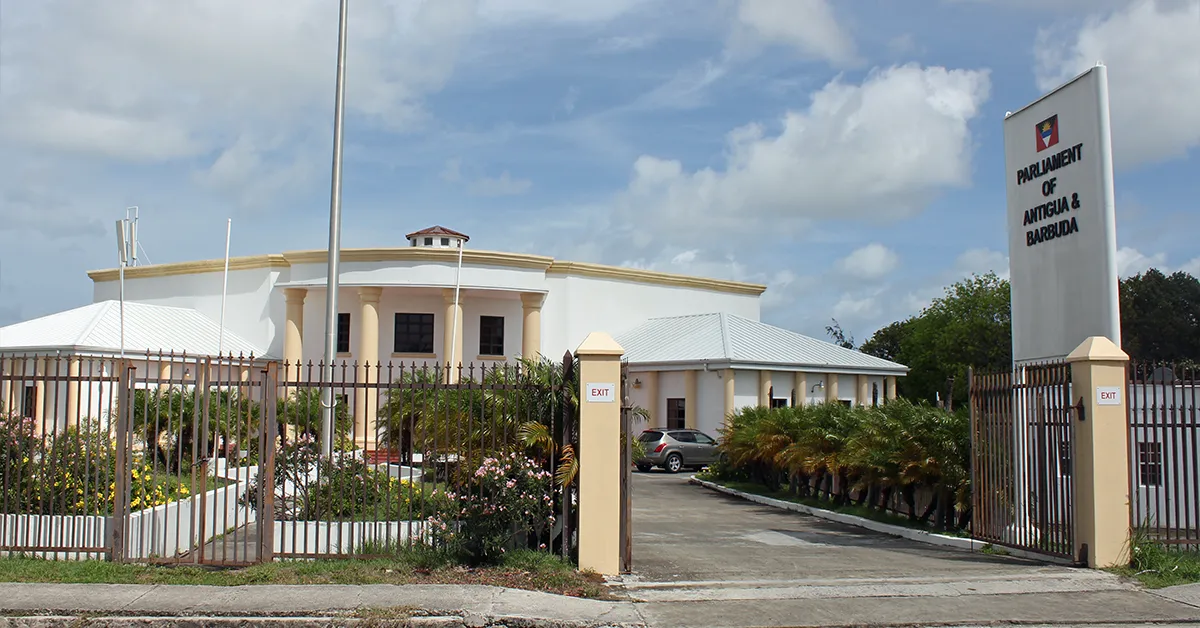
Politics in Antigua and Barbuda follows a Westminster-style parliamentary democracy under a constitutional monarchy. King Charles III is head of state, represented locally by the Governor-General. Real executive power lies with the Prime Minister and Cabinet, while the bicameral Parliament consists of an appointed Senate and a directly elected House of Representatives. The 1981 Constitution, adopted at independence, is the fundamental legal document governing the structure and operation of the political system.
Two main parties have dominated political life from the 1970s to the present: the Antigua and Barbuda Labour Party (ABLP) and the United Progressive Party (UPP). In addition, the Barbuda People’s Movement (BPM) is a party representing Barbuda specifically. Competition between the ABLP and the UPP has shaped transfers of power for almost five decades, with long periods of continuous rule by each party.
Detailed article onthe country of Antigua and Barbuda.
Message
The Constitution and structure of the state
The legal foundation of politics in Antigua and Barbuda is the Constitution adopted on 31/10/1981 and in force from 01/11/1981 — the day independence was declared. It replaced the pre-independence constitution of the Associated State of Antigua, which did not clearly define the relationship between the two islands. Under the 1981 Constitution, Antigua and Barbuda is a unitary state in which Barbuda has considerable autonomy over internal affairs, while Antigua is governed directly by the central government.
The state is divided into three distinct branches of power: legislative, executive and judicial. Executive power is theoretically vested in the monarch and exercised by the Governor-General, but in practice it is exercised by the Prime Minister and Cabinet. Legislative power lies with the bicameral Parliament. Judicial independence is guaranteed through the court system, with the Eastern Caribbean Supreme Court serving as the shared superior court for OECS member states.
The Constitution guarantees fundamental rights including freedom of expression, freedom of the press, freedom of religion, freedom of assembly and freedom of movement. It also sets out provisions for removing the Prime Minister through a vote of no confidence in the House of Representatives, procedures for declaring a state of emergency and the conditions for constitutional amendment. Amendments require special majorities in both the Senate and the House, with certain entrenched provisions requiring approval by referendum.
Considering a residency programme? The Prosperous Living Investment team assesses your profile free of charge and advises on the pathway that fits your goals.
The monarchy and the Governor-General
Antigua and Barbuda is a Commonwealth realm, with King Charles III as head of state since the death of Queen Elizabeth II in September 2022. The King is represented locally by the Governor-General — a position appointed by the monarch on the advice of the Prime Minister of Antigua and Barbuda.
The Governor-General performs ceremonial functions and some important constitutional functions. According to documents published on the website ofGovernment of Antigua and Barbuda, the Governor-General appoints the Prime Minister, ministers on the Prime Minister’s advice, senators, senior judges and ambassadors. The Governor-General also assents to laws passed by Parliament, grants pardons on the advice of the Advisory Committee on the Prerogative of Mercy, and may declare a public emergency on the advice of the Cabinet.
Sir Rodney Williams has served as Governor-General since 2014, succeeding Dame Louise Lake-Tack (2007–2014), Sir James Carlisle (1993–2007) and Sir Wilfred Jacobs (1981–1993) — the first Governor-General after independence. Although legally serving “at His Majesty’s pleasure”, in practice the Governor-General usually serves for a term matching that of the nominating Prime Minister and may be replaced when the ruling party changes.
After the death of Queen Elizabeth II, Prime Minister Gaston Browne announced his intention to hold a referendum on becoming a republic. The proposal was first raised in September 2022, although no specific timetable has been set. The 2018 constitutional referendum — on removing the role of the UK Privy Council in the judicial system — was rejected by voters, showing society’s caution towards major constitutional changes.
The bicameral Parliament
The legislature of Antigua and Barbuda is a bicameral Parliament consisting of the Senate and the House of Representatives. This structure is inherited from the British Westminster tradition and has remained stable since independence in 1981. Both houses sit in the Parliament building in Saint John’s, opened on 31/10/1981 just before the independence ceremony in the presence of Princess Margaret, representing the Queen.
The Senate
The Senate has 17 members appointed by the Governor-General on specified recommendations:
- 10 government senators on the advice of the Prime Minister
- 1 senator resident in Barbuda on the advice of the Prime Minister
- 4 opposition senators on the advice of the Leader of the Opposition
- 1 senator on the advice of the Barbuda Council
- 1 independent senator at the Governor-General’s own discretion
This appointment mechanism aims to guarantee a voice for both Barbuda and the opposition in the legislature. The Senate reviews bills passed by the House of Representatives and may amend or reject certain types of bills, except money bills, which fall under the exclusive authority of the House.
The House of Representatives
The House of Representatives has 17 members directly elected from 17 constituencies under the first-past-the-post system. 16 constituencies are on Antigua and 1 is on Barbuda. In addition, the House has a Speaker elected by the members and the Attorney General ex officio if not an elected member — bringing total membership to 19. The House has a maximum term of 5 years and may be dissolved early by the Governor-General on the advice of the Prime Minister.
Constituency boundaries have remained essentially unchanged since 1984, leading to significant population disparities between constituencies. The Constituencies Boundaries Commission began a review in November 2025 to redraw them based on registered voter numbers, because the 2021 census was repeatedly postponed and only completed in June 2025.
The executive and the Cabinet
Executive power is exercised by the Prime Minister — the head of government — and the Cabinet he leads. Under Section 69 of the 1981 Constitution, the Governor-General appoints as Prime Minister the member of the House of Representatives judged most likely to command the support of a majority of the House. In practice, this has always been the leader of the majority party.
The Prime Minister nominates ministers for formal appointment by the Governor-General. Ministers must be members of the House of Representatives or the Senate. Usually the most senior ministers are members of the House — especially in key portfolios such as Finance, Foreign Affairs and Justice. This structure ensures the Cabinet is accountable to Parliament under the classic Westminster principle.
Gaston Alphonso Browne has been Prime Minister since June 2014, after the ABLP won a resounding victory over the incumbent UPP. Browne has been elected Prime Minister three times (2014, 2018, 2023) and is campaigning for a fourth term in the general election of 30/04/2026 — an election held almost 18 months ahead of the constitutional deadline in 2028. Before Browne, the prime ministers since independence were Vere Cornwall Bird Sr. (1981–1994), Lester Bird (1994–2004) and Baldwin Spencer (2004–2014).
The judiciary and the rule of law
The judicial system of Antigua and Barbuda is based on English common law inherited from the colonial era. The courts comprise Magistrate Courts for minor cases, the High Court for complex cases, and the Eastern Caribbean Supreme Court (ECSC) as the shared appellate court for OECS member states.
The final court of appeal for most cases is still the Judicial Committee of the Privy Council in London. A proposal to make the Caribbean Court of Justice (CCJ) the final court of appeal was put to a referendum in 2018 but rejected by voters. To date, Antigua and Barbuda accepts the CCJ’s jurisdiction only in matters of CARICOM trade.
According to Freedom House, the judiciary of Antigua and Barbuda is generally considered independent, especially since 2022, when the courts actively asserted their independence from the ABLP government. However, some challenges remain: prisoners wait an average of 3–4 years for trial, and prisons are overcrowded, with occupancy exceeding 250% of official capacity in mid-2023. Jury trials were largely abolished in 2024.
The party system
Politics in Antigua and Barbuda currently operates under a three-party system:
- Antigua and Barbuda Labour Party (ABLP): the current ruling party, which originated in the trade union movement of the 1940s under the leadership of Vere Cornwall Bird Sr. The ABLP was once described as a social democratic party but has gradually shifted towards a conservative line since independence. The party has a strong base on Antigua.
- United Progressive Party (UPP): the main opposition party, founded in March 1992 through the merger of the Antigua Caribbean Liberation Movement (ACLM), the Progressive Labour Movement (PLM) and the United National Democratic Party (UNDP). The UPP governed from 2004 to 2014 under the leadership of Baldwin Spencer.
- Barbuda People’s Movement (BPM): a local party representing Barbuda, active mainly on issues concerning the island’s autonomy and land management. The BPM usually allies with the UPP in national elections and was part of the 2004–2014 coalition government.
Some other small parties, such as the Democratic National Alliance (DNA), have contested some elections but have not won significant seats. Independent candidates also occasionally win individual constituencies — for example Asot Michael, a former ABLP member, won the Saint Peter seat in the 2023 election.
Elections and recent results
Elections to the House of Representatives are the central event of politics in Antigua and Barbuda, held under the Representation of the People Act of 31/10/1975 (last amended in 2002) and overseen by the Office of the Supervisor of Elections and the Electoral Commission established in 2002. The Commission has 5 members appointed by the Governor-General: 3 (including the chairman) on the advice of the Prime Minister and 2 on the advice of the Leader of the Opposition.
Recent election results reflect the swing between the two main parties:
- 2014: the ABLP won 14 of 17 House seats, making Gaston Browne Prime Minister after 10 years of UPP government
- 2018: the ABLP increased its majority to 15 of 17 seats in an early election
- 2023: the ABLP won narrowly with 9 of 17 seats (47% of the vote), the UPP won 6 seats (45% of the vote), the BPM held the Barbuda seat, and independent candidate Asot Michael won the Saint Peter seat
The next general election is being held on 30/04/2026, almost 18 months ahead of the constitutional deadline of January 2028. Prime Minister Browne announced the election date at the launch of the ABLP manifesto on 07/04/2026, after Parliament was dissolved on 01/04/2026. According to data published onthe Inter-Parliamentary Union (IPU) Parline, a total of 37 candidates were nominated for the 17 constituencies: 17 ABLP candidates, 16 UPP candidates, 3 independents and 1 BPM candidate.
Administrative divisions and the Barbuda Council
Antigua is divided into 6 parishes — administrative units inherited from the colonial era: Saint John, Saint George, Saint Mary, Saint Paul, Saint Peter and Saint Philip. These parishes have no local government of their own — all administration is centralised in the national government in Saint John’s. This differs from the United States and many federal countries, where local units have independent legislative powers.
Barbuda is administered by the Barbuda Council, established in 1976 — even before the country gained independence. The Council has authority over land management, natural resources and some public services on the island. Barbuda’s history of communal land ownership — a legacy of the Codrington family era — has created recurring tensions with the central government, especially after Hurricane Irma in 2017, when the government sought to push large-scale tourism development projects.
The 2025 Barbuda Council election saw a landslide win for the BPM, which took all contested seats — a significant defeat for the ABLP. The result reflects the Barbudan community’s discontent with some central government policies and further complicates the political landscape ahead of the general election of 30/04/2026.
Relations between the government and the opposition
Competition between the ABLP and the UPP has shaped politics in Antigua and Barbuda since the 2004 election — when the UPP first ended 28 years of ALP/ABLP dominance. Relations between the two parties are often tense, especially around elections. However, the political system has generally operated stably without major upheavals or unconstitutional events.
Recurring points of contention between the two parties include: economic policy on the citizenship by investment programme, corruption and transparency in campaign finance, relations with China on infrastructure projects, and disputes between the central government and the Barbuda Council over land ownership and use.
Women remain under-represented in the House of Representatives. In the 2023 election, only 1 woman was elected to the 17-seat House. The share of women in the Senate is higher — almost 53% after the 2018 appointments. The government and the parties have made commitments to increase women’s political participation, although actual progress remains slow.
Politics of Antigua and Barbuda — a summary
Politics in Antigua and Barbuda shows a relatively stable parliamentary democracy over almost five decades of independence, with peaceful transfers of power between the two main parties. The Westminster model is maintained with a balance between a nominal head of state, a representative Governor-General, a bicameral Parliament and an executive Cabinet. Barbuda’s autonomy through the Barbuda Council is a unique feature of the state structure.
Upcoming challenges include: reform of constituency boundaries, a possible transition to a republic, relations between the central government and the Barbuda Council, and international pressure on the citizenship by investment programme. The general election of 30/04/2026 will be an important political event shaping the country’s course over the next term.
Accompanying you on your journey in residency investment
The Prosperous Living Investment team advises on pathways, assesses profiles and manages investments transparently for every residency, citizenship and international property objective.
Free profile assessmentWhere life gets prosperous