


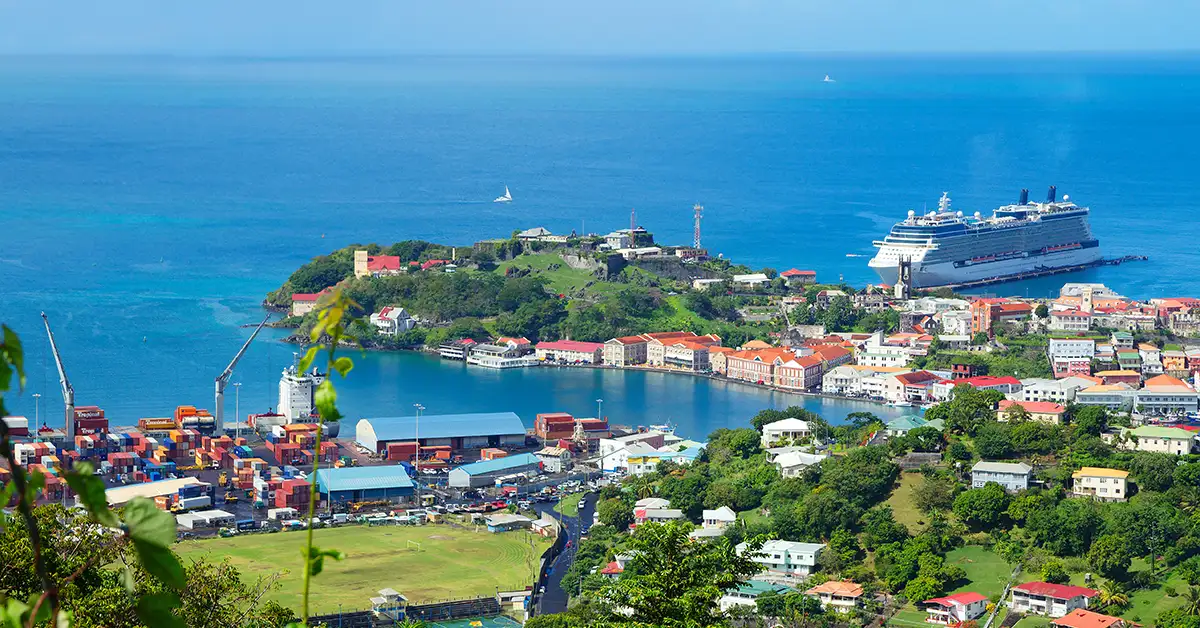
Grenada is an island nation in the West Indies, in the eastern Caribbean Sea. As the southernmost island in the Windward Islands chain, Grenada lies immediately south of Saint Vincent and the Grenadines and around 160 km north of Trinidad and Tobago.
With an area of only 344 km² and a population of around 114,621 (2024 estimate), Grenada is one of the smallest countries in the Western Hemisphere but has a rich history, diverse nature and an increasingly important international standing — particularly thanks to theGrenada residence-by-investmentprogramme and the onlyvisa E-2treaty in the Caribbean region with the United States.
Grenada is known as the “Island of Spice” for its large output of nutmeg and mace, once accounting for nearly 20% of global production. The capital and largest city is St. George’s, on the south-west coast with its famous natural harbour and pastel-coloured houses clinging to the hillsides.
Message
Overview
| Basic information | Details |
|---|---|
| Official name | Grenada |
| Capital | St. George’s |
| Area | 344 km² |
| Population | ~114,621 (2024 estimate) |
| Official language | English |
| Currency | The East Caribbean dollar (XCD) |
| Time zone | UTC−04:00 |
| Form of government | Constitutional monarchy, parliamentary democracy |
| Head of state | Vua Charles III |
| Prime Minister | Dickon Mitchell (since 2022) |
| National day | 7 February 1974 |
| Internet country code | .gd |
| International dialling code | +1-473 |
| Driving | On the left |
| Official website | https://www.gov.gd/ |
Considering a residency programme? The Prosperous Living Investment team assesses your profile free of charge and advises on the pathway that fits your goals.
The origin of the name
The origin of the name “Grenada” is not entirely clear, but historians believe Spanish sailors named it after the city of Granada in Spain. Spanish maps from the 1520s record the name “Granada” for the island and call the small islands to the north “Los Granadillos” (the little Granadas). When the French settled and colonised it from 1649, they kept the name but rendered it as “La Grenade” in French. In 1763, when the island was ceded to Britain under the Treaty of Paris, the British changed the name to “Grenada” — the anglicised version used to this day.
Before Europeans arrived, the Indigenous Arawak inhabitants called the island Camajuya. Christopher Columbus sighted Grenada in 1498 on his third voyage to the Americas and named it “La Concepción” in honour of the Virgin Mary.
History
Detailed article:The history of Grenada
Grenada’s history stretches from its Indigenous South American inhabitants through the colonial period to the building of a modern nation.
The pre-colonial and colonial periods
Before Europeans arrived, the island was home to the Carib — Indigenous people who had migrated up from South America. The French began settling and colonising Grenada in 1649, after several failed European attempts in the face of resistance from the Indigenous Carib. Over the following nearly 2 centuries, around 127,600 Africans were brought to Grenada as slaves by both the British and the French (from 1669 to 1808).
On 10/02/1763, Grenada was ceded to Britain under the Treaty of Paris. British rule continued unbroken from 1783 to 1974, other than a brief French reoccupation (1779–1783). In 1795, Fédon’s Rebellion — inspired by the Haitian Revolution — came close to succeeding, and required major military intervention to suppress. Slavery was abolished in 1833.
Independence and political upheaval
Grenada obtained full internal self-government in 1967 as an Associated State of the United Kingdom. On 07/02/1974, Grenada became formally independent under the leadership of Eric Gairy — the country’s first Prime Minister. This date is celebrated each year as National Day.
On 13/03/1979, the Marxist-Leninist New JEWEL Movement carried out a bloodless coup while Eric Gairy was abroad, suspending the constitution and forming the People’s Revolutionary Government with Maurice Bishop as Prime Minister. However, Bishop was later arrested and executed by members of his own party.
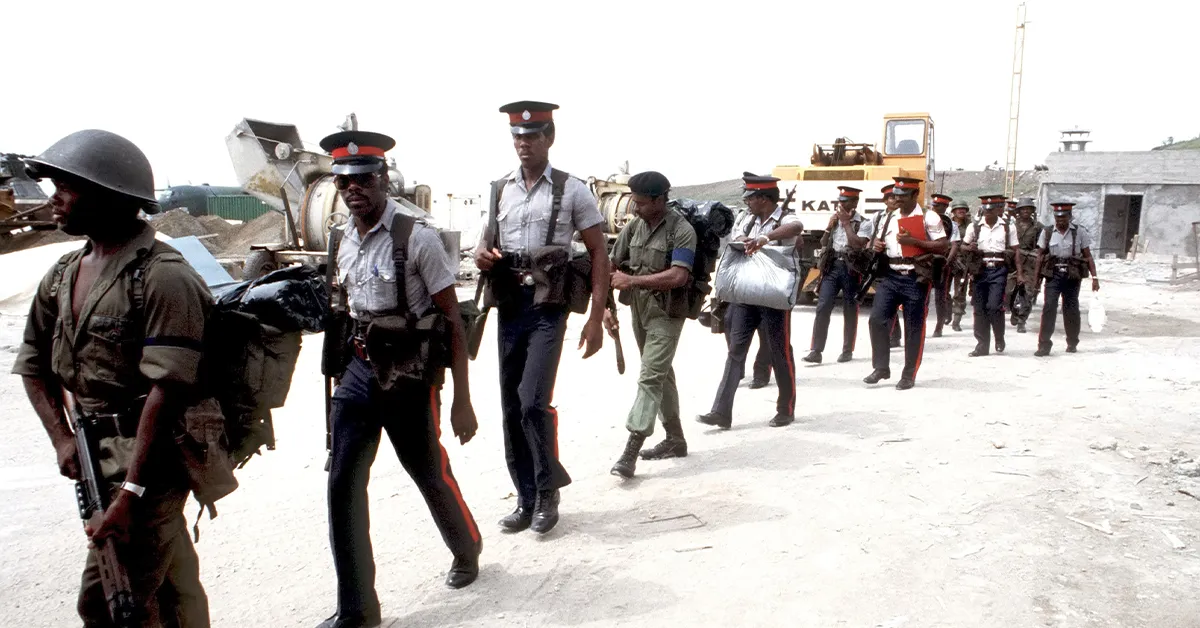
On 25/10/1983, a coalition of the United States and the Regional Security System (RSS) launched Operation “Urgent Fury” invading Grenada, quickly overthrowing the military government of General Hudson Austin in 4 days. 45 Grenadians, 25 Cubans and 19 Americans died in the conflict. The United Nations General Assembly condemned the action by 108 votes to 9.
Since 1984, Grenada has returned to parliamentary democracy and maintained continuous political stability. The most recent general election was held in June 2022, when the National Democratic Congress (NDC) won 9 of the 15 parliamentary seats, and Dickon Mitchell became Prime Minister.
Geography
Detailed article:The geography of Grenada
Grenada has a total area of 344 km² (twice the size of Washington, D.C.), comprising the main island of Grenada and 2 smaller islands, Carriacou and Petite Martinique, together with several small islands in the southern part of the Grenadines. The main island is oval, around 34 km long and around 19 km wide.
Terrain
Grenada is of volcanic origin, clearly evident in its soils, its hilly interior and its many extinct craters, including Lake Antoine, Grand Etang Lake and Levera Pond. The mountain range runs north–south, with steeper slopes to the west and gentler ones to the east and south-east. The highest peak is Mount St. Catherine at 840 metres.
Grand Etang Lake lies in an extinct crater at an altitude of 530 metres, covers around 15 hectares and is the centre of the Grand Etang Forest Reserve — the largest reserve on the island, established in 1906. The only active volcano in the region is Kick ’em Jenny, underwater between Grenada and Carriacou.
Climate
Grenada has a tropical climate, moderated by the north-easterly trade winds. The average temperature is 28°C and is stable year round, ranging from 26–32°C during the day and 19–24°C at night. Rainfall varies from 1,500 mm on the coast to more than 3,500 mm in the mountains. The wet season runs from June to December.
Grenada lies south of the usual hurricane track, but when hurricanes do strike — as in 1955, 1979, 2004 (Hurricane Ivan) and 2005 (Hurricane Emily) — the damage is usually severe. Hurricane Ivan in 2004 destroyed 90% of the buildings on the island and severely damaged the nutmeg industry.
Natural resources
The main natural resources are timber, tropical fruit and deepwater harbours. The island has lush vegetation year round with a diversity of tropical fruit trees, flowering shrubs and ferns. The interior forest includes teak, mahogany, saman and blue mahoe.
Politics and government
Detailed article:The politics of Grenada
Grenada is a constitutional monarchy on the Westminster model. The head of state is King Charles III (King of Grenada and 14 other Commonwealth realms), represented locally by the Governor-General of Grenada. Executive power lies with the Prime Minister — the leader of the party holding a majority in Parliament.
The Parliament of Grenada has 2 chambers: the Senate (13 appointed members) and the House of Representatives (15 directly elected members serving 5-year terms). The two largest political parties are the New National Party (NNP, centre-right) and the National Democratic Congress (NDC, centre-left).
Grenada is a member of many international organisations including the United Nations, the Commonwealth, the Organisation of Eastern Caribbean States (OECS), the Caribbean Community and Common Market (CARICOM), and the Organization of American States (OAS).
Administration
Grenada is divided into 6 parishes on the main island and 2 parishes for the dependent islands:
- St. George (including the capital St. George’s)
- St. David
- St. Andrew
- St. Patrick
- St. Mark
- St. John
- Carriacou
- Petite Martinique
Economy
Detailed article:The economy of Grenada
Grenada is a small economy depending mainly on tourism and agriculture. According to the CIA World Factbook, the sectoral structure of GDP is: services accounting for the largest share (including tourism), followed by agriculture and industry. The main trading partners are the United States, Germany, Malaysia, the Netherlands and other Caribbean countries.
Agriculture
Grenada is world-famous for nutmeg — the spice occupying the central place on the country’s flag. Beyond nutmeg, other important agricultural products are cocoa, bananas, tropical fruit, vegetables, maize and various spices. In the 19th century, cocoa replaced sugar cane as the main export, and by the 20th century nutmeg had risen to first place. Hurricane Ivan in 2004 destroyed most of the island’s nutmeg trees, and the industry took many years to recover.
Tourism
Tourism is Grenada’s most important economic sector. The island attracts visitors with its white sand beaches, diverse coral reefs, rainforest and distinctive cultural heritage. St. George’s is the yachting and sailing centre of the eastern Caribbean. The notable attractions include the Grand Etang Forest Reserve, Fort George, the Grenada National Museum, and the Molinere Underwater Sculpture Park — the world’s first underwater museum.
Currency
Grenada uses the East Caribbean dollar (XCD) issued by the Eastern Caribbean Central Bank (ECCB), the common currency of the member states of the Eastern Caribbean Currency Union (ECCU). The exchange rate is fixed at XCD 2.7 = USD 1.
The citizenship-by-investment programme
Grenada has run a citizenship-by-investment (CBI) programme since 2013, allowing foreign investors to obtain citizenship through a financial contribution. This programme plays an important role in attracting foreign investment, financing national development projects and creating jobs. Grenada is the only Caribbean country with an E-2 visa treaty with the United States, allowing Grenadian citizens to qualify for a business investor visa to the United States.
Demographics
Detailed article:The demographics of Grenada
Grenada’s population is estimated at around 114,621 (2024). Most of the population is of African descent, descendants of those brought there as slaves during the colonial period. There are also minorities of mixed heritage (mulatto), of East Indian descent (descendants of the indentured labourers who replaced slaves after abolition), of French and British descent, together with recent immigrants from North America and Europe.
Language
English is the official language. Some older people in rural villages still use Grenadian Creole — a mixed language of French origin.
Religion
At the 2020 census, 96.6% of the population was Christian, of whom Protestants made up 48.8%, Catholics 39.2%, and other Christian denominations 8.6%. Hindus made up 1.3%, those with no religion 1.0%, and Rastafari 0.7%.
Emigration
Grenada has a high rate of emigration, particularly among the young. Although only just over 100,000 people live in Grenada, it is estimated that at least an equivalent number of Grenadians live in other Caribbean countries (such as Barbados and Trinidad and Tobago), and a similar number in developed countries. Popular emigration destinations are New York, Toronto, London and Montreal. It is estimated that only around 1/3 of those born in Grenada still live on the island.
Education
Detailed article:Education in Grenada
Grenada has an education system on the British model with compulsory education from ages 5 to 16. Spending on education accounts for around 3.2% of GDP. The best-known higher education institution is St. George’s University (SGU) — a medical school of international standing, attracting students from around the world. SGU graduates are commonly accepted into residency programmes in the United States and Canada. SGU was also one of the reasons the United States gave for the 1983 invasion — protecting American medical students studying there.
Healthcare
Grenada provides healthcare through a system of public hospitals and clinics across the island. Life expectancy is around 76 years. Health spending accounts for around 5.8% of GDP. The doctor density is around 1.5 per 1,000 people.
Culture
Detailed article:The culture of Grenada
Grenadian culture is a rich blend of African, French, British and Indigenous Caribbean influences, clearly evident in its music, food, festivals and art.
Food
Grenadian cuisine reflects the “Island of Spice” nickname with abundant use of nutmeg, cinnamon, ginger, cloves and cocoa in its dishes. The national dish is “Oil Down” — a stew of breadfruit, salted meat, greens, turmeric and coconut milk cooked in a large pot. Grenadian cocoa is highly regarded worldwide and is the raw material for a strongly growing artisan chocolate industry.
Festivals
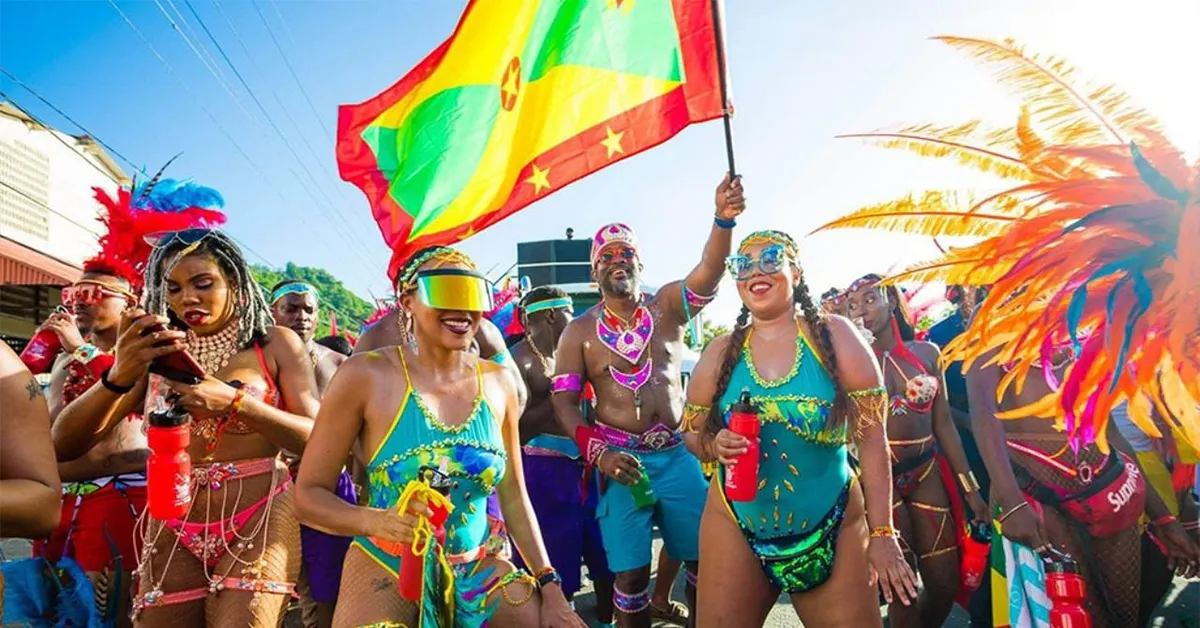
The Carnival festival (Spicemas) is the biggest cultural event of the year, held in August, comprising colourful parades, calypso and soca music, steel pan competitions, and the “Jab Jab” tradition — performers covered head to toe in black paint and oil. The Chocolate Festival in May and Nutmeg Day also attract many international visitors.
Music
Calypso and soca are the most popular musical genres. Steelpan music also holds an important place in musical life. Grenada also has the “Big Drum” tradition on Carriacou — traditional African-origin drum music used in spiritual rites and community festivals.
Defence
Grenada has had no standing army since 1983. National security is the responsibility of the Royal Grenada Police Force, which includes a small Coast Guard unit. Grenada is a member of the Regional Security System (RSS) — the collective defence alliance of the eastern Caribbean states.
Sport
Cricket is the most popular sport in Grenada. The Grenada National Stadium hosted matches in the 2007 ICC Cricket World Cup.
Football is also increasingly popular. Grenada is also famous in international athletics — the athlete Kirani James won Olympic gold in the 400 metres at the London 2012 Games, becoming the first and only Olympic champion in Grenada’s history and the youngest athlete to win gold in that event. James went on to win silver at Rio 2016 and bronze at Tokyo 2020.
Transport
Maurice Bishop International Airport (formerly Point Salines airport) is the main aviation gateway, serving international flights from North America, the United Kingdom and the Caribbean islands. This airport has a particular history — it was built with Cuban assistance during the People’s Revolutionary Government and was one of the reasons the United States gave for the 1983 invasion. Carriacou has the smaller Lauriston airport serving domestic flights.
Road traffic on the island drives on the left (following British tradition). The port of St. George’s is the main port, serving both cargo ships and cruise liners.
Environment
Grenada’s main environmental issues are coastal saltwater intrusion, coral degradation, deforestation and solid waste management. Grenada is party to many international environmental treaties including the United Nations Framework Convention on Climate Change, the Kyoto Protocol and the Paris Agreement. As a small island state, Grenada is particularly vulnerable to the effects of climate change, including sea level rise, increasingly severe tropical storms and ocean acidification.
International relations
Grenada maintains extensive diplomatic relations and is an active member of many international and regional organisations. After the 1983 invasion, Grenada has had close relations with the United States. Notably, Grenada has maintained an E-2 visa treaty with the United States since 1989 — the only Caribbean country with such a treaty, allowing Grenadian citizens to apply for a business investor visa to live and work in the United States.
Grenada is also a founder member of the Organisation of Eastern Caribbean States (OECS) and the Caribbean Community (CARICOM), playing an important role in regional economic and security co-operation.
National symbols
The flag of Grenada was adopted when the country gained independence on 07/02/1974. The flag has a red field with a gold border, comprising 6 gold stars (representing the 6 parishes on the main island), a large star at the centre on a red disc (representing the capital St. George’s), and a nutmeg on the left — the most characteristic emblem of the spice island.
Grenada’s coat of arms depicts Grand Etang Lake, Christopher Columbus’s ship the Santa Maria, a lion (symbolising the link with the United Kingdom), together with a banana plant and a maize cob representing agriculture. Two native animals — the armadillo and the Grenada dove (a critically endangered species and the national bird) — stand on either side of the arms.
The national motto: “Ever Conscious of God We Aspire, Build and Advance as One People”.
The national anthem: “Hail! Grenada”.
Accompanying you on your journey in residency investment
The Prosperous Living Investment team advises on pathways, assesses profiles and manages investments transparently for every residency, citizenship and international property objective.
Free profile assessmentWhere life gets prosperous