

Education in Antigua and Barbuda

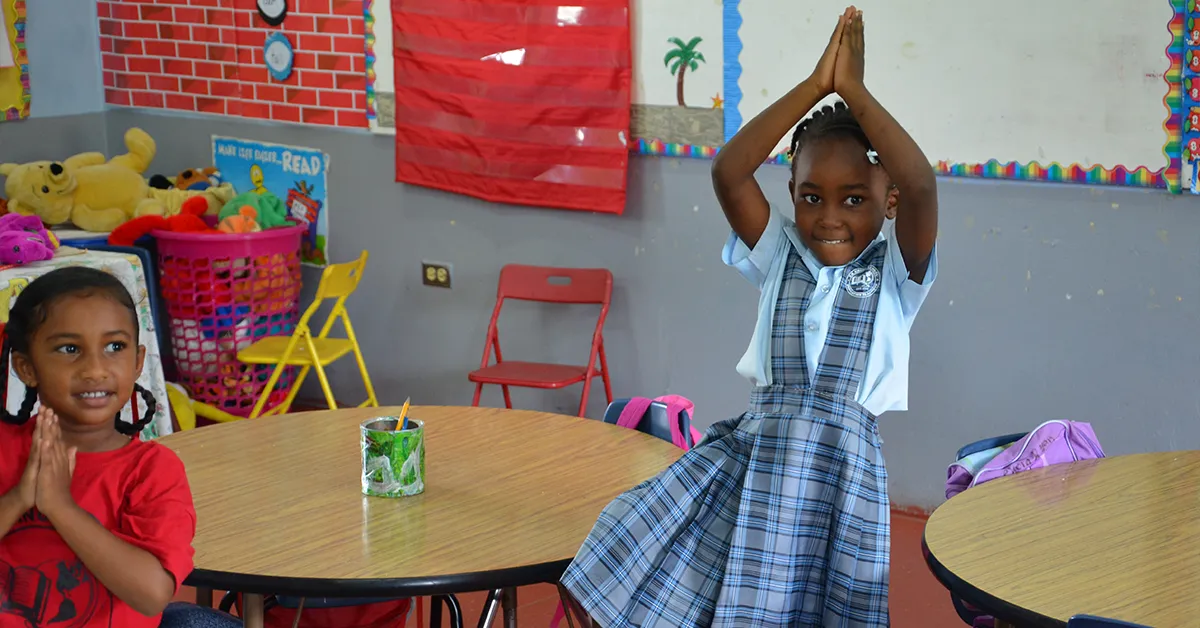
Education in Antigua and Barbuda follows the British model in the Westminster tradition, with compulsory schooling from age 5 to 16 and a structure divided into preschool, primary and secondary levels. The system is managed by the Ministry of Education, Sports and Creative Industries, currently led by Minister Daryll Matthew. Adult literacy is above 99% — one of the highest rates in the Caribbean and Latin America.
Higher and post-secondary education has developed significantly over the past decade, especially with the establishment of the fifth campus of the University of the West Indies (UWI) at Five Islands in 2019. This additional university, together with Antigua State College (ASC) and several vocational training institutions, has reduced the pressure on local young people to study abroad. This article analyses in detail the levels of education, curricula, higher education institutions and current reform trends.
Detailed article onthe country of Antigua and Barbuda.
Message
Legal framework and administration
The 1981 Constitution and the Education Act are the fundamental legal texts governing the educational rights and obligations of citizens of Antigua and Barbuda. The Constitution provides that every child has the right to access education, while the Education Act sets out the requirements for compulsory school age, curriculum standards and regulations for managing public and private educational institutions.
The Ministry of Education, Sports and Creative Industries is the government body responsible for state administration of education. The Minister is nominated by the Prime Minister and formally appointed by the Governor-General. According to information published on the website ofGovernment of Antigua and Barbuda, the Ministry is responsible for education policy, budget allocation, teacher training, quality assurance and the administration of national examinations.
The government allocates about 3–3.5% of GDP to education according to recent data. Public education is free at primary and secondary levels for citizens of Antigua and Barbuda. Textbooks and some learning materials are provided free to primary pupils and some secondary students. Private schools operate alongside the public system, mainly religious schools and international schools serving the foreign community.
Considering a residency programme? The Prosperous Living Investment team assesses your profile free of charge and advises on the pathway that fits your goals.
Early childhood and preschool education
The first stage of education in Antigua and Barbuda is for children aged 0 to 5, including private nurseries, childcare centres and kindergartens. Most kindergartens are privately run or belong to religious organisations, although the government also operates some public kindergartens. Preschool education is not compulsory, but participation has risen steadily in recent decades.
The preschool curriculum focuses on English language development, motor skills, basic numeracy and social development. Preschool teachers need a qualification in early childhood education or an equivalent licence. Some early childhood centres are affiliated with international programmes, using Montessori or Reggio Emilia methods.
About 80–85% of children aged 3–5 attend early childhood education according to UNICEF data — higher than the average for upper-middle-income countries in the region. Investment in early childhood education is seen as key to building a solid foundation for later stages of schooling.
Primary education
Primary education is compulsory for children aged 5 to 11 and lasts 6 years, from Grade 1 to Grade 6. There are about 65 primary schools nationwide, both public and private, spread across all 6 parishes of Antigua and on Barbuda. Class sizes range from 25 to 35 pupils depending on the school.
The primary curriculum covers core subjects: English, Mathematics, Science, Social Studies, Religious Education, Art, Music and Physical Education. Spanish is taught as a second language from Grade 4. Religious Knowledge reflects the character of Caribbean society, where most people are Protestant Christians.
At the end of Grade 6, pupils sit a national examination called the Grade Six National Assessment (GSNA) — an important exam that determines placement in secondary schools. GSNA results are used to allocate pupils to secondary schools in order of merit: the 100 highest-scoring pupils are placed in the two prestigious schools, Antigua Grammar School (boys) and Antigua Girls’ High School (girls), and the rest are placed in comprehensive public secondary schools near where they live.
Secondary education
Secondary education lasts 5 years, from Form 1 to Form 5, for students aged 11 to 16. There are about 16 public secondary schools nationwide plus several private schools. Antigua Grammar School (founded 1884) and Antigua Girls’ High School (founded 1886) are the two most prestigious schools, with long academic traditions.
The secondary curriculum follows the standards of the Caribbean Examinations Council (CXC) — a regional examining body headquartered in Barbados that serves all CARICOM countries. At the end of Form 5, students sit the Caribbean Secondary Education Certificate (CSEC) — equivalent to the British GCSE. Students typically take 5–9 subjects across English, Mathematics, Sciences (Physics, Chemistry, Biology), Social Studies, Information Technology, Foreign Languages and the Arts.
After Form 5, students can continue to Form 6 (lasting 2 years) to sit the Caribbean Advanced Proficiency Examination (CAPE) — equivalent to British A-Levels. CAPE is widely recognised for university admission in the Caribbean, the United Kingdom, the United States and Canada. Some secondary schools have their own Form 6, while many students choose to take Form 6 at Antigua State College.
Secondary education also includes technical and vocational schools. The Antigua and Barbuda Technical College, the Hospitality Training Institute and several other institutions offer vocational programmes in engineering, construction, hospitality, culinary arts, information technology and cosmetology. These programmes usually last 1–3 years and award regionally recognised vocational certificates.
College education — Antigua State College
Antigua State College (ASC) is the leading national college, founded in 1977 through the merger of three training institutions: the Antigua Teachers’ Training College, the School of Nursing and the Technical College. ASC is located at Golden Grove on the outskirts of Saint John’s and has about 2,000 students each year.
ASC’s main programmes are:
- Liberal Arts: general programmes geared towards university transfer
- Sciences: natural sciences and mathematics at foundation level
- Business: accounting, finance, business administration and computer science
- Health Sciences: training for nurses, midwives and health specialisations
- Hospitality Studies: hospitality and tourism
- Engineering: electrical, mechanical and construction engineering
Most ASC students take the CAPE-equivalent Form 6 programme and then transfer to university at UWI or abroad. Some ASC programmes are linked with UWI, allowing students to complete the first 1–2 years of a bachelor’s degree in Antigua before transferring to another UWI campus or graduating at UWI Five Islands.
University of the West Indies — Five Islands Campus
The University of the West Indies (UWI) is the leading regional university in the Caribbean, founded in 1948 as a college affiliated with the University of London in Jamaica. UWI now has 5 main campuses: Mona (Jamaica), St. Augustine (Trinidad and Tobago), Cave Hill (Barbados), Five Islands (Antigua and Barbuda) and the Open Campus for distance learning.
The Five Islands Campus is UWI’s fifth and newest campus, officially launched in 2019 with the backing of Prime Minister Gaston Browne. According to the official website ofUWI Five Islands, the campus is structured differently from the other campuses: instead of faculties, Five Islands is organised into 4 schools:
- School of Business and Innovation
- School of Health Sciences
- School of Humanities and Education
- School of Science and Technology
Undergraduate tuition at Five Islands is the lowest in the entire UWI system. Students from OECS countries receive special scholarships from the government of Antigua and Barbuda. In the 2025–2026 academic year, the campus welcomed about 500 new students at its matriculation ceremony in September 2025, bringing total enrolment to almost 1,500.
In January 2023, Prime Minister Browne signed an agreement with the Saudi Fund for Development (SFD) securing $80 million USD of investment to develop the campus. In September 2025, an expansion was announced with a further $200 million USD commitment from Saudi Arabia, due to begin in Q1 2026 and expand the campus to 5,000 students. The expansion includes modern student residences, a sports complex and a School of Computing and Artificial Intelligence — reflecting the trend towards training in new technologies. A Bachelor of Laws programme starts in September 2026.
Higher education and studying abroad
Higher education in Antigua and Barbuda is currently provided domestically by UWI Five Islands and ASC, while a significant number of students choose to study abroad to pursue specialised fields or gain international experience. The main study destinations are:
- United States: business, engineering, health and sciences
- United Kingdom: law, medicine, social sciences and the arts
- Canada: engineering, information technology, finance and health
- Cuba: medicine (under bilateral cooperation programmes)
- Dominican Republic: medicine and some engineering fields
The government of Antigua and Barbuda offers several national scholarship programmes for outstanding students in priority fields. The Antigua and Barbuda passport offers many visa advantages for study abroad, notably visa-free entry to the United Kingdom and the 27 European Schengen countries for many short-term programmes.
The gross enrolment ratio (GER) for tertiary education in Antigua and Barbuda is about 30–35% — higher than the OECS average but lower than countries with long-established UWI campuses such as Barbados, Jamaica and Trinidad and Tobago. The expansion of UWI Five Islands is expected to raise this ratio significantly over the next decade.
Educational attainment of the population
The overall effectiveness of the education system in Antigua and Barbuda is clearly reflected in the educational attainment of the population aged over 25. According to 2011 census data, educational attainment is distributed as follows:
- Primary education or less: 16,55%
- Secondary education: 48,34%
- College education: 7,87%
- University education (bachelor’s): 13,57%
- Postgraduate education (master’s, doctorate): 5,8%
The share of people with a college/university degree or higher (27.24% of the total) is one of the highest in the Caribbean. Women have higher educational attainment than men at university and postgraduate levels — a common trend in many Caribbean and Latin American countries in the generations since independence.
Vocational training and skills development
An important component of education in Antigua and Barbuda is the vocational and technical training system, which has been expanded to meet workforce needs in tourism, construction, financial services and technology. The Antigua and Barbuda Institute of Continuing Education (ABICE) offers training courses for adults and workers in industry. The Hospitality Training Institute trains staff for the tourism and hotel industry — a sector accounting for 60% of national GDP.
The Skills Development Programme — the national skills development programme — is being implemented with support from the IMF and the World Bank to raise labour productivity. The One Stop Employment Centre programme connects employers with jobseekers and provides specific skills training based on labour market needs. Vocational programmes award the Caribbean Vocational Qualification (CVQ), recognised throughout the CARICOM region.
Education in Antigua and Barbuda — a summary
Education in Antigua and Barbuda has achieved significant progress since independence in 1981, with literacy above 99%, a free public school system, alignment with international standards through CXC qualifications and the presence of the UWI Five Islands university campus since 2019. The British model inherited from colonial times has been maintained, with adjustments suited to the Caribbean context and globalisation.
Important future trends include: expanding UWI Five Islands to 5,000 students with $200 million USD of investment from 2026, launching the School of Computing and Artificial Intelligence, strengthening vocational training and expanding international scholarship opportunities. The government’s goal is to make Antigua and Barbuda the Eastern Caribbean’s “centre of educational excellence” — a direction of significant economic and social importance.
Accompanying you on your journey in residency investment
The Prosperous Living Investment team advises on pathways, assesses profiles and manages investments transparently for every residency, citizenship and international property objective.
Free profile assessmentWhere life gets prosperous