

Culture of Antigua and Barbuda

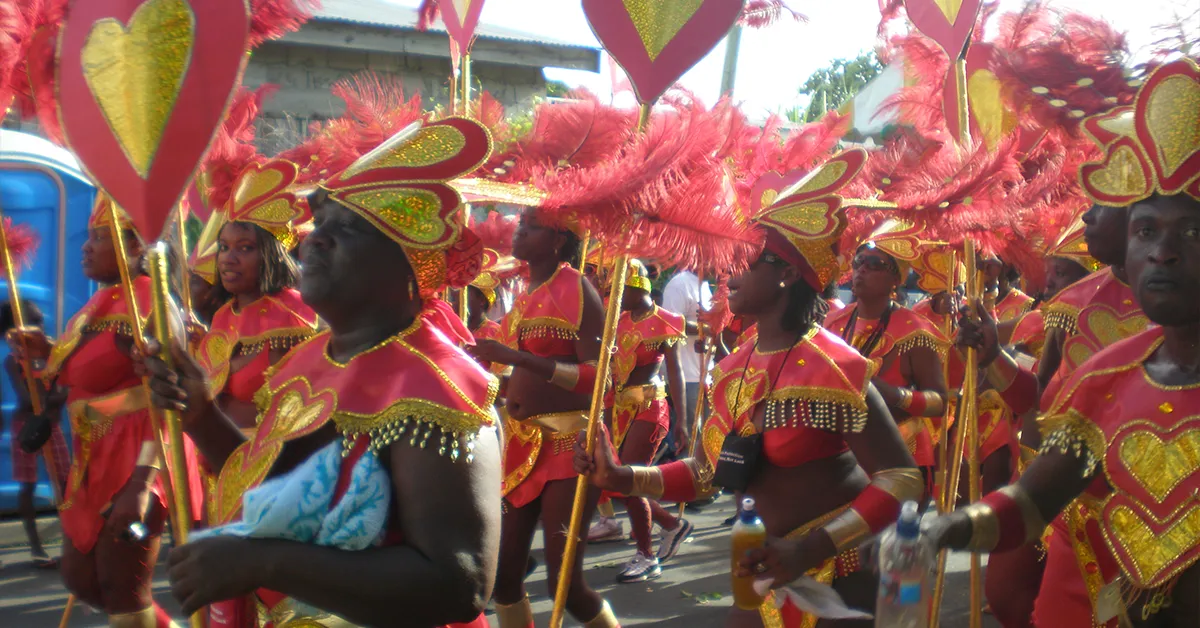
The culture of Antigua and Barbuda is the result of more than three centuries of blending the West African heritage of enslaved people, British influence from the colonial era, interaction with neighbouring Caribbean islands and global modernisation. The country’s cultural character is expressed through music, cuisine, Carnival, traditional sports and national symbols that reflect its journey from colony to independence.
The core of this culture is its strong African roots — reflecting the fact that the majority of the population descends from West Africans brought over during the colonial period. Official English and the British Westminster tradition form a “colonial” cultural layer on top.
The result is a hybrid culture with calypso and soca, a Carnival celebrating emancipation, a passionate love of cricket, fungee and pepperpot cuisine, and ancient games such as warri inherited from West Africa. This article analyses in detail the key elements that shape the cultural identity of modern Antigua and Barbuda.
Detailed article onthe country of Antigua and Barbuda.
Message
Carnival
The central event of modern Antiguan and Barbudan culture is Antigua Carnival, held from late July to the first week of August and lasting about two weeks. The festival celebrates the abolition of slavery in the British colonies on 01/08/1834. Antigua Carnival was first held in 1957 and quickly became one of the most distinctive carnivals in the Eastern Caribbean, widely promoted as “the Caribbean’s Greatest Summer Festival”.
The main Carnival events include the Calypso Monarch competition to crown the calypso king or queen of the year, the equivalent Soca Monarch competition for modern soca music, the Carnival Queen Pageant — a traditional beauty contest — the Panorama competition for steelpan bands, and Teen Splash for young people, featuring DJs and young artists. The festival peaks with J’Ouvert on the first Monday of August — a pre-dawn street party when thousands of people pour onto the streets at 4 a.m. to dance to steelpan and brass bands.
J’Ouvert is followed by the Parade of the Bands — the main procession of troupes in dazzling costumes decorated with feathers and crystals. Most events take place in Saint John’s, especially at Carnival City — the dedicated festival area with the main stage, food stalls and costume booths. According to the official website of theAntigua and Barbuda Tourism Authority, tens of thousands of visitors from North America, Europe and neighbouring Caribbean islands take part every year, contributing significantly to the tourism industry.
Barbuda holds Caribana — its own version of Carnival, usually around Whit Monday in May or June. Caribana is smaller but retains a distinctive community feel, with a calypso competition, horse racing, fishing boat races and showcases of the island’s famous seafood.
Considering a residency programme? The Prosperous Living Investment team assesses your profile free of charge and advises on the pathway that fits your goals.
Music
Music plays a central role in the culture of Antigua and Barbuda, with a strong African heritage and close ties to other Caribbean musical styles. Historical records note musical activity on Antigua dating back to the Arawaks and Caribs, although the main heritage was formed during the period of West African slavery. African labourers on Antigua are recorded dancing outdoors from the 1780s with instruments such as the toombah (later called the tum tum) — a drum fitted with tin jingles and shells — and the banjar (a forerunner of the European banjo).
Benna — the indigenous music
Benna is the indigenous music of Antigua and Barbuda, which emerged after emancipation in 1834. Benna uses the call-and-response structure characteristic of West African music. Benna songs are often satirical, spreading gossip and social commentary, and were improvised on the streets by street vendors known as Quarkoo — a role similar to that of modern street rappers in the United States.
By the early 20th century, Benna had become a popular means of spreading news on the island, especially given low literacy and limited formal media. Benna lyrics were sometimes so controversial that some Quarkoo were jailed for their songs. Jamaica Kincaid’s famous short story collection “At the Bottom of the River” mentions Benna as part of her Antiguan childhood memories. Over time, Benna was overshadowed by calypso and soca, although it is still performed at traditional cultural events.
Calypso and soca
Calypso is a Caribbean music style widely popular in Antigua and Barbuda; it originated in Trinidad and Tobago but has been adopted and developed in its own way locally. King Short Shirt (Sir McLean Emmanuel) is one of the country’s legendary calypso artists, with many socio-political songs reflecting Antiguan life. The annual Calypso Monarch competition during Carnival is an important showcase for artists.
Soca — a younger style blending calypso with East Indian rhythms and elements of funk — has come to dominate modern Carnival. Soca artist Ricardo Drue (1985–2024) was one of the leading representatives of Antiguan music, although he grew up in Trinidad and later settled in Florida. Drue’s album “Happy Music” became emblematic of soca’s characteristically upbeat, joyful style. Patrice Roberts — Drue’s wife — is also a well-known soca artist who has performed at many events in Antigua.
Steelpan and other music
Steelpan — an instrument made from modified oil drums that originated in Trinidad — is widely popular in Antigua and Barbuda. Steelpan bands perform at Carnival, weddings, community events and for tourists. The Panorama competition during Carnival is the major steelpan contest, attracting bands from across the country.
In addition, reggae from Jamaica and zouk from the neighbouring French-speaking islands are also popular. Religious music (gospel) plays an important role in Christian community life, with Anglican, Methodist and Pentecostal hymns performed in churches and at community events. Gregory Isaacs — the internationally famous reggae artist — had close ties with Antigua, although he was born in Jamaica.
Cuisine
Cuisine is an important part of the culture of Antigua and Barbuda, reflecting a combination of tropical Caribbean ingredients, African cooking techniques, British and Portuguese (Madeiran) influences and abundant seafood. Antiguans eat more fish and seafood than people in any other country in the West Indies — a trait reflecting the island nation’s geography and long fishing tradition.
The national dish
Fungee and pepperpot are the national dish pairing of Antigua and Barbuda. Fungee (pronounced “foon-jee”, known as “cou-cou” on other Caribbean islands) is yellow cornmeal cooked with okra into a firm mass with a texture similar to polenta. Antiguan pepperpot is a thick, rich, spicy stew containing spinach, okra, aubergine, squash, peas, dumplings called “spinners” and meats such as salted pork, beef or chicken. Antiguan pepperpot differs from Guyanese pepperpot, which is made with cassareep (a cassava extract).
A Creole proverb sums up the relationship between the two dishes: “Ebrey fungee ha e pepperpot” — meaning “every fungee has its pepperpot”, implying that everyone has their ideal partner. Saltfish and fungee are often eaten for Sunday lunch after church — a common tradition in Antiguan families.
Other traditional dishes
Ducana is a sweet dumpling made from grated sweet potato, coconut, sugar, flour and spices, wrapped in a banana leaf and boiled. Ducana is usually eaten with stewed saltfish and “chop-up” — a mixed vegetable stew. Johnny cake is a crispy fried bread served with main dishes. Conch (a large sea snail) is made into many dishes such as chowder, fritters and salad. Spiny lobster, crab and a wide variety of tropical fish are plentiful in the local cuisine.
The Antigua black pineapple is a native pineapple famous for its exceptional sweetness, grown on small farms on the island. Rum cake — a cake soaked in rum — is a traditional dessert. Goat water (goat stew) is a signature Caribbean stew eaten in Antigua. Many kinds of hot sauce made from habanero chillies and Caribbean peppers are widely used for cooking and dipping.
Antigua produces several local rum brands that are exported within the region. Tropical fruit juices such as mango, passion fruit and tamarind, and fresh coconut water, are popular drinks. Coffee and tea — a legacy of British tradition — are still widely drunk at breakfast and afternoon tea.
Sport
Cricket is the national sport of Antigua and Barbuda, a legacy of British colonial rule that has been embraced and developed into a national passion. Antigua and Barbuda is one of the Caribbean’s most prolific producers of outstanding cricketers, contributing significantly to the West Indies team — the joint team of the English-speaking Caribbean countries.
Sir Vivian Richards and the cricket legends
Sir Isaac Vivian Alexander Richards (born 1952) is the greatest cricketer from Antigua and Barbuda and one of the finest cricketers of all time. Richards played for the West Indies from 1974 to 1991 and has been made a Knight Companion of the Order of the National Hero (KNH), an Officer of the Order of the British Empire (OBE) and an Officer of the Order of the Caribbean Community (OOC). The national cricket stadium at North Sound — which hosts international matches — is named after him.
Anderson “Andy” Roberts was the first Antiguan to play Test cricket for the West Indies. Curtly Ambrose and Richie Richardson are other legendary players. The Sir Vivian Richards Stadium — completed in February 2007 with a capacity of 20,000 — hosted 8 matches of the 2007 Cricket World Cup and co-hosted the 2024 T20 World Cup.
The domestic cricket season runs from January to July, with teams from parishes and villages competing in the Parish League. The Antigua and Barbuda national team competed at the 1998 Commonwealth Games. In regional competitions, Antiguan players play for the Leeward Islands team.
Other sports
Football is the second most popular sport. The Antigua and Barbuda national football team was founded in 1928 and competes in CONCACAF tournaments. Daniel Bailey is the most famous track and field athlete, having competed at the Olympics and represented the country at international events. Sailing is an important tradition — Antigua Sailing Week was founded in 1967 and is one of the world’s leading yacht regattas, held in the waters of English Harbour.
Surfing, snorkelling/diving, sport fishing and horse racing are also popular. Antigua and Barbuda has never won an Olympic medal but has a tradition of active participation in international competitions. Dominoes — a traditional game among Caribbean men — and warri (a mancala game from West Africa) are popular pastimes in the community.
Literature and the arts
Although small, the literature of Antigua and Barbuda includes some prominent international names. Jamaica Kincaid (born 25/05/1949 as Elaine Cynthia Potter Richardson) is the most internationally known Antiguan author. She was born in Saint John’s, emigrated to the United States in 1965 at the age of 16, and later became a staff writer for The New Yorker and a professor of African and African American Studies at Harvard University.
Kincaid’s works focus on colonial legacy, mother-daughter relationships, the experience of migration and Caribbean identity. Her major works include “At the Bottom of the River” (1983) — a short story collection that won the Morton Dauwen Zabel Award of the American Academy of Arts and Letters; “Annie John” (1985) — a coming-of-age novel about a girl growing up in Antigua; and “Lucy” (1990) — which follows the character’s journey to the United States as an au pair.
“A Small Place” (1988) is an incisive essay critiquing colonial legacy and post-colonial tourism. It was unofficially banned in Antigua for 5 years under the Vere Bird government because of its sharply critical tone. Kincaid was elected to the American Academy of Arts and Letters in 2004 and the American Academy of Arts and Sciences in 2009.
Mary Prince (c. 1788–after 1833) was an Antiguan born into slavery and the author of “The History of Mary Prince” (1831) — the first autobiography of a Black woman published in the United Kingdom and an important work of the abolitionist movement. It had a significant influence on the passage of the Slavery Abolition Act of 1833.
Visual art in Antigua and Barbuda takes many forms: painting, sculpture, handmade pottery, traditional textiles and photography. Sylvanie Abbott is a prominent contemporary artist who uses art to raise environmental awareness. Handmade pottery by Antiguan artisans is highly regarded for its quality. Crafts include hand-woven, dyed and embroidered Sea Island cotton, basket weaving, wood carving and shellwork.
Religion and spiritual life
Christianity is the faith of the overwhelming majority in Antiguan and Barbudan culture, with Protestants the largest group (68.3%), Anglicans about 17.6% and Roman Catholics 8.2%. Religious life is closely tied to community life — people usually attend church on Sundays, while Seventh-day Adventists observe the Saturday Sabbath. Births, marriages and deaths are all marked by Christian rites.
Christmas is one of the most important occasions of the year. By old tradition, about three weeks before Christmas, carol-singing groups went around the villages with Christmas trees and lanterns. The figure of the “John Bulls” — masked representations of African witch doctors — once dominated traditional Christmas festivities. Jazz bands dressed in red-and-blue clown costumes were also common at these events.
Besides Christianity, smaller religions include Rastafari — a religious movement originating in Jamaica with Christian, Jewish and African elements — Islam (mainly Sunni) in the Middle Eastern community, Hinduism in the Indian community, the Baháʼí Faith and a small Sephardic Jewish community in Saint John’s. Freedom of religion is protected by the 1981 Constitution and consistently respected in practice.
Heritage and national symbols
Antigua and Barbuda has a single UNESCO World Heritage Site: the Antigua Naval Dockyard and Related Archaeological Sites, inscribed in 2016. According to information published on the website ofUNESCO World Heritage Centre, the site includes Nelson’s Dockyard at English Harbour — a British naval base built from 1725 and later named after Admiral Horatio Nelson, who was stationed there in 1784–1787. It is one of the most intact British colonial naval architectural sites remaining in the world.
The flag of Antigua and Barbuda was adopted in 1967 (when the country became an associated state) and retained after independence in 1981. Designed by Reginald Samuel, its symbolism is:
- Red: the dynamism of the people
- Black: the soil and African heritage
- Gold: the tropical sun
- Blue: the Caribbean Sea
- White: the white sand beaches
The stylised half-sun rising symbolises the dawn of a new era. The national anthem “Fair Antigua, We Salute Thee” — written by Reverend Novelle Hamilton Richards — is used at official events, although it had not been formally recognised in law as of 2025.
The national tree is the lignum vitae (Guaiacum officinale) — a sacred tree with very heavy, durable wood. The national bird is the Magnificent Frigatebird — a seabird that breeds in large colonies in Codrington Lagoon on Barbuda. Antigua and Barbuda has 11 public holidays a year, including Independence Day (01/11), Labour Day (early May), J’Ouvert and Carnival Monday.
Culture of Antigua and Barbuda — a summary
The culture of Antigua and Barbuda is a vibrant Eastern Caribbean identity formed by the confluence of African heritage, British colonialism and inter-island mixing within the region. Core elements such as the Carnival celebrating emancipation, calypso and soca music, the passion for cricket, fungee and pepperpot cuisine, and literary figures such as Jamaica Kincaid and Mary Prince have shaped the country’s cultural identity on the international stage.
The UNESCO-listed Nelson’s Dockyard, the symbolism of the national flag and national ceremonies reflect efforts to preserve historical memory while building a post-colonial identity. Contemporary trends include the revival of indigenous art forms such as Benna, the growth of the soca music industry and the expansion of film and digital content production. The culture of Antigua and Barbuda remains an important intangible asset for tourism and national identity.
Accompanying you on your journey in residency investment
The Prosperous Living Investment team advises on pathways, assesses profiles and manages investments transparently for every residency, citizenship and international property objective.
Free profile assessmentWhere life gets prosperous