

History of Antigua and Barbuda

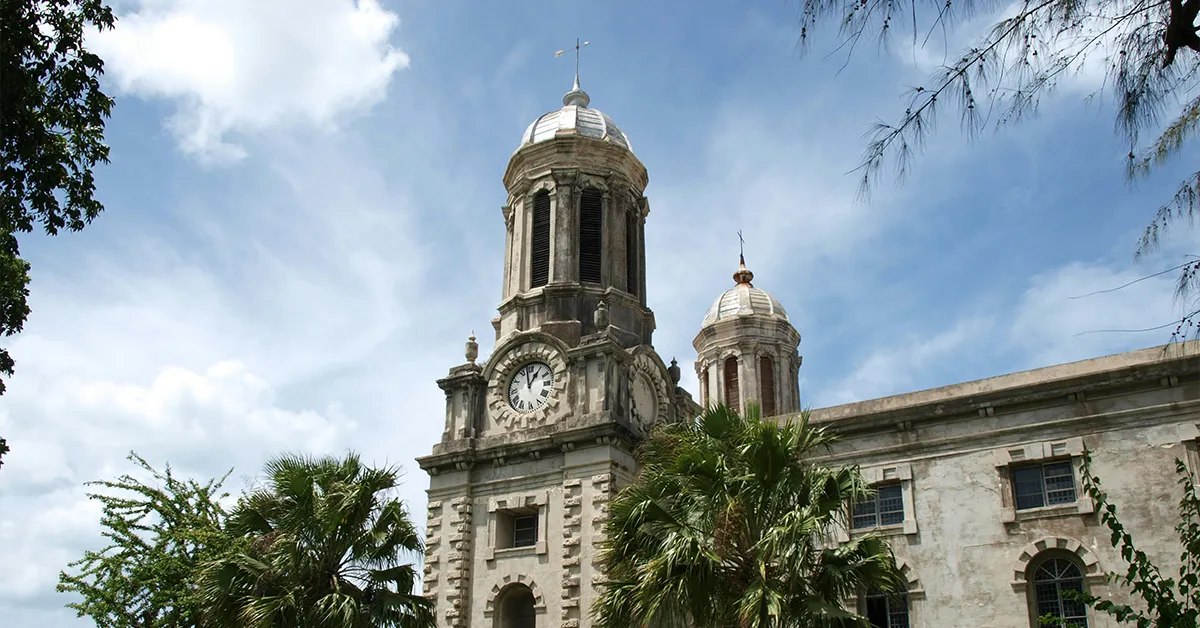
The history of Antigua and Barbuda is the story of two Caribbean islands spanning more than 4,000 years, from pre-agricultural indigenous communities to a modern independent state. It includes successive waves of settlement by indigenous peoples, the arrival of Christopher Columbus in 1493, more than three centuries of British colonial rule based on a sugar plantation economy and slave labour, and then a decolonisation process that ended with independence on 01/11/1981.
The country’s development is tied to many important turning points: Sir Christopher Codrington’s establishment of the first sugar plantation in 1674, the abolition of slavery in 1834, the rise of the trade union movement in the 1940s under the leadership of Vere Cornwall Bird, and finally the transition from associated statehood to a fully sovereign nation. This article traces the history of Antigua and Barbuda through its main periods, from prehistory to the present.
Detailed article onthe country of Antigua and Barbuda.
Message
The pre-Columbian period
The history of Antigua and Barbuda before Europeans arrived spans more than four millennia. Archaeological evidence shows that people had settled on Antigua by at least 2400 BC.
The first inhabitants were pre-agricultural peoples known locally as the Siboney, although the more accurate academic term is “Archaic People”, since the Siboney were actually a pre-ceramic group in Cuba. Archaeological sites found at many locations on both islands show that this was a hunter-gatherer community using finely crafted shell and stone tools.
Around the beginning of the Common Era, the pottery-making, farming Saladoid people migrated up the island chain from the lower Orinoco river in Venezuela. They were the ancestors of the Arawaks — the first well-documented inhabitants of the two islands, settled there from around 1200 AD. The Arawaks travelled to the islands from Venezuela in canoes called piraguas and brought agriculture to Antigua and Barbuda. They grew many crops, including the famous Antigua black pineapple, maize, white sweet potatoes, guavas, tobacco and cotton.
Most of the Arawaks left Antigua around 1100 AD. Those who stayed were later attacked by the warlike Caribs from Dominica and Saint Kitts. The Caribs had better weapons and superior seafaring skills, which allowed them to defeat many Arawak tribes across the West Indies. However, the Caribs did not settle permanently on Antigua or Barbuda, partly because of the scarcity of fresh water on the two islands. By the 16th century, almost no Caribs lived on either island.
Some archaeological records on Barbuda show prehistoric settlement dating to around 3685 BC in the River area. The sand dunes of the Palmetto area also began to form during this period. Most sites from the ceramic period are concentrated in the eastern part of Barbuda, with the most important settlements appearing in the second half of the first millennium AD.
Considering a residency programme? The Prosperous Living Investment team assesses your profile free of charge and advises on the pathway that fits your goals.
European discovery and attempts at settlement
A major turning point in the history of Antigua and Barbuda came at the end of the 15th century, when Christopher Columbus discovered the two islands on his second voyage to the New World in 1493. He observed the larger island from a distance and named it Santa Maria la Antigua, after the church of Santa Maria la Antigua in Seville, Spain — home to a saint the Spanish believed could work miracles. Columbus did not go ashore or plant a flag of possession, but simply recorded it in his ship’s log.
Early European attempts to settle the two islands largely failed in the 16th and early 17th centuries. The Spanish set up a short-lived stopover from 1520 but built no permanent settlement. The French made a similar attempt in 1629 without success. The main reasons included fierce resistance from Caribs on neighbouring islands, the lack of fresh water, and a location poorly placed for supply from the large Spanish colonies in North and South America.
English settlers from neighbouring Saint Kitts successfully established a permanent settlement on Antigua in 1632 under the leadership of Sir Thomas Warner — who had earlier led the expedition to Saint Christopher (today’s Saint Kitts). Warner became the first colonial governor. The first settlers and indentured servants grew tobacco, cotton and food crops, while defending themselves against attacks by the Caribs and the French.
Antigua officially became an English colony in 1667 under the Treaty of Breda, which ended the Second Anglo-Dutch War. Barbuda was annexed by England in 1628, and in 1685 King Charles II granted the island to the Codrington family in return for a nominal tribute of “one fat sheep or pig each year if asked”. The Codrington family continued to lease the island for almost 200 years until Barbuda was formally annexed to Antigua in 1860.
The sugar plantation era and slavery
Sir Christopher Codrington established the first large sugar plantation on Antigua in 1674. He came from Barbados — where the sugar industry was already thriving — to explore replicating the model on Antigua. Over the next 50 years, sugar became extremely profitable, leading many farmers to replace other crops with sugar cane and turning sugar into the economic backbone of the two islands.
Codrington used Barbuda as a supply base for his plantation system on Antigua. The island provided livestock, food and some labour. The story that Barbuda was a “slave breeding farm” supplying other plantations has become a widespread myth, although modern historians question its accuracy. According to a 1977 study by Lowenthal and Clark, only 172 slaves were exported from Barbuda between 1779 and 1834, most of them to Antigua and a few to the Leeward and Windward Islands and the southern United States.
Enslaved labour was imported from the West African coast on a massive scale throughout the 17th and 18th centuries. By the late 18th century, Antigua had become an important strategic port and a valuable commercial colony of Great Britain. The island was positioned to control major shipping lanes to and from the Caribbean colonies. It was also the base of the British Royal Navy in the Caribbean from 1725 to 1854.
Admiral Horatio Nelson arrived in Antigua in 1784 to command the Leeward Islands Squadron, tasked with developing British naval facilities at English Harbour and strictly enforcing trade laws. The result was the construction of Nelson’s Dockyard — a naval architectural heritage site inscribed as a UNESCO World Heritage Site in 2016. Fortifications such as Fort Barrington were built to protect the main harbours.
The abolition of slavery and its economic consequences
The British Parliament’s Slavery Abolition Act of 1833 took effect on 01/08/1834 in most colonies of the British Empire. Antigua stood out by granting full emancipation immediately, without the four-year “apprenticeship” period imposed in many other Caribbean colonies. This exceptional decision is still celebrated every year through the Carnival festival.
The situation on Barbuda was more complicated. Enslaved residents of Barbuda were not named in the 1834 abolition act. Facing the threat of forced removal to the Codrington plantations on Antigua, the people of Barbuda freed themselves. The uprising of 1834–1835 was so serious that troops had to be sent from Antigua to suppress it. At the time of abolition, Barbuda’s population was about 500.
Emancipation did not automatically improve living conditions for Black residents. They remained economically dependent on plantation owners because they lacked farmland, had no access to credit, and the economy relied entirely on plantation agriculture rather than industrial production. An earthquake in 1843 and a major hurricane in 1847 made the economic situation worse. For almost a century after abolition, the political, social and economic life of the two islands remained essentially unchanged.
Barbuda returned to Crown ownership in the late 19th century, and in 1860 it was formally annexed to Antigua under a single colonial administration. The Federal Colony of the Leeward Islands was established in 1871 and governed the two islands until it was dissolved in 1956. Only in 1898 did the Antiguan legislature formally take responsibility for administering Barbuda.
The 20th century and the trade union movement
Harsh working conditions persisted until 1939, when a member of a British Royal Commission called for the formation of a trade union movement. Soon afterwards, the Antigua Trades and Labour Union was founded, becoming the political vehicle for Sir Vere Cornwall Bird — who became the union’s president in 1943. Bird is the most important historical figure in the country’s modernisation and independence.
The Antigua Labour Party (ALP) was founded by Bird and other trade unionists and first contested the 1946 election. The ALP became the majority party in the 1951 election, beginning a long run of consecutive victories. The 1951 election was also the first democratic election with universal adult suffrage in Antigua and Barbuda, marking an important turning point in the country’s democratisation.
In 1956, the Federal Colony of the Leeward Islands was dissolved. Antigua joined the short-lived West Indies Federation, which existed from 1958 to 1962 — a federal project of British Caribbean colonies aimed at joint independence. When the federation was dissolved, Antigua continued to discuss alternative forms of self-government. In 1961, Vere Bird became Chief Minister, a newly created position.
After the 1966 Antigua Constitutional Conference, the island achieved “associated state” status with the United Kingdom from 27/02/1967 under the West Indies Act 1967. Barbuda and the small island of Redonda were included as dependencies. Antigua had full autonomy over internal affairs, while Britain retained responsibility for foreign affairs and defence. Bird became Premier of Antigua from 1967 to 1971 and again from 1976 to 1981.
The road to independence
The 1971 election marked the ALP’s first defeat, when George Walter’s Progressive Labour Movement (PLM) won 13 of the 17 House seats with 57.72% of the vote. Walter served as Premier from 1971 to 1976. However, the ALP returned to power after the 1976 election and began pushing towards full independence.
In 1978, the Antiguan government announced its intention to separate from the United Kingdom. The April 1980 election was seen as an informal referendum on independence, with the pro-independence ALP winning 13 of the 17 House seats. Negotiations with London took place in 1980–1981, with a major challenge being Barbuda’s delegates’ demand to become a separate territory — a proposal Britain rejected because the population was too small. A compromise was reached by amending the Barbuda Local Government Act to increase the island’s autonomy.
On 23/04/1981, the Antiguan House of Representatives passed a resolution agreeing to end the association with Britain. On 01/05/1981, the Senate passed a similar resolution. According to official archival records on the website of theGovernment of Antigua and Barbuda, the British Parliament debated the Antigua Termination of Association Order in the House of Lords on 08/07/1981, and it passed by 75 votes to 7. Queen Elizabeth II signed the necessary instruments at Buckingham Palace on 31/07/1981.
The independence ceremony took place at midnight on 31/10, in the early hours of 01/11/1981. Princess Margaret represented the Queen at the opening of the new Parliament building the day before. At the stroke of midnight, the association agreement ended and the United Kingdom relinquished all responsibility for the associated state. The new nation was officially named Antigua and Barbuda. Vere Cornwall Bird Sr. became the first Prime Minister, and Sir Wilfred Jacobs was reappointed as the first Governor-General representing the Queen in the new country.
From independence to the present
The first two decades after independence were politically dominated by the Bird family and the ALP. Vere Bird Sr. governed from 1981 to 1994, and his son Lester Bird then continued from 1994 to 2004. This period brought relative political stability and rapid growth in tourism, but also many allegations of corruption, nepotism and poor financial management. Vere Bird Jr. — the eldest son — was forced out of the cabinet in 1990 after a scandal involving the shipment of Israeli weapons to Colombian drug cartels.
The ALP’s dominance ended with the 2004 general election, when Baldwin Spencer’s United Progressive Party (UPP) won 12 of the 17 House seats. Spencer was Prime Minister from 2004 to 2014, ending what had been the longest-serving elected government in the Caribbean. In 1995, Hurricane Luis caused heavy damage on Barbuda — foreshadowing the country’s vulnerability to climate change.
The ALP — later restructured as the Antigua and Barbuda Labour Party (ABLP) — returned to power in 2014 with a resounding victory under Gaston Browne. Browne went on to win the 2018 and 2023 elections. During his tenure, the government focused on expanding the citizenship by investment programme launched in 2013 under the previous Spencer government, boosting tourism, and advancing discussion of a transition to a republic after the death of Queen Elizabeth II in 2022.
In September 2017, Hurricane Irma — one of the most powerful Atlantic hurricanes on record — caused severe damage on Barbuda, forcing the island’s entire population to evacuate to Antigua. The reconstruction of Barbuda took years and stirred tensions between the Barbuda Council and the central government over tourism development plans. The aftermath of Hurricane Irma still affects life and development policy on the island today.
The history of Antigua and Barbuda by period — a summary
The history of Antigua and Barbuda reflects a path shared by many Caribbean countries — from pre-Columbian indigenous societies, through a colonial era of plantation economies and slavery, to a peaceful achievement of independence through the trade union movement and democratic elections. Even so, the history of Antigua and Barbuda has distinctive features: Antigua’s immediate full emancipation in 1834, the role of the Codrington family on Barbuda, and decades of political continuity under the Bird family.
Independence on 01/11/1981 opened the period of modern nation-building in the history of Antigua and Barbuda, balancing the inherited British Westminster tradition with the development of a distinct Caribbean identity. Subsequent challenges — Hurricane Irma in 2017, international pressure over the citizenship by investment programme, and climate change — are shaping the country’s contemporary history.
Accompanying you on your journey in residency investment
The Prosperous Living Investment team advises on pathways, assesses profiles and manages investments transparently for every residency, citizenship and international property objective.
Free profile assessmentWhere life gets prosperous