

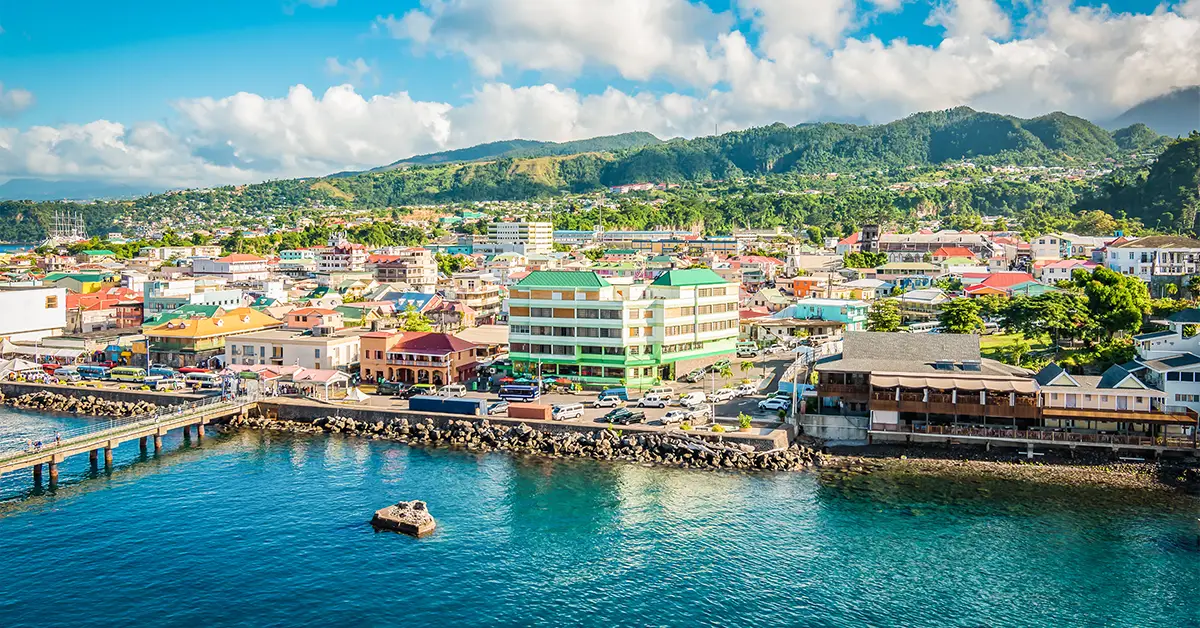
Dominica, officially the Commonwealth of Dominica, is an island nation in the Lesser Antilles chain in the Caribbean Sea. The country covers about 750 km² and has a population of about 72,000 as of 2026, with its capital Roseau on the island’s west coast. Dominica lies between two French overseas territories — Guadeloupe to the north and Martinique to the south — and is geologically one of the youngest islands in the Lesser Antilles, as geothermal and volcanic activity is still ongoing.
The country gained independence from the United Kingdom on 03/11/1978 and became a republic within the Commonwealth. Dominica is known as “the Nature Island of the Caribbean” thanks to its pristine rainforest ecosystem, the world’s second-largest natural hot lake and Morne Trois Pitons National Park, a UNESCO World Heritage Site. Beyond its value for ecotourism, Dominica is internationally known for the oldest citizenship by investment (CBI) programme in the Caribbean, running since 1993.
Message
Country overview
The full name “Commonwealth of Dominica” is used in official documents to distinguish it from the Dominican Republic, a different country in the Caribbean. Dominica is about 47 km long and up to 26 km wide, with its highest point, Morne Diablotins, rising 1,448 m above sea level.
English is the official language and is widely used in education, administration and the media. French-based Creole (Kwéyòl) is also widely spoken in daily life, reflecting a French colonial heritage lasting from the late 17th century until 1763. Most of the population is Roman Catholic, alongside Protestant denominations such as Methodist, Pentecostal and Seventh-Day Adventist.
The official currency is the Eastern Caribbean dollar (XCD), pegged to the US dollar at $1 USD = $2.7169 XCD since 1976. Dominica shares this currency with seven other members of the Eastern Caribbean Currency Union (ECCU). The country uses Atlantic Standard Time (UTC-4) all year round and does not observe daylight saving time.
Considering a residency programme? The Prosperous Living Investment team assesses your profile free of charge and advises on the pathway that fits your goals.
History
Detailed article onHistory of Dominica
The island was settled by the Ortoroid people from South America from around 3100 BC, followed by the Arawak in the 5th century. By the 15th century, the Kalinago (also known as the Carib), who migrated from South America, had replaced the Arawak and become the dominant inhabitants. Christopher Columbus is recorded as having sailed past the island on 03/11/1493, a Sunday, and named it after the Latin word “dominica”, meaning “Sunday”.
Dominica was controlled by French colonists from the 1690s until 1763, when the island was ceded to Britain under the Treaty of Paris that ended the Seven Years’ War. After the First World War, rising political awareness in the Caribbean led to the founding of the Representative Government Association in 1924. Dominica became an associated state of the United Kingdom in 1967 and gained full independence on 03/11/1978.
After independence, the country went through considerable political turmoil and severe natural disasters, most notably Hurricane David in 1979 and Hurricane Maria in 2017. Hurricane Maria caused damage equivalent to 226% of the country’s GDP, forcing the government to launch a large-scale reconstruction programme funded substantially by CBI revenue.
Geography
Detailed article onGeography of Dominica
Dominica is an island of volcanic origin with rugged, mountainous terrain covered mostly by tropical rainforest. The country has nine potentially active volcanoes, the highest concentration by land area of anywhere in the world. Boiling Lake, located inMorne Trois Pitons National Parkis the world’s second-largest natural hot lake, after Frying Pan Lake in New Zealand.
Dominica has a tropical climate, with average daytime temperatures ranging from 26°C in January to 32°C in June. The dry season runs from February to May, while the rainy season from June to October coincides with the Atlantic hurricane season. Rainfall varies sharply with terrain, from 1,500 mm in the dry coastal areas to more than 6,350 mm in the mountainous interior.
Dominica’s flora and fauna are exceptionally rich; the imperial parrot (sisserou) is the island’s only endemic parrot species and a national symbol that appears on the national flag. The island nation has 365 rivers, a symbolic number matching the days of the year.
Politics
Detailed article onPolitics of Dominica
Dominica operates as a parliamentary republic within the Commonwealth. The President is the head of state with a largely ceremonial role, elected by the House of Assembly for a five-year term. The Prime Minister is the head of government and holds real executive power, nominated by the majority party in the House of Assembly.
The unicameral parliament has 32 seats: 21 directly elected, 9 appointed by the President on the advice of the Prime Minister and the Leader of the Opposition, plus the Speaker and the Attorney General ex officio. The judiciary comprises magistrates’ courts and the Eastern Caribbean Supreme Court, with the UK Privy Council serving as the final court of appeal.
The two largest political parties are the ruling Dominica Labour Party (DLP) and the opposition United Workers’ Party (UWP). Universal suffrage applies to citizens aged 18 and over. The Constitution, adopted in November 1978 at independence, empowers Parliament to legislate on citizenship by investment under Section 101.
Economy
Detailed article onEconomy of Dominica
Dominica has a mixed economy with GDP of about $600 million USD and GDP per capita of about $8,000 USD according to 2023 data. Its three main economic pillars are agriculture, ecotourism and revenue from the citizenship by investment programme. CBI revenue hit a record $232 million USD in the 2022/23 fiscal year, equivalent to 37% of GDP, up from 26% in 2018.
Traditional agriculture focuses on bananas, coconuts, citrus and cocoa, with bananas once the main export. Following the impact of international trade agreements and natural disasters, the country has diversified into root crops, spices and herbal oils. Manufacturing accounts for a small share, mainly agro-processing, soap making and textiles.
Ecotourism is thriving thanks to the “Nature Island” brand, with about 200,000 visitors a year. A new international airport project at Wesley, due for completion in 2027, is expected to significantly increase direct air connections and tourism capacity. According tothe International Monetary Fund (IMF), Dominica still relies heavily on imports of basic goods and is vulnerable to fuel price swings and climate disasters.
Demographics
Detailed article onDemographics of Dominica
Dominica’s population in 2026 is estimated at about 72,000, making it the 10th least populous country in the world. Population growth is very low, and even negative in some periods, due to emigration, particularly to the United States, the United Kingdom and other more economically developed Caribbean islands.
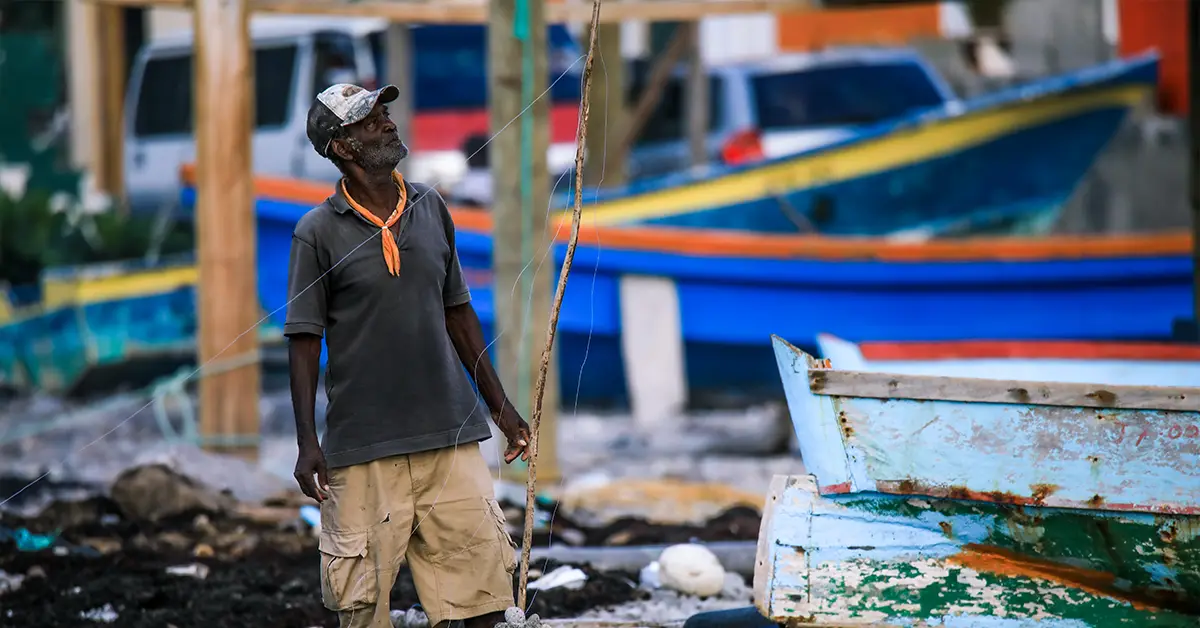
Most of the population is of African descent, descendants of enslaved people brought to the island during the colonial era. Dominica is the only Caribbean island nation that still has an Indigenous Kalinago community, with about 2,000 to 3,000 people living in the 1,500-hectare Kalinago Territory on the island’s east coast. The community has limited self-governance and special recognition under national law.
Life expectancy is about 78 years, and the adult literacy rate is 94%. Family structure is largely matrifocal, with women playing a central role in household livelihoods and passing on culture.
Education
Detailed article onEducation in Dominica
Dominica’s education system follows the British model, with free, compulsory primary education for children aged 5 to 14. The system comprises primary (ages 5 to 11), secondary (ages 11 to 17) and tertiary levels. Primary enrolment is close to 100%, and adult literacy remains high at 94%.
Dominica State College is the country’s main public post-secondary institution, offering associate degree programmes and some university partnership programmes. In addition, the University of the West Indies (UWI) has a site in Dominica serving distance learning programmes for local students.
The island nation is also home to Ross University School of Medicine and All Saints University, two private medical schools that attract international students mainly from North America. Ross Medical School was once one of the largest sources of foreign exchange and employment before relocating to Barbados after Hurricane Maria in 2017.
Culture
Detailed article onCulture of Dominica
Dominican culture blends African, European and Indigenous Kalinago heritage, creating an identity distinct from other Caribbean islands. Carnival, held over the two days before Lent, is the biggest cultural event of the year, with lively parades, calypso music and traditional costumes.
The World Creole Music Festival, held every October, is one of the largest Creole music festivals in the world, attracting artists from across the Caribbean, Central America and Africa. Signature music genres include bouyon, cadence-lypso and jing ping.
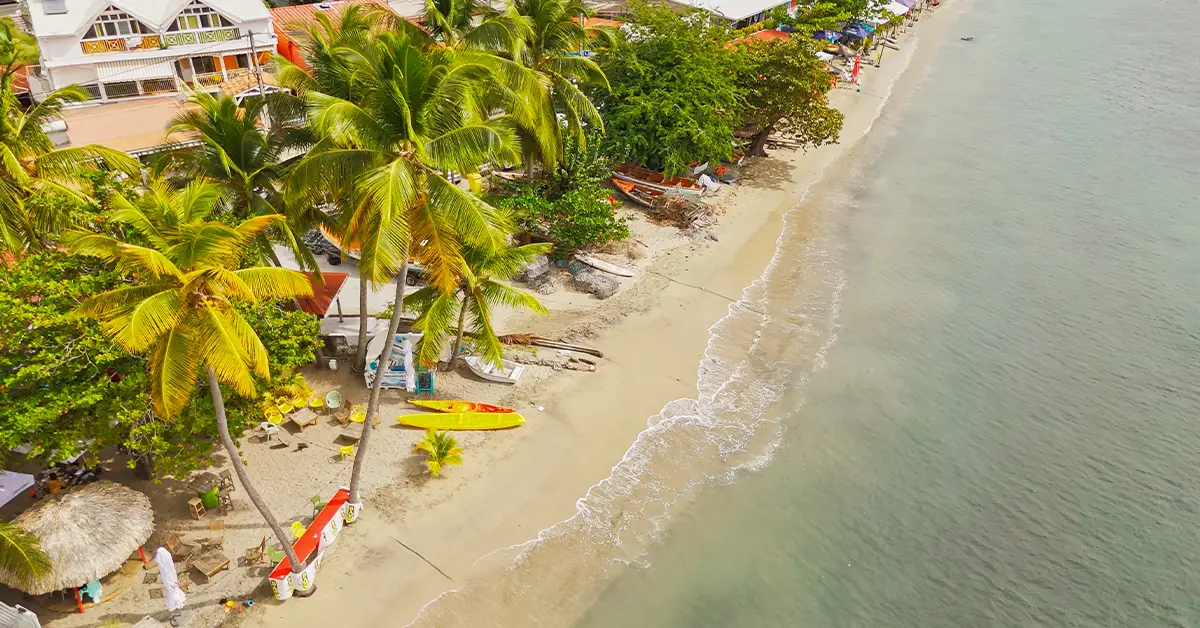
Local cuisine uses many native ingredients such as bananas, dasheen, salted fish, callaloo and tropical fruit. “Mountain chicken” (actually a large endemic frog) was once the national dish but has become rare and protected after a fungal disease severely reduced its population. The traditional Wob Dwiyèt costume, with its multicoloured plaid pattern, is a cultural symbol worn by women on national occasions.
International relations
Detailed article onInternational relations of Dominica
Dominica pursues a foreign policy focused on economic development and regional cooperation. The country is a founding member of the Organisation of Eastern Caribbean States (OECS) and the Caribbean Community (CARICOM), and has been a member of the United Nations and the International Monetary Fund since 1978. Dominica joined the Organization of American States (OAS) and the World Bank in 1979.
The island nation established diplomatic relations with the People’s Republic of China in March 2004, switching from its previous relations with Taiwan. In 2008, Dominica joined the Venezuela-led Bolivarian Alliance for the Americas (ALBA). The country maintains diplomatic missions in Washington, New York, London and Brussels.
Relations with the United States and the European Union have come under considerable strain since 2025 over the CBI programme. President Trump issued an executive order in December 2025 imposing partial travel restrictions on Dominican citizens, and the US Department of State cut the validity of visas for Dominicans from 10 years to 3 months in early 2026. The EU has also introduced stricter oversight of golden passport programmes in the Caribbean.
Position in the Caribbean region
Dominica holds a special place in the Caribbean as “the Nature Island” and is one of the leading ecotourism destinations. The country is a member of both La Francophonie and the Commonwealth, reflecting its dual colonial heritage.
Among the five Caribbean countries operating CBI programmes — Antigua and Barbuda, Dominica, Grenada, Saint Kitts and Nevis, and Saint Lucia — Dominica is often considered the most cost-competitive, with a minimum investment of $200,000 USD. According to data fromInvestment Migration Council, Dominica’s programme has issued about 34,500 passports since its launch.
The island nation is also a member of the Regional Security System (RSS), an Eastern Caribbean defence alliance that provides shared security capacity for small island states without standing armed forces. The Dominica Police Force is primarily responsible for internal security.
The Dominica passport and freedom of travel
The Dominica passport is valid for 10 years and renewable, granting visa-free or visa-on-arrival access to 140 to 145 countries and territories as of 2026. Key destinations include Europe’s Schengen Area, the United Kingdom, Hong Kong, Singapore and most of Central and South America.
However, the passport’s standing has come under pressure since late 2025 as the United States tightened its visa policy and the EU stepped up scrutiny of golden passport programmes. Although visa-free access to the Schengen Area remains in place, the European Commission has warned that operating a CBI programme could be grounds for triggering the visa suspension mechanism.
Dominica allows unrestricted dual citizenship, meaning those granted citizenship through the CBI programme can keep their original nationality. Passports are issued to both the main applicant and eligible family members, including spouses, dependent children, dependent parents and unmarried siblings.
Citizenship by Investment (CBI) programme
TheDominica citizenship by investment programmewas established under Section 101 of the Constitution and Sections 8 and 20 of the Citizenship Act 1978. It is one of the oldest CBI programmes in the world, operating continuously since 1993 under the management of the Citizenship by Investment Unit of Dominica (CBIU).
Investors have two main options for obtaining citizenship. The first is a non-refundable contribution to theEconomic Diversification Fund (EDF)of at least $200,000 USD for a single applicant. The second is an investment in a government-approved real estate project worth at least $200,000 USD, with the condition that it be held for at least 3 years before resale.
Application due diligence usually takes 3 to 9 months and includes comprehensive background checks against multiple international databases. Due diligence and government fees start at $75,000 USD per applicant. New regulations issued in June 2024 codified the programme’s legal framework and introduced tighter measures, such as a ban on name changes within 5 years of being granted citizenship.
In March 2026, the CBIU suspended processing of applications from Iranian nationals unless they meet all three strict conditions: not having lived in Iran for at least 10 years, holding no significant assets there, and conducting no business connected to Iran. This rule reflects the trend of tightening due diligence across the Caribbean under pressure from the United States and the European Union.
Tax advantages and investment environment
Dominican citizens enjoy a favourable tax regime, with no income tax on foreign-sourced income for those who are not tax residents of the country. Dominica also has no inheritance tax, wealth tax or capital gains tax, making it easier to preserve and pass on wealth across generations.
For tax residents, income tax is levied on a progressive scale with a top rate of 35% for high earners. Value-added tax (VAT) is 15% and applies to most goods and services. The country has double taxation agreements with other CARICOM members, supporting the movement of capital and labour within the region.
Obtaining Dominican citizenship through CBI does not automatically make an investor a tax resident of the country. Tax residence is determined by the number of days of actual presence and other criteria under tax law, allowing investors to maintain tax residence in another country in line with their personal financial strategy.
Summary
Dominica is a Caribbean island nation with an exceptionally rich natural heritage, a stable parliamentary political system and one of the oldest and most trusted citizenship by investment programmes in the world. Although its economy is modest and it is affected by natural disasters and international geopolitical pressure, the country remains an attractive destination for investors seeking a second passport at a competitive cost.
For more detail on specific aspects of Dominica, readers can refer to the dedicated articles on the country’s history, geography, politics, economy, demographics, education, culture and international relations. For investors interested in obtaining citizenship through the CBI programme, in-depth articles on the process, costs and investment options provide practical information to support the right decision.
Accompanying you on your journey in residency investment
The Prosperous Living Investment team advises on pathways, assesses profiles and manages investments transparently for every residency, citizenship and international property objective.
Free profile assessmentWhere life gets prosperous