


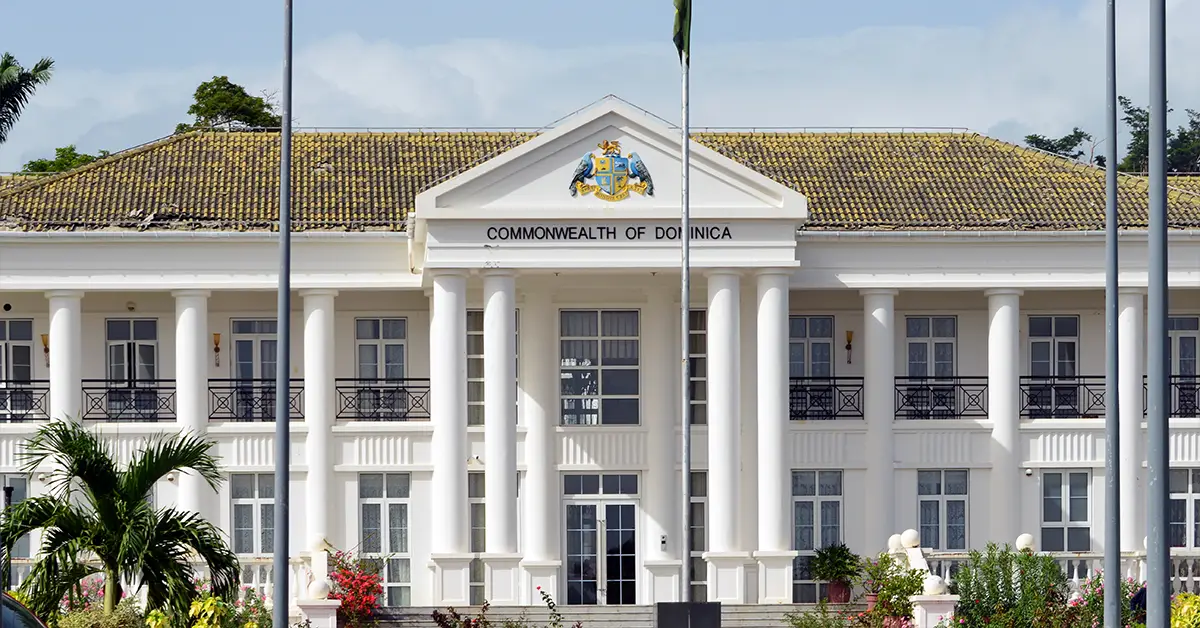
The politics of Dominica operate as a parliamentary republic within the Commonwealth, established when the country gained independence on 03/11/1978. The 1978 Constitution divides power between a ceremonial President as head of state, a Prime Minister holding real executive power and a 32-seat unicameral Parliament representing voters.
Dominica’s political system inherits many features of the British Westminster model, with adjustments to suit Caribbean traditions and the island nation’s small size. Understanding the power structure helps explain howDominicahas maintained a stable democracy for nearly 50 years of independence, overcoming challenges from coup attempts, natural disasters and international pressure.
Message
The Constitution and legal framework
The Constitution of Dominica was adopted on 03/11/1978 at independence, establishing the country as a republic with a multi-party system and separation of powers. It has 11 chapters covering the fundamental rights of citizens, the structure of the branches of government, the electoral system and the procedure for constitutional amendment.
Section 101 of the Constitution empowers Parliament to make laws on granting citizenship to people who do not qualify through the ordinary procedure, providing the legal basis for the Citizenship by Investment (CBI) Programme launched in 1993. Fundamental rights protected by the Constitution include freedom of expression, freedom of religion, freedom of assembly and the right to property. English common law is the basis of the judicial system.
Amending the Constitution requires a two-thirds majority in the House of Assembly and, in some cases, a referendum. Since 1978, the Constitution has been amended several times, but the basic parliamentary republic structure has remained unchanged. The Eastern Caribbean Supreme Court acts as guardian of the Constitution in legal disputes involving the Constitution.
Considering a residency programme? The Prosperous Living Investment team assesses your profile free of charge and advises on the pathway that fits your goals.
The President and the role of head of state
In Dominican politics, the President is the head of state with a largely ceremonial role, elected by the House of Assembly for a 5-year term and eligible for re-election for one further term. Presidential candidates must be at least 40 years old, citizens of Dominica and hold no office in a political party.
The President’s responsibilities include appointing the Prime Minister (by convention, the leader of the majority party in the House of Assembly), dissolving the House on the advice of the Prime Minister, assenting to laws passed by Parliament and representing the country at official diplomatic events. The President has no veto over legislation and must act on the advice of the Prime Minister and Cabinet.
Sylvanie Burton became Dominica’s first female President in October 2023, and also the first President of Indigenous Kalinago descent in the country’s history. This carries important symbolic significance for the Kalinago community and for the movement for women’s representation in Caribbean politics.
The Prime Minister and the Cabinet
The Prime Minister is the head of government and holds real executive power in Dominica’s political system. The Prime Minister is appointed by the President, by convention the leader of the party that wins a majority of seats in the House of Assembly after a general election. The Prime Minister’s term matches that of the House, up to 5 years, with no limit on the number of terms.
The Cabinet consists of the Prime Minister and ministers nominated by the Prime Minister and appointed by the President. Ministers must be members of the House of Assembly or appointed Senators. A typical ministry structure includes finance, foreign affairs, national security, health, education, agriculture, tourism, environment, labour and culture. The Prime Minister usually also serves as Minister of Finance.
The current Prime Minister, Roosevelt Skerrit of the Dominica Labour Party, has been in office since January 2004 and is the longest-serving head of government in the Caribbean. Under his leadership, the country implemented a climate resilience strategy after Hurricane Maria and significantly expanded the CBI Programme to finance reconstruction.
The Parliament of Dominica
In Dominican politics, Parliament is a 32-seat unicameral legislature, officially called the House of Assembly. Of the 32 seats, 21 Representatives are directly elected from 21 constituencies, 9 Senators are appointed by the President on the advice of the Prime Minister (5 seats) and the Leader of the Opposition (4 seats), plus the Speaker and the Attorney General ex officio.
The House of Assembly serves a 5-year term and can be dissolved early on the advice of the Prime Minister. Parliament has the power to pass laws, approve the budget, scrutinise the executive, amend the Constitution and ratify international agreements. Parliamentary sittings are held in public and broadcast live on the Dominica Broadcasting Corporation.
The voting system uses first-past-the-post in single-member constituencies. Universal suffrage applies to all Dominican citizens aged 18 and over who have not been disqualified by a court ruling. Turnout in general elections is usually 60% to 70%, high for the Caribbean.
The party system in Dominican politics
Dominican politics is characterised by a main two-party system alongside smaller parties. The Dominica Labour Party (DLP), founded in 1955, is a centre-left party that has governed continuously since 2000. The DLP has a traditional support base in rural areas and among working people. The party positions itself as representing social justice and sustainable economic development.
The United Workers’ Party (UWP), founded in 1988, is the main opposition party, centre-right with market-oriented economic policies. The UWP governed from 1995 to 2000 under the leadership of Edison James. The Dominica Freedom Party (DFP), founded in 1968, was once one of the three major parties under Eugenia Charles but has declined significantly since 2000.
According to the Inter-Parliamentary Union, the results of the general election of 06/12/2022 gave the DLP 19 of the 21 elected seats, consolidating its dominant position in government. The UWP won 2 seats and is the official opposition. Women make up 33% of the House of Assembly, above the global average.
The judicial system
The judicial system in Dominica has three tiers: the Magistrates’ Courts, the Eastern Caribbean Supreme Court and the UK Privy Council as the final court of appeal. The Eastern Caribbean Supreme Court (ECSC), established in 1967, is the shared court for 9 Eastern Caribbean countries and territories, comprising the High Court and the Court of Appeal.
The Judicial Committee of the Privy Council in London is the final court of appeal, a colonial legacy maintained by many Caribbean countries. Some countries in the region are moving to the Caribbean Court of Justice (CCJ) as their final court of appeal, but Dominica has not yet made this change.
The Attorney General is the government’s principal legal adviser and head of the prosecution service. The post is usually held by a member of the Cabinet. The judiciary maintains relative independence, with senior judges appointed by the Judicial and Legal Services Commission rather than directly by the executive.
Elections and electoral reform
In Dominican politics, general elections are held at least once every 5 years, with the possibility of early dissolution of the House on the advice of the Prime Minister. The Electoral Commission is an independent body responsible for organising elections, registering voters and verifying results. Electoral Commissioners are appointed by the President for 7-year terms.
Recent general elections were held in 2009, 2014, 2019 and 2022, all won by the DLP. The December 2022 election saw the UWP partly boycott the vote over disputes about electoral reform, resulting in lower-than-usual turnout of about 50%. The UWP’s reform demands include updating the voter list, voter ID cards and stricter campaign finance rules.
The DLP government has announced several electoral reform proposals for its 2022 to 2027 term, including biometric voter cards, electronic voter registration and transparency rules on party funding. Implementation of these reforms remains a subject of debate between the parties and civil society groups.
Foreign policy and the CBI Programme
Dominica’s foreign policy focuses on three pillars: Caribbean regional cooperation, relations with the major powers and an economic policy built on CBI. The country is a founding member of the Caribbean Community (CARICOM) and the Organisation of Eastern Caribbean States (OECS), and a member of the United Nations, the IMF, the World Bank and the OAS.
Relations with the People’s Republic of China were established in 2004, leading to many Chinese-funded infrastructure projects, including Windsor Park cricket stadium, a hospital and the Wesley international airport now under construction. Relations with the United States and the European Union have come under growing pressure since 2025 over the CBI programme, with the United States cutting the validity of visas for Dominicans from 10 years to 3 months and the EU threatening to suspend visa-free Schengen access.
TheDominica citizenship by investmentprogramme is an issue in Dominican politics of major foreign and domestic importance. CBI revenue accounted for 37% of GDP in the 2022/23 fiscal year and was the main source of funding for reconstruction after Hurricane Maria. The government must balance protecting the value of the programme against pressure from the United States and the EU to tighten due diligence, leading to many reforms in 2024 to 2026.
Summary of Dominica’s political system
Dominican politics shows a blend of British Westminster tradition and a distinctive Caribbean context. The parliamentary republic model has proven stable for nearly five decades, overcoming many challenges including failed coups, devastating natural disasters and international geopolitical pressure.
The Dominica Labour Party’s long hold on power since 2000 has brought policy continuity but also raises questions about checks on power and electoral reform. The 2022 to 2027 term will shape the country’s relations with the major powers and the future of the CBI Programme, a pillar of the economy in contemporary Dominican politics.
Accompanying you on your journey in residency investment
The Prosperous Living Investment team advises on pathways, assesses profiles and manages investments transparently for every residency, citizenship and international property objective.
Free profile assessmentWhere life gets prosperous