

Education in Dominica follows the British model, with free, compulsory primary education for children aged 5 to 14. The system is organised into three levels: primary (ages 5 to 11), secondary (ages 11 to 17) and post-secondary/tertiary. Adult literacy remains high at 94%, one of the highest rates in the Caribbean.
Dominica’s education system also stands out for the presence of international medical schools that attract students from North America and Europe, contributing significantly to foreign exchange earnings and the country’s academic reputation. This feature helpsDominicaposition itself as a competitive destination for medical education in the Caribbean.
Message
Structure of Dominica’s education system
The public education system is managed by the Ministry of Education, Human Resource Planning, Vocational Training and National Excellence. The ministry sets policy and curricula and allocates budgets to public educational institutions. About 4.8% of GDP is invested in education, a high level for the Caribbean and in line with UNESCO recommendations.
Dominica’s education structure is divided into 5 levels. Pre-school (ages 3 to 5) is not compulsory, but participation is about 75%. Primary school (ages 5 to 11) is compulsory and free, with 6 years from Grade 1 to Grade 6. Lower secondary (ages 11 to 14) covers 3 years, Form 1 to Form 3. Upper secondary (ages 14 to 17) covers Form 4 and Form 5, preparing for the CSEC exams, followed by Form 6 (Sixth Form), preparing for the CAPE exams.
After secondary school, students can enter post-secondary institutions in the country or study abroad. Dominica’s education system uses the Caribbean Examinations Council (CXC) certification exams, like other English-speaking Caribbean countries. Children not attending public schools can study at private schools, most of them religious schools run by Catholic or Protestant churches.
Considering a residency programme? The Prosperous Living Investment team assesses your profile free of charge and advises on the pathway that fits your goals.
Primary education
Primary education is compulsory and free in Dominica’s education system. The country has about 60 public primary schools across its territory, ensuring that children in every area have access to education. Class sizes are usually 20 to 25 pupils, low compared with the average in developing countries.
The primary curriculum includes core subjects: English, mathematics, science, social studies, physical education, religious education, and arts and crafts. Kwéyòl Creole was introduced into the cultural education curriculum in 2014 to preserve the local language and identity. Some primary schools have begun introducing French as a second language because of the country’s proximity to French-speaking islands.
At the end of primary school, pupils sit the National Primary Leaving Certificate (NPLC) exam to determine their secondary school. The exam plays an important role in allocating pupils to different secondary schools, with well-known schools such as Convent High School and St. Mary’s Academy taking the highest-scoring pupils.
Secondary education
The country has about 15 public secondary schools and several private schools, serving about 6,000 students across Dominica’s education system. The main secondary schools include Convent High School (girls, Catholic, in Roseau), St. Mary’s Academy (boys, Catholic), Dominica Grammar School and Pierre Charles Secondary School. Some private schools offer international programmes such as the International Baccalaureate (IB).
At the end of Form 5, students sit the Caribbean Secondary Education Certificate (CSEC) exams in 8 to 10 subjects. The exam is equivalent to the British GCSE and is recognised across the Caribbean and in many Commonwealth countries. Students who pass 5 or more CSEC subjects at Grade 1, 2 or 3 are eligible for Form 6.
Form 6 (Sixth Form) is an optional 2-year level preparing for the Caribbean Advanced Proficiency Examination (CAPE). CAPE is equivalent to the British A Level and is an entry requirement for many regional universities. Form 6 is offered only at some selective secondary schools, concentrated in Roseau and a few other regional centres.
Dominica State College and post-secondary education
Dominica State College (DSC) is the country’s main public post-secondary institution, established in 2002 by merging 5 separate institutions. DSC offers associate degree programmes in business, teacher education, nursing, information technology, engineering and the arts. It has about 1,500 students and is the main training institution for the domestic labour market.
The college has 6 specialised faculties: the Faculty of Teacher Education, the Faculty of Health Sciences, the Faculty of Natural Sciences & Mathematics, the Faculty of Liberal Arts, the Faculty of Applied Arts and Technology, and the Centre for Continuing Education. DSC associate degrees are recognised for transfer to UWI or universities abroad.
The University of the West Indies (UWI) has a presence in Dominica through the UWI Open Campus, offering distance programmes for local students in economics, law, social sciences and business administration. Students can study entirely at a distance or combine terms at other UWI campuses such as Mona (Jamaica), St. Augustine (Trinidad) or Cave Hill (Barbados).
International medical training
A distinctive feature of education in Dominica is the presence of international medical schools serving mainly North American and European students. Ross University School of Medicine is the best-known medical school, founded in Portsmouth in 1978 and training doctors for the US and Canadian markets. Its ECFMG accreditation allows students to sit the USMLE and work in the United States.
After Hurricane Maria severely damaged its facilities in 2017, Ross temporarily relocated to Knoxville (Tennessee, United States) and then settled permanently at a new campus in Bridgetown (Barbados) in 2018. However, Ross’s legacy in Dominica lives on in its people, medical library and alumni network. Ross’s departure caused significant damage to Portsmouth’s economy, but the country still has other international medical schools.
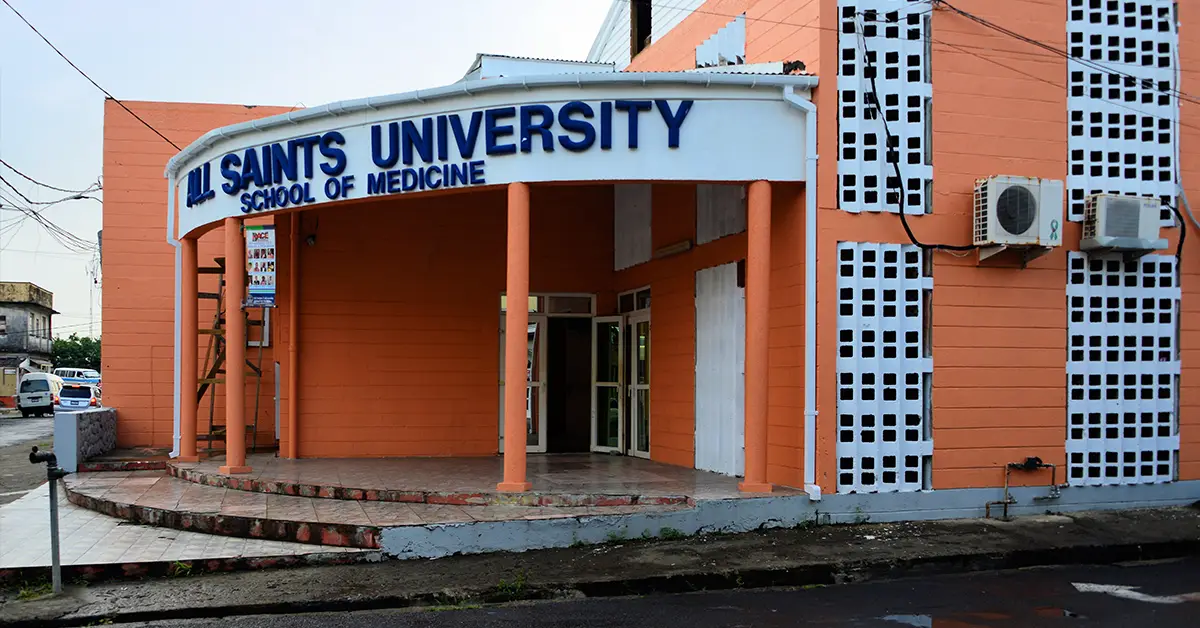
All Saints University School of Medicine and Aureus University School of Medicine are the two private medical schools currently operating. They attract North American students seeking medical programmes at lower cost than in the United States and with more flexible entry requirements. Tuition at these schools is about $40,000 USD to $60,000 USD a year, providing significant foreign exchange earnings for the country.
Public investment and the development of education infrastructure in Dominica
After Hurricane Maria in 2017, the government prioritised rebuilding education infrastructure with funding from the CBI Programme and international aid. More than 30 primary and secondary schools have been rebuilt to climate-resilient designs, able to withstand Category 5 hurricanes and serve as evacuation centres during disasters. This is part of the strategy to become “the world’s first climate-resilient nation”.
According to data from thethe UNESCO Institute for Statistics, education in Dominica achieves many positive indicators: primary enrolment close to 100%, 92% of primary teachers holding qualifications, and a 95% primary completion rate. The government has also launched a School Feeding Programme providing free school meals for disadvantaged pupils.
About 5% of CBI revenue is allocated directly to education each year, supporting overseas scholarships, school library upgrades, technology investment and curriculum development. The national scholarship programme funds about 200 Dominican students a year to study at UWI, Cuban universities (under a health cooperation agreement), the United States and the United Kingdom.
Vocational training and continuing education
Dominica’s education system also emphasises vocational training through the Skills Training Centre and the Dominica Centre for Continuing Education. These programmes provide vocational training in construction, mechanics, electrical work, electronics, hospitality, hairdressing, cooking and agriculture. They are an important training channel for unskilled and semi-skilled workers.
The DOMLEC Human Resource Development Fund finances training for workers in electricity, renewable energy and systems management. It is a public-private partnership to develop the workforce for an electricity sector transitioning to 100% renewable energy by 2030.
Tourism training is the fastest-growing area of vocational training, with short courses in ecotourism guiding, restaurant management, baking and bartending. The Dominica Tourism Training Institute (DTTI) works with upscale hotels and resorts to train staff to international standards.
Challenges and reform in Dominica’s education
Education in Dominica faces several structural challenges. “Brain drain”, with a high proportion of top students studying abroad and not returning to work in the country, is a long-standing problem. About 60% of Dominican students who graduate from universities abroad choose to stay in that country, especially the United States, Canada and the United Kingdom.
The small size of the higher education market makes it economically difficult to sustain specialised programmes. Many specialist fields do not have enough students to run a course, forcing students to study abroad. The gap between public and private education in STEM subjects (Science, Technology, Engineering, Mathematics) is also a challenge that must be addressed to prepare the workforce for the digital economy.
The 2023 to 2030 education reform programme focuses on digitising classrooms, retraining teachers, expanding STEM programmes and integrating global citizenship education into the curriculum. The government is also negotiating partnerships with international universities to open high-quality higher education campuses in Dominica, taking advantage of its political stability and attractive natural environment.
Summary of Dominica’s education system
Education in Dominica has achieved significant results over nearly 5 decades of independence, with high literacy, universal free primary education and a distinctive presence of international medical schools. Despite the challenges of small size and student emigration, the country continues to invest heavily in education through CBI funds and international aid.
The post-Maria reconstruction strategy and the 2023 to 2030 reform programme lay the foundation for a modern, disaster-resilient education system in Dominica that meets the needs of the global digital economy.
Accompanying you on your journey in residency investment
The Prosperous Living Investment team advises on pathways, assesses profiles and manages investments transparently for every residency, citizenship and international property objective.
Free profile assessmentWhere life gets prosperous