


Dominica has a modest mixed economy: nominal GDP of about $600 million USD and GDP per capita of about $8,000 USD according to 2023 data. The three main pillars of the economy are traditional agriculture, ecotourism and revenue from the Citizenship by Investment (CBI) Programme. CBI revenue reached a record $232 million USD in the 2022/23 fiscal year, equivalent to 37% of GDP, up from 26% in 2018.
Dominica’s economic structure reflects the characteristics of a small island state with limited resources, vulnerable to natural disasters and fluctuations in commodity prices. Understanding the economy ofDominicahelps explain the strategic role of CBI in financing post-hurricane reconstruction and providing foreign exchange for the national budget.
Message
Economic overview and GDP
According to data from theInternational Monetary Fund, Dominica’s economy had nominal GDP of about $600 million USD in 2023, ranking 174th in the world by size. GDP per capita of $8,000 USD places the country in the upper-middle-income group under the World Bank classification. Real GDP growth ranged from 4% to 6% in 2022 to 2025, thanks to the post-pandemic tourism recovery and public investment in reconstruction.
Inflation remains low, below 3%, thanks to the Eastern Caribbean dollar (XCD) being pegged to the US dollar at a fixed rate of $1 USD = $2.7169 XCD. The peg has been maintained by the Eastern Caribbean Central Bank (ECCB) since 1976 and is an important stabilising factor for all 8 members of the Eastern Caribbean Currency Union (ECCU).
Public debt is about 100% of GDP, high because of reconstruction costs after Hurricane Maria in 2017. However, the debt consists mainly of concessional loans from international institutions and CBI funds, keeping the interest burden within sustainable limits. The government has committed to reducing public debt below 60% of GDP by 2035 through prudent fiscal measures and higher revenue from CBI and tourism.
Considering a residency programme? The Prosperous Living Investment team assesses your profile free of charge and advises on the pathway that fits your goals.
Agriculture and fisheries
Agriculture plays a traditional role in Dominica’s economy, accounting for about 14% of GDP and employing 25% of the workforce. The main exports include bananas, coconuts, grapefruit, oranges, cocoa and vegetables. Bananas were once the main export, accounting for more than 50% of export earnings in the 1980s and 1990s, but declined sharply after the EU ended preferential access for Caribbean bananas following a WTO ruling in 1997.
The country has diversified agriculture into higher-value products such as coconut soap and Bay Oil (extracted from the bay tree), herbal essential oils, specialty tropical fruit and organic vegetables for the tourism market. The Kalinago Territory is known for handicrafts made from coconut and palm leaves, woven into baskets, hats and decorative items for export.
Fisheries contribute about 1.5% of GDP, mainly for domestic consumption and exports of fresh seafood to neighbouring Caribbean islands. The sector faces challenges from climate change altering sea temperatures and fish distribution. The government is investing in commercial aquaculture with support from the United Nations Food and Agriculture Organization (FAO).
Tourism and travel
Tourism is an important driver of Dominica’s economy, with about 200,000 visitors a year before the COVID-19 pandemic. Figures for 2024 show the sector has recovered beyond pre-pandemic levels, reaching about 250,000 visitors. Tourism directly contributes about 12% of GDP and employs 15% of the workforce, with spillover effects on related sectors such as transport, food and retail.
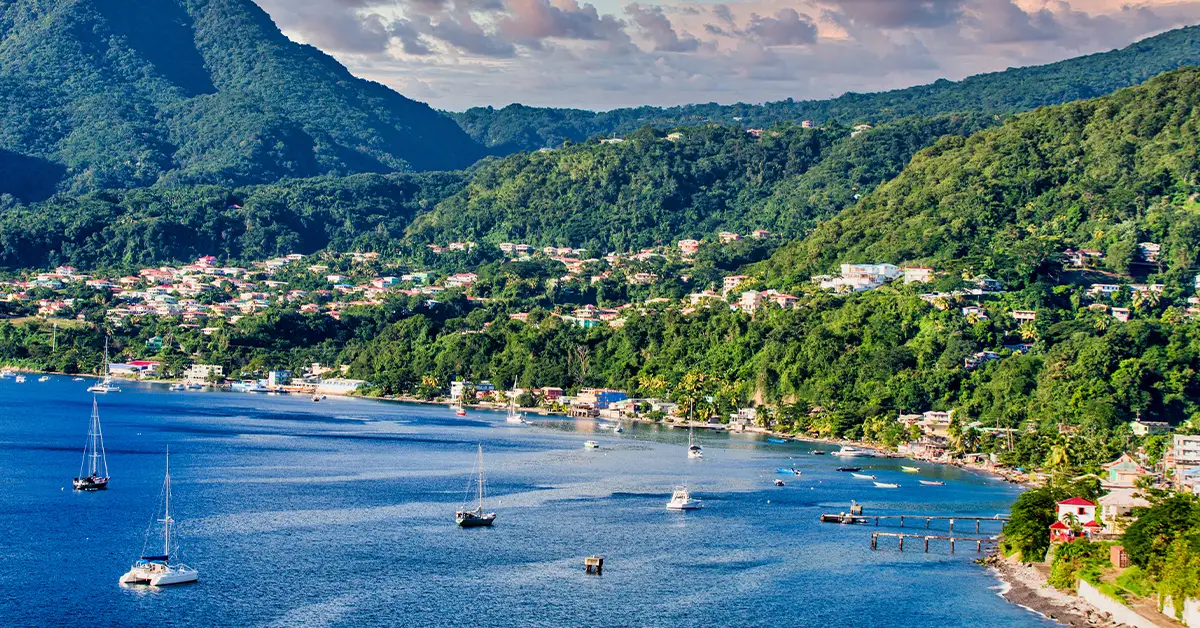
Ecotourism is Dominica’s core segment under the “Nature Island of the Caribbean” brand. Key attractions include Morne Trois Pitons National Park (a UNESCO site), Boiling Lake, Champagne Reef, the Indian River and the Kalinago Territory. The country is also developing wellness tourism, with natural hot spring spas at Wotten Waven, and winter whale watching.
Cruise tourism is a large segment by volume but lower in value than stay-over tourism. The port of Roseau receives about 350 cruise ship calls a year with more than 400,000 day visitors, but each visitor spends on average only $40 USD to $80 USD during a few hours on the island. The Wesley international airport, due for completion in 2027, will significantly increase capacity for direct international flights from North America and Europe.
The Citizenship by Investment (CBI) Programme
Revenue from the Citizenship by Investment Programme is the newest and largest pillar of Dominica’s contemporary economy. Government statistics show CBI brought in $232 million USD in the 2022/23 fiscal year, equivalent to 37% of GDP. This is a significant increase from $130 million USD in 2018 (26% of GDP), reflecting strong demand for second passports amid global geopolitical instability.
CBI revenue comes from three main sources: contributions to theEconomic Diversification Fund (EDF)of at least $200,000 USD for a single applicant, real estate investments of at least $200,000 USD in government-approved projects, and due diligence and government fees starting at $75,000 USD per person. The programme is administered by the Citizenship by Investment Unit (CBIU), established in 2014.
CBI revenue has funded most of the reconstruction after Hurricane Maria, including climate-resilient housing, the Wesley international airport, and new hospitals and schools. See the articleDominica citizenship by investmentfor details on how to take part in the programme. Pressure from the United States and the EU in 2025 to 2026 has led to many reforms tightening due diligence, which may affect application volumes in the coming years.
Manufacturing and industry
Manufacturing accounts for about 5% of Dominica’s economy and is small in scale, serving mainly the domestic market and exports within CARICOM. The main industries are agro-processing (coconut soap, Bay oil), fruit juices and alcoholic drinks (rum), small-scale garment making and printing. The main processed exports include coconut soap, fruit juices and cigars.
Energy is undergoing a strong transition in Dominica’s economy. Fossil fuel imports currently account for nearly 20% of total imports, creating a foreign exchange burden. The country is investing heavily in renewable energy, aiming for 100% renewable electricity by 2030. Hydropower currently supplies 28% of electricity, and a 7 MW geothermal plant project at Wotten Waven is under way, expected to begin commercial operation in 2027.
Construction contributes about 8% of GDP, driven by the reconstruction programme after Hurricane Maria and public investment in infrastructure. The $1.2 billion USD Wesley international airport, partly funded by China, is the largest construction project in the country’s history. Many CBI real estate projects also contribute significantly to construction activity in coastal areas.
Finance and banking
The financial sector in Dominica’s economy comprises commercial banks, non-bank financial institutions and offshore financial services. The four main commercial banks operating in the country are the National Bank of Dominica, Royal Bank of Canada, First Caribbean International Bank (FCIB) and CIBC FirstCaribbean. The Eastern Caribbean Central Bank (ECCB) acts as the shared central bank for the 8 ECCU member states.
Dominica has an international business company (IBC) registry and licenses offshore funds for foreign companies, although the sector has shrunk significantly since 2018 under pressure from the OECD and the EU over tax transparency. The country has signed the Multilateral Agreement on the automatic exchange of tax information (CRS) and complies with FATF anti-money laundering standards.
Income tax is levied on a progressive scale with a top rate of 35%, and value-added tax (VAT) is 15%. Companies pay 25% income tax. The country has no wealth tax, inheritance tax or capital gains tax, an attractive feature for individuals and families in the CBI programme seeking to preserve wealth across generations.
International trade
Dominica traditionally runs a trade deficit because the country imports most of its consumer goods, machinery, fuel and food. Imports in 2023 were about $300 million USD, while exports were only about $80 million USD. The main trading partners are the United States, China, CARICOM members (especially Trinidad and Tobago) and the United Kingdom.
The main goods exports include bananas, coconut soap, Bay oil, fruit juices and alcoholic drinks. However, the overall external balance is supported by a surplus in services (tourism, financial services) and CBI inflows. The country is a member of the CARICOM Single Market and Economy (CSME), which allows goods, services, capital and labour to move freely within the region.
According to the World Bank, Dominica’s economy faces structural challenges of small size, vulnerability to natural disasters and dependence on imports. The government is implementing an economic diversification strategy aimed at reducing dependence on CBI and developing high-value services such as remote IT services, transparent financial services and renewable energy for export.
Outlook and challenges for Dominica’s economy
The outlook for Dominica’s economy in 2026 to 2030 depends on three key factors. The first is the ability to sustain CBI revenue amid pressure from the United States and the EU to tighten due diligence. The US cut in visa validity from 10 years to 3 months and the threat of suspending visa-free Schengen access could reduce the appeal of the Dominican passport.
The second is the completion of Wesley international airport in 2027, which is expected to double tourism capacity and open the way for luxury, retirement and wellness tourism. The third is progress on the energy transition towards 100% renewable energy by 2030, which could significantly reduce fuel imports and create electricity exports to neighbouring islands.
The main challenges include climate change and ever-stronger tropical storms, pressure on CBI revenue, competition from other Caribbean CBI programmes, and the need to diversify the economy away from dependence on a few sectors. Dominica’s economy over the next decade will be a test of how a small island state adapts to global geopolitical pressure.
Summary of Dominica’s economy
Dominica’s economy is a distinctive combination of traditional agriculture, ecotourism and an innovative CBI financing model. The country has shown its ability to recover from severe shocks such as Hurricane Maria in 2017 and the COVID-19 pandemic through a combination of international support, prudent fiscal policy and stable inflows from the CBI programme.
However, the structural challenges of small size, climate change and geopolitical pressure on CBI mean Dominica’s economy must keep reforming to sustain growth and protect the gains made over nearly 5 decades of independence.
Accompanying you on your journey in residency investment
The Prosperous Living Investment team advises on pathways, assesses profiles and manages investments transparently for every residency, citizenship and international property objective.
Free profile assessmentWhere life gets prosperous