


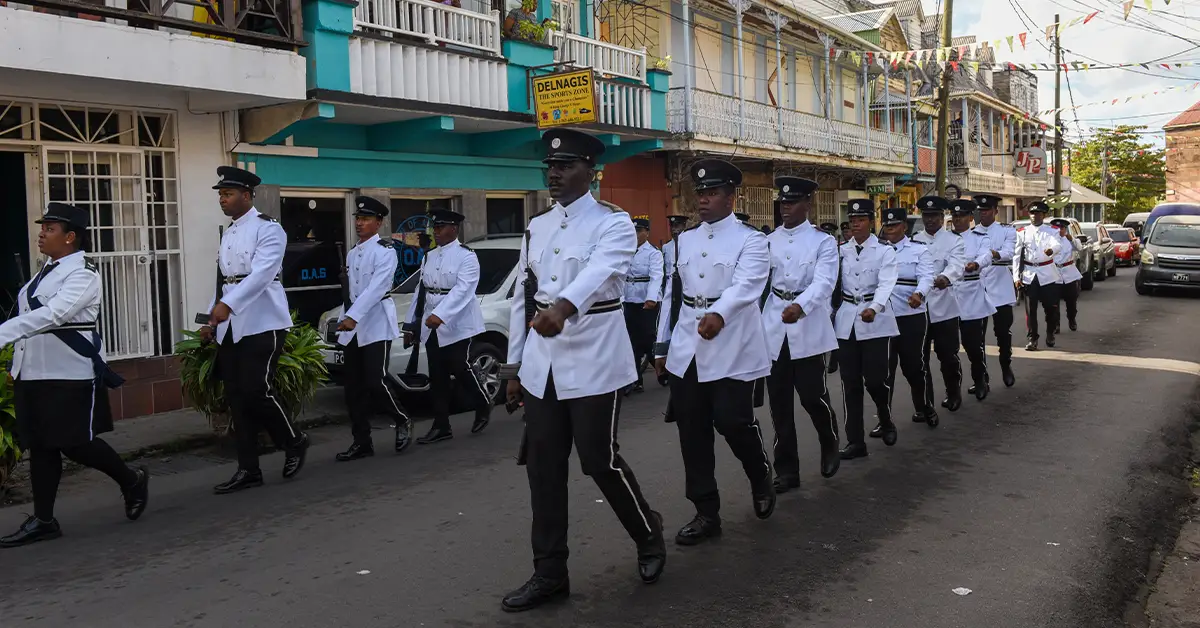
Dominica’s demographics have distinctive features in the Caribbean: a population of about 72,000 as of 2026, mostly of African descent, and the only Caribbean island nation that still has a pre-Columbian Indigenous community. The Kalinago community of about 3,000 people living in the 1,500-hectare Kalinago Territory is a rare demographic heritage in the whole of the Antilles.
Dominica’s demographic features reflect a complex history of migration over more than 5 centuries, from French and British colonial rule to contemporary emigration. Understanding the population structure helps explain howDominicamaintains a pluralistic cultural identity while facing the challenge of population decline due to emigration.
Message
Population size and density in Dominica’s demographics
Dominica’s population in 2026 is estimated at about 72,000 according to United Nations Population Division data, making it the 10th least populous country in the world. Population density is about 96 people/km², low-to-average for the Caribbean. Natural population growth is close to zero, with a birth rate of about 13.1 per 1,000 people and a death rate of about 8.2 per 1,000.
When migration is taken into account, actual population growth has often been negative for many years. Emigration, especially to the United States, the United Kingdom, Canada and more developed Caribbean islands such as Antigua and Barbuda and Saint Kitts and Nevis, is the main cause. About 200,000 people of Dominican origin live abroad, nearly 3 times the domestic population.
The population is concentrated in coastal and urban areas because of the rugged interior. About 70% of the population lives within 5 km of the coast. The capital Roseau and its surroundings are home to about 20% of the national population, while Portsmouth is the second-largest urban area with about 3,500 residents.
View the official reporthere.
Considering a residency programme? The Prosperous Living Investment team assesses your profile free of charge and advises on the pathway that fits your goals.
Age and sex structure
The age structure in Dominica’s demographics reflects mild ageing. The median age in 2026 is about 36, up from 30 in 2010. Children under 14 make up 19% of the population, people of working age (15 to 64) 67% and people over 65 14%. The share of older people is gradually rising due to improved life expectancy and emigration, which is mostly by young people.
The sex ratio is fairly balanced, at about 1.01 males per female at birth, falling to 0.93 in the over-65 age group because women live longer. Average life expectancy is 78 years — 75 for men and 81 for women. The country has a significant number of centenarians, a feature many researchers link to the traditional diet and natural living environment.
The infant mortality rate fell to 7.8 per 1,000 live births in 2024, a significant improvement from 13 per 1,000 in 2006. A public health system that is free for citizens and permanent residents is an important factor. Nearly 100% of pregnant women receive antenatal care and 99% of births are attended by skilled health personnel.
Ethnicity and origins of the population in Dominica’s demographics
Most of the population is of African descent, descendants of enslaved people brought to the island during French and British colonial rule from the 17th to the early 19th century. People of African and Afro-European descent make up about 86% of the population, while the mixed group (mainly European-African) accounts for 9%. The Indigenous Kalinago community makes up about 4% of the population.
Lebanese and Syrian communities who immigrated in the late 19th and early 20th centuries make up a small share but play a significant economic role, especially in retail and real estate. People of British, French and Irish descent (descendants of plantation owners and indentured workers) make up about 1%. A small number of East Asians, mainly Chinese small business owners, have immigrated in recent decades.
The CBI Programme has granted about 34,500 passports to foreign nationals since 1993, but most of these people do not actually live in the country. They do not affect Dominica’s actual demographic structure, as the programme has no residence requirement before or after naturalisation. See the articleDominica citizenship by investmentfor details of the programme.
The Indigenous Kalinago community
The Kalinago community is the most distinctive ethnic heritage in Dominica’s demographics. It is the only remaining Indigenous Carib community in the whole of the Lesser Antilles, descendants of the people who lived on the island before Christopher Columbus arrived in 1493. The community now has about 3,000 people, up from about 2,000 in 2000.
The 1,500-hectare (3,700-acre) Kalinago Territory on the island’s east coast in Saint David Parish was officially recognised by the British Crown in 1903. It comprises 8 main villages: Salybia, Bataka, Crayfish River, Sineku, Touna Auati, Mahaut River, Concord and Gaulette River. Salybia is the largest village and the administrative and cultural centre of the community.
The Kalinago system of governance consists of a Chief, directly elected for a 5-year term, and a 6-member Council. The current Chief, Lorenzo Sanford, was elected in 2024. The Chief has self-governing authority over the community’s land, represents the community in relations with the central government and protects its cultural and land rights under national law. A historic event in 2023 was the election of Sylvanie Burton, a woman of Kalinago descent, as President of Dominica.
Language and cultural identity
English is the official language and is widely used in education, administration, the media and business. English literacy is close to 100% among adults. The linguistic tradition is inherited from British colonial rule, although some local features show French influence.
French-based Creole, Kwéyòl, is widely spoken in daily life, especially in rural areas and informal settings. About 60% of the population speaks Kwéyòl fluently, and 80% understand it at a basic level. It is an Antillean creole closely related to the Creoles of Saint Lucia, Martinique and Guadeloupe. The government officially recognised Kwéyòl as cultural heritage and introduced it into the school curriculum in 2014.
An English-based pidgin known as Kokoy is spoken in the northeastern villages of Marigot and Wesley, by descendants of 19th-century immigrants from Antigua and Barbuda and Montserrat. The Indigenous Kalinago language (Iñeri) died out around 1920, but the Kalinago community is working to revive it through cultural education programmes and cooperation with the Garifuna community in Central America — Kalinago descendants who still speak the language.
Religion
Religion in Dominica’s demographics reflects the historical influence of French and British colonial rule combined with Indigenous traditions. Roman Catholicism is the majority religion, followed by about 53% of the population, a legacy of French rule and missionary work by European churches. The Archdiocese of Roseau is the central Catholic body, directly under the Vatican.
Protestant denominations account for about 33% of the population, including Methodists (5%), Pentecostals (6%), Seventh-day Adventists (7%), Baptists (4%), Anglicans (3%) and others. Pentecostalism has grown rapidly in recent decades, especially in urban areas. Protestant communities are often active in social and educational activities.
Minority religions include Rastafari (about 1.5%), Islam (a small number within the Lebanese and Syrian community), Hinduism, the Bahá’í Faith and Jehovah’s Witnesses. A small group practises Caribbean folk beliefs combining Catholicism with African and Kalinago spiritual traditions. The Constitution of Dominica guarantees freedom of religion, and relations between religions are generally harmonious, with no significant religious conflict in the country’s history.
Migration and the diaspora
Migration has been a key factor shaping Dominica’s demographics throughout the 20th and 21st centuries. The first wave of emigration took place in the 1950s and 1960s to the United Kingdom under Commonwealth labour recruitment schemes. The second wave, to the United States and Canada, began in the 1970s and surged after Hurricane David in 1979, when more than 5,000 people left the island.
Hurricane Maria in 2017 triggered a new wave of emigration, with about 2,000 people leaving the country in the first 6 months after the storm, some of whom have not returned. The largest Dominican diaspora communities are in the United Kingdom (about 80,000 people, mainly in London), the United States (60,000, mostly in New York and Florida), Canada (15,000 in Toronto and Montreal) and neighbouring Caribbean islands (45,000).
Remittances from the diaspora contribute about 5% of GDP, an important source of income for many households. The Dominica Diaspora Fund was set up by the government in 2010 to attract remittances for development investment and maintain ties with the overseas community. Many people of Dominican origin return home after retirement, taking advantage of the tax regime and favourable living environment.
Urbanisation and population distribution
The urbanisation rate in Dominica’s demographics is relatively low for the region, at about 71% in 2024, but most “urban areas” are small. Roseau is the largest city with 14,500 residents, followed by Portsmouth (3,500), Marigot (2,500) and Castle Bruce (2,300). The whole country has only 4 areas that can be considered “urban” by UN standards.
Roseau and its surroundings (including Goodwill, Bath Estate and Stock Farm) are home to about 20% of the national population. It is the main administrative, economic, educational and health centre. Princess Margaret Hospital in Roseau is the country’s largest medical facility, serving the whole of the south and centre.
Portsmouth is the main centre of the north, with the port at Prince Rupert Bay and the former Ross University School of Medicine. The northeast and southeast are more sparsely populated because of mountainous terrain and a lack of infrastructure. The Kalinago Territory is a special settlement area with low density and a traditional village structure.
Summary of Dominica’s demographics
Dominica’s demographics are a rare combination of a majority African heritage, the only remaining Indigenous Kalinago community in the Caribbean and diverse minority groups. The country faces population decline due to emigration but has preserved its distinctive cultural identity thanks to a large diaspora and policies to conserve traditional culture.
A mildly ageing population structure and dependence on remittances create a need for long-term population policy, education reform to create jobs at home, and efforts to attract young workers to return.
Accompanying you on your journey in residency investment
The Prosperous Living Investment team advises on pathways, assesses profiles and manages investments transparently for every residency, citizenship and international property objective.
Free profile assessmentWhere life gets prosperous