


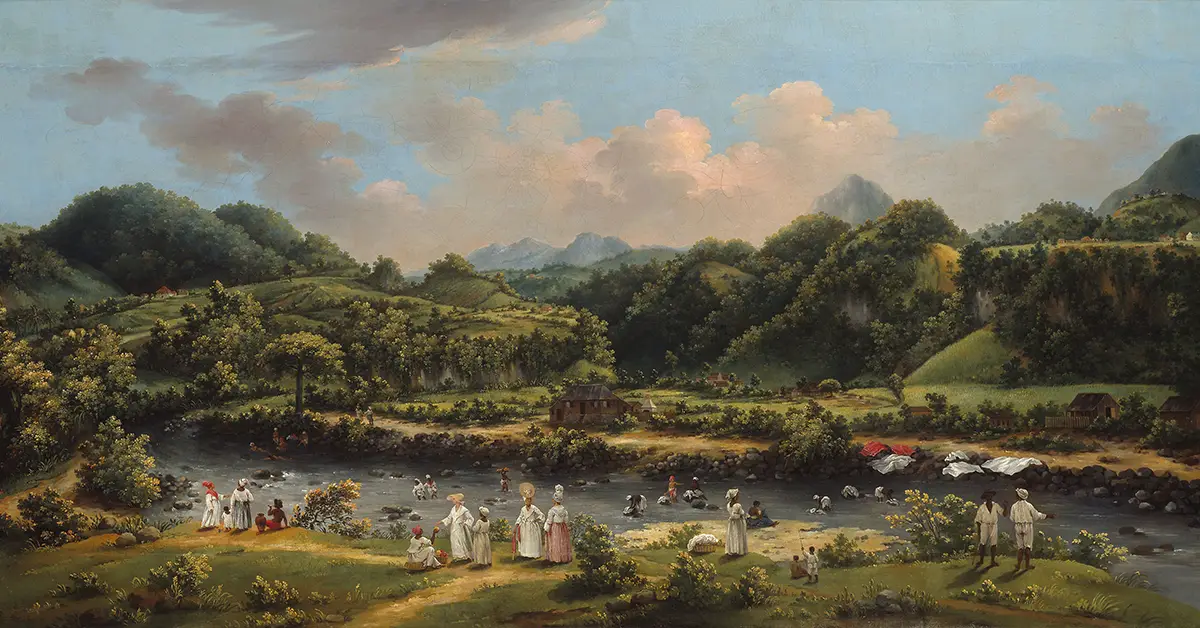
The history of Dominica spans more than 5,000 years, from the pre-colonial era of Indigenous peoples through fierce rivalry between European empires and French and British colonial rule to independence on 03/11/1978. Dominica’s history is tied to a small island in the Lesser Antilles that the Indigenous Kalinago called Waitukubuli, meaning “tall is her body”, reflecting its characteristically rugged, mountainous terrain.
Understanding the history of Dominica helps explain the blend of African, European and Kalinago heritage still clearly present in the contemporary society ofDominica. It is also the only Caribbean island nation that still has a pre-Columbian Indigenous community, a rare heritage in the whole of the Antilles.
Message
The pre-colonial period and Indigenous inhabitants
Archaeological evidence in Dominica shows that humans first reached the island around 3100 BC, when the Ortoroid people travelled by boat from South America to the Caribbean islands. This hunter-gatherer community lived on the island until around 400 BC, when it disappears from the archaeological record.
They were followed by the Arawak, an Arawakan-speaking people from the Orinoco region of South America, who settled on the island from around the 5th century AD. The Arawak developed settled agriculture based on cassava, combined with sea fishing, and lived in small coastal villages. They left behind many pottery remains and stone tools at archaeological sites across the island.
By around 1400, the Kalinago (also known as the Carib) had migrated up the Lesser Antilles from the Guianas and become the dominant people on Dominica. The Kalinago were excellent seafarers and seasoned warriors and organised their society into clans led by chiefs. They named the island Waitukubuli and regarded it as their final home in their migration from the mainland.
A notable feature of this period in Dominica’s history is the continuous presence of three successive Indigenous cultures, each leaving its mark on place names, pottery and farming traditions. The Kalinago were the only people still living there at the time of contact with Columbus, and the only Indigenous people in the Lesser Antilles to survive the colonial era.
Considering a residency programme? The Prosperous Living Investment team assesses your profile free of charge and advises on the pathway that fits your goals.
Christopher Columbus and the era of Spanish neglect
An important turning point in the history of Dominica came when Christopher Columbus sailed past the island’s east coast on Sunday 03/11/1493, during his second voyage to the New World. He named the island after the Latin “dies Dominica”, meaning “Sunday” or “the Lord’s day”. However, Columbus never actually landed on the island because of its rugged terrain and the fierce resistance of the Kalinago.
Spain claimed sovereignty in name but made no significant attempt at colonisation. Dense forest, volcanoes and above all the determined resistance of the Kalinago made the island more of a stopover for fresh water and timber than a real colony. The Kalinago regularly launched dugout-canoe attacks on European ships and landing parties.
Throughout the 16th century, there were almost no significant colonial events in Dominica’s history, and Europeans nicknamed it “the wild island”. Some Indigenous refugees from neighbouring islands fled to Dominica to escape Spanish repression, further strengthening the Kalinago population there. The island became the last stronghold of Indigenous Carib culture in the whole of the Lesser Antilles.
Anglo-French rivalry in the 17th and 18th centuries
In the 17th century, a new chapter in Dominica’s history began as both France and Britain took an interest in the island because of its strategic position between the French colonies of Martinique to the south and Guadeloupe to the north. In 1632, France’s Compagnie des Îles de l’Amérique claimed sovereignty over all of the Petites Antilles, including Dominica, but failed to establish a real colony. From 1642 to 1650, the French missionary Raymond Breton became the first European to visit the island regularly and left many records of Kalinago culture.
In 1660, France and Britain agreed to make Dominica and Saint Vincent neutral territories reserved for the Kalinago. However, this was only a brief pause in Dominica’s history, as France broke the agreement from 1690 by establishing the first settlements on the island’s west coast. The French called the island “Dominique” and began developing coffee plantations, bringing enslaved Africans to work in place of the Kalinago, who refused to submit.
In 1727, Dominica officially became a French colony under its first commander, M. Le Grand. The island was divided into administrative districts called “quartiers”. During the Seven Years’ War (1756 to 1763), a British expeditionary force under Admiral Andrew Rollo captured the island in 1761. Under theTreaty of Paris of 1763that ended the war, France ceded Dominica and several other Caribbean colonies to Britain.
The British colonial period
The British colonial period is the longest chapter in Dominica’s history, lasting 215 years from 1763 to 1978. After taking over, Britain established a legislative assembly on the island in 1763, initially representing only the white community. In 1768, the island gained its own legislative assembly, separate from the shared administrative structure with Grenada. During the American Revolutionary War, France recaptured Dominica in 1778 with the active support of part of the local population. The island was returned to Britain under the Treaty of Paris in 1783.
The 19th century brought many important changes to Dominica. In 1831, the Brown Privilege Bill granted political and social rights to free non-white people, leading to three Black men being elected to the legislative assembly the following year. After slavery was abolished in 1834, the island nation became the only British West Indian colony with a legislature controlled by Black members in the 19th century.
In reaction to this shift in power, the white plantation owners lobbied for more direct rule from London. In 1865, the British Colonial Office replaced the elected assembly with a half-elected, half-appointed body. Most of the Black legislators were landowners or merchants whose economic and social views were opposed to those of the white planter minority.
In 1871, Dominica joined the Leeward Islands colonial group and was later transferred to the Windward Islands in 1940. An important event in Dominica’s early 20th-century history was the British Crown’s official recognition of the Kalinago Territory in 1903, reserving 3,700 acres of land for the Indigenous community. After the First World War, rising political awareness in the Caribbean led to the founding of the Representative Government Association in 1924, which won a third of the elected seats in the legislative council.
The road to independence
After the Second World War, a wave of decolonisation swept the British Empire and began to reshape the final colonial chapter of Dominica’s history. The island joined the West Indies Federation in 1958, a short-lived attempt to unite Britain’s Caribbean colonies into a single federal state. When the federation collapsed in 1962, the island nation entered a transitional period in search of a new form of self-government.
In 1967, the British West Indies Act gave Dominica the status of an “associated state of the United Kingdom”, allowing the island full internal self-government while defence and foreign affairs remained with London. The most important turning point in Dominica’s 20th-century history was the 1967 Constitution, which established a legislature of 11 elected seats, 3 appointed seats and the Attorney General ex officio, with Edward Le Blanc as the first Premier.
On 03/11/1978, exactly 485 years after Columbus named the island, Dominica gained full independence from the United Kingdom and became a republic within the Commonwealth. It is the most important milestone in Dominica’s modern history. Patrick Roland John became the first Prime Minister of the independent nation. The republican constitution established a unicameral legislature of 21 elected and 9 appointed seats on the Westminster model.
A turbulent early period after independence
Independence did not bring Dominica immediate stability. In August 1979, Category 5 Hurricane David, with winds of 240 km/h, devastated the island, killing 42 people and destroying or severely damaging 75% of homes. In the same year, Patrick John’s government was accused of involvement in several scandals, including a plan to lease land to a company suspected of illegally supplying oil to South Africa, then under international embargo.
Political discontent led to a civil uprising in 1979 and a vote of no confidence in the House of Assembly that brought down John’s government. A transitional government led by Oliver Seraphin was formed to prepare for the 1980 general election. That election brought Eugenia Charles of the Dominica Freedom Party to power as Prime Minister, the first female Prime Minister in Caribbean history.
In 1981, two coup plots to return Patrick John to power were uncovered and defeated, marking the most tense period in Dominica’s post-independence history. John was put on trial but acquitted in 1985. In October 1983, as Chair of the Organisation of Eastern Caribbean States, Eugenia Charles supported the US military intervention in Grenada, placing Dominica on the pro-US geopolitical axis of the Cold War.
The modern era and recent events
In Dominica’s contemporary history, Eugenia Charles remained in power until she retired in 1995, after which the United Workers’ Party (UWP) led by Edison James took office. In September 1995, Hurricane Luis destroyed almost all the banana plantations, causing a prolonged agricultural crisis. In 2000, the Dominica Labour Party (DLP) won 10 of the 21 seats and formed a coalition with the Freedom Party, beginning a period of continuous DLP government that continues to this day.
In 1993, the Dominican government launched the Citizenship by Investment (CBI) Programme under the Citizenship Act of 1978 to attract foreign investment. It is one of the earliest CBI programmes in the world and contributes significantly to government revenue and to financing post-disaster reconstruction. Those interested in the programme can refer to the articleDominica citizenship by investmentfor details.
In September 2017, Category 5 Hurricane Maria made landfall with catastrophic force, causing damage equivalent to 226% of GDP and destroying 90% of buildings on the island. It was one of the most severe natural disasters in Dominica’s history. The event prompted Roosevelt Skerrit’s government to announce its ambition to make Dominica “the world’s first climate-resilient nation” through a comprehensive reconstruction programme.
In 2025 to 2026, the country faced diplomatic pressure from the United States and the European Union over the CBI programme, leading to reforms tightening due diligence and restricting citizenship for certain nationalities such as Iranians. This is the latest chapter in Dominica’s contemporary history, reflecting the geopolitical pressure on the whole Caribbean region as the world order is reshaped.
Key periods in the history of Dominica
The history of Dominica can be divided into 5 major periods: the pre-Columbian Indigenous era, the period of neutrality and Anglo-French conflict in the 17th to 18th centuries, British colonial rule in the 19th century, self-government and independence from 1958 to 1978, and the modern post-independence era. Each period has left a clear mark on the country’s social structure, language, religion and legal system.
The history of Dominica is a story of resilience and an unbowed identity. From the first Indigenous inhabitants to the Kalinago resistance against European invasion, and from the era of slave plantations to the struggle for independence in 1978, this small island has forged a distinctive national identity in the Caribbean. Despite repeated challenges from tropical hurricanes and international economic pressure, the country has maintained a stable democracy.
The island nation continues to make its voice heard internationally through Eastern Caribbean regional organisations and the world’s oldest citizenship by investment programme, which has operated continuously since 1993.
Accompanying you on your journey in residency investment
The Prosperous Living Investment team advises on pathways, assesses profiles and manages investments transparently for every residency, citizenship and international property objective.
Free profile assessmentWhere life gets prosperous