

Dominican culture is a unique blend of the African heritage of the majority of the population, the traditions of the only surviving Indigenous Kalinago people in the Caribbean, and European influences from two centuries of French and British colonial rule. This combination creates an identity distinct from other Caribbean islands, expressed through music, the Kwéyòl Creole language, cuisine, festivals and handicrafts.
The features of Dominican culture help explain whyDominicais known as “the Nature Island”, not only for its geography but also for its unspoilt culture. Many of the country’s cultural heritage elements have been recognised by UNESCO and are being actively preserved against the pressures of globalisation.
Message
Music in Dominican culture
Music is central to Dominican culture, with many distinctive genres developed over centuries. Bouyon is the most distinctive genre, created in the 1980s by the band WCK (Windward Caribbean Kulture). It blends traditional Jing Ping rhythms, soca, calypso and elements of French Caribbean zouk. Bouyon has become a national musical symbol and spread across the Eastern Caribbean.
Cadence-lypso has been an influential genre since the 1970s, pioneered by Gordon Henderson’s band Exile One. It combines cadence (a French Caribbean rhythm) with Trinidadian calypso. Cadence-lypso was once the most listened-to genre in the French-speaking Caribbean islands before giving way to zouk in the late 1980s.
Jing Ping is the oldest traditional folk music genre, using the accordion, the “boumboum” (a large bamboo pipe), the shak-shak and the “tambou lélé” (drum). It is rural music played for quadrille and bélé dances of African origin. Jing Ping is being preserved through traditional music groups and has been included in cultural education programmes.
Considering a residency programme? The Prosperous Living Investment team assesses your profile free of charge and advises on the pathway that fits your goals.
The World Creole Music Festival and music festivals
The World Creole Music Festival is the most important event in Dominican culture, held every year in late October since 1997. It is the largest Creole music festival in the world, running for 3 consecutive nights at Windsor Park Stadium in Roseau with artists from the Caribbean, Africa, Central America and Europe. The festival attracts about 30,000 people each year, 40% of them from abroad.
International artists who have performed at the festival include Magic System (Côte d’Ivoire), Kassav’ (French Caribbean), Wyclef Jean (Haiti – United States), Beres Hammond (Jamaica) and many zouk, kompa and bouyon stars. The event has become a symbol of preserving and developing Creole culture worldwide, generating about $5 million USD in direct tourism revenue each year.
Besides the World Creole Music Festival, the country has the Mas Domnik Carnival before Lent, the Kalinago Festival in September celebrating Indigenous culture, and the Mango Festival in July. Each parish also holds its own patron saint’s festival in the Catholic tradition, combining religion with local music and food.
Carnival — the heart of Dominican culture
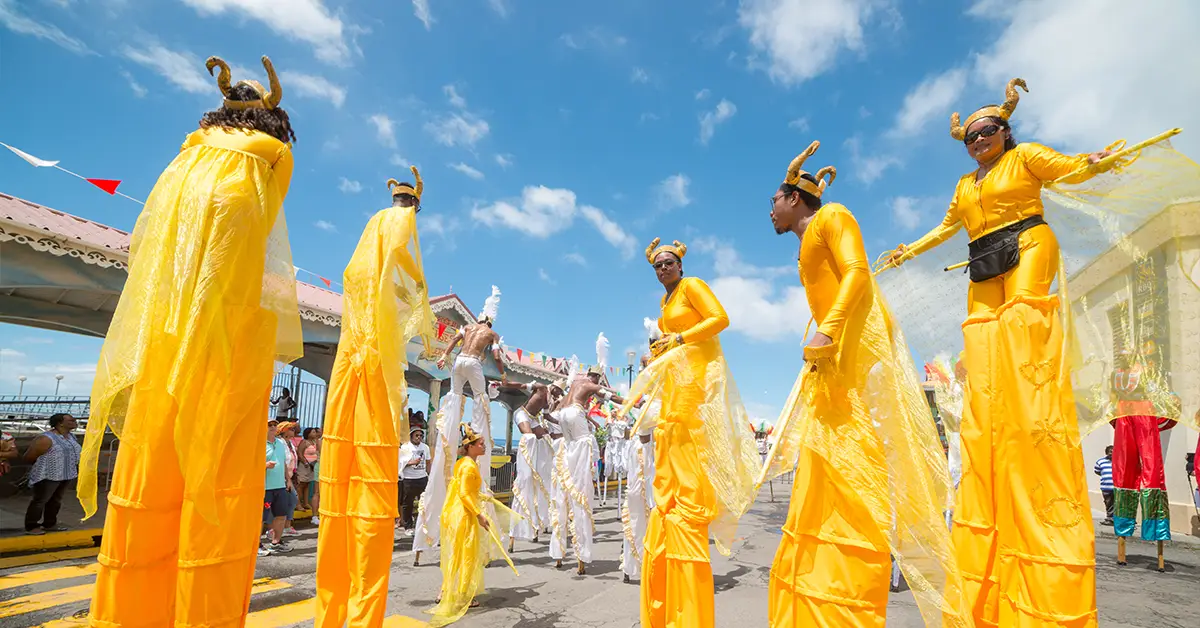
Carnival, known locally as Mas Domnik, is the biggest street festival in Dominican culture, held over the 2 days before Ash Wednesday. It has its roots in French Catholic tradition combined with African masking and dance traditions brought by enslaved people. A distinctive custom of Dominica’s Carnival is “ole mas” (old mas), with traditional costumes and political satire, unlike the glitzy style of Trinidad’s Carnival.
Signature costumes include the “sensay”, with striped fabric masks and all-covering outfits worn in the streets; the “black devil”, whose wearers are dressed all in black and smeared with soot, carrying bells and pitchforks; and “stilt walkers” in Mocojumbie costumes 3 to 4 m tall. Parades combined with bouyon, calypso and soca music create a lively festival atmosphere.
The festival takes place mainly in Roseau, with “Jouvert” starting at 4 am on Sunday, followed by Carnival Monday and Tuesday, culminating in the “Las Lap” parade on Tuesday evening. Foreign visitor numbers during Carnival are 30% higher than in other months, contributing significantly to first-quarter tourism revenue each year.
Creole language and literature
Kwéyòl Creole (also written Kweyol or called Patois) is an important cultural asset of Dominica, spoken fluently by about 60% of the population. It is a French-based Creole with vocabulary drawn mainly from 17th- and 18th-century French, combined with African-derived grammar and some Kalinago elements. Kwéyòl belongs to the same branch as the Creoles of Saint Lucia, Martinique and Guadeloupe but has its own distinctive features.
UNESCO has acknowledged the importance of Kwéyòl as part of the intangible cultural heritage of the French-speaking Caribbean. The government officially introduced Kwéyòl into the school curriculum in 2014 under the “Mwen sé Dominik” (I am Dominican) initiative to preserve the language from being overwhelmed by standard English. International Creole Day on 28/10 is celebrated with literary and musical events.
Dominican literature has some internationally prominent names. Jean Rhys (1890 to 1979), born in Roseau, is the best-known novelist, whose novel “Wide Sargasso Sea” (1966) was included in Time Magazine’s list of the 100 best English-language novels of the 20th century. Phyllis Shand Allfrey (1908 to 1986) wrote “The Orchid House” (1953), depicting Caribbean colonial life. Contemporary writers such as Gabriel Christian, Lennox Honychurch and Rosalind Volney continue to develop the national literature.
Traditional cuisine in Dominican culture
Cuisine clearly expresses the cultural blend of Dominica, combining native ingredients, African techniques, French flavours and Kalinago traditions. Key ingredients include green bananas, dasheen, cassava, watermelon, pumpkin, sea fish and poultry. The Mango Festival in July and the Cocoa Festival in December celebrate traditional agricultural produce.
The traditional national dish is “mountain chicken” (Crapaud) — a large frog endemic to the island. However, due to chytrid fungus and habitat loss, the frog has become critically endangered, with only a few hundred individuals left. Hunting mountain chicken has been completely banned since 2003. Today, “Crapaud” is usually replaced with other meats in traditional restaurants.
Other signature dishes include “callaloo” (dasheen leaf soup), “saltfish bakes” (fried dough with salted fish), “souse” (pickled pig’s trotters in lime), “pelau” (rice with meat and peas), “freshwater shrimp”, “blue marlin” and “bouillon” (meat and vegetable soup). Traditional drinks include local rum, Bois Bandé infusions and “Mauby”, made from the bark of the mauby tree.
Dress and handicrafts
The traditional Wob Dwiyèt costume, with its multicoloured yellow, red and green plaid pattern, is a cultural symbol worn by women on national holidays, at traditional weddings and in cultural performances. The outfit consists of a long “douillette” gown, a “jupe” skirt and a “tête chaudière” headscarf tied into three points symbolising the island’s mountain peaks. Women wearing the Wob Dwiyèt often wear gold and coral jewellery known as “kuk pwam” and “neg jeté”.
Kalinago handicrafts are a special heritage of the Indigenous community, including “Larouma” baskets woven from the leaves of the larouma plant, with a wide variety of traditional patterns and good water resistance. Larouma products have received support from the World Intellectual Property Organization (WIPO) to register a Geographical Indication to protect and promote them in international markets. Besides baskets, Kalinago artisans also make straw hats, pottery, textiles and shell jewellery.
Contemporary Dominican art includes prominent artists such as Earl Etienne, Hilroy Fingol and Roy Moko, whose works depict the island’s landscapes, rural life and Kalinago history. Galleries in Roseau and the Trafalgar arts village display their work. Some contemporary painters have successfully exported their work to the US and European markets.
Religion and rituals
Religion plays a central role in Dominican culture, with Roman Catholics making up 53% of the population, a legacy of French colonial rule. Major Catholic celebrations such as Easter, Christmas and parish patron saints’ days are held with ceremony and combined with local traditions. Many religious customs have distinctive Caribbean elements, such as sacred music with the tambou lélé and the “Carnival of Light” procession before Christmas.
Protestants make up 33% of the population, with Methodist, Pentecostal and Seventh-day Adventist churches growing strongly in many areas. Rastafari also has a small but active community, contributing to reggae music and the movement for cannabis rights. The Kalinago community maintains some traditional spiritual rituals alongside Catholicism, especially related to natural healing, connecting with ancestors and harvest celebrations.
Independence Day on 03/11 is a solemn national event combining a military parade, Mass at Roseau Cathedral and traditional cultural performances. National Day of Reconciliation on 19/9, commemorating those who died in the 1981 coup attempts, is also an important memorial. Parishes hold their own patron saint festivals throughout the year, attracting local residents and tourists.
Heritage conservation and international promotion
The government of Dominica has made many efforts to preserve Dominican culture and promote it internationally. The Cultural Division of the Ministry of Culture, Youth and Sports is responsible for programmes to preserve the Kwéyòl language, traditional music, handicrafts and festivals. The Dominica Museum in Roseau holds Kalinago archaeological artefacts, colonial documents and cultural objects from independence to the present.
Morne Trois Pitons National Park, recognised byinscribed by UNESCO as a World Heritage Sitein 1997, is not only a natural heritage site but also an important cultural space for the Kalinago community and Maroon history. Trails in the national park are linked to local legends and traditions. The Kalinago Territory is also being proposed for recognition as UNESCO Intangible Cultural Heritage.
National media include the Dominica Broadcasting Services (DBS), Kairi FM, Q95 and the television channels SAT TELECOM and Mar PBN. These outlets play an important role in broadcasting local music, news in English and Kwéyòl, and cultural and educational programmes. Dominica’s embassies in London, Washington and Brussels organise many cultural events to promote the country internationally.
Summary of Dominican culture
Dominican culture is a diverse and vibrant heritage reflecting the complex historical journey of a small Caribbean island nation. The blend of African, European and Indigenous Kalinago heritage creates a cultural identity that cannot be mistaken for that of any other Caribbean island. Preserving traditional culture amid globalisation poses challenges but also offers opportunities to develop cultural tourism and export creative products.
The World Creole Music Festival, the official teaching of the Kwéyòl language and international recognition of Kalinago handicrafts are evidence of the success of the national cultural conservation strategy in recent decades.
Accompanying you on your journey in residency investment
The Prosperous Living Investment team advises on pathways, assesses profiles and manages investments transparently for every residency, citizenship and international property objective.
Free profile assessmentWhere life gets prosperous