


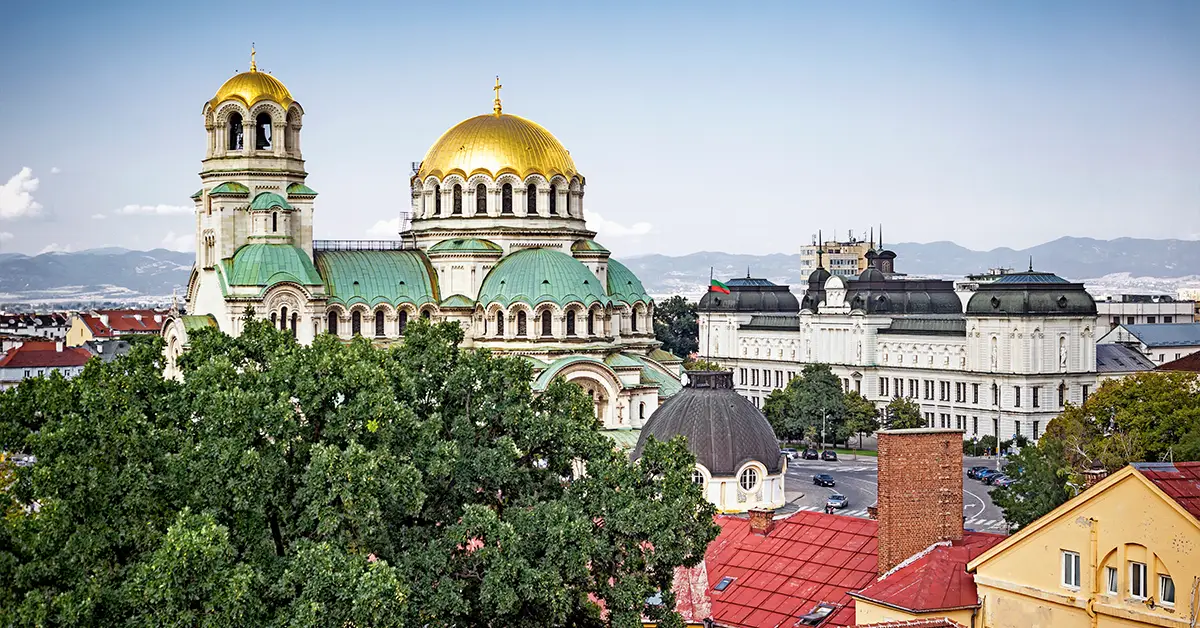
Bulgaria is a country in South-Eastern Europe that joined theEuropean Union (EU)in 2007, became a Schengen member on 31 March 2024 and formally joined the eurozone on 01/01/2026. This is a set of three deep integration steps completed within less than two years, making Bulgaria a notable destination for international investors seeking EU permanent residence and citizenship through lawful investment programmes.
For Vietnamese people, Bulgaria offers a less competitive option than the traditional markets such as Portugal, Greece or Malta, together with a flat income tax rate of 10% — the lowest in the EU. The material below provides a systematic overview of the geography, population, economy, politics and current settlement routes, based on official data from the EU and the Bulgarian Ministries of Foreign Affairs and the Interior.
Message
An overview
Bulgaria’s official name is the Republic of Bulgaria. It lies on the Balkan Peninsula, bordering Romania to the north, the Black Sea to the east, Turkey and Greece to the south, and North Macedonia and Serbia to the west. Its total area is around 110,996 km², with a population estimated at around 6.4 million as at 2025 on Eurostat data.
The capital and largest city is Sofia, at the foot of Mount Vitosha in the west of the country, with a metropolitan population of around 1.3 million. The second largest city is Plovdiv, regarded as one of the oldest continuously inhabited cities in Europe. Varna on the Black Sea coast is an important maritime and tourism centre, while Burgas is the second largest port serving trade and logistics.
The country is divided into 28 administrative provinces, headed by governors appointed by the Prime Minister. The local language is the official language and the only EU language using the Cyrillic alphabet. Most of the population is Eastern Orthodox, while Islam is the second largest religion, mainly within the ethnic Turkish community.
Considering a residency programme? The Prosperous Living Investment team assesses your profile free of charge and advises on the pathway that fits your goals.
Bulgaria’s EU, Schengen and eurozone standing
Bulgaria joined the EU on 01/01/2007 alongside Romania in the bloc’s fifth enlargement. Over the following nearly two decades, the country carried out a series of fiscal and administrative reforms to meet the Maastricht criteria and the Schengen requirements. Full integration into the bloc’s three main pillars has been completed through three consecutive milestones.
The first milestone was joining the Schengen area on 31/03/2024, initially for air and sea borders. By 01/01/2025, land border controls between Schengen members were removed entirely. Permanent residents from that point may travel freely throughout the Schengen area for 90 days in every 180 without any further visa.
The second milestone was joining the eurozone on 01/01/2026. The lev (BGN) was formally replaced by the euro at the fixed rate of 1 EUR = 1.95583 BGN, after nearly two decades pegged to the single currency. This is an important event for property investors and investment funds because domestic currency risk is removed entirely, while the sovereign credit rating has been upgraded.
The third milestone, still an expectation, is the possibility of joining the United States Visa Waiver Program in 2026. The refusal rate for B tourist visas for Bulgarian citizens in 2024 fell to 6.02%, the lowest in 18 years and approaching the 3% threshold required under United States law.
History
A detailed article onThe history of Bulgaria
Bulgarian history stretches over more than 13 centuries, counted from 681 when Khan Asparuh founded the First Bulgarian Empire on the Danube plain. The land was once home to the ancient Thracians, and was then ruled successively by Rome, Byzantium and the Ottomans. The two imperial periods — the First (681–1018) and the Second (1185–1396) — were the height of culture and power, leaving a deep mark on modern national identity.
After 500 years under Ottoman rule, Bulgaria gained partial independence in 1878 after the Russo-Turkish War and full independence in 1908. The 20th century saw a period of constitutional monarchy, participation in two world wars, and the People’s Republic of Bulgaria (1946–1990) within the Soviet bloc. The transition to democracy and a market economy was completed with the milestones of joining NATO in 2004 and the EU in 2007.
Geography
A detailed article onThe geography of Bulgaria
Bulgarian territory comprises four main terrain regions: the Danube plain in the north, the Stara Planina range running east to west across the country, the fertile Thracian plain in the south, and the Rila-Pirin-Rhodope ranges along the Greek border. Musala peak in the Rila range, at 2,925 metres, is the highest point in the Balkans.
The coastline runs 354 km along the Black Sea with well-known beaches such as Sunny Beach, Albena, Sozopol and Sveti Vlas. This area is the main engine of the tourism industry, particularly in the summer months when average temperatures range from 25–30°C. The Danube forms the natural border with Romania over 470 km, serving as a river transport artery and an important source of hydroelectricity.
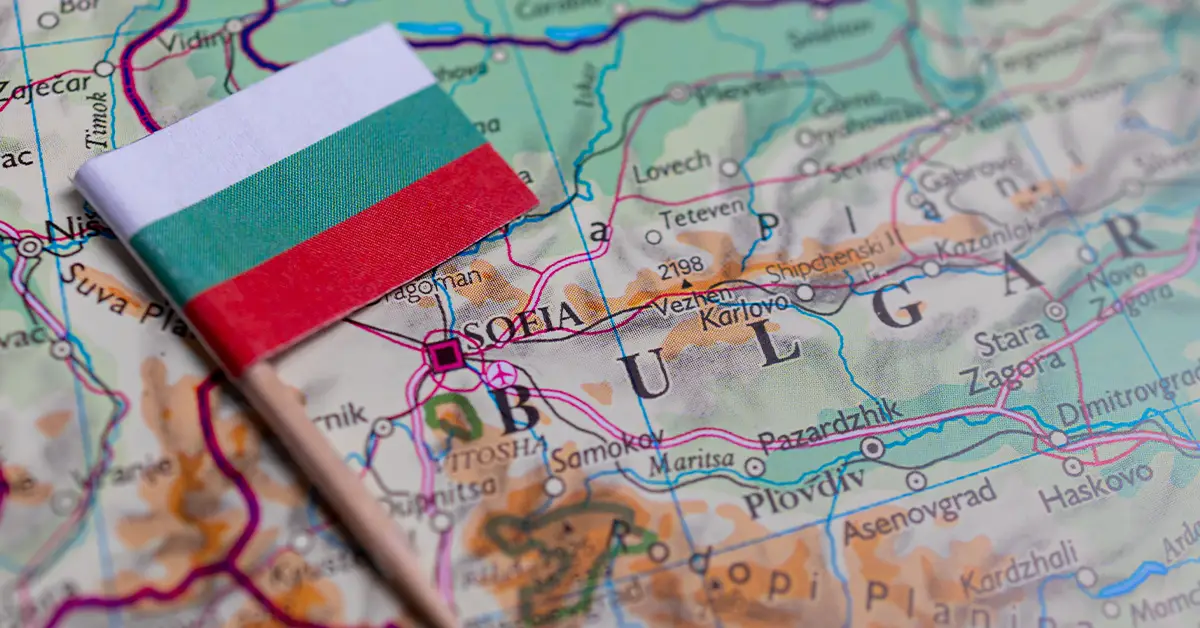
Bulgaria’s climate is transitional between temperate continental and Mediterranean. Winters are cold with snow in the mountains, lasting from November to March, ideal conditions for the ski resorts of Bansko, Pamporovo and Borovets. Summers are warm and dry on the plains but mild in the high mountains, creating varied domestic destinations year round.
Politics
A detailed article onThe politics of Bulgaria
Bulgaria is a unicameral parliamentary republic on the principle of proportional representation. The current constitution was adopted in 1991, two years after the fall of the communist regime. The National Assembly comprises 240 members directly elected every four years. The Prime Minister heads the government and holds real executive power, while the President is head of state with a representative role and a limited veto.
The judicial system has three levels: district courts, provincial courts and the Supreme Court of Cassation. The Constitutional Court of 12 judges reviews the constitutionality of legislation. As an EU member, Bulgaria applies the primacy of EU law in matters within the bloc’s competence, and accepts the jurisdiction of the Court of Justice of the European Union (CJEU).
The legal framework governing foreign nationals comprises two main instruments. The Act on Foreigners in the Republic of Bulgaria (the Foreigners Act) governs visas, temporary residence, permanent residence and the investment conditions for obtaining permanent residence. The Bulgarian Citizenship Act governs the routes to citizenship, including naturalisation after 5 years’ permanent residence on the basis of investment under Article 14a.
The economy
A detailed article onThe economy of Bulgaria
Nominal GDP in 2024 was estimated at around USD 107 billion, with GDP per capita at PPP of around USD 36,000 on IMF figures. Public debt was 29.9% of GDP in 2025, one of the lowest in the EU and far below the 60% limit under the Maastricht Treaty. The national budget has been balanced for several years, an important basis for the European Commission and the European Central Bank to confirm eligibility for the eurozone.
The main economic sectors comprise energy, mining, metallurgy, machinery, agriculture and tourism. Services contribute around 60% of GDP, with information technology, technical support and business process outsourcing (BPO) growing quickly. Sofia is the main financial and technology centre, home to the regional headquarters of many European and United States multinationals.
Personal income tax and corporate income tax have both been at a flat 10% since 2008. This is the lowest flat rate in the EU and a decisive factor when individual investors, freelance professionals and international companies weigh establishing tax residence in Bulgaria. Workers in the country had average earnings of around 2,468 leva (EUR 1,262) a month at the end of 2024, giving a cost advantage over the Western European markets.
A detailed article onThe Bulgarian tax system.
Demographics
A detailed article onThe demographics of Bulgaria
On Eurostat data for 2025, Bulgaria’s population is around 6.4 million, falling continuously since its peak of 9 million in 1989. Average population density is 58 per km², unevenly distributed with nearly 75% of the population concentrated in urban areas. Sofia, Plovdiv, Varna and Burgas are the four largest population centres.
The ethnic composition comprises around 84% Bulgarians, 9% Turks living mainly in the south-eastern provinces, 5% Roma and the remainder other minorities. The population is ageing quickly with a median age of 45 — above the EU average — and a fertility rate below replacement level. This has driven the government to adopt selective immigration policies, particularly through the investment programmes.
The main religion is Eastern Orthodoxy at around 60% of the population, with Sunni Islam at 8%, mainly within the Turkish and Pomak communities. The remainder are of no religion or of other Christian denominations. The Constitution guarantees religious freedom and a clear separation between state and church.
Education
A detailed article onEducation in Bulgaria
State education in Bulgaria is free at primary and secondary level, while higher education charges fees but at a very low level by EU standards. Literacy is 98.4% — among the highest in Eastern Europe. Compulsory education lasts 12 years and is taught in Bulgarian, although there are many international and bilingual schools in the major cities.
Sofia University “St. Kliment Ohridski”, founded in 1888, is the oldest and largest higher education institution and is internationally recognised. The other well-known universities comprise the Technical University of Sofia, the Medical University of Sofia and the American University in Bulgaria at Blagoevgrad — teaching entirely in English on the United States model. Many Bulgarian universities offer English-language programmes for international students, particularly in medicine, engineering and economics.
For investor families with young children, the international schools in Sofia such as the Anglo-American School of Sofia, the American College of Sofia and the Lycée Français Victor-Hugo offer IB, American or French curricula. Fees range from EUR 6,000–18,000 a year — considerably lower than equivalent schools in Western Europe.
Culture
A detailed article onBulgarian culture
Bulgaria is the home of the Cyrillic alphabet, developed by the two missionaries Cyril and Methodius in the 9th century. 24 May each year is celebrated as the Day of Bulgarian Culture and Literacy, one of the most important festivals of the year. The folk music tradition, with the female choir Mystery of the Bulgarian Voices, won a Grammy in 1990 and continues to be performed on international stages.
Seven sites in Bulgaria are UNESCO World Heritage Sites, comprising the 10th-century Rila Monastery, the Thracian tomb of Kazanlak, the old town of Nessebar on the Black Sea, Boyana Church and the Madara Rider. Two natural sites, Pirin National Park and the Srebarna Nature Reserve, are also on the list. Bulgaria is known as the “land of roses” because it produces around 70% of the world’s commercial damascena rose oil, concentrated in the Valley of the Roses around Kazanlak.
Bulgarian cuisine reflects the meeting of Slavic, Greek and Ottoman cultures. Bulgarian yogurt, banitsa, shopska salata, kebapche and rakia are the emblematic dishes. The foreign community in Bulgaria is spread widely from Sofia to Varna, Plovdiv and Bansko, and is not concentrated into large distinct communities as in Portugal or Spain. This is a difference for those seeking a deeply integrated experience of local life rather than living in an “expat bubble”.
International relations
A detailed article onBulgaria’s international relations
Bulgaria has been a United Nations member since 1955, a NATO member since 2004 and an EU member since 2007. The country maintains diplomatic relations with more than 170 countries and is an active member of regional bodies such as the Council of Europe, the Organization for Security and Co-operation in Europe (OSCE) and the Organization of the Black Sea Economic Cooperation.
Relations with the Balkan neighbours are stable, although some historical issues remain with North Macedonia over the interpretation of history and national identity. Relations with Turkey — a country with large communities of Bulgarian origin and of Bulgarian Turks — form an important strategic axis in both economics and security.
Vietnam and Bulgaria established diplomatic relations on 08/02/1950 and have now maintained more than 75 years of cooperation. Bulgaria has an Embassy in Hanoi and an Honorary Consulate in Ho Chi Minh City, while Vietnam has an Embassy in Sofia. Both are partners within the EU-Vietnam framework, particularly through the EVFTA free trade agreement in force since 2020.
The Vietnamese community in Bulgaria numbers around 500–800 people, living and doing business mainly in Sofia. It is a small but stable community with a long tradition dating from the labour cooperation of the 1980s.
The Bulgarian passport and freedom of movement
The Bulgarian passportis a full EU passport ranked highly on the international indices of freedom of movement. On data published byProsperous Passport Index, the Bulgarian passport allows visa-free entry or visa on arrival to around 152–179 countries and territories depending on the counting method, placing it among the 30 strongest passports in the world.
Bulgarian citizens enjoy all four EU freedoms comprising the free movement of goods, services, capital and labour throughout the bloc. They have the right to live, work, study and do business in any EU country without needing a further residence or work permit. This is the benefit foreign investors are particularly interested in when weighing the route from Bulgarian permanent residence to citizenship.
One limitation that remains is that Bulgarian citizens, along with those of Romania and Cyprus, still need a visa to enter the United States. However, negotiations to join the United States Visa Waiver Program are at a final stage, with completion expected in 2026. When that happens, the Bulgarian passport will become one of the strongest EU passports by total number of countries accessible.
The Bulgaria settlement routes for foreign nationals
The current legal framework offers three main groups of routes for non-EU citizens wanting long-term residence in Bulgaria. The first is residence on the basis of investment, governed by Article 25 of the Foreigners Act with several capital options. The most popular option today isGolden Visa Bulgariarequiring an investment of EUR 512,000 in an alternative investment fund (AIF) or an ETF licensed by the Bulgarian Financial Supervision Commission. This option grants permanent residence immediately without a temporary residence stage.
The second group is residence on the basis of employment, marriage or family reunification, using the Bulgarian D visa as the initial gateway. The D visa is a long-stay national visa permitting stays of more than 90 days, after which the applicant converts to a temporary residence permit at the Migration Directorate of the Ministry of the Interior. This group requires actual residence in Bulgaria for 30 months within 5 years before becoming eligible for permanent residence.
The third group isBulgaria residence by investmentthrough the business routes, comprising setting up a company employing at least 10 Bulgarian workers, investing BGN 1,000,000 in the shares of a Bulgarian company listed on a regulated exchange, or investing BGN 500,000 in the share capital of a Bulgarian company holding more than 50% of the shares and creating at least 10 jobs. Every route in this group leads to permanent residence and then toBulgarian citizenshipafter 5 years of maintaining a qualifying investment.
Important changes to the residence by investment programme
Bulgaria ran a direct citizenship by investment (CBI) programme from 2013 to March 2022. On the analysis by theUnited States Library of Congressof the 2021 citizenship law amendments, the fast-track route once allowed investors to obtain citizenship after only one year of permanent residence where they doubled the investment to BGN 2,000,000 or invested in a priority project certified by the Ministry of the Economy.
In March 2022, the Bulgarian Parliament voted to abolish the fast-track citizenship option under pressure from the European Commission over money laundering and security concerns. All citizenship applications filed before the amendment were cancelled. However, the residence by investment route was unaffected and continues to be the main mechanism for foreign investors.
There is currently no direct route to Bulgarian citizenship through investment alone. Investors must maintain permanent residence and the investment for at least 5 years and pass a Bulgarian language test at A1 or A2 level (or obtain an exemption under special provisions) before filing for naturalisation. Spouses and children under 18 benefit from a simplified process and are not bound by the actual residence or language requirements.
Life and costs in Bulgaria
A detailed article onLife in Bulgaria
The cost of living in Bulgaria is among the lowest in the EU. A single person in Sofia spends an average of around EUR 600 a month excluding rent, while a family of four needs around EUR 2,000. Rent on a studio apartment in Sofia starts from EUR 400, considerably below the Western European capitals. For retirees or digital nomads, this cost level is markedly attractive against the EU and Schengen infrastructure network the country offers.
The Bulgarian health systemoperates on a compulsory national health insurance model combined with a private sector. Permanent residents have access to this system on the same terms as citizens.
Transport infrastructure continues to be upgraded with EU co-funding. The motorway network links Sofia with Plovdiv, Burgas and Varna, while Sofia airport serves more than 7 million passengers a year with direct flights to most European capitals. Schengen accession has considerably increased intra-bloc flight frequency and simplified cross-border logistics connections.
Read more aboutretirement in Bulgaria.
Summary
Bulgaria has completed three key integration steps — the EU, Schengen and the eurozone — in a very short timeframe, turning the country from a peripheral member into a core investment destination within the bloc. The combination of a 10% flat tax, low living costs, a strong EU passport and a clear residence by investment route creates a value proposition distinct from the traditional markets.
For Vietnamese investors weighing an EU route, Bulgaria deserves assessment alongside Portugal, Greece and Malta — not as a complete replacement, but to widen the range of options. Specialist material on the Golden Visa, the D visa, business residence by investment and the route to Bulgarian citizenship will be set out in detail in the specialist articles that follow.
Accompanying you on your journey in residency investment
The Prosperous Living Investment team advises on pathways, assesses profiles and manages investments transparently for every residency, citizenship and international property objective.
Free profile assessmentWhere life gets prosperous