


Bulgarian culture is one of the oldest and most diverse cultures in Eastern Europe — the result of more than 1,300 years of blending ancient Thracian heritage, Greco-Roman influence, Slavic tradition, Turkic Bulgar heritage and five centuries of Ottoman interaction. The country has 10 UNESCO World Heritage Sites and several unique cultural elements recognised worldwide — such as Bulgarian yoghurt, rose oil and the Cyrillic alphabet.
For foreigners considering settling inBulgaria, understanding the country’s culture is important for social integration and assessing the living environment. This article analyses in detail the pillars of the culture: UNESCO heritage, literature and language, folk and contemporary music, traditional cuisine, signature festivals, art and cinema, and social customs Vietnamese people should be aware of.
Message
The pillars of Bulgarian culture
Bulgarian culture was formed from three main historical layers, according toBritannica’s analysis of Bulgarian cultural life. The first layer is ancient Thracian heritage — a civilisation that developed from the third millennium BC, leaving famous gold treasures (Panagyurishte, Valchitran, Rogozen) and thousands of ancient tombs. The Thracians influenced Greek legend — Orpheus, the mythical musician, is said to have been born in the Rhodope Mountains.
The second layer is the Slavic-Bulgar heritage from the 7th century AD. The fusion of the Turkic Bulgars and Slavic tribes over the centuries created the modern Bulgarian people. The high point of this cultural layer was the adoption of Orthodox Christianity in 865 and the development of the Cyrillic alphabet in the late 9th century in Preslav. This is Bulgarian culture’s important contribution to the wider Slavic heritage.
The third layer is Ottoman influence from 1396 to 1878. Although this was a difficult period for the Bulgarian people, five centuries of coexistence left their mark on cuisine, music and some customs. After the 1878 liberation, Bulgaria went through a “National Revival” with movements to restore its culture and language. The 20th century, with the communist regime, and EU integration after 1989 continued to shape modern Bulgarian culture.
Considering a residency programme? The Prosperous Living Investment team assesses your profile free of charge and advises on the pathway that fits your goals.
Ten UNESCO World Heritage Sites
Bulgaria has 10 sitesrecognised by UNESCO— an impressive number for a country of just 110,994 km². It is international recognition of the value of Bulgarian culture. There are 7 cultural sites and 3 natural/mixed sites. Most are concentrated in regions with a strong historical tradition — Sofia, Plovdiv, Veliko Tarnovo and Nessebar.
The Rila Monastery (1983) is the best-known UNESCO site — Bulgaria’s largest Orthodox monastery, founded in the 10th century by Saint Ivan of Rila. It is a symbol of Bulgarian culture and an important pilgrimage site. The Boyana Church (1979) in Sofia has 13th-century frescoes regarded as a forerunner of the European Renaissance.
The Ancient City of Nessebar (1983) on the Black Sea coast has more than 40 churches from different periods, combining Byzantine and medieval Bulgarian architecture. The Thracian Tomb of Kazanlak (1979) and the Thracian Tomb of Sveshtari (1985) are two Thracian tombs from the 4th–3rd centuries BC with unique frescoes and stone carvings.
The Madara Rider (1979) is an 8th-century AD rock relief — a symbol of the First Bulgarian Empire, carved into a cliff face 23 m high. The Rock-Hewn Churches of Ivanovo (1979) are a complex of 12th–14th-century rock churches in the valley of the Rusenski Lom river. Pirin National Park (1983) and the Srebarna Nature Reserve (1983) are the two natural sites — protecting old-growth forest and wetlands with rare birds.
The newest UNESCO site is the Old Bulgarian Forests (2017) — shared with 17 other European countries in the “Primeval Beech Forests of the Carpathians and Other Regions of Europe” listing. These ten UNESCO sites provide an important foundation for Bulgaria’s cultural tourism — attracting millions of international visitors every year.
Literature and language
Bulgarian literature has a long tradition dating back to the 9th century, with religious works in Old Slavonic. It is one of the earliest literatures written in a Slavic language. The “Bulgarian Apocrypha” and the works of the disciples of Cyril and Methodius are the foundation of all Slavic literature. Veliko Tarnovo during the Second Bulgarian Empire (1185–1396) was the most important literary centre in Southeastern Europe.
Bulgarian culture came back to life in the “National Revival” of the 18th–19th centuries. The monk Paisius of Hilendar wrote “Slavonic-Bulgarian History” (1762) — the work that awakened national consciousness. Petko Slaveykov, Lyuben Karavelov and Hristo Botev were famous writer-revolutionaries of the liberation period. Ivan Vazov (1850–1921) — the “father” of modern Bulgarian literature — wrote the novel “Under the Yoke” (1894), the most widely translated work of Bulgarian literature.
Bulgarian literature in the 20th century developed in many directions. Elias Canetti — born in Ruse, Bulgaria in 1905 — won the Nobel Prize in Literature in 1981. Although he wrote in German, Canetti is an international icon of Bulgarian culture. Tsvetan Todorov, Julia Kristeva and Maria Todorova are internationally renowned Bulgarian thinkers. Contemporary literature includes Georgi Gospodinov — winner of the 2023 International Booker Prize for the novel “Time Shelter.”
Bulgarian is the official language and the core of Bulgarian culture. It is a South Slavic language, close to Macedonian and Serbo-Croatian. Since Bulgaria joined the EU in 2007, its Cyrillic script has been one of the EU’s three official alphabets — Cyrillic, Latin and Greek. Bulgarian has about 9 million speakers worldwide.
Folk and contemporary music
Bulgarian folk music is internationally famous for its complex rhythms and unique vocal technique. The women’s choir “Le Mystère des Voix Bulgares” won a Grammy in 1990 — taking the music of Bulgarian culture to the world. Bulgaria’s distinctive “open throat” singing style creates a unique sound not found in other musical cultures.
Traditional Bulgarian instruments include the gaida (bagpipe), kaval (long wooden flute), gadulka (3–5-string bowed instrument), tambura (plucked string instrument) and tapan (large drum). Complex 5/8, 7/8, 9/8 and 11/8 rhythms are common in folk music — reflecting the complexity of Bulgarian culture. Regions with distinct musical traditions: Shopluk (Sofia), Trakia (the Thracian Plain), Rodopi (the Rhodopes), Pirin (the southwest) and Dobrudzha (the northeast).
A unique contribution of Bulgarian culture to world music is on the Voyager Golden Record. NASA included “Izlel ye Delyo Haydutin” (Delyo the Hajduk Has Gone Out) — a Bulgarian folk song — on the golden record launched with the Voyager spacecraft in 1977. It is one of 27 pieces of music sent into space to represent humanity — a great honour for Bulgarian music.
Contemporary Bulgarian music ranges widely, from pop-folk (chalga) to rock, metal and electronic. Lili Ivanova is a pop star with a career of 60+ years. Theodosii Spassov is a contemporary composer who blends folk music with jazz. The Eurovision Song Contest is an important opportunity for Bulgarian artists — Kristian Kostov came second in 2017 with “Beautiful Mess.”
Cuisine — yoghurt, Shopska salad, banitsa
Bulgarian cuisine reflects the country’s geography and history. It is a Southeastern European cuisine combining Greek, Ottoman and Slavic influences. A hallmark of Bulgarian culinary culture is the use of fresh Balkan ingredients — vegetables, fruit, dairy, meat and grains — prepared simply, with few strong spices.
Bulgarian yoghurt (kiselo mlyako) is the national culinary symbol — recognised as part of Bulgaria’s cultural heritage. Bulgaria is the home of the bacterium Lactobacillus bulgaricus, discovered by the scientist Stamen Grigorov in 1905. Traditional Bulgarian yoghurt has a distinctive flavour thanks to Balkan ecological conditions — impossible to reproduce artificially elsewhere. Bulgarians eat yoghurt every day — one of the reasons for high life expectancy in rural areas.
Shopska salad is the most famous salad of Bulgarian culture — tomatoes, cucumbers, onions, bell peppers and fresh parsley topped with grated white cheese (sirene). Named after the Shopluk region around Sofia, it was created in the 1950s and is now popular worldwide. Banitsa is a phyllo pastry filled with sirene and eggs — the most popular breakfast dish.
Typical main dishes: kavarma (pork stewed with vegetables), kebapche (grilled sausage), kufte (grilled meatballs), shopski grill and mish-mash (scrambled eggs with vegetables and cheese). Bulgarian wine has a 5,000-year history — the native grape varieties Mavrud, Rubin and Melnik produce distinctive full-bodied red wines. Rakia is the traditional spirit — distilled from fruit (plums, grapes, peaches) at 40–60% alcohol.
Signature festivals
Bulgarian culture has many unique festivals reflecting long-standing traditions. Martenitsa (1 March) is a festival unique to Bulgarian culture — people wear red-and-white threads on their wrists from 1 March until they see the first stork or a tree in blossom, then hang them on a fruit tree. It is a symbol of spring, luck and health — recognised by UNESCO as intangible cultural heritage in 2017.
The Kazanlak Rose Festival (late May/early June) is held in the Rose Valley — the region that produces 70% of the world’s commercial Damask rose oil. The festival includes traditional rose picking, folk performances and the election of the Rose Queen. It is one of the most important events in Bulgaria’s cultural tourism, attracting tens of thousands of international visitors.
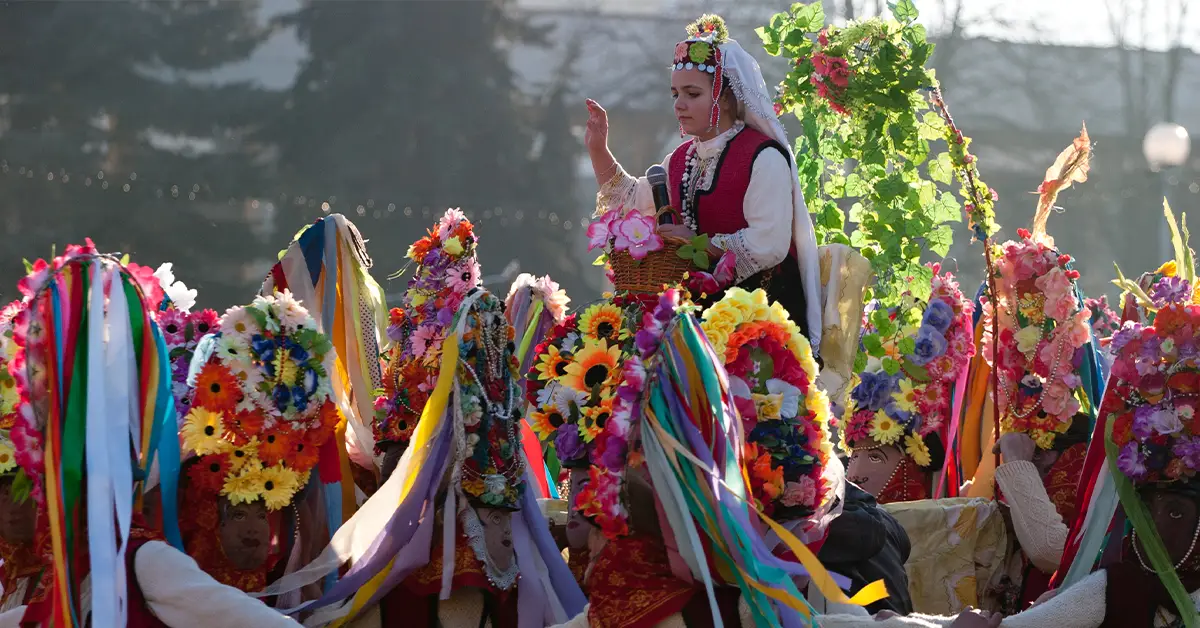
The Surva Festival (January) in Pernik is the largest kukeri masquerade festival in Southeastern Europe — recognised by UNESCO in 2015. Participants wear kukeri costumes (masks and sheepskins) and perform rituals to drive away evil spirits and welcome the new year. It is a direct legacy of ancient Thracian times — one of the oldest surviving traditions of Bulgarian culture.
Other major festivals: Trifon Zarezan (14 February — the wine festival), National Liberation Day (3 March — marking the 1878 liberation), the Day of Cyril and Methodius (24 May — the festival of writing and culture, a national holiday) and the Apollonia Festival in Sozopol (early September — an arts festival on the Black Sea coast). Every region also has its own local festivals — a rich cultural diversity.
Art, cinema and architecture
Bulgarian visual art has a strong tradition of Orthodox icon painting and church frescoes. The Tarnovo school (13th–14th centuries) was the high point of medieval Bulgarian art — the monastery and church frescoes of this period are recognised as UNESCO heritage. Vladimir Dimitrov “Maistora” (1882–1960) is a famous modern painter known for scenes of rural Bulgaria.
Christo Vladimirov Javacheff (1935–2020) — born in Gabrovo — is Bulgaria’s most internationally famous artist. With his wife Jeanne-Claude, he created large-scale artworks such as “The Gates” in New York’s Central Park, the “Wrapped Reichstag” in Berlin and “The Floating Piers” on Lake Iseo in Italy. Christo is a global icon of contemporary art with roots in Bulgarian culture.
Bulgarian cinema dates back to 1910. During the communist period of 1944–1989, the film industry was heavily state-funded and produced many well-known films. After 1989, the industry developed independently with directors such as Stephan Komandarev (the Oscar-shortlisted “The World is Big and Salvation Lurks Around the Corner”), Kamen Kalev and Maya Vitkova. The Sofia Film Festival is the most important film event in Southeastern Europe.
Bulgarian architecture reflects the interplay of many periods. Byzantine and medieval religious architecture includes the Boyana, Rila and Bachkovo churches and monasteries. 19th-century Bulgarian Revival architecture can be seen in the old towns of Plovdiv, Koprivshtitsa and Tryavna, with their traditional wooden houses. Communist architecture of 1944–1989 is typified by socialist realist buildings in Sofia. After 1989, contemporary Bulgarian architecture developed in many directions following international trends.
Social customs and traditions
Bulgarian culture has some distinctive customs foreigners should be aware of. The most unusual is the “Bulgarian head shake” — Bulgarians nod to mean “no” and shake their heads to mean “yes” — the opposite of most of the world. This is the source of many misunderstandings for newly arrived foreigners. Although the habit is fading among younger generations, it still pays to be careful when communicating.
Bulgarian family culture values solidarity and respect for elders — similar to Vietnamese culture. Shared meals are long, often starting with rakia alongside appetisers (mezze). Dinner with family or friends is an important social event. Bulgarians value sincerity and dislike insincere gestures — they are fairly direct in communication.
Bulgarian business culture is fairly formal. People shake hands when meeting and use surnames and titles (Mr/Mrs/Dr) at work. Building personal relationships is important before business negotiations. Bulgarians often invite partners home for dinner or out socially once a relationship has been established.
Bulgarian culture regards Eastern Orthodoxy as its cultural foundation, but society is fairly secular. Major religious holidays are celebrated: Christmas (25 December — by the Western calendar), Orthodox Easter (by the Julian calendar), St. George’s Day (6 May — a national holiday) and St. Nicholas Day (6 December). On these days many shops and offices close.
Bulgarian culture and the Vietnamese
For Vietnamese people consideringBulgaria residency by investment, there are some cultural similarities that make integration easier. Bulgarian and Vietnamese cultures both value family, respect for elders, education and hard work. Both cultures have rich culinary traditions with fresh produce and traditional cooking techniques.
Cultural differences to note: Bulgaria has an Eastern Orthodox tradition and a more direct communication style than Vietnam. Business culture in Bulgaria is more formal but also values personal relationships. The pace of life in Sofia is slower than in Vietnam’s big cities — well suited to people who prioritise work-life balance.
The Vietnamese community in Bulgaria is small (500–800 people) — living mainly in Sofia. It is a long-established community dating back to labour cooperation in the 1980s. The community is well integrated into Bulgarian society — keeping Vietnamese culture alive through Tết celebrations, festivals and community meals. For newly arrived Vietnamese, connecting with this community is a good way to understand Bulgarian culture faster.
Summary
Bulgarian culture is a unique combination of a 1,300-year heritage with 10 UNESCO sites, distinctive cuisine (yoghurt, roses, wine), internationally recognised folk music and a deep Eastern Orthodox tradition. It is a rich culture that is still relatively little known in Vietnam — offering newcomers plenty to discover.
For Vietnamese families considering settling, Bulgarian culture has many similarities with Vietnamese culture (family, education, cuisine) that make integration easier than in some less familiar Western European countries. Learning about Bulgarian culture before settling — through books, films and experiential trips — is key to the success of a long-term decision to settle in the country.
Accompanying you on your journey in residency investment
The Prosperous Living Investment team advises on pathways, assesses profiles and manages investments transparently for every residency, citizenship and international property objective.
Free profile assessmentWhere life gets prosperous