


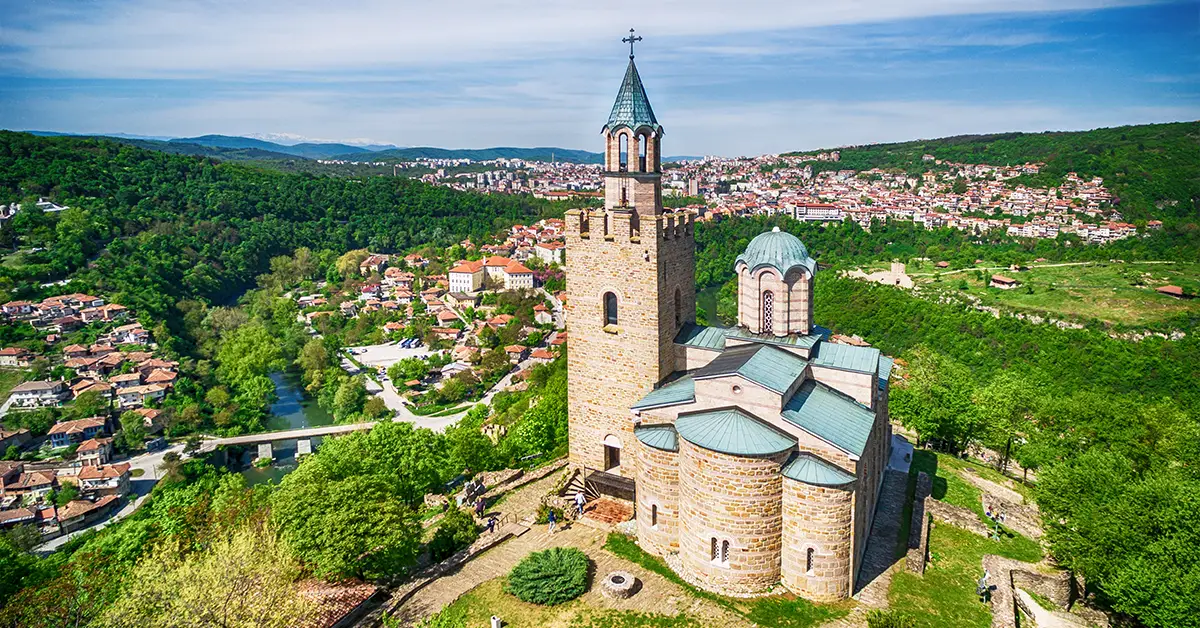
The history of Bulgaria spans more than 1,300 years — one of the earliest national histories in Europe to have kept its name and national identity to this day. The First Bulgarian Empire was founded in 681 by Khan Asparuh, laying the foundation for a Southeastern European Slavic state that went through dramatic ups and downs: two golden empires, five centuries of Ottoman rule, two world wars, nearly five decades of communism and, finally, reintegration into Europe, completed with eurozone membership from 01/01/2026.
For foreigners considering settling inBulgaria, understanding the country’s history is important for assessing its cultural character, social psychology and current political environment. This article analyses in detail the main historical periods: Thracian antiquity, the First Bulgarian Empire, the Second Bulgarian Empire, the Ottoman period, the National Revival, independence and the two world wars, the communist period and EU integration.
Message
Antiquity — the land of Thrace
The territory of present-day Bulgaria was known in antiquity as Thrace — the homeland of the Thracians, one of Europe’s earliest cultures and the first chapter of Bulgarian history. The Thracians settled in the Balkan Peninsula from the third millennium BC, leaving a rich legacy that includes famous gold treasures (Panagyurishte, Valchitran, Rogozen) and thousands of ancient tombs.
The region successively belonged to the great civilisations of the ancient world. The Greek empire under Alexander the Great conquered Thrace in the 4th century BC. The Roman Empire annexed Thrace into the province of Moesia in 46 AD — the legacy of this period includes the cities of Serdica (today’s Sofia), Philippopolis (Plovdiv) and Augusta Trajana (Stara Zagora). After the Roman Empire split in two, the region belonged to the Eastern Roman (Byzantine) Empire.
Slavs migrated into the Balkans in the 6th century AD and mixed with the native Thracians. In the 7th century, the Bulgars — a Turkic-Iranian people from the Eurasian steppe — crossed the Danube and conquered the Slavic tribes. The fusion of Bulgars and Slavs over the centuries created the modern Bulgarian people — a key turning point in Bulgarian history, combining the Bulgar legacy of state organisation with a Slavic cultural and linguistic foundation.
Considering a residency programme? The Prosperous Living Investment team assesses your profile free of charge and advises on the pathway that fits your goals.
The First Bulgarian Empire (681–1018)
The First Bulgarian Empire was founded in 681 by Khan Asparuh — an important event in the history of Bulgaria and 7th-century Europe. The Eastern Roman Empire was forced to recognise the new state through a peace treaty. It was the first Slavic state to be officially recognised by a major European empire.
The empire flourished under Khan Krum (803–814), who extended its territory to the Danube and the Adriatic. However, the most transformative event of early Bulgarian history came under Knyaz Boris I (852–889), when Bulgaria officially adopted Orthodox Christianity in 865. This decision shaped Bulgaria’s cultural and spiritual identity for the next 1,160 years.
The adoption of Christianity was also bound up with the creation of the Slavic alphabet. The brothers Cyril and Methodius created the Glagolitic alphabet, and their disciples then developed the Cyrillic alphabet in Preslav — the Bulgarian capital — in the late 9th century. Today the Cyrillic alphabet is used by nearly 250 million people worldwide and is the third official alphabet of the European Union after Latin and Greek.
The empire reached its height under Tsar Simeon the Great (893–927). Bulgarian territory stretched from the Black Sea to the Adriatic and from the Carpathians to the Aegean. Old Bulgarian literature flourished — this was the “Golden Age” of Bulgarian history and classical culture. However, after the death of Tsar Samuel in 1014 — after Byzantine Emperor Basil II “Bulgaroctonus” blinded 15,000 captured soldiers — the First Bulgarian Empire collapsed in 1018 and was annexed by Byzantium.
The Second Bulgarian Empire (1185–1396)
After 167 years of Byzantine rule, the noble brothers Petar and Asen led an uprising in 1185 that established the Second Bulgarian Empire — an important turning point in Bulgarian history. The capital was Veliko Tarnovo — a city still regarded today as Bulgaria’s “historic capital”.
The empire reached its height under Tsar Ivan Asen II (1218–1241). Its territory bordered three seas — the Black Sea, the Aegean and the Adriatic. Culture and the arts flourished, especially church architecture. The Tarnovo school of art and the frescoes of churches from this period are recognised as UNESCO heritage.
However, the empire weakened in the 14th century due to civil war and pressure from the rising Ottoman Empire. In 1396, after the siege of Vidin, Sultan Bayezid I completed the conquest — Bulgaria became the first European country to fall to the Ottomans and one of the last to be liberated. Five centuries of Ottoman rule began — one of the longest and most painful periods in Bulgarian history, shaping many aspects of society to this day.
The Ottoman period (1396–1878)
The five centuries of Ottoman rule were the most difficult period in Bulgarian history. According toCouncil of Ministers Bulgaria, foreign occupation destroyed all of Bulgaria’s administrative, legal, fiscal, military and cultural institutions. The Bulgarian nobility was almost wiped out. The Bulgarian Orthodox Church lost its autonomy and was placed under the rule of the Patriarchate of Constantinople.
However, Bulgarian culture and language were preserved in Orthodox monasteries — especially the Rila, Bachkovo and Troyan monasteries. Monks maintained literary traditions, copying scriptures and histories in Old Bulgarian. This was decisive for the survival of national identity through five centuries.
The Bulgarian National Revival began in the 18th century — its starting point is considered to be “Slavonic-Bulgarian History” by the monk Paisius of Hilendar, written in 1762. The work awakened national consciousness, reminding Bulgarians of the greatness of their past empires and calling on them to take pride in their language and culture. It marked the beginning of the national liberation process.
Education in Bulgarian grew strongly from 1835 with the first Lancasterian school in Gabrovo. In 1870,the Ottoman Sultan issued a decree establishing the Bulgarian Exarchate— an independent Bulgarian Orthodox Church — after two decades of struggle against Greek cultural domination. This was an important step in preparing for the political liberation struggle.
The April Uprising and the liberation of 1878
On 20/04/1876, the April Uprising broke out — a pivotal event in 19th-century Bulgarian history. The uprising was organised by the revolutionaries Vasil Levski, Hristo Botev and Lyuben Karavelov, although it was poorly prepared. The Ottoman army suppressed it brutally — using irregular bashi-bazouk troops — killing about 30,000 Bulgarians, including women and children.
News of the “Bulgarian Horrors” spread across Europe. William Ewart Gladstone in Britain, Victor Hugo in France, Fyodor Dostoevsky in Russia and many other intellectuals spoke out in protest. The strongest reaction came from Russia — a fellow Orthodox country of Slavic origin. In April 1877, Russia declared war on the Ottoman Empire.
The Russo-Turkish War of 1877–1878 ended with a decisive victory for Russia and Bulgarian volunteers (the Opalchentsi) at the Shipka Pass and Pleven. The Treaty of San Stefano of 03/03/1878 established an autonomous Bulgarian state including Moesia, Thrace and Macedonia — a momentous day in Bulgarian history. However, the European powers — especially Britain, Austria-Hungary and Germany — feared a large Slavic state under Russian influence.
The Treaty of Berlin of 13/07/1878 divided Bulgarian lands into three parts: the autonomous Principality of Bulgaria (limited to Moesia, with Sofia as its capital), Eastern Rumelia (an autonomous Ottoman province) and Macedonia, which returned to Ottoman rule. It was a great disappointment for Bulgarians but still an act of liberation — Bulgaria regained statehood after nearly 500 years. 03/03 is celebrated every year as National Liberation Day.
The Kingdom of Bulgaria and the two world wars (1878–1946)
The period 1878–1908 saw the formation of the modern state in Bulgarian history. The Tarnovo Constitution of 1879 — one of the most progressive democratic constitutions in Europe at the time — established a constitutional monarchy. Prince Alexander of Battenberg became the first monarch in 1879, followed by Ferdinand I from 1887.
In 1885, Eastern Rumelia united with Bulgaria through a bloodless coup in Plovdiv. On 22/09/1908, Prince Ferdinand declared Bulgaria’s full independence from the Ottoman Empire and proclaimed himself Tsar — an important milestone in Bulgarian history. Sofia grew rapidly from 20,000 people in 1878 to 120,000 in 1912 — a sixfold increase.
The two Balkan Wars of 1912–1913 are a sad chapter in Bulgarian history. In the first war, Bulgaria allied with Greece, Serbia and Montenegro against the Ottomans and took most of Macedonia. However, dissatisfied with the division of territory, Bulgaria attacked its former allies in the second war and lost much of the territory it had gained.
Bulgaria joined the First World War on the side of the Central Powers. The Treaty of Neuilly-sur-Seine in 1919 imposed harsh punitive terms — loss of territory, war reparations and limits on the army. In the Second World War, Bulgaria was an ally of Nazi Germany but did not take part directly in the fighting. A notable fact in Bulgarian history is that the plan to deport Bulgaria’s 48,000 Jews was not carried out because of strong opposition from politicians, clergy and citizens — an important humanitarian legacy.
The communist period (1946–1989)
On 09/09/1944, after the Soviet Union declared war and sent troops into Bulgaria, a pro-Soviet Fatherland Front government took power. After the referendum of 15/09/1946, Bulgaria became a People’s Republic — beginning an important 43-year period of Bulgarian history under communist rule by the Bulgarian Communist Party (BCP).
The first communist period (1946–1956) under Vasil Kolarov and Valko Chervenkov was marked by severe political repression — tens of thousands of people were convicted, imprisoned or executed. Industry and farmland were nationalised. Tens of thousands of farmers were forced to join cooperatives.
The rule of Todor Zhivkov (1954–1989) was the longest and most stable part of the communist period in Bulgarian history. Bulgaria industrialised strongly — especially in energy (the Kozloduy nuclear power plant was completed in 1974), mining and machinery. GDP per capita rose significantly thanks to Soviet aid and economic ties with COMECON. However, in the early 1980s, “assimilation” campaigns forced Bulgarian Muslims and ethnic Turks to adopt Slavic names — causing a mass exodus of 360,000 Turks to Turkey in 1989.
The fall of the Berlin Wall in November 1989 led to the rapid collapse of Bulgaria’s communist regime. Todor Zhivkov was ousted on 10/11/1989 — just one day after the fall of the Berlin Wall. The Communist Party renamed itself the Bulgarian Socialist Party. The first multi-party elections were held in June 1990. A new democratic constitution was adopted in 1991.
European integration (1990–2026)
The transition from communism to a free market was a difficult period in modern Bulgarian history. The economic crisis of 1996–1997, with inflation peaking at 311%, almost brought the economy to collapse. Bold reforms by the Union of Democratic Forces (UDF) government in 1997 — including a currency board pegging the lev to the German mark — stabilised the economy.
Bulgaria joined NATO on 29/03/2004, becoming part of the Western defence alliance after nearly 60 years in the Warsaw Pact. This was the most important geopolitical shift in Bulgarian history in the 21st century. As a result of far-reaching economic and legal reforms, Bulgaria joined the European Union on 01/01/2007 — the culmination of an 18-year transition.
Two recent events in Bulgarian history are important milestones. On 31/03/2024, Bulgaria partially joined the Schengen Area — with checks lifted only at air and sea borders. On 01/01/2025, Bulgaria joined Schengen in full — with no more land border checks with the EU. Finally, on 01/01/2026, Bulgaria joined the eurozone at a fixed rate of 1 EUR = 1.95583 BGN — completing its EU integration after 19 years.
The historical significance for modern Bulgaria
Bulgarian history has left three main legacies that deeply influence modern society. The first is cultural resilience — the ability to preserve language and national identity through five centuries of Ottoman rule. This is a great source of inspiration for modern Bulgarians and explains their emphasis on education, family and tradition.
The second legacy of Bulgarian history is a complex relationship with Russia. Although Bulgaria is a full member of the EU and NATO, emotional ties with Russia persist among part of the population because of Russia’s role in the 1878 liberation. This complicates modern Bulgarian politics, especially since the Ukraine crisis of 2022.
The third legacy is the aspiration for European integration. After nearly half a century cut off from Western European cultural and economic currents (1944–1989), the post-1989 generation of Bulgarians regards EU integration as a historic destination. Joining Schengen in 2025 and the eurozone in 2026 represents the completion of the “return to Europe” — an important chapter in Bulgarian history.
For Vietnamese investors consideringBulgaria residency by investment, understanding Bulgarian history helps to correctly assess the country’s political stability, business culture and social environment. Bulgaria has completed its most important transitions — it is now a full EU member with a strong commitment to the West.
Summary
The history of Bulgaria is a story of resilience, loss and rebirth — spanning 1,345 years from the First Bulgarian Empire in 681 to the eurozone in 2026. The country has been through two golden empires, five centuries of Ottoman occupation, two world wars and 43 years of communist rule — and has kept its own national identity and language.
Bulgaria’s accession to the eurozone in 2026 marks the completion of a long historical cycle. For foreigners considering settling or investing, understanding Bulgarian history is important for correctly assessing the cultural character, social psychology and political environment of their new country — a full member of the EU club with a rich 1,300-year heritage.
Accompanying you on your journey in residency investment
The Prosperous Living Investment team advises on pathways, assesses profiles and manages investments transparently for every residency, citizenship and international property objective.
Free profile assessmentWhere life gets prosperous