

Education in Bulgaria is one of the most comprehensive free public education systems in Eastern Europe. Since the communist era, Bulgaria has invested heavily in public education, resulting in a literacy rate of 98.6% — one of the highest in the European Union. After the reforms of 1990–2007, Bulgaria’s education system was modernised to EU standards and the Bologna Process, with qualifications recognised throughout the EU.
For foreign families settling inBulgaria, education is an important factor to assess carefully. This article analyses in detail the structure of the education system from preschool to university, international schools in Sofia, the public and private university system, tuition fees for international students, English-taught programmes and scholarship opportunities for Vietnamese students.
Message
Structure of Bulgaria’s education system
Bulgaria’s education system is governed by the Preschool and School Education Act, together with theHigher Education Act. The Bulgarian Ministry of Education and Science (МОН) is responsible for policy and quality oversight. The structure has four levels: preschool (ages 3–7, not compulsory but widespread), primary school (ages 7–11, grades 1–4), lower secondary school (ages 11–15, grades 5–8) and upper secondary school (ages 15–19, grades 9–12).
Education in Bulgaria is compulsory from age 5 to 16 — including the final year of preschool. Public schools are completely free for citizens and legal residents, including textbooks for grades 1–7. The 98.6% literacy rate is a direct result of free public education policy. Bulgarian education maintains a strong academic tradition in mathematics, the natural sciences and languages.
The main language of instruction is Bulgarian. A second language (usually English) is taught from grade 2. Some specialised language schools — such as the Anglo-American School of Sofia, the French School of Sofia and the German School of Sofia — teach in foreign languages. A 2–6 grading scale is used (6 = excellent, 5 = very good, 4 = good, 3 = satisfactory, 2 = fail).
Considering a residency programme? The Prosperous Living Investment team assesses your profile free of charge and advises on the pathway that fits your goals.
International schools for expat families
Sofia is the hub for international schools in Bulgarian education — serving most foreign families settling in Bulgaria. There are 4 large international schools with standard international curricula. The Anglo-American School of Sofia (AAS) is the largest international school, using the IB and American curricula, with fees of 16,000–18,000 EUR a year for grades 1–12. The school has modern facilities in the Lozenets district.
The American College of Sofia is a premium international boarding school — using an American curriculum, with fees of 13,000–17,000 EUR a year. Lycée Français Victor-Hugo Sofia is a French school with a full French curriculum — fees of 8,000–12,000 EUR a year. Deutsche Schule Sofia is a German school — fees of 6,000–9,000 EUR a year.
Plovdiv has fewer international schools — fees of 6,000–12,000 EUR a year. Varna has even more limited options — 6,000–10,000 EUR a year. For expat families who prioritise premium international education, Sofia is the only option that truly competes with other developed EU markets such as Germany or France.
Compared with international school costs in Western Europe (25,000–40,000 EUR a year in the UK, France and Germany), education in Bulgaria costs 50–60% less. For Vietnamese HNWI families going throughGolden Visa Bulgaria, this is an important financial factor — saving 100,000–200,000 EUR per child over 12 years of schooling.
The public university system
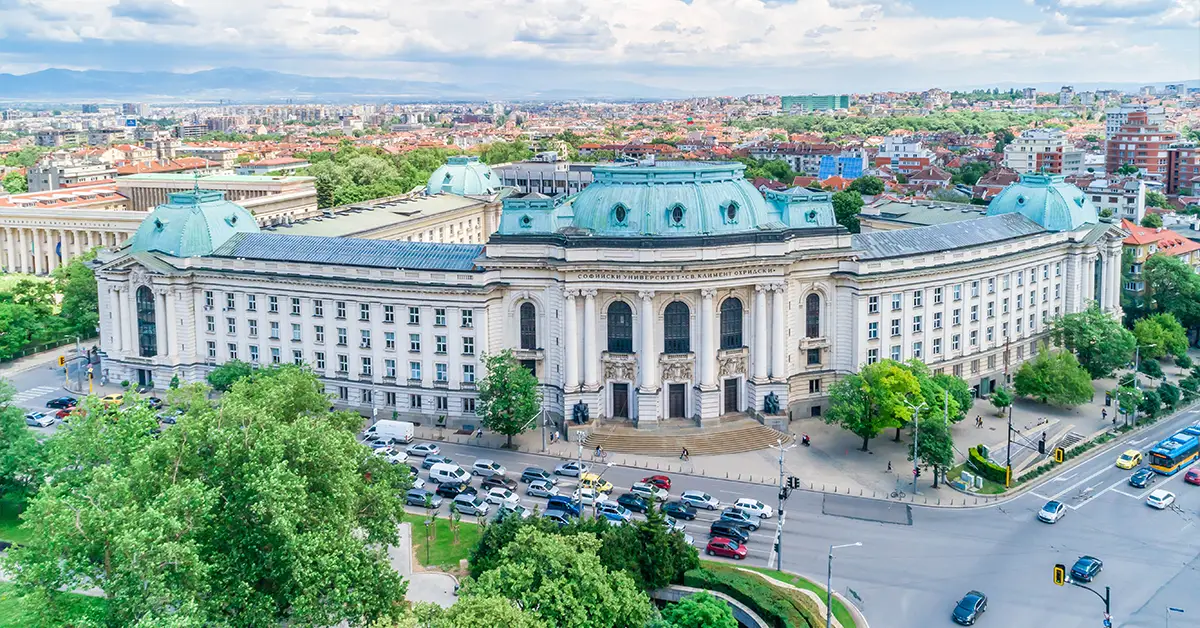
Bulgaria has 47public and private universitiesaccording to Ministry of Education data for 2026. Public universities are partly state-funded and have significantly lower fees than private ones. Sofia University “St. Kliment Ohridski” is the oldest and most prestigious — founded in 1888 and ranked 731–740 globally in the QS World University Rankings 2026.
Sofia University is the leading university in Bulgarian education, leading in the Arts, Humanities and Natural Sciences. Tuition for international students varies by programme: bachelor’s 3,000–6,000 EUR a year, master’s 3,500–7,000 EUR a year, medicine 7,700 EUR a year. International students may receive fee reductions under bilateral agreements — Vietnamese students in particular can apply through Vietnam’s Ministry of Education.
The Technical University of Sofia (TU Sofia) is the leading technical university — specialising in engineering, information technology and computer science. Tuition is 4,000–4,500 EUR a year for English-taught programmes. New Bulgarian University (NBU) is a private liberal arts university with modern facilities — tuition of 3,500–5,500 EUR a year.
The American University in Bulgaria (AUBG) in Blagoevgrad is one of the leading independent American universities in Eastern Europe — founded in 1991 with support from the Open Society Foundation. AUBG follows an American curriculum taught entirely in English, with tuition of 11,500 EUR a year. It is a top choice for international students who want a low-cost American degree.
Medical universities and INSAIT
Medical universities are a highlight of Bulgarian education for international students. Bulgaria has 6 major public medical schools: Medical University Sofia, Plovdiv, Varna, Pleven, Stara Zagora (Trakia University) and Sofia University. All offer English-taught programmes for international students — medicine 6 years, dentistry 5.5 years, pharmacy 5 years.
Tuition for English-taught medicine: Medical University Sofia 7,700 EUR a year, Plovdiv 9,000 EUR a year, Varna 10,000 EUR a year, Pleven 9,000 EUR a year, Trakia University 7,000 EUR a year. This is 50% cheaper than Western European medical schools (15,000–25,000 EUR a year). Entry requirements: a high school diploma, passing entrance exams in Biology and Chemistry, and proof of English (IELTS 6.0+ or equivalent).
Medical degrees from Bulgarian universities are recognised throughout the EU under the Professional Qualifications Directive 2005/36/EC. Graduates can practise in all 27 EU countries. The degrees are also listed in the World Directory of Medical Schools (WDOMS) and recognised by the GMC (UK), AMC (United States) and other international bodies.
INSAIT (Institute for Computer Science, Artificial Intelligence and Technology) is a new highlight of Bulgarian education — founded in Sofia in partnership with ETH Zurich and EPFL. In 2026, INSAIT brought Bulgaria to the top of Eastern Europe in high-impact AI research, competing with leading American and British universities. INSAIT specialises in PhD and master’s training in Machine Learning, Computer Vision and Cybersecurity.
Tuition and living costs for international students
Tuition at public universities in Bulgaria for international students varies considerably by field. According to Eurydice, standard fields (economics, engineering, IT, social sciences) cost 2,000–4,500 EUR a year. Medicine, pharmacy and dentistry cost 7,000–10,000 EUR a year — the highest, because of the cost of clinical training. Fine arts and theatre also have higher fees than core subjects.
For EU/EEA students, tuition is significantly lower — usually 300–1,500 EUR a year — thanks to EU agreements. Vietnamese students are treated as international students and pay the higher rates. However, Bulgaria has a bilateral agreement with Vietnam that provides a number of government scholarships — students can apply through Vietnam’s Ministry of Education.
Living costs for international students in Bulgaria are about 350–700 EUR a month in Sofia and 300–500 EUR a month in Plovdiv or Varna. A typical breakdown: rent 200–400 EUR (shared), food 150–250 EUR, transport 25 EUR a month, textbooks and other costs 50–150 EUR. The total annual cost of studying in Bulgaria is 4,500–10,000 EUR including tuition and living costs — the lowest in the EU.
Compared with other study-abroad markets, costs in Bulgaria are about 30–40% of those in Germany, 25–30% of the UK and 20–25% of the United States. This is why Bulgarian education attracts more and more international students — especially from India (5,000+ students), Turkey, Greece, Israel, Germany and African countries.
Scholarships and financial aid
International students in Bulgaria have many scholarship and financial aid opportunities. Sofia University offers annual scholarships to outstanding students after their first year. New Bulgarian University offers both merit-based and need-based financial aid. Medical University Sofia occasionally offers merit-based fee reductions or grants.
The Erasmus+ programme is a major opportunity for students already studying in the EU or at partner universities. Students can study in Bulgaria for a semester or a year, with tuition and living costs heavily subsidised. It is a popular way for international students to experience Bulgarian education without committing to a full programme.
For people of Bulgarian origin living abroad (the diaspora), there are arrangements for free or reduced-fee education in Bulgaria, even for non-EU nationals. This policy aims to attract the diaspora to return and naturalise under Article 15 of the Citizenship Act — an important mechanism for the descendants of Bulgarians living in the United States, Canada, Germany, Argentina and other countries.
The Open Society Foundation (Soros) and DAAD (for German citizens) fund study in Eastern Europe, including Bulgaria. Some other international institutions, such as the Vienna Diplomatic Academy and Central European University, also run partnership programmes with Bulgarian universities. Vietnamese students can learn about these opportunities through the Bulgarian Embassy in Hanoi.
Vocational and postgraduate education
Besides higher education, Bulgarian education has a well-developed vocational and postgraduate system. Vocational colleges (професионални колежи) offer 2–3 year programmes in engineering, services and agriculture. The system was restructured to EU standards after 2007 — programmes are recognised under the EQF (European Qualifications Framework).
Bulgarian higher education follows the Bologna Process with a three-cycle structure: bachelor’s (3–4 years), master’s (1–2 years) and doctorate (3–4 years). All programmes use the ECTS (European Credit Transfer System) — students can transfer credits to any EU university. Bulgarian bachelor’s and master’s degrees are fully recognised throughout the EU/EEA.
A doctorate in Bulgaria usually requires a three-year full-time programme. PhD tuition for international students is 2,500–5,000 EUR a year. Strong research centres include INSAIT (AI), the GATE Institute (computer science) and the Bulgarian Academy of Sciences (multidisciplinary). Postdoc opportunities in Bulgaria are expanding thanks to EU Horizon Europe funding.
Education in Bulgaria for investors’ children
For Vietnamese families consideringBulgaria residency by investment, their children’s education is an important factor. There are three main options. The first is a Bulgarian public school — free and of good quality, but taught in Bulgarian. It suits young children (ages 3–7) who pick up languages quickly, or families committed to long-term settlement who want their children to integrate deeply into Bulgarian society.
The second option is an international school in Sofia — fees of 6,000–18,000 EUR a year depending on the system. The IB or American curriculum at the Anglo-American School suits families aiming for US/UK universities. The French curriculum at Lycée Victor-Hugo suits those heading for French/Belgian universities. The German curriculum at Deutsche Schule suits those heading for German/Austrian/Swiss universities.
The third option is a Bulgarian bilingual private school — teaching in Bulgarian and English, at an average cost of 3,000–8,000 EUR a year. It is a balanced choice for families who want their children to integrate into Bulgaria while keeping up international English. Some good schools: Mecho-Pooh Bilingual School, St. George International School and AESI Sofia.
With 47 universities, EU-recognised qualifications and low costs, education in Bulgaria is worth considering for the children of investors planning long-term settlement. After graduating from a Bulgarian university, children can live and work freely throughout the EU without additional work permits — an important benefit of an EU degree.
Summary
Education in Bulgaria is a comprehensive free public system of good quality by EU standards and with the lowest costs in the region. The university system of 47 institutions — including Sofia University, ranked 731st globally, internationally recognised medical schools and the up-and-coming INSAIT in AI — offers international students a wide range of options. The combination of academic quality, low tuition and EU-recognised degrees creates a distinctive value proposition.
For Vietnamese families considering settling or studying in Bulgaria, there are three key recommendations. First, choose an international school in Sofia if premium international education is the priority. Second, choose a Bulgarian medical school if the goal is a medical degree at a competitive cost. Third, make use of INSAIT and IT programmes if aiming for a high-tech career. Planning education in Bulgaria early is key to a settling family’s success.
Accompanying you on your journey in residency investment
The Prosperous Living Investment team advises on pathways, assesses profiles and manages investments transparently for every residency, citizenship and international property objective.
Free profile assessmentWhere life gets prosperous