


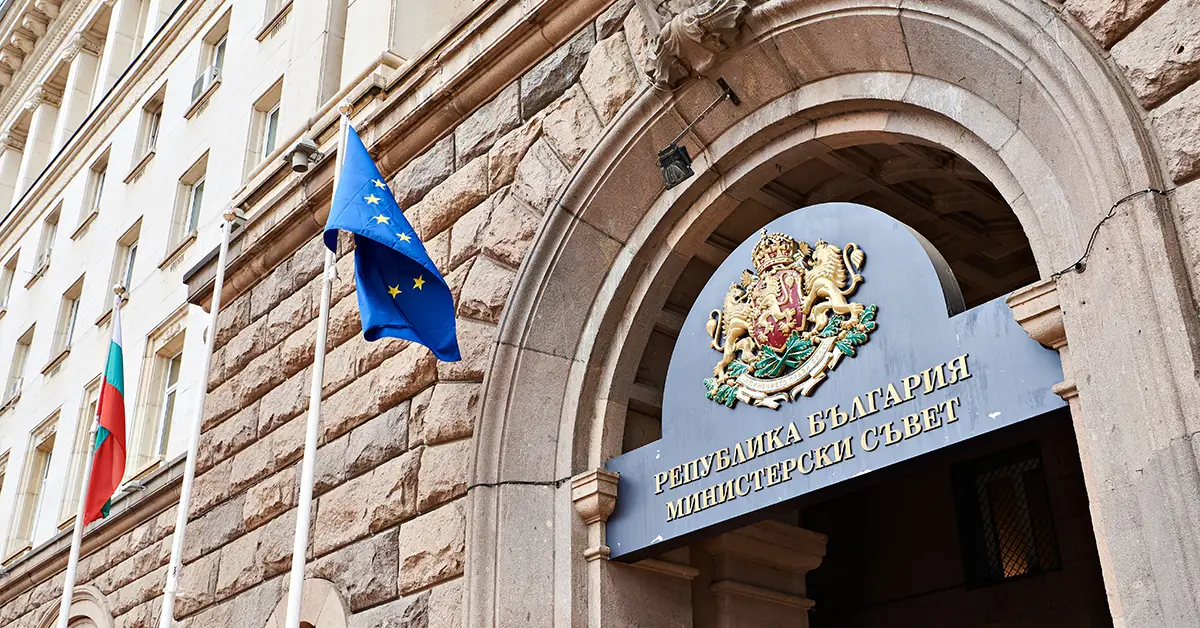
Bulgarian politics operates under the 1991 Constitution — which laid the foundation for a multi-party representative parliamentary republic with separation of powers between the legislature, the executive and the judiciary. Unlike the presidential systems of the United States or France, Bulgaria follows a parliamentary model similar to Germany and Italy — the Prime Minister is the head of government and holds real executive power, while the President mainly performs ceremonial and representative functions.
For foreigners considering settling inBulgaria, understanding the country’s political system is important for assessing the legal environment, political stability and investment risk. This article analyses in detail the 1991 constitutional framework, the three branches of power, the main parties, the electoral history of the past five years and the snap election of 19/04/2026.
Message
The 1991 constitutional framework
The Bulgarian Constitution was adopted by theGrand National Assemblyon 12/07/1991 — just 19 months after the fall of the communist regime. It was one of the most progressive democratic constitutions in Eastern Europe at the time, guaranteeing direct presidential elections, separation of powers, and freedom of speech, the press, conscience and religion.
The Constitution defines Bulgaria as a “state governed by the rule of law”, with sovereignty vested in the people. All laws and regulations are reviewed for constitutionality by theConstitutional Court of Bulgaria. International treaties ratified according to constitutional procedure become part of domestic law — an important factor for EU integration. This is the legal foundation of modern Bulgarian politics.
The Constitution has been amended several times — most recently in 2023, with important changes to the procedure for dissolving the National Assembly. Under the 2023 amendment, a dissolved National Assembly continues to function until the new Assembly is constituted — unlike the old rule under which MPs automatically lost their mandates when the Assembly was dissolved. This mechanism ensures legislative continuity during political crises.
Considering a residency programme? The Prosperous Living Investment team assesses your profile free of charge and advises on the pathway that fits your goals.
The three branches of power
Bulgaria’s political system clearly separates three branches of power along classic Montesquieu lines. The first branch is the legislature — the National Assembly (Народно събрание). It is a unicameral body of 240 MPs, directly elected by popular vote for a four-year term under a proportional representation system. The threshold for entering the Assembly is 4% of the national vote.
The second branch of Bulgarian politics is the executive — the Council of Ministers headed by the Prime Minister. The Council consists of the Prime Minister, the Deputy Prime Ministers and the Ministers. Under the Constitution, the Council of Ministers “directs and implements the domestic and foreign policy of the country.” The Prime Minister is elected by the National Assembly on the President’s nomination — a three-mandate procedure.
The third branch is an independent judiciary. The court system comprises the Supreme Court of Cassation, the Supreme Administrative Court, local courts, appellate courts and military courts. The 25-member Supreme Judicial Council appoints judges, prosecutors and investigators. The Constitutional Court of Bulgaria — independent of the ordinary judicial system — has 12 judges serving nine-year terms, appointed by the National Assembly (4), the President (4) and the supreme courts (4).
The role of the President
The President is Bulgaria’s head of state — and also commander-in-chief of the armed forces. Under the Constitution, the President “embodies the unity of the nation and represents the Republic of Bulgaria in international relations.” The main role within Bulgaria’s political system is to arbitrate between the different institutions — not to lead the executive.
The President is directly elected in a two-round system — for a five-year term, up to two terms. Eligibility: Bulgarian citizenship only (no other nationality), aged 40 or over, and residence in Bulgaria for the five years before the election. A second round is held if no one wins a majority in the first round or turnout is below 50%. A historical note: no candidate has ever won outright in the first round.
The President’s powers include: granting, restoring or revoking Bulgarian citizenship; pardoning prisoners and writing off uncollectable debts to the state; renaming villages, towns, cities and nationally important sites; representing Bulgaria in international relations; concluding treaties; appointing ambassadors. The President can veto laws, but the veto is weak — the National Assembly can override it by a simple majority.
When the National Assembly cannot elect a Prime Minister after three mandates, the President can appoint a caretaker government and call a snap election. This important power has been used 12 times since 1991. The incumbent President in 2026 is Iliana Iotova — she took office after former President Rumen Radev resigned in January 2026 to enter parliamentary politics.
The National Assembly — the legislature
The National Assembly of Bulgaria (Народно събрание) is a unicameral legislature of 240 MPs. It is the body with the most real power in Bulgaria’s political system — it elects the government, passes and amends laws, ratifies international treaties, levies taxes and can pass votes of no confidence in the Council of Ministers or the Prime Minister.
Parliamentary elections are held under proportional representation in multi-member constituencies. Bulgaria has 31 constituencies, with seat numbers varying by population. Parties must win at least 4% of the national vote to enter the Assembly. Eligibility to stand as an MP: Bulgarian citizens aged 21 or over, not placed under legal incapacity and not serving a prison sentence.
Since the 2023 constitutional reform, Bulgarian citizens with dual nationality must have resided in Bulgaria for the 18 months before election day to be eligible to stand as MPs — this rule does not apply to citizens holding only Bulgarian nationality. This is important for Bulgarian citizens of Vietnamese origin considering entering Bulgarian politics.
The Grand National Assembly is a special body convened only for major matters: adopting a new Constitution, amending key provisions (such as citizens’ fundamental rights) and changing the territory. Seven Grand National Assemblies have been convened in Bulgarian history — the most recent, from 10/07/1990 to 12/07/1991, adopted the current Constitution.
The multi-party system
Bulgarian politics has had a multi-party system since 1990 — ending 45 years of communist one-party rule. In 1990–2009 the system was characterised by alternation between the Bulgarian Socialist Party (BSP, successor to the Communist Party) and the Union of Democratic Forces (UDF, the opposition). After 2009, Bulgaria’s political system entered a new phase with the rise of personality-based parties.
GERB (Citizens for European Development of Bulgaria) was the most important party of 2009–2024 — founded in 2006 by former Sofia mayor Boyko Borisov. The party is centre-right, pro-EU, pro-NATO and pro-free market. GERB won many elections from 2009 to 2024 but had to share power because of the proportional electoral system.
We Continue the Change — Democratic Bulgaria (PP–DB) is a liberal centre-right alliance founded in 2021 by former Prime Minister Kiril Petkov and Asen Vasilev. The alliance rose on an anti-corruption and reform agenda. The Bulgarian Socialist Party (BSP) retains its traditional political base but has declined significantly — to below 5% in 2026 polls.
The Movement for Rights and Freedoms (DPS) is the party representing Bulgaria’s Turkish community (8% of the population). For decades it has had a stable voter base of about 7–8% of the total vote. In 2024, DPS split into the original DPS and the Alliance for Rights and Freedoms (APS) because of an internal dispute between two factions.
Vazrazhdane (Revival) is a far-right, pro-Russian, strongly anti-EU party — it has risen since 2021 with growing support. Velichie is another new right-wing party. The rise of far-right parties is a hallmark of Bulgarian politics in the second half of the 2020s.
The 2021–2026 political crisis
The period 2021–2026 was the longest crisis in modern Bulgarian political history, with 8 parliamentary elections — almost one a year. The crisis began in April 2021 when GERB lost its majority after nearly 12 years in power. The rise of anti-corruption parties (We Continue the Change, Democratic Bulgaria) complicated the formation of coalition governments.
The October 2024 election produced a minority government led by Prime Minister Rosen Zhelyazkov (GERB), made up of GERB-SDS, BSP-OL and There is Such a People (ITN), with APS support in confidence votes. However, after a Constitutional Court ruling in March 2025 allowed the far-right Velichie into the National Assembly, the coalition was left with exactly 121 seats — the minimum needed to govern — against 119 opposition seats in Bulgarian politics.
The Zhelyazkov government resigned on 11/12/2025 after large-scale anti-corruption protests. President Rumen Radev — long regarded as a pro-Russian figure in Bulgarian politics — resigned in January 2026 to enter parliamentary politics, founding the populist centre-left alliance Progressive Bulgaria (PB) on a platform of “dismantling the oligarchic system.”
On 18/02/2026, the new President Iliana Iotova appointed a caretaker government led by Prime Minister Andrey Gyurov (a former member of We Continue the Change who left the alliance in 2023) and set the parliamentary election for 19/04/2026. The Gyurov government asked the EU for help countering Russian interference before the election — warning that foreign actors were trying to manipulate public opinion through social media.
The parliamentary election of 19/04/2026
The parliamentary election of 19/04/2026 was the 8th snap election of Bulgaria’s five-year political crisis — the biggest recent event. There were 4,786 candidates competing for 240 seats, 3,347 men and 1,439 women. The total number of eligible voters was 6,641,768, according to preliminary data from the Central Election Commission (CEC).
The campaign was overshadowed by a crackdown on vote-buying — electoral law violations rose 500–600% compared with the same period before the October 2024 election. By 14/04, more than €1 million had been seized in police operations against vote-buying. The main campaign issues were political corruption, the cost of living, foreign election interference and allegations of vote-buying.
Rumen Radev’s Progressive Bulgaria (PB) alliance won a landslide victory. According to preliminary data with 60% of ballots counted, PB won about 45% and at least 132 seats — an absolute majority in the 240-seat National Assembly. Five parties entered parliament: PB with 131 seats, GERB with 39 seats, PP/DB, DPS and Vazrazhdane. Radev is regarded as Prime Minister-designate — a more powerful position than the presidency he once held.
Administrative divisions
Bulgaria’s territory is divided into 28 provinces (oblasts), each headed by a governor appointed by the government. Sofia is a special city-province that is both a province and the capital city. The provinces are further divided into municipalities (obshtina) — 265 municipalities in total nationwide.
Municipalities enjoy considerable autonomy under the principles of the European Charter of Local Self-Government. Each municipality has an elected Municipal Council (four-year term) and a directly elected Mayor. The mayor of Sofia is the third most powerful position in Bulgarian politics after the Prime Minister and the President — several Sofia mayors have become Prime Minister (Boyko Borisov, Yordanka Fandakova).
Provinces have no elected government of their own — governors appointed by the government represent the central government in each province. This differs from federal systems such as Germany or Spain. Bulgaria is a unitary state with limited decentralisation to local level within Bulgaria’s political structure.
Assessing the political environment
For Vietnamese investors consideringBulgaria residency by investment, assessing Bulgaria’s political environment is important. Bulgaria has three positives: stable EU and NATO membership; an independent and strong constitutional court; and anti-corruption reforms progressing under EU pressure.
Points to note include: low- and mid-level corruption persists; the complexity of the party system leads to unstable coalition governments; and there is a risk of Russian interference, especially through disinformation on social media. However, these issues do not affect the stability of property rights, contracts and investments — the most important factors for real estate investors and businesses, for whom involvement in Bulgarian politics is not the goal.
Full Schengen membership from 2025 and eurozone membership from 01/01/2026 reinforce Bulgaria’s Western commitment — regardless of any particular election result. Deep EU integration creates firm legal constraints in favour of democratic reform and the rule of law. This is the most important long-term stabilising factor in Bulgarian politics, above short-term electoral cycles.
Summary
After 35 years of democracy, Bulgarian politics has been through many ups and downs — from a stable two-party period and the rise of personality-based parties to the crisis of the last five years with 8 parliamentary elections. The 1991 Constitution, with its parliamentary system, three separate branches of power and an independent constitutional court, has provided a solid legal foundation for weathering Bulgaria’s political crises.
For Vietnamese investors considering settling or investing in Bulgaria, system-level legal stability matters more than short-term government stability. Bulgaria is fully integrated into the EU and NATO — taking part in all EU democracy and rule-of-law monitoring mechanisms, which ensures an investment environment as safe as that of other developed EU countries. Bulgaria’s 2021–2026 political crisis is a problem of governments — not of institutions.
Accompanying you on your journey in residency investment
The Prosperous Living Investment team advises on pathways, assesses profiles and manages investments transparently for every residency, citizenship and international property objective.
Free profile assessmentWhere life gets prosperous