


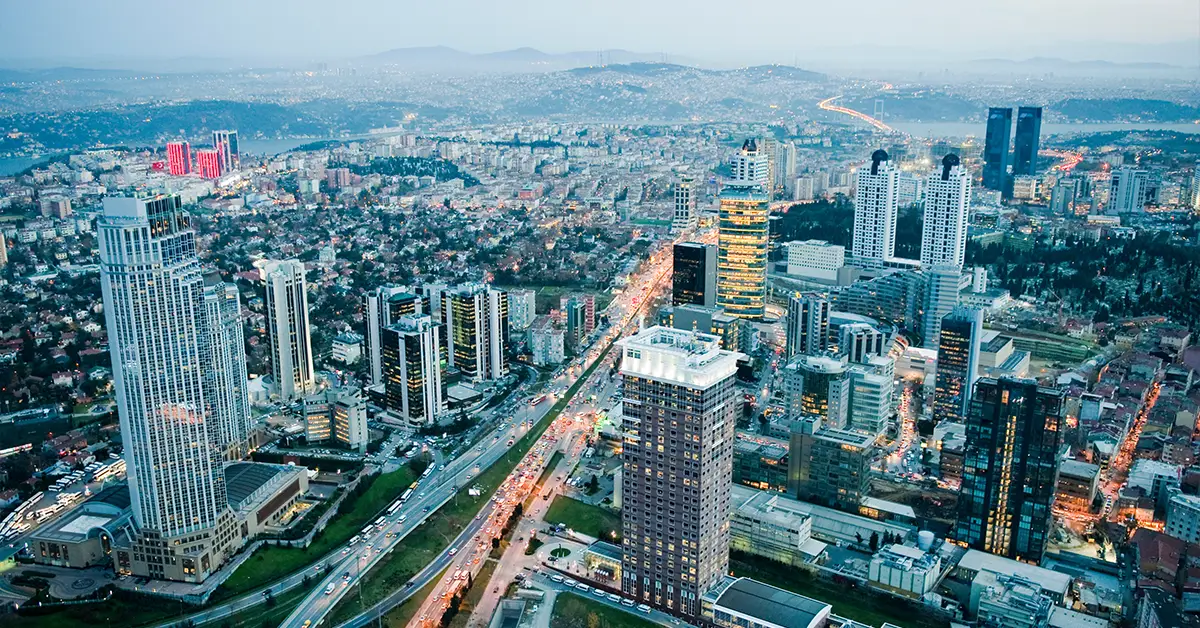
Turkey’s economy is one of the largest emerging economies in the world, ranking 16th globally by nominal GDP. With its position bridging Europe and Asia, this economy has a diverse structure combining modern manufacturing, large-scale agriculture and a strongly developed service sector. After years of upheaval from high inflation and a falling lira, the country is entering a period of macroeconomic stabilisation with growth of 3 to 4% a year.
A detailed article onthe country of Turkey.
Message
An overview of scale and GDP growth
According to the International Monetary Fund, the nominal GDP ofTurkeyreached around USD 1,565 billion in 2,025, up USD 207 billion on the figure of USD 1,358 billion in 2,024. This is a significant leap, marking the first time the country formally joined the club of trillion-dollar economies in 2,023.
This scale accounts for around 1.34% of global GDP, the highest in its history. The lowest figure ever recorded was 0.47% in 1,988, showing a powerful rise over more than three decades. GDP per capita reached around USD 15,398 in 2,024, considerably above the global average of USD 10,589.
Theo World Bank, real GDP growth reached 4.5% in 2,023 and eased slightly to 3.2% in 2,024. Growth in 2,025 is forecast to remain at 3.1 to 3.5%, rising to 3.7% in 2,026. Average growth over the past decade has been 5.3%, far above comparable emerging economies.
Since 2,020, the country has overtaken four developed economies in nominal GDP: Switzerland in 2,021, the Netherlands in 2,023, Saudi Arabia in 2,024, and Indonesia in 2,025. This trajectory reflects resilient manufacturing and export strength despite macroeconomic shocks.
Considering a residency programme? The Prosperous Living Investment team assesses your profile free of charge and advises on the pathway that fits your goals.
The sectoral structure of Turkey’s economy
The country’s economy has a diverse structure with three main sectors: services, industry and agriculture. On 2,022 figures, services accounted for 54% of GDP, manufacturing 19.4%, other industrial activity 20.4%, and agriculture 6.2%.
On the labour force, services employ 58% of workers, industry 27%, and agriculture around 15%. The higher-than-average share of agricultural labour compared with developed economies reflects the important role of rural areas in the social structure.
On the expenditure side, private consumption accounted for 59.4% of GDP in 2,023, government consumption 13.6%, fixed investment 29.4%, and net exports minus 2.4%. This structure shows an economy relying mainly on domestic demand, while the trade deficit remains a persistent problem.
As at November 2,023, the country had 1,086,670 formally registered businesses. Manufacturing led with 241,362 companies, followed by wholesale trade with 197,476 and services with 187,325. This wealth of businesses reflects the dynamism of the private sector.
Industry and manufacturing
Industry is the backbone of the economy, accounting for around 31 to 32% of GDP and the main source of exports. Manufacturing contributed 94.1% of total goods export earnings in 2,024, showing industry’s dominant role in global integration.
The motor industry leads, with Ford, Renault, Toyota, Fiat and Hyundai plants operating in the country. It is one of Europe’s largest car manufacturing centres, with annual output exceeding 1.3 million vehicles. Commercial vehicles and SUVs are mainly exported to EU countries.
Textiles are the second spearhead, placing the country among the world’s largest clothing and textile exporters. Vestel is Europe’s largest television manufacturer, accounting for around 25% of all televisions made on the continent in 2,006. Together with Beko, these two brands once accounted for more than half of all European television output.
Other important sectors include iron and steel, chemicals, electronics, electrical equipment, plastics, processed food, construction materials and defence. The defence industry has made a particular mark with the Bayraktar drone and the Altay tank, reaching export earnings of more than USD 5 billion in 2,023.
Industrial output grew 7% year on year in December 2024, the strongest increase since February 2024 when output rose 11%. This recovery shows manufacturing’s resilience despite macroeconomic challenges.
Agriculture and natural resources
Agriculture retains an important role, placing the country among the world’s 10 largest agricultural producers. Around 50% of the land area is used for agriculture, employing around 15% of the labour force although contributing only around 6% of GDP.
The main products are wheat, sugar beet, milk, poultry, cotton, vegetables and fruit. The country is the world’s number 1 producer of hazelnuts, apricots and oregano — three commodities in which it dominates global export market share. Output in 2,024 reached 75.5 million tonnes of cereals and other crops, 33.6 million tonnes of vegetables, and 28 million tonnes of fruit, beverages and spices.
The tea industry in the Black Sea region, particularly Rize, supplies most domestic tea consumption under the famous Çay brand. Olive oil from the Aegean and Mediterranean regions places the country among the world’s top 5 producers. Almost all the seed used in agriculture is produced domestically.
On mineral resources, the country holds the world’s largest borate reserves, around 73% of the global total. Other important minerals are coal, iron ore, copper, chromium, marble and gold. The renewable energy sector is growing strongly, with hydroelectricity accounting for around 20% of total electricity output.
Services and tourism
Services are the largest contributor to GDP with a share of 54 to 58%, including finance, tourism, retail, health,education, property and information technology. This sector employs 58% of the labour force, making it the main driver of job growth.
Tourism is the star of the service sector, contributing around 12% of GDP and 10.2% of total employment. Tourism revenue reached a record in 2,024 with growth of 8.3% on the previous year. Istanbul, Antalya, Bodrum and Cappadocia are the leading destinations attracting international visitors.
Medical tourism is a fast-growing segment, with millions of international patients coming to the country each year for hair transplants, cosmetic surgery, dentistry and IVF. Costs 50 to 70% below Europe and North America together with high service quality have created a particular competitive advantage.
The financial sector centred in Istanbul plays an important role, with major banks such as Ziraat, Garanti BBVA, Akbank and İşbank. The Istanbul Financial Center, opened in 2,023, has the ambition of becoming a regional financial centre competing with Dubai and Singapore.
Information technology and e-commerce have boomed. Trendyol — the leading e-commerce platform — is valued at more than USD 10 billion and has expanded into many international markets. Getir was once a global technology unicorn before restructuring in 2,024.
International trade and foreign investment
Export earnings in 2,024 reached USD 261.855 billion, up 2.4% on the previous year. Imports fell 5% to USD 344.020 billion, showing the trade deficit narrowing. The negative trade balance is equivalent to 2.4% of GDP — a stable level compared with previous years.
The largest export partner is the European Union (EU), accounting for around 41% of total earnings, thanks to the Customs Union Agreement signed in 1,995. Germany, the United Kingdom, Italy, the United States, Iraq, Spain and France are key markets. Manufactured goods account for 73.3% of exports, food 12%, mineral fuels 6.4%, and metal ores 4.4%.
On imports, manufactured goods account for 57.6%, mineral fuels 8.3%, metal ores 6.6%, food 6.5% and agricultural raw materials 1.8%. Dependence on imported energy is a structural weakness, with more than 70% of oil and gas consumed having to be imported.
Foreign direct investment (FDI) has been around USD 10 to 12 billion a year over 2,021-2,024. The major investors come from the EU, the United Kingdom, Saudi Arabia, the UAE and the United States. Property, finance, energy, manufacturing and technology attract the main FDI flows.
TheTurkey citizenship by investmentprogramme, launched in 2,017, has attracted billions of dollars into the property market. With a minimum investment of USD 400,000, it is one of the world’s lowest-threshold CBI programmes, providing a passport with visa-free access to more than 110 countries.
Currency, inflation and monetary policy
The Turkish lira (TRY) has been the economy’s most prominent problem over the past decade. From around TRY 3.5 to USD 1 in 2,016, the lira has fallen continuously, to around TRY 34-35 to USD 1 by the end of 2,025. This depreciation is bound up with the controversial low interest rate policy of 2,021-2,023.
Inflation peaked at 85% in October 2022 — the highest in more than two decades. After the presidential election of May 2023, a new economic team launched a macroeconomic normalisation policy, raising the policy rate sharply to 50% to curb inflation.
Theo International Monetary Fund, inflation is forecast to fall to 34.9% in 2,025 and 24.7% in 2,026. The Central Bank of Türkiye aims to bring inflation below 10% by the end of 2,027. This is a difficult process but one heading in the right direction.
Foreign exchange reserves have risen sharply again after a period of depletion, reaching around USD 170 billion at the end of 2,025. The sovereign credit rating has been upgraded several times by S&P, Moody’s and Fitch over the past two years, reflecting returning international investor confidence.
Challenges and prospects for Turkey’s economy
The economy faces many structural challenges to be addressed in the medium and long term. Persistent inflation, slow productivity growth and declining FDI flows are the three biggest obstacles to sustainable growth. The current account deficit is expected to widen to 1.2% of GDP in 2,025 and 2% in 2,027.
Reconstruction costs after the Kahramanmaraş earthquake of February 2023 are estimated at more than USD 100 billion, putting pressure on the budget. However, the government budget deficit is forecast to fall from 4.3% of GDP in 2,025 to 3.6% in 2,026 as emergency costs gradually decline.
Unemployment has remained at 8 to 8.3%, fairly low for an emerging economy. However, underemployment and discouraged workers reached 29.6% in July 2025, showing the labour market has yet to realise its full potential.
The long-term outlook remains positive thanks to structural advantages: a strategic geographical position, a young population with a median age of 33, a skilled workforce, modern transport infrastructure and diverse manufacturing. The “Turkish Century” vision sets the goal of putting the country in the world’s top 10 economies.
10.9% of the population was below the poverty line on the USD 8.3 a day PPP standard in 2,022, sharply down from 12.9% in 2,021. Poverty reduction is expected to continue over 2,025-2,027 where the reform policies are fully implemented.
Standing in the region and the world
Turkey’s economy plays a key role in the Middle East, the Balkans and the Caucasus. As a member of the G20 and NATO, the country takes an active part in global economic and political forums. Membership of the Organisation for Economic Co-operation and Development (OECD) since 1,961 also confirms its standing as an upper-middle developed economy.
Its energy transit role is a strategic advantage. The Baku-Tbilisi-Ceyhan oil pipeline and the TANAP and TurkStream gas pipelines carry energy from the Caucasus, Russia and Central Asia to Europe. This role brings significant transit fees and geopolitical influence.
On international integration, the country applied to join the European Union in 1,987 and has been a formal candidate since 1,999, although the negotiation process has slowed considerably. The Customs Union Agreement with the EU remains the most important trade foundation.
Bilateral free trade agreements with the United Kingdom, South Korea, Singapore, Malaysia, Chile, Ukraine and many other countries widen export markets. The country is also a member of the Black Sea Economic Cooperation (BSEC) and the Organization of Turkic States (OTS) — the bloc of Turkic-speaking countries.
Conclusion
Turkey’s economy is a large emerging economy with GDP of USD 1,565 billion in 2,025, ranking 16th in the world. Its diverse structure with strong manufacturing, large-scale agriculture and well-developed services and tourism is the foundation for the resilience it has demonstrated over many decades. Although it faces the challenges of high inflation and a falling currency, the macroeconomic normalisation policies since 2,023 are producing positive results.
With its distinctive geographical position, young population and modern infrastructure, the medium and long-term outlook remains bright. For Vietnamese investors interested in opportunities in this country, a deep understanding of its economic structure and drivers is essential to making the right investment decision.
Accompanying you on your journey in residency investment
The Prosperous Living Investment team advises on pathways, assesses profiles and manages investments transparently for every residency, citizenship and international property objective.
Free profile assessmentWhere life gets prosperous