

Turkey’s politics is a multi-party presidential republic, operating on the principle of separation of powers between the legislature, executive and judiciary. Since the referendum of 2,017 and the formal transition in 2,018, the country has abandoned the traditional parliamentary model for a presidential model with highly concentrated executive power. It is one of the most important structural changes in the history of the republic since 1,923.
A detailed article onthe country of Turkey.
Message
Turkey’s current political system
Under the Constitution as amended in 2,017,Turkeyis a unitary state under a representative presidential republic and multi-party democracy. State power is divided into three branches: the legislature held by Parliament, the executive headed by the President, and an independent judiciary.
Unlike the previous parliamentary model, the President is now both head of state and head of government. The office of Prime Minister has been abolished entirely, and the President has taken over all its former powers. This is a landmark change in the country’s architecture of power.
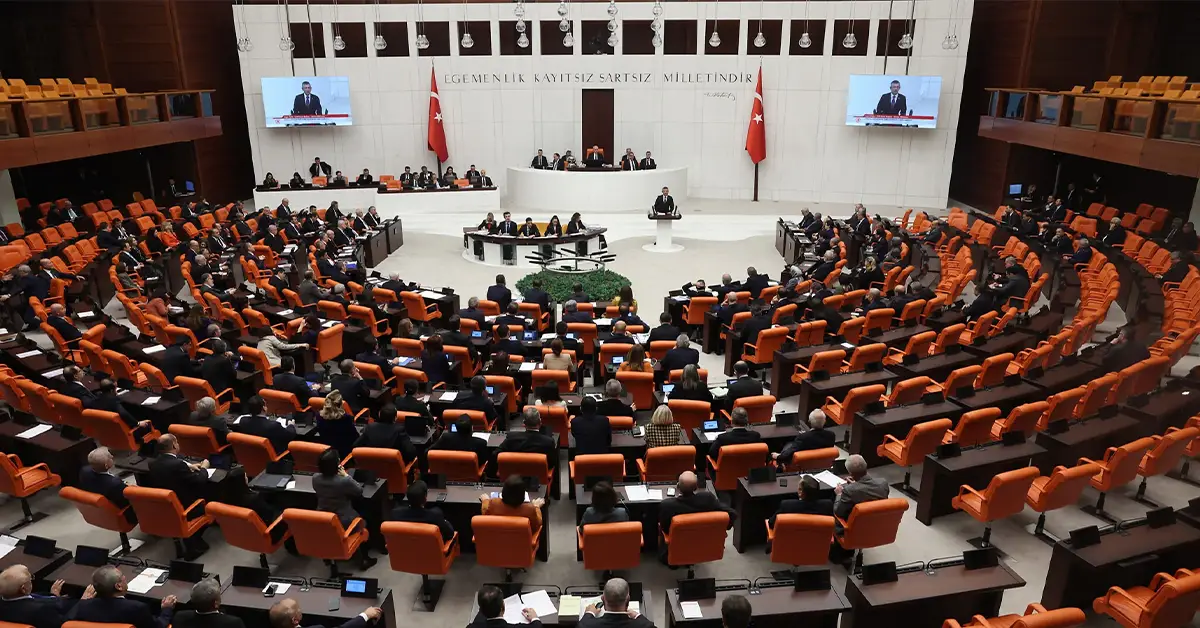
The founding principle of the system is that sovereignty belongs to the people, recorded in the traditional slogan “Sovereignty belongs unconditionally to the Nation” (Egemenlik Kayıtsız Şartsız Milletindir). This principle was set out by Mustafa Kemal Atatürk in 1,920 and still hangs above the speaker’s rostrum in Parliament today.
Secularism (laiklik) is another constitutional principle, separating religion from the state. Even so, the role of religion in political life has in practice increased considerably since the AKP came to power in 2,002, generating much debate about the direction of the system.
Considering a residency programme? The Prosperous Living Investment team assesses your profile free of charge and advises on the pathway that fits your goals.
The constitution and the history of the system
The current Constitution was originally adopted in 1,982 after the military coup of 1,980, replacing the Constitution of 1,961 and that of 1,924. It has undergone many major amendments, the most notable being the reforms of 2,001, 2,007, 2,010 and 2,017.
The 1,924 Constitution was drafted by Mustafa Kemal and the Republican People’s Party (CHP) immediately after the Republic was founded. It was influenced by French thinking, giving most power to Parliament on a majoritarian model. Interestingly, although Mustafa Kemal held supreme standing in the new system, he delegated most executive authority to Prime Minister İsmet İnönü, keeping the presidency largely symbolic.
The 1,961 Constitution came after the coup of 1,960 that overthrew Prime Minister Adnan Menderes. It established a pluralist system with broader civil liberties. However, the 1,982 Constitution restricted many of these freedoms to strengthen political stability from the military’s point of view.
The referendum of 16/04/2017 approved 18 important amendments with 51.4% support. The package abolished the office of Prime Minister, gave executive power to the President, increased the number of parliamentary seats from 550 to 600, and allowed the President to serve up to 3 five-year terms in certain special circumstances. The new system formally came into operation on 09/07/2018.
The President and the executive structure
The President is the most powerful office in Turkey’s modern political system. Directly elected by the whole people since 2,014, the President serves a 5-year term and may be re-elected once. Where Parliament calls an early election during a second term, the President may stand for a third term.
Recep Tayyip Erdoğan has been the incumbent President since August 2014. He won the direct elections of 2,014, 2,018 and 2,023. In the second round on 28/05/2023, Erdoğan won 52.18% of the vote, defeating the opposition candidate Kemal Kılıçdaroğlu. He was sworn in for his third term on 03/06/2023.
The President has very broad powers including appointing and dismissing ministers and senior state officials, setting the national budget, signing presidential decrees with the force of law, declaring a state of emergency, and dissolving Parliament. The President also appoints half the members of the Council of Judges and Prosecutors, and 12 of the 15 members of the Constitutional Court.
The executive structure comprises the Presidency and 16 functional ministries. Ministers are appointed directly by the President and are answerable to the President rather than to Parliament. This creates flexibility in governing but also sharply reduces the legislature’s mechanisms for controlling the executive.
The TBMM Parliament and the legislative branch
The Parliament of Turkey, officially the Türkiye Büyük Millet Meclisi (TBMM) or Grand National Assembly, is a unicameral legislature. According toGrand National Assembly of Türkiye, since the 2,017 reform Parliament has had 600 members directly elected from 81 provinces and 87 constituencies.
Members serve 5-year terms coinciding with the presidential term. Citizens aged 18 and over have the right to vote and stand for election. Universal suffrage has applied to both sexes since 1,934 — earlier than in many European countries.
The electoral threshold is an important feature of the system. From 1,983 to 2,022, a very high nationwide threshold of 10% excluded many small parties from Parliament. Since 2,022, this threshold has been lowered to 7% on the initiative of the AKP-MHP coalition, giving medium-sized parties the chance of representation in the legislature.
Parliament’s powers include enacting, amending and repealing legislation; scrutinising the executive through parliamentary questions and inquiries; approving the state budget; declaring war; ratifying international treaties; granting amnesties and deciding other matters under the Constitution. However, under the new presidential system, Parliament no longer has the power to hold a confidence vote in the government as it did under the parliamentary system.
The Parliament building is in Ankara, opened in 1,961 and designed by the Austrian architect Clemens Holzmeister. The flag and coat of arms are always present in the chamber, together with the founding slogan of the late President Atatürk.
The major political parties
Turkey’s political system currently has more than 100 registered parties, of which around 10 have significant national influence. The two largest parties dominating the landscape are the Justice and Development Party (AKP) and the Republican People’s Party (CHP).
The Justice and Development Party (Adalet ve Kalkınma Partisi, abbreviated AKP) was founded in 2,001 by Recep Tayyip Erdoğan and colleagues. The AKP has governed continuously since 2,002, on a moderate conservative-Islamic orientation combined with a market economy. The AKP is currently the largest party in Parliament with 273 seats after the 2,023 election.
The Republican People’s Party (Cumhuriyet Halk Partisi, abbreviated CHP) is the oldest party, founded by Mustafa Kemal Atatürk in 1,923. The CHP follows a social democratic, secular and Kemalist line. It won 169 parliamentary seats in 2,023 and unexpectedly won big at the local elections of 31/03/2024 with 37.76% of the vote, overtaking the AKP for the first time since 1,977.
The other important parties are the Nationalist Movement Party (MHP) — the AKP’s main ally, on a nationalist conservative line with 50 seats; the Peoples’ Equality and Democracy Party (DEM Party) — the successor to the HDP, representing Kurdish voters with 57 seats; the Good Party (İYİ Party) on a secular nationalist centre-right line with 43 seats; and the New Welfare Party (YRP) on a conservative Islamic line, which rose strongly in 2,024.
The governing coalition, the People’s Alliance (Cumhur İttifakı), comprises the AKP, MHP and several small parties. The main opposition bloc is the Nation Alliance (Millet İttifakı) led by the CHP, although this alliance broke up after the defeat at the 2,023 presidential election.
The electoral system and recent events
Turkey holds several different types of election: direct presidential elections, proportional parliamentary elections, and local elections for mayors and councils. The Supreme Electoral Council (YSK) is the independent body overseeing the whole electoral process.
The presidential and parliamentary elections of 2,023 were the most important political event of the decade. In the first round on 14/05/2023, Erdoğan led with 49.52% but short of an absolute majority. In the second round on 28/05/2023, he was elected with 52.18% of the vote. It was the first time in the country’s history that a presidential election went to a second round.
The local elections of 31/03/2024 caused a shock when the CHP won big with 37.76% of the vote, overtaking the AKP on 35.48%. It was the first time the AKP had lost a national election since its founding in 2,001. Ekrem İmamoğlu was re-elected mayor of Istanbul by a 12-point margin, while Mansur Yavaş continued as mayor of Ankara.
In March 2025, the mayor of Istanbul Ekrem İmamoğlu was arrested along with more than 100 other individuals, leading to large protests nationwide. On the same day as the arrest, the CHP held a primary to choose its presidential candidate for 2,028 and İmamoğlu won overwhelmingly. This event raises major questions about the prospects for democracy and political freedom in the period ahead.
Erdoğan announced on 08/03/2024 that he would retire after his current term ends in 2,028. The succession race within the AKP and the contest with the CHP-led opposition bloc is the focus of political attention.
The judiciary and constitutional review
The judicial branch in Turkish politics comprises the ordinary courts, administrative courts, military courts and specialist courts. At its head is the Constitutional Court (Anayasa Mahkemesi) with 15 judges serving 12-year terms, responsible for reviewing the constitutionality of legislation.
Of the 15 Constitutional Court judges, 12 are appointed directly by the President and 3 elected by Parliament. This structure has generated controversy about the independence of the highest judicial body, particularly in politically sensitive cases.
The Court of Cassation (Yargıtay) is the highest court for civil and criminal cases. The Council of State (Danıştay) is the highest court for administrative cases. The Council of Judges and Prosecutors (HSK) is the body managing judicial personnel, with half its members appointed by the President and half elected by Parliament.
The failed coup attempt of 15/07/2016 led to a wave of large-scale purges within the judiciary. Thousands of judges and prosecutors were dismissed, arrested or investigated on suspicion of links to the Gülen movement. A two-year state of emergency significantly changed the judicial landscape.
Local government and administrative structure
Turkey is divided into 81 provinces (il), each headed by a governor (vali) appointed by the central government. The provinces are further divided into 973 districts (ilçe). Alongside this central administrative system is a system of elected local government.
Major urban areas are organised as metropolitan municipalities (büyükşehir) with directly elected mayors and councils. There are currently 30 metropolitan municipalities, including Istanbul, Ankara, İzmir and other cities with populations above 750,000. The mayor of Istanbul is the second most important political office after the presidency.
Local government budgets and powers have expanded since 2,004 when the Metropolitan Municipality Act came into force. However, the Ministry of the Interior still has the power to remove mayors in certain circumstances, particularly mayors accused of links to terrorism. This power has been used many times against mayors of the pro-Kurdish party.
Foreign policy and international relations
Foreign policy is directed by the Ministry of Foreign Affairs under the President’s direct authority. According toRepublic of Türkiye Ministry of Foreign Affairs, the guiding motto is “Peace at home, peace in the world”, set out by Atatürk in 1,923.
The country is a founder member of the United Nations, a NATO member since 1,952, an OECD member since 1,961, and a member of the Council of Europe and many other international organisations. European Union accession negotiations began in 2,005 but have stalled since 2,016 over concerns about the rule of law and democracy.
Its geopolitical role in the region is highly distinctive. The country is involved in important conflicts and negotiations in Syria, Libya, Ukraine, Gaza, Nagorno-Karabakh and Iraq. Its “multi-directional” foreign policy pursues balanced relations with the United States, the EU, Russia, China and the Middle Eastern countries.
Vietnam–Turkey relations were established in 1,978, with the Vietnamese Embassy in Ankara and the Turkish Embassy in Hanoi. Two-way trade reached more than USD 2 billion in 2,024, with potential for expansion in textiles, electronics, processed food andeducation.
TheTurkey citizenship by investmentis an important economic diplomacy tool, attracting tens of thousands of international investors. The Turkish passport currently gives visa-free access to more than 110 countries, a considerable advantage over theVietnamese passport.
Conclusion
Turkish politics has been through a complex journey from a traditional multi-party parliamentary model to the current presidential republic. Under the Constitution as amended in 2,017, the President has become the most concentrated seat of power, while the 600-seat TBMM Parliament continues to hold legislative and scrutiny functions. The local elections of 2,024 and developments in 2,025 show a political landscape in strong flux, with the CHP rising and Erdoğan planning to retire in 2,028.
Understanding this country’s political system is essential for anyone interested in investing, doing business or settling here. Institutional stability combined with the vibrancy of multi-party politics creates a distinctive environment — one with many opportunities and no shortage of risks to assess carefully.
Accompanying you on your journey in residency investment
The Prosperous Living Investment team advises on pathways, assesses profiles and manages investments transparently for every residency, citizenship and international property objective.
Free profile assessmentWhere life gets prosperous