

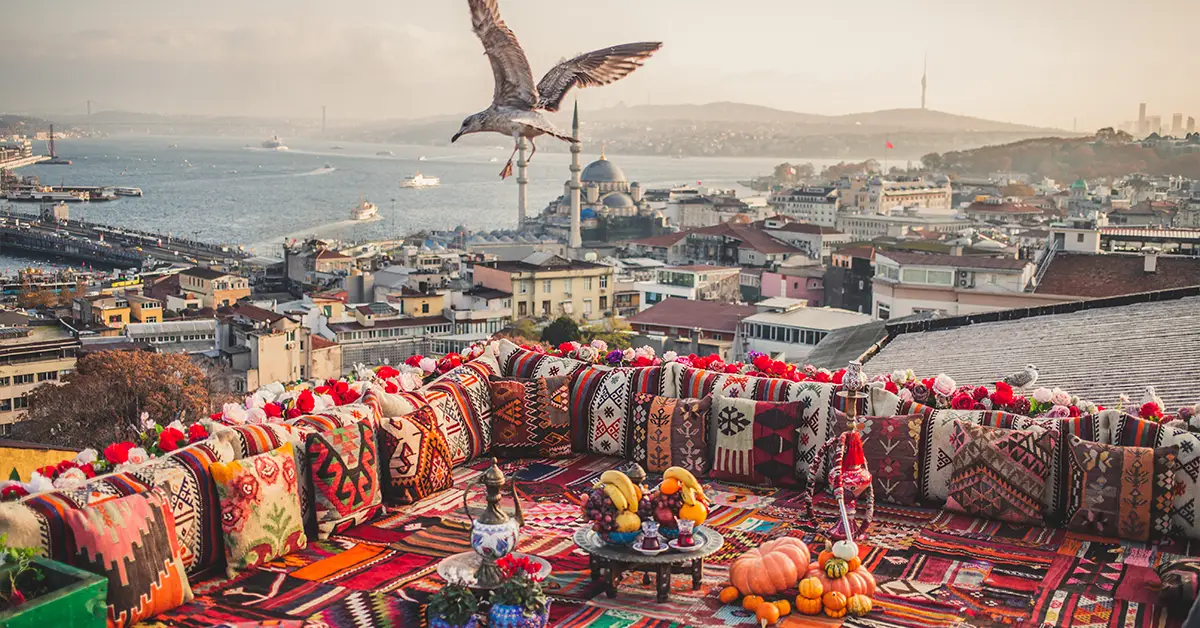
Turkish culture is a distinctive synthesis of Central Asian, Persian, Arab, Graeco-Roman and Byzantine currents, refined over more than six centuries of Ottoman empire and a century of modern republic. This is the culture of a country bridging Asia and Europe, where the call to prayer from the minaret sounds beside the Orthodox church and the synagogue.
With 31 elements recognised by UNESCO as Intangible Cultural Heritage, the country is among the 5 nations with the most intangible cultural heritage in the world.
A detailed article onthe country of Turkey.
Message
Cultural foundations and identity
Turkey is a cultural house built on four great foundations: the Central Asian heritage of the nomadic Turks, Islamic-Persian influence, the Byzantine-Roman treasury from ancient Anatolia, and the current of Western-style modernisation after 1,923. Each cultural layer does not replace but overlays the others, creating a distinctive complexity not easily found in any other country.
The principle of hospitality (misafirperverlik) is a core value running through every social class. Guests are received with tea, sweet pastries, sometimes a full meal even where the host is not wealthy. The proverb “Tanrı misafiri” — “guest of God” — shows that hospitality is not merely politeness but a spiritual duty.
The extended family remains an important social unit, although urbanisation has weakened the traditional extended family model. Relations between relatives, neighbours (komşu) and friends (arkadaş) are still maintained through visits, weddings, funerals and religious holidays. Older people are especially respected, expressed through forms of address (abi, abla, amca, teyze) and the custom of kissing the hands of elders on festive occasions.
Emotion and the expression of feeling are a notable characteristic. Turks readily express joy, sorrow, praise and anger through gesture, tone and body language. The tradition of “gönül” — the heart, the soul — is a central concept in both classical Sufi poetry and everyday life.
Considering a residency programme? The Prosperous Living Investment team assesses your profile free of charge and advises on the pathway that fits your goals.
Cuisine — one of the world’s three great cuisines
Cuisine is the most clearly marked summit of Turkish culture, often ranked among the world’s three great cuisines alongside French and Chinese. It is the result of the interweaving of ingredients and cooking techniques from nomadic Central Asia, agricultural Middle East and the coastal Mediterranean, standardised over centuries in the Ottoman court kitchen.
The traditional meal begins with meze — a set of many small starters comprising hummus, baba ganoush, yogurt with herbs, dolma (stuffed vine leaves), cıvırma (cheese pastry) and various salads. Meze usually goes with rakı — the distinctive anise liqueur called “lion’s milk” when mixed with cold water. Meze culture is bound up with the long dinner, an important social space for Turks.
The famous main dishes comprise kebab (dozens of variants from Adana and Urfa to İskender), köfte (meatballs), lahmacun (thin Turkish-style pizza), pide (flatbread with topping), mantı (small dumplings in yogurt sauce), dolma and imam bayıldı (stuffed aubergine). Pilav rice, bulgur and pulses are common accompaniments at every meal.
The famous sweets comprise baklava (thin pastry with nuts and syrup), künefe (stretched cheese pastry with syrup), lokum (Turkish delight), helva, muhallebi and dondurma (a distinctively chewy ice cream). Maraş dondurma made from goat’s milk and sahlep root is a unique culinary heritage with a technique stretching back centuries.
Theo GoTürkiye, many dishes and culinary traditions have been recognised by UNESCO. Keşkek — wheat cooked with meat, served at weddings and religious ceremonies — was listed in 2,011. Mesir macunu — the distinctive herbal paste of the city of Manisa, distributed free every year for the past 400 years — was listed in 2,012. Traditional flatbread making was inscribed in 2,016 in a multinational file together with Iran, Azerbaijan, Kazakhstan and Kyrgyzstan.
Street food (sokak yemekleri) is no less abundant. Simit (sesame-covered bread rings), balık ekmek (fish sandwiches in Istanbul), midye dolma (stuffed mussels), kokoreç (grilled lamb offal) and boza (fermented millet drink) are indispensable everyday items of urban life.
Tea and coffee culture
Tea (çay) is the national drink, with production and consumption among the highest in the world. Each person drinks an average of 3-5 glasses of tea a day, the highest per capita consumption in the world. Tea is brewed in a double çaydanlık pot and served in small tulip-shaped glasses (ince belli bardak) with sugar cubes but no milk.
Tea culture is bound up with everyday life. From the tea garden (çay bahçesi) in the village to the office (ofis) at work, every serious conversation begins with “çay içer misiniz?” — “would you like some tea?”. Tea is also a signal of reconciliation, of accepting a proposal, and of opening a relationship. Tea customs were recognised by UNESCO in 2,022 in a joint file with Azerbaijan.
Turkish coffee (Türk kahvesi) is a unique cultural heritage with its distinctive brewing technique in a copper cezve. Finely ground coffee is heated with water and sugar over a low flame, then poured into a small cup with a fine foam called köpük. Turkish coffee customs were recognised by UNESCO in 2,013 as intangible cultural heritage.
Turkish coffee is not only a drink but also a social rite. In the traditional proposal ceremony (kız isteme), the bride-to-be makes the coffee herself, and may playfully put salt in the groom’s cup to test his reaction. After drinking, the grounds at the bottom of the cup are turned upside down to read fortunes (fal), a tradition still very much alive in urban life.
Sufi literature and poetry
The literary tradition stretches over more than 1,300 years from the ancient Orkhon inscriptions to Nobel Prize-winning contemporary novels. The pre-Islamic period is notable for the Dede Korkut epic recounting the ancient Turks, and the legend of Köroğlu — a popular hero’s tale spread from the Caucasus to Central Asia.
Sufi poetry is Turkish culture’s most brilliant contribution to world literature. Mevlana Celâleddîn-i Rûmi (1207-1273) — commonly known in the West as Rumi — spent most of his life in Konya and wrote in Persian. His Masnavi-i Ma’navi comprises 25,000 couplets, regarded as one of the masterpieces of Islamic literature and the inspiration for the entire Mevlevi school.
Yunus Emre (1238-1320) was a Sufi poet writing in the vernacular Turkish, regarded as “the father of Turkish literature”. He turned Turkish into a literary language with hundreds of poems on love, humanity and spirituality. The government held the international Year of Yunus Emre in 1,991 and 2,021 under UNESCO patronage.
The Ottoman period developed Divan şiiri — court poetry strongly influenced by Persian and Arabic, with such great names as Fuzuli, Baki and Nedim. Alongside it was şiir halk — folk poetry composed and performed by troubadours (âşık), with Karacaoğlan, Pir Sultan Abdal and Âşık Veysel as its masters.
Modern literature flourished after the script reform of 1,928. Nazım Hikmet (1902-1963) — the “romantic communist poet” — left a deep international mark with works on working people and freedom. Orhan Pamuk won the Nobel Prize in Literature in 2,006, becoming the first Turk to be so honoured. The novels My Name Is Red, Snow and The Museum of Innocence have been translated into more than 60 languages. Elif Shafak is a powerful contemporary voice, with The Forty Rules of Love and The Island of Missing Trees widely received internationally.
Music, cinema and the performing arts
Traditional music divides into several streams: Ottoman classical music (Türk sanat müziği) with its complex makam (modes); folk music (halk müziği) with the saz — the emblematic stringed instrument; Sufi music; and the famous Mehter military music with its stirring marches.
The whirling dance of the Mevlevi dervishes (Sema) is the most internationally recognised cultural emblem. This rite is performed by “whirling dervishes”, turning about a vertical axis on one still foot, the right hand turned up to heaven and the left directed down to earth — a symbol of receiving God’s grace and passing it down to humankind. The Mevlevi Sema ceremony was recognised by UNESCO in 2,008, and the performances in Konya each December draw tens of thousands of visitors.
Popular music developed strongly from the 1,960s with such legendary artists as Sezen Aksu (dubbed the “queen of pop”), Barış Manço (pop rock), Tarkan and Ajda Pekkan. Arabesque music, combining Arabic music with popular styles, became a social phenomenon with such names as İbrahim Tatlıses, Orhan Gencebay and Müslüm Gürses.
Yeşilçam cinema (1960-1990) was the golden age, with thousands of films across many genres. Contemporary cinema has won many international awards: Nuri Bilge Ceylan won the Palme d’Or at Cannes in 2,014 with Winter Sleep, Semih Kaplanoğlu won the Golden Bear at Berlin in 2,010 with Honey, and Deniz Gamze Ergüven won an Oscar nomination for Best Foreign Language Film in 2,016 with Mustang.
Television has become a considerable cultural export. Serial dramas (dizi) such as Muhteşem Yüzyıl, Diriliş: Ertuğrul and Kuruluş Osman are exported to more than 150 countries with audiences of over 500 million. The industry brings in revenue of more than USD 600 million a year and is a powerful instrument of cultural diplomacy.
Architecture and material heritage
Turkish architecture is a chronicle in stone and brick of many civilisations. The Byzantine heritage in Istanbul with Hagia Sophia (537), the Chora Church and the Theodosian walls still stands firm after more than 1,500 years.
Ottoman architecture reached its summit at the hands of the architect Mimar Sinan (1489-1588). He designed more than 300 works, notably the Süleymaniye Camii in Istanbul and the Selimiye Camii in Edirne — a masterpiece recognised by UNESCO in 2,011. Topkapı Palace was the residence of the Sultans for nearly four centuries, and is now a museum holding the royal treasures.
The Historic Areas of Istanbul were recognised as a UNESCO World Heritage Site in 1,985, comprising four main areas: the Archaeological Park, Süleymaniye, Zeyrek and the Theodosian walls. The other UNESCO sites include Safranbolu (the old Ottoman town), Bursa and Cumalıkızık (birthplace of the Ottoman Empire), Diyarbakır and the Hevsel Gardens, together with many ancient pre-Ottoman sites.
Vernacular architecture varies by region. The wooden houses of Safranbolu with their pitched roofs and projecting windows, the stone houses of Mardin in the south-east, the cave dwellings of Cappadocia and the wooden houses of the Black Sea are distinctive styles. The underground shelters in Cappadocia, with Derinkuyu reaching 85 metres deep and able to hold 20,000 people, are an astonishing ancient engineering achievement.
Craft and decorative arts
Traditional crafts flourished under the Ottomans and remain alive today. Çini (glazed tiles) is the speciality of the city of İznik, with floral and geometric motifs painted by hand then fired at high temperature. Çini was recognised by UNESCO in 2,016, and the masters at İznik still maintain workshops using the classical technique.
Ebru (the art of painting on water) creates soaring patterns by dropping ink onto a treated water surface, then transferring the image to paper. Ebru was recognised by UNESCO in 2,014. This form was once used to decorate the margins of Ottoman books, and has now become an independent art form with many internationally renowned practitioners.
Turkish carpets (halı) are famous worldwide for the motifs of the Hereke region (court silk carpets), Uşak, Konya and Kayseri. Each region has its own style of colour, pattern and knotting technique. Flat-woven kilim without pile is also a widespread craft, often used to decorate walls and floors.
The other crafts include Kütahya ceramics, Gaziantep brassware, Bursa embroidered fabrics, Istanbul Kapalıçarşı silverware, Anatolian goatskin and Ottoman calligraphy. The art of manuscript illumination (tezhip) combined with Arabic calligraphy produces exquisite pages of the Quran — also a UNESCO heritage in 2,020.
Shadow theatre (Karagöz and Hacivat) is a folk dramatic form using leather puppets to cast shadows on a white screen. The comic exchanges between Karagöz and Hacivat reflect Ottoman social life, and were once very popular in the coffee houses during Ramadan. This art was recognised by UNESCO in 2,009.
Customs, festivals and social life
The traditional wedding is a major social event, usually lasting 2-3 days with distinctive rites. The kına (henna) night is an important rite for the bride, where her mother and girlfriends paint henna on her hands to music both sad and joyful. The formal wedding day comprises the signing ceremony at the place of worship and a large reception with hundreds to thousands of guests.
The circumcision ceremony (sünnet düğünü) for boys of around 5-10 is a cultural event no less important than a wedding. The boy dresses in a little sultan’s costume, rides in procession on horseback and receives gifts from relatives. After the medical rite, a celebration is held with many guests.
Ramadan (Ramazan) is the holiest month of the year. Everyone fasts from dawn to dusk, eating iftar at sunset and sahur before daybreak. Cities are decorated with electric lights (mahya) strung between the minarets bearing spiritual mottoes. Ramadan ends with Ramazan Bayramı (Eid al-Fitr) lasting 3 days, followed around two months later by the 4-day Kurban Bayramı (Eid al-Adha).
The important national holidays comprise Republic Day on 29/10 marking the founding of the Republic in 1,923, National Sovereignty and Children’s Day on 23/04 (a festival created by Atatürk for the children of the whole world), Youth and Sports Day on 19/05, and Victory Day on 30/08.
The Kırkpınar oil wrestling festival, held annually at Edirne since 1,346 — the oldest in the world in its category — was recognised by UNESCO in 2,010. The Nevruz festival on 21/03 marking spring is celebrated exuberantly by the Kurdish, Alevi and Azerbaijani communities. The Hıdırellez festival on 06/05 is a traditional folk festival marking spring, inscribed by UNESCO in 2,017.
Religion and spirituality in Turkish culture
Islam is the predominant spiritual framework shaping Turkish culture over more than 950 years since the Seljuks brought Islam into Anatolia. The mosque (cami) is the centre of community life, with more than 82,000 mosques nationwide, making this one of the countries with the highest density of places of worship in the world.
The Sufi tradition is the most distinctive spiritual contribution. Besides the Mevleviye famous for the whirling dance, other Sufi orders such as the Bektaşi, Nakşibendi, Halveti and Kadiri have all left a deep mark. The tekke (Sufi lodges) were once centres of culture and learning; although officially closed in 1,925, the tradition has continued through informal forms.
The Alevi community at 15-25% of the population has a distinct spiritual culture. The cem rite at the cemevi combines music, dance and philosophy, with men and women taking part together — something rarely found in traditional Sunni Islam. The poetry of Âşık Veysel and Pir Sultan Abdal and the Alevi traditions form an independent strand of culture within the national whole.
The religious minority communities have also left an important cultural mark. Greek Orthodoxy in Istanbul, with the Ecumenical Patriarch as spiritual leader of Orthodoxy worldwide. The Armenian community with the Kumkapı church, the Sephardic Jewish community with its many ancient synagogues, and the Syriac Christian community in the south-east all contribute to a rich spiritual mosaic.
UNESCO intangible cultural heritage
Theo UNESCO Intangible Cultural Heritage, the country had 31 elements inscribed on the UNESCO lists as at 2,024, placing it in the world’s top 5. Besides the heritage already mentioned, the list also includes Meddah (traditional storytelling, 2,008), Âşıklık (the minstrel tradition, 2,009), Hıdırellez (the spring festival, 2,017), the Kuşköy whistled language (2,017), the Ahi guild brush-painting tradition (2,020), and Ahlat stonework (2,023).
The multinational culinary heritage is also recognised, comprising flatbread culture (2,016, with Iran-Azerbaijan-Kazakhstan-Kyrgyzstan), tulum craft (the leather bagpipe, 2,023, with North Macedonia), tea culture (2,022, with Azerbaijan) and the Nasreddin Hoca festivity tradition (2,022, with Azerbaijan-Kazakhstan-Kyrgyzstan-Uzbekistan).
Policy on conserving and promoting cultural heritage is carried out by the Ministry of Culture and Tourism together with the Yunus Emre Institute — a body similar to the British Council or the Goethe Institute. The Institute has more than 60 centres in 48 countries, running Turkish language courses, exhibitions and film weeks. This turnsTurkish cultureinto one of the region’s most effective instruments of soft diplomacy.
For Vietnamese people intending to invest or settle, culture is a dimension not to be overlooked. TheTurkey citizenship by investmentprogramme came into being partly to connect international investors with this rich heritage, providing not only a powerful passport but also access to one of the most many-layered cultures in the world.
Conclusion
Turkish culture is a many-coloured picture of 12,000 years of Anatolian history, 1,000 years of Turkish presence, 600 years of Ottoman empire and a century of republican modernisation. From a cuisine among the world’s top three, the Sufi poetry of Rumi and Yunus Emre, and the Mevlevi Sema dance, to 31 UNESCO intangible heritage elements, this country possesses one of the richest cultural treasuries of humankind. Culture here is not a relic on display but the breath of every day, in every glass of tea, every call to prayer, every welcoming greeting.
Understanding this country’s culture is the key to reading every other dimension correctly — from business and politics to daily life. It is a culture familiar enough for Asians to feel an affinity, and different enough to offer a fresh experience. For Vietnamese investors, this is one of the most rewarding cultures to explore and connect with in the Eurasian region.
Accompanying you on your journey in residency investment
The Prosperous Living Investment team advises on pathways, assesses profiles and manages investments transparently for every residency, citizenship and international property objective.
Free profile assessmentWhere life gets prosperous