

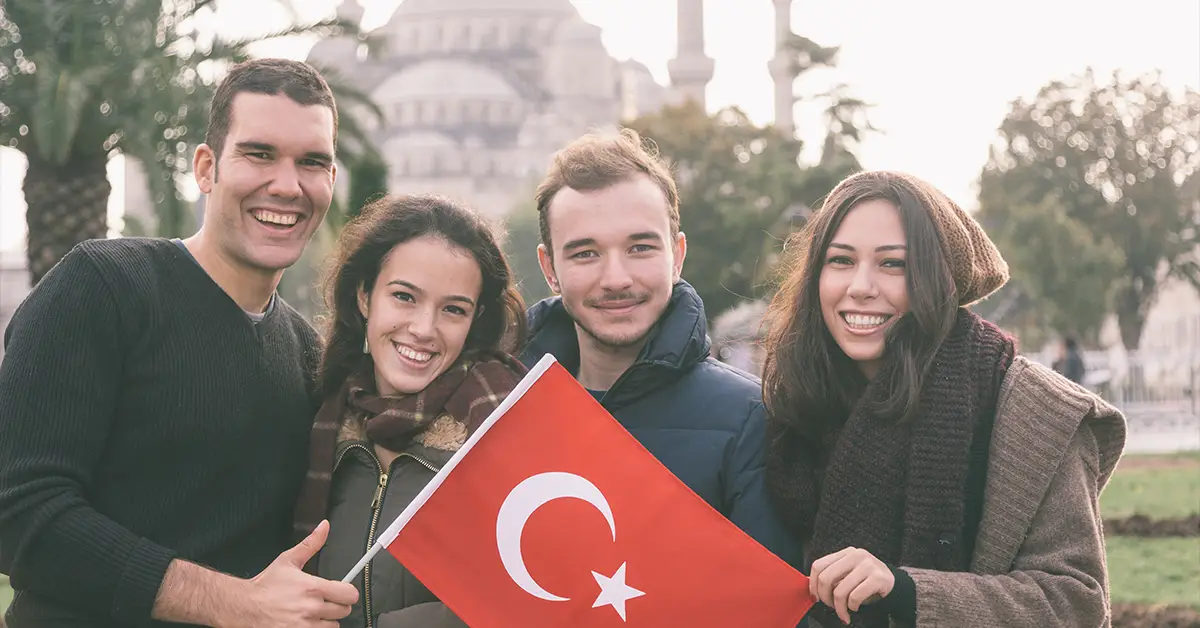
Turkey’s demographics are one of the most notable cases in Eurasia, with the world’s 18th largest population, a median age of 34.9 in 2,025 and an urbanisation rate exceeding 77%.
The country’s striking feature is the combination of a still relatively young society with a steady ageing trend, together with rich ethnic and religious diversity beneath a Sunni Muslim majority. These factors shape the labour market, consumer demand and social structure of the world’s 16th largest economy.
A detailed article onthe country of Turkey.
Message
Population size and growth rate
Theo Turkish Statistical Institute, the total population ofTurkeyreached 86,092,168 as at 31/12/2025, including 1,519,515 permanently resident foreign nationals. This figure does not include the around 2.29 million Syrian refugees under temporary protection.
The population rose slightly by 427,224 on the end of 2,024 (85,664,944), reflecting population growth of around 0.5% a year — far below the 1.6% of the 2,000s. TÜİK projections show the population reaching 88.2 million by 2,030 and 91.5 million by 2,040.
The population is projected to peak in 2,053 at 93.9 million, then enter a period of natural decline. This is an important demographic turning point, marking the transition from a period of growth to one of stability and ageing.
Compared with the population in 1,927 (13,648,270) and in 2,000 (67,803,927), the population has grown more than sixfold in a century. This is the result of both high natural growth in the period 1,950-2,000 and waves of international immigration in recent years.
Considering a residency programme? The Prosperous Living Investment team assesses your profile free of charge and advises on the pathway that fits your goals.
Age and sex structure
The median age in 2,025 was 34.9, up sharply from 28.3 in 2,007 and 25.8 in 2,000. Compared with the European Union’s 44.5, the country remains considerably younger, holding its position as one of the countries with the youngest population in the region. Half the population was under 34.9 in 2,025, the largest young age group among EU member states.
The population share by age group shows a clear ageing trend. Children under 15 accounted for 20.4% in 2,025, down from 26.4% in 2,007. Conversely, those over 65 rose from 7.1% in 2,007 to 11.1% in 2,025. The working-age group of 15-64 accounts for around 68.5% of the population.
On TÜİK projections, the child and elderly groups will be equal in share by the 2,040s. After that, the proportion of older people will overtake and continue widening the gap, putting great pressure on the social security and healthcare systems.
The sex structure is extremely balanced, among the most stable in the region. The difference between men and women is statistically negligible, which is regarded as a positive indicator of the health, education and gender equality situation. Universal suffrage for both sexes has applied since 1,934, earlier than in many European countries.
The total fertility rate was around 1.51 children per woman in 2,024, sharply down from 2.13 in 2,018 and far below the replacement level of 2.1. This is a record low, reflecting a demographic transition happening faster than expected.
Geographical distribution and urbanisation
The urbanisation rate reached 77.5% in 2,023, with an average urbanisation rate of 1.11% a year over 2,020-2,025. The shift from countryside to town has continued since the 1,950s, transforming the country from an agricultural society into a modern industrial and service society.
Istanbul is the largest city with a population of 15,754,053 as at January 2026, accounting for 18.30% of the national population. Population density there reaches 2,934 per km² — the highest in the country. It is the only metropolis in the world lying on two continents, serving both as an economic centre and as a cultural emblem.
Ankara — the administrative capital — has 5,910,320 inhabitants (6.87%), concentrating most government bodies, embassies and major universities. İzmir on the Aegean coast is third with 4,504,185 (5.23%), a major seaport and industrial centre in the west.
The other major metropolitan cities are Bursa (3.1 million), Antalya (2.7 million), Adana (2.3 million), Gaziantep (2.1 million) and Konya (2.2 million). There are currently 30 metropolitan municipalities with populations above 750,000 — all organised as a special administrative tier with elected mayors and councils.
Average population density is 111 per km². However, the distribution is very uneven between regions. The Marmara region in the north-west concentrates more than 30% of the population on just 8.5% of the area, while the vast Eastern Anatolia region has the lowest population density in the country.
The province with the smallest population is Bayburt in the north-east with 82,836 inhabitants. Bayburt has a population density of only around 20 per km², reflecting harsh geographical conditions and the outward migration of its people to the major cities.
Ethnic groups in Turkey’s demographics
Turks are the main ethnic group, accounting for around 70-75% of the population. The government does not officially recognise ethnic groups other than the non-Muslim religious minorities protected under the Treaty of Lausanne of 1,923.
Kurds are the largest minority, estimated at around 15 million people, equivalent to 18-20% of the total population. The great majority of Kurds live in the Eastern Anatolia and South-Eastern Anatolia regions, where they form the majority in provinces such as Şanlıurfa, Şırnak, Mardin and Diyarbakır. In recent decades, the Kurdish community has migrated significantly to Istanbul and the western cities, forming a new urban middle class.
Most Kurds are Sunni Muslims of the Shafi’i school — differing from Turks, who mainly follow the Hanafi school. There are also Kurdish communities following Alevism, Shia Islam, Christianity, Judaism and Yazidism. Kurdish (Kurmanji and Zazaki) is widely used within the community although Turkish is the sole official language.
The other ethnic groups account for the remaining 6-11% of the population, including Armenians, Arabs, Assyrians, Albanians, Bulgarians, Bosniaks, Circassians, Chechens, Georgians, Greeks, Hemshin, Pomaks, Rum, Russians, Roma, Jews and Laz. The Arab community is concentrated in the provinces bordering Syria such as Hatay, Gaziantep and Mardin.
The Syrian refugee community is the largest immigrant group in modern history. As at April 2026, around 2.29 million Syrians were registered under temporary protection, after hundreds of thousands had returned home or been naturalised. The country has been the world’s largest refugee-hosting nation for nearly a decade.
Language and cultural diversity
Language is an important dimension of Turkey’s demographics. Turkish (Türkçe) is the sole official language under the Constitution, used in administration, education, media and all public dealings. It belongs to the Turkic-Oghuz group of the Turkic language family, and has used the Latin alphabet since 1,928 following Atatürk’s reform.
Modern Turkish was standardised on the basis of the Istanbul dialect and removed many words of Arabic and Persian origin in a process of “language purification” led by the Turkish Language Association. Around 60-65% of modern vocabulary is of old Turkic origin or newly coined, with the remainder retaining loanwords.
Kurdish (Kurmanji and Zazaki) is the second largest mother tongue with around 15 million speakers. Since 2,009, Kurdish-language television and radio have been officially licensed after decades of restriction. Private schools teaching Kurdish have been permitted since 2,014, and some universities such as Mardin Artuklu have opened Kurdology departments.
Other minority languages include Arabic (mainly in Hatay, Gaziantep and Mardin), Circassian, Laz, Georgian, Armenian and Greek. The Sephardic Jewish community in Istanbul still maintains Ladino although the number of speakers has fallen sharply.
English is the most common foreign language, taught from primary level in most schools. The proportion of people speaking English at a conversational level is around 20-25%, concentrated in the major cities and among the under-40s.Bilingual and international educationis expanding rapidly in the major cities.
Religion and religious practice
Religion is a key factor in Turkey’s demographics. Islam is the predominant religion, with around 95-99% of the population identifying as Muslim in surveys and official statistics. The figure of 99.8% in administrative records is somewhat higher than reality because the civil registration system records newborns as “Muslim” by default.
Within the Muslim community, Sunnis account for around 85-90%, mainly of the Hanafi school of jurisprudence. This is also the school officially supported by the Directorate of Religious Affairs (Diyanet) — the state body responsible. The Diyanet controls all mosques and pays the salaries of around 140,000 clerics nationwide.
The Alevi community is the largest religious minority, estimated at 10-20 million people or 15-25% of the population. Alevism combines Shia and Sunni elements with pre-Islamic Anatolian traditions, with distinctive rites in which men and women take part together through poetry, music and dance. The Alevi-Bektashi community comes under the Ministry of Culture and Tourism rather than the Diyanet.
The religious minorities officially recognised under the Treaty of Lausanne comprise around 65,000 Armenian Orthodox believers, 23,000 Jews, and around 4,000 Greek Orthodox believers. Istanbul is also the seat of the Ecumenical Patriarch of Constantinople — the spiritual head of Orthodoxy worldwide.
Other religious communities include Roman Catholics, Protestants, Yazidis, Ja’faris (mainly Azerbaijanis) and Alawites (the Arab community in the south). With more than 82,693 mosques nationwide, this is one of the countries with the highest density of places of worship in the world.
Education and literacy
Literacy reached 97.4% of the total population in 2,023 on TÜİK figures, with 98.8% among men and 96.0% among women. This is one of the most impressive improvements of the past century — from around 10% in 1,927 when the Republic was founded.
The compulsory education system runs for 12 years (the 4+4+4 model) comprising primary, lower secondary and upper secondary school. Primary enrolment is close to 100%, while the upper secondary completion rate is 88%. The number of university students reached around 8 million in 2,024, up sharply from 1.5 million in 2,000.
The country has 208 universities, of which 131 are public and 77 private, as at 2,024. Istanbul University, founded in 1,453, and Middle East Technical University (METU) in Ankara are the two most prestigious institutions. The Türkiye Bursları scholarship programmes award places to thousands of international students each year, including Vietnamese students.
Education quality on the PISA 2,022 assessment has improved but remains below the OECD average. Mathematics scored 453 (OECD 472), reading 456 (OECD 476) and science 476 (OECD 485). The gap between high-quality schools and struggling ones is an important issue to address.
Health, life expectancy and quality of life
Life expectancy reached 78.6 years in 2,024, with 81.5 for women and 75.8 for men — approaching the OECD average. This is a considerable improvement from 48.27 in 1,960 and 73.94 in 2,011, thanks to advances in public health, nutrition and living conditions.
The public health system has been comprehensively reformed since 2,003 through the Health Transformation Programme (Sağlıkta Dönüşüm). Universal health insurance (GSS) covers almost the whole population. Public health spending accounts for around 4.3% of GDP, plus around 2% from the private sector.
The hospital network comprises more than 1,500 facilities, of which 900 are public hospitals, 560 private and 40 university hospitals. Since 2,010, a large-scale “City Hospital” model has been rolled out in many cities, providing modern specialist services to international standards.
Medical tourism is a spearhead sector with more than 1.5 million international patients a year. The popular services are hair transplants, cosmetic surgery, dentistry, IVF and cancer treatment. Prices are 50-70% below Europe and North America but quality meets JCI accreditation at many facilities.
Infant mortality has fallen sharply to 8.7 per 1,000 live births in 2,024 — close to the OECD level. Childhood immunisation coverage is above 97% for the basic vaccines, demonstrating effective preventive health policy.
International migration and attracting talent
Invest in Türkiyestress that a young population and an abundant labour force are the leading competitive advantage. With around 34 million people of working age and a fast-rising proportion holding university degrees, the labour market provides a firm foundation for foreign investment.
In recent years, the “brain drain” trend (beyin göçü) has become a major concern. Tens of thousands of young professionals, doctors and engineers have gone abroad to study and work, mainly to Germany, Britain, the United States and Canada. In 2,023, around 15% of graduates planned to settle abroad according to an internal survey.
Conversely, the inflow of immigrants from abroad has also reached historic scale. Besides Syrian refugees, the Russian, Ukrainian, Iranian, Afghan and Iraqi communities have also grown quickly. TheTurkey citizenship by investmentprogramme has granted citizenship since 2,017 to more than 40,000 international investors and their families, mostly from the Middle East and Asia.
The Vietnamese community in Turkey numbers around 500-1,000 people, mainly students, businesspeople and those married to Turkish nationals. Although small compared with other communities, the number has risen steadily over the years. The citizenship programme with its low USD 400,000 investment threshold is attracting the interest of many Vietnamese investors thanks topassportallowing visa-free travel to more than 110 countries.
Demographic trends and challenges
The country stands at its most important demographic turning point since the Republic was founded. The fertility rate has fallen sharply to 1.51 children per woman, far below the replacement level of 2.1. The western urban provinces such as Istanbul have a fertility rate of only 1.3-1.4, while the south-eastern Kurdish provinces such as Şanlıurfa still maintain 3.27.
Population ageing is the great challenge of the next two decades. When the proportion of people over 65 passes 20% of the population by the middle of the 21st century, the burden on the pension fund and healthcare will rise considerably. Pension costs are forecast to rise from 8% of GDP today to 12-13% of GDP by 2,050.
The government has rolled out many policies encouraging childbearing since 2,022, including birth allowances, longer maternity leave, tax breaks for families with several children and expanded public nurseries. However, the effectiveness of these policies remains limited against economic pressure and general social trends.
Rural-to-urban migration has slowed but continues, putting pressure on infrastructure and housing in the major cities. Istanbul faces the problem of expanding transport infrastructure, wastewater treatment and affordable housing for an ever-growing population.
Finally, integrating the Syrian refugee community and the new immigrant groups is a long-term social and political test. Despite their considerable economic contribution, the presence of 2.29 million Syrians remains a source of controversy over welfare, jobs and cultural identity.
Conclusion
Turkey’s demographics present the picture of a society in profound transition: a population of 86.2 million still young with a median age of 34.9, but ageing quickly with a fertility rate that has fallen below replacement level. Ethnic diversity with Turks in the majority and Kurds as the largest minority, together with a Sunni Muslim foundation combined with a substantial Alevi community, creates a complex social structure rich in identity. The urbanisation rate of 77% and the network of metropolitan cities are continuing to reshape the country’s economic and cultural landscape.
For Vietnamese investors interested in this market, understanding the population and social structure is the foundation for making the right decisions on the timing, location and form of investment. The long-term trends in population ageing, urbanisation and attracting international migration also create many business opportunities in health, education, property and consumer goods.
Accompanying you on your journey in residency investment
The Prosperous Living Investment team advises on pathways, assesses profiles and manages investments transparently for every residency, citizenship and international property objective.
Free profile assessmentWhere life gets prosperous