


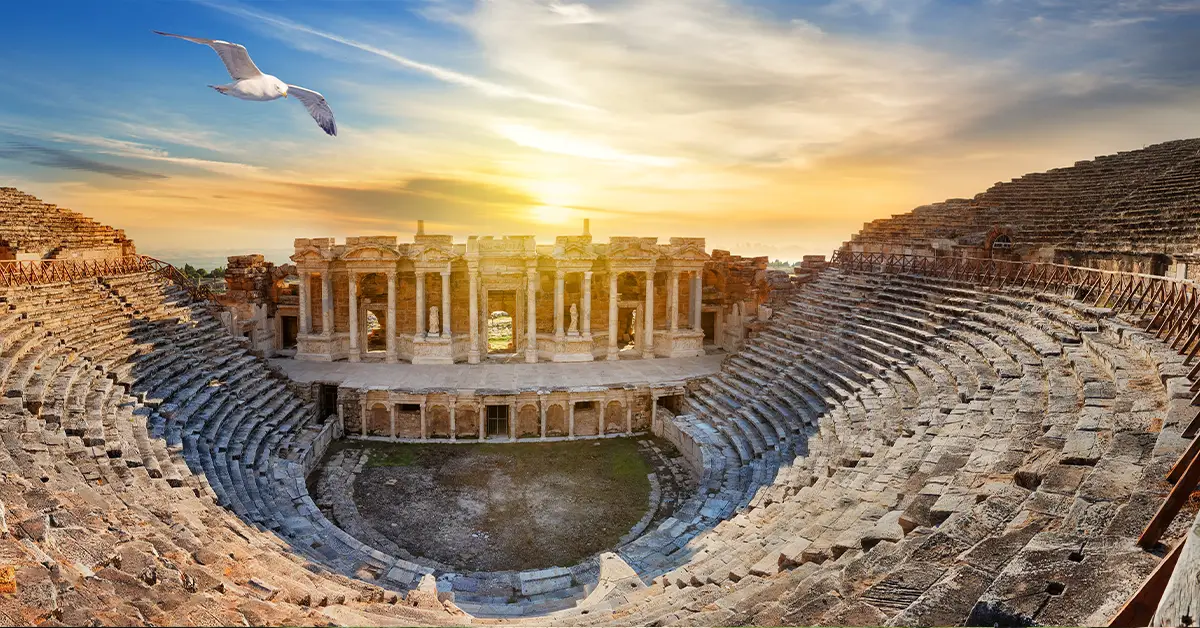
The history of Turkey is one of humanity’s most continuous and richest stories, stretching more than 12,000 years across the Anatolian peninsula. This land was the cradle of the first civilisation, the foothold of the mightiest empires in history and finally the birthplace of a modern republic in 1923. Each period has left a deep mark on the country’s identity, culture and politics.
A detailed article onthe country of Turkey.
Message
Prehistory and the cradle of Anatolian civilisation
The Anatolian peninsula, where most of the territory of modernTurkeylies, is one of the areas with the earliest traces of human habitation in the world. Archaeological evidence shows that early human communities settled here from the Palaeolithic, with sites spanning tens of thousands of years.
The most important archaeological discovery is Göbekli Tepe in Şanlıurfa province in south-eastern Turkey. According toUNESCO World Heritage Centre, this site dates from around 9,600 BC, built by Neolithic hunter-gatherer communities.
Göbekli Tepe comprises circular and oval megalithic stone structures, with T-shaped limestone pillars up to 5.5 metres tall. This discovery entirely changed our understanding of the emergence of religion and complex society in humankind, because the site was built even before settled agriculture appeared.
Another important site is Çatalhöyük, home to the world’s earliest agricultural community, dating from around 7,500 BC. Both Göbekli Tepe and Çatalhöyük are recognised by UNESCO as World Heritage Sites, confirming Anatolia’s particular role in the progress of human civilisation.
Considering a residency programme? The Prosperous Living Investment team assesses your profile free of charge and advises on the pathway that fits your goals.
The ancient civilisations of Anatolia
After the Neolithic, Anatolia was continuously the meeting point of many great civilisations. From around 1,600 to 1,180 BC, the Hittite Empire controlled most of the peninsula, with its capital at Hattusa in present-day Çorum province.
The Hittites were one of the first civilisations to use iron, developed an advanced legal system and had diplomatic relations with ancient Egypt. The Treaty of Kadesh signed between the Hittites and Egypt in 1,259 BC is regarded as the oldest international peace treaty whose text survives.
After the Hittite Empire collapsed, Anatolia came in turn under the rule of many different powers: the Phrygians, the Lydians, the Achaemenid Persians, and then Alexander the Great in the 4th century BC. The Hellenistic period left many magnificent cities such as Ephesus, Pergamon, Troy and Aphrodisias, most of which are UNESCO World Heritage Sites today.
From the 2nd century BC, Anatolia became part of the Roman Empire. When Rome divided in 395 AD, this land fell wholly within the Eastern Roman Empire, also known as the Byzantine Empire.
The Byzantine Empire and the birth of Constantinople
The Byzantine Empire lasted more than 1,000 years, from 330 to 1453, with its capital Constantinople founded by Emperor Constantine the Great on the site of the ancient city of Byzantium. This period left a deep mark on the architecture, religion and culture of this land.
Constantinople became the centre of Eastern Orthodoxy, and at the same time an important trading hub between Europe and Asia. Hagia Sophia, built by Emperor Justinian I in the 6th century, was for nearly a millennium the largest religious building in the Christian world.
The Turks, the ancestors of today’s Turkish people, began migrating from Central Asia to Anatolia from the 11th century. The Seljuk victory over the Byzantines at the Battle of Manzikert in 1,071 opened the way to the Turkification of Anatolia. The Turkish Seljuk Empire brought Islam and Persian-Turkish culture to the peninsula, laying the foundations for the later Turkish identity.
By the 13th century, as the Seljuk Empire weakened under Mongol invasions, many small beyliks formed in Anatolia. One of them, led by Osman I in the Söğüt region, would grow into the mightiest empire in Turkish history.
The Ottoman Empire: 600 golden years
The Ottoman Empire was founded in the late 13th century by Osman I, regarded as the progenitor of the Ottoman dynasty. From a small beylik in north-western Anatolia, the Ottomans expanded their territory through continuous conquest.
The most important milestone was 1,453, when Sultan Mehmed II conquered Constantinople, ending the Byzantine Empire. The city was renamed Istanbul and became the capital of the Ottoman Empire. This event not only marked a transfer of power in Anatolia but is also regarded by many historians as the moment marking the end of the European Middle Ages.
The 16th century was the Ottoman golden age under Sultan Süleyman I — also known as Süleyman the Magnificent. Over his 46 years of rule from 1,520 to 1,566, Ottoman territory stretched from Eastern Europe through the Middle East to North Africa, controlling important trade routes and major cities such as Cairo, Damascus, Baghdad and Belgrade.
Süleyman is called Kanuni by the Turks — meaning the Lawgiver — for his comprehensive legal reforms. This period also saw a flowering of Ottoman architecture with masterpieces such as the Süleymaniye Mosque in Istanbul designed by the architect Mimar Sinan.
From the 18th century, the Ottoman Empire gradually weakened under pressure from the European powers and successive military defeats. Much territory was lost in North Africa, the Balkans and the Middle East. By the 19th century, the Ottomans were commonly called by the West “the Sick Man of Europe”, though they still held an important geopolitical role.
The First World War was a fatal blow to the empire. The Ottomans fought on the side of the Central Powers with Germany and suffered heavy defeat. After the war, Ottoman territory was carved up by the Allies under the Treaty of Sèvres of 1,920, and even the Anatolian heartland was threatened with partition.
The War of Independence and the Republic of Türkiye
Faced with the loss of the country, a national resistance movement formed in Anatolia under the leadership of Mustafa Kemal, a general who had won fame at Gallipoli. According toRepublic of Türkiye Ministry of Foreign Affairs, the Turkish War of Independence lasted from 1,919 to 1,923, defeating the occupying Greek, Armenian and French forces.
The provisional government in Ankara declared itself the lawful government on 23/04/1920. After decisive military victories, the Ankara delegation successfully negotiated the Treaty of Lausanne signed on 24/07/1923, replacing the Treaty of Sèvres and recognising the sovereignty of the new Turkish state.
On 01/11/1922, the Turkish Parliament in Ankara formally abolished the Sultanate, ending 623 years of Ottoman dynastic rule. The Republic of Türkiye was formally founded on 29/10/1923, with Mustafa Kemal Atatürk becoming its first president.
Atatürk carried out a series of sweeping reforms to modernise and secularise the country. The notable reforms included changing the alphabet from Arabic to Latin, abolishing the Caliphate in 1,924, enacting a new civil code based on Swiss law, giving women the vote in 1,934, and separating religion from the state.
The language reform is regarded as one of the boldest decisions. Replacing the Arabic script with the Latin alphabet in 1,928 helped raise literacy from only around 10% to more than 50% within a few decades. Atatürk also founded the Turkish Language Association to purify the language, gradually removing words of Arabic and Persian origin and replacing them with words of old Turkic origin or new words the association itself created.
Alongside cultural reform, Atatürk’s government also focused on building transport, industrial and educational infrastructure. The slogan “Peace at home, peace in the world” (Yurtta sulh, cihanda sulh) became the guiding principle of foreign policy, helping Turkey maintain stable relations with both its neighbours and the great powers. The reforms of this period shaped the country’s political identity to this day, and Atatürk is revered by Turks as the father of the modern nation.
Turkey in the modern era
After Atatürk died in 1,938, Turkey continued on the path of modernisation under successive governments. The country remained neutral for most of the Second World War, declaring war on the Axis only in the final stage.
In 1,946, Turkey moved to a multi-party system, and in 1,952 became a member of the North Atlantic Treaty Organization (NATO), confirming its role as a strategic Western ally in the Cold War. Turkey was also a founder member of the Council of Europe in 1,949 and of the Organisation for Economic Co-operation and Development (OECD) in 1,961.
Turkish politics in the second half of the 20th century went through much upheaval, with four military coups in 1,960, 1,971, 1,980 and 1,997. Even so, the country continuously maintained economic growth and deep international integration. In 1,987, Turkey formally applied to join the European Economic Community, the forerunner of the European Union.
The period from 2,003 to the present has seen a strong rise in economic and geopolitical standing. Turkey is now the world’s 17th largest economy and a regional power in the Middle East, the Balkans and the Caucasus. In 2,022, the country formally asked the United Nations to use its official name Türkiye instead of Turkey.
Entering the 21st century, Turkey retains its distinctive position as a bridge between Asia and Europe, with a diverse economy, a strongly growing tourism industry and a multi-directional foreign policy. Istanbul continues to be one of the largest and most dynamic cities in the world, reflecting the image of a Turkey that both preserves its ancient heritage and reaches out globally.
Turkish history in contemporary life
Turkish history is preserved not only in books but is also vividly present in contemporary life. The country currently has 21 UNESCO-recognised sites, comprising 19 cultural and 2 mixed sites, placing it among the 15 countries with the most World Heritage Sites.
Historic sites such as old Istanbul, Cappadocia, Hierapolis-Pamukkale, Ephesus, Nemrut Dağı and Göbekli Tepe attract tens of millions of international visitors each year. Tourism contributes around 12% of GDP and provides jobs for millions of people.
Turkey’s development policy is also bound up with its historical heritage. In 2,023, marking the centenary of the Republic’s founding, the Turkish government announced its “Turkish Century” vision, setting the goal of making the country one of the world’s 10 largest economies and raising its international influence.education in Turkeyis also being comprehensively reformed to meet this goal, with hundreds of universities and international programmes taught in English.
The country’s appeal to international investors is growing. TheTurkey citizenship by investmentprogramme, launched in 2,017, has attracted tens of thousands of global investors, allowing them to hold a powerfulpassportwith visa-free access to more than 110 countries. This is the modern continuation of a tradition of openness and cultural exchange dating back to Ottoman times.
Conclusion
Turkish history is a journey stretching more than 12,000 years, from the hunter-gatherer communities of Göbekli Tepe, through the mighty Hittite, Greco-Roman, Byzantine, Seljuk and Ottoman empires, to the modern Republic founded by Mustafa Kemal Atatürk in 1,923. Each period has left architectural, cultural and intellectual marks contributing to the distinctive identity of this country bridging Asia and Europe.
Today, Turkey stands before a new period of development with its “Turkish Century” vision, combining a thousand-year heritage with the standing of a middle power. For Vietnamese readers interested in this country — whether for tourism, study, or investment and settlement — a deep understanding of its historical journey will help in accurately assessing its potential and opportunities.
Accompanying you on your journey in residency investment
The Prosperous Living Investment team advises on pathways, assesses profiles and manages investments transparently for every residency, citizenship and international property objective.
Free profile assessmentWhere life gets prosperous