

Turkish education is a system with a long history, rooted in the Islamic schools (madrasas) of the Ottoman Empire and comprehensively modernised after Mustafa Kemal Atatürk founded the Republic in 1923. The constitution provides that education is a fundamental right of every citizen, and since 2012 Turkey has applied 12 years of compulsory education (the “4+4+4” model).
With more than 200 universities, a student population of nearly 8 million and a large-scale state scholarship programme for international students, Turkey is becoming an increasingly attractive education destination in the Euro-Asian region. This article is a detailed part of the series onThe country of Turkey.
Message
The historical development of education
Before the reforms, Ottoman education was mainly provided by madrasas (Islamic schools), teaching Arabic, Islamic law and theology. After the Republican Revolution of 1923, Atatürk carried out comprehensive education reform with a series of fundamental changes.
In 1924, the Law on the Unification of Education (Tevhid-i Tedrisat Kanunu) brought the whole education system under the Ministry of National Education (MEB), abolishing traditional religious education. In 1928, the Latin script replaced Arabic throughout the education system — the greatest cultural transformation in modern Turkish history. In 1934, women were granted equal rights in education, earlier than in many European countries.
From the 1990s onwards, Turkey strongly expanded its higher education system with dozens of new public and private universities, and joined the European Union’s Bologna Process in 2001 — helping Turkish qualifications gain recognition across the EU.
Considering a residency programme? The Prosperous Living Investment team assesses your profile free of charge and advises on the pathway that fits your goals.
The structure of the education system
Since 2012, Turkey has applied 12 years of compulsory education under the4+4+4.
- Early years education (İlköğretim öncesi — ages 3–6): not compulsory, for children aged 3 to 6. Expanding rapidly with rising enrolment rates.
- Primary school (İlkokul — 4 years): compulsory, from ages 6 to 10. The curriculum focuses on Turkish, mathematics, natural sciences, social sciences and the arts.
- Lower secondary school (Ortaokul — 4 years): compulsory, from ages 10 to 14. This adds foreign languages (English compulsory), computing, and more specialised subjects. At the end of this stage, pupils sit the LGS (Liseye Geçiş Sınavı) for admission to high-quality upper secondary schools.
- Upper secondary school (Lise — 4 years): compulsory, from ages 14 to 18. There are several types: Anadolu high schools (general academic), science high schools (Fen Lisesi — for high-achieving pupils), vocational high schools (Meslek Lisesi), Imam Hatip high schools (religious), and arts and sports high schools.
- Higher education: comprising bachelor’s (Lisans — 4 years), associate (Ön Lisans — 2 years), master’s (Yüksek Lisans — 2 years) and doctoral (Doktora — 4 years or more) levels.
The official website of theTurkish Ministry of National Education.
The YKS university entrance examination
The Turkish university entrance examination is called the YKS (Yükseköğretim Kurumları Sınavı) — the university admission examination run by the Student Selection and Placement Centre (ÖSYM) once a year. It is one of the most fiercely competitive examinations in the world, with more than 3 million candidates sitting it each year.
The YKS has 3 parts: TYT (testing basic knowledge — Turkish, basic mathematics, social sciences and natural sciences), AYT (testing specialist knowledge for the chosen field), and YDT (testing foreign languages, for candidates choosing language courses).
YKS scores determine admission to universities under a centralised allocation system — candidates register their preferences according to their scores and are allocated by ÖSYM to a matching institution.
The university system
Turkey has more than200 universities, comprising around 130 public and 80 private institutions. The Council of Higher Education (YÖK — Yükseköğretim Kurulu) is the body governing the whole national university system.
The leading universities
- Middle East Technical University (METU — Orta Doğu Teknik Üniversitesi)in Ankara — one of the most prestigious technical universities in Turkey and the region. Teaching entirely in English, it is regularly among the leading universities in the Middle East–Europe region on the QS Rankings.
- Boğaziçi University (Boğaziçi Üniversitesi)in Istanbul — heir to the tradition of Robert College (the first American university founded outside the United States, in 1863). Teaching entirely in English, it is the most competitive university in Turkey.
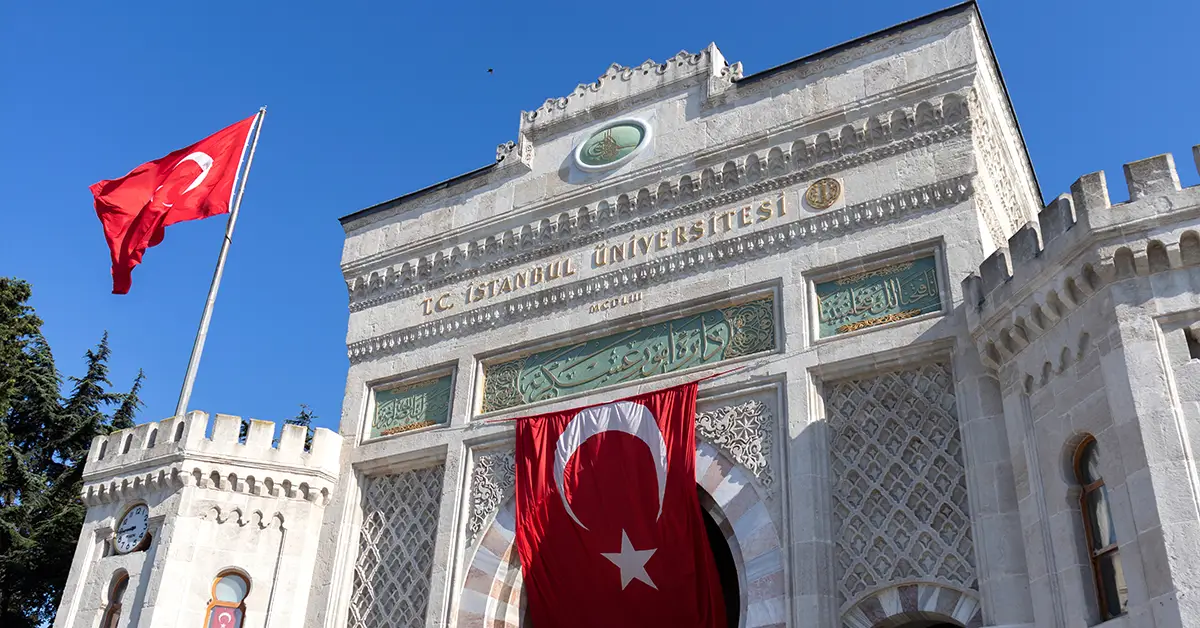
- Istanbul University (İstanbul Üniversitesi)— Turkey’s oldest university, founded in 1453 (immediately after Constantinople became Istanbul), and one of the oldest continuously operating universities in the world.
- Hacettepe Universityin Ankara — renowned for medicine, pharmacy and health sciences. Hacettepe University Hospital is Turkey’s leading medical research facility.
- Koç Universityin Istanbul — the leading private university, ranked highest in the private sector, teaching in English.
- Sabancı Universityin Istanbul — a private university with an interdisciplinary education model, renowned for engineering and business administration.
- Bilkent Universityin Ankara — Turkey’s first private non-profit university, teaching in English.
International rankings
On the QS World University Rankings 2025, several Turkish universities are in the world’s top 500: Koç University, METU, Sabancı University, Boğaziçi University, Istanbul Technical University and Bilkent University. This is a considerable achievement for a developing country.
Türkiye Bursları scholarships for international students
Türkiye Bursları (Türkiye Scholarships) is the Turkish Government’s scholarship programme for international students, regarded as one of the most generous scholarship programmes in the world.
- Scale: each year it awards around5,000 scholarshipsto students from 170 countries. As at 2025, more than 40,000 international students had graduated from this programme.
- The scholarship benefitscomprise: full tuition, a monthly living allowance (TL 800 for bachelor’s, TL 1,100 for master’s, TL 1,600 for doctoral students), return flights, health insurance, free accommodation, and a 1-year Turkish language course before starting the main programme.
- Who may apply: bachelor’s (for school leavers), and master’s and doctoral for students already holding a degree.
- The notable fields: medicine, engineering, social sciences, Islamic art, and Middle Eastern studies.
The annual application deadline is usually from January to February. Applications comprise transcripts, letters of recommendation, a study plan and language certificates (where held).
English and language education
Turkish is the main language of instruction in the state education system. However, many leading universities — particularly METU, Boğaziçi, Koç, Sabancı and Bilkent — teach100% in English. Students need a TOEFL or IELTS certificate (IELTS 6.0–6.5 minimum) or must pass the institution’s own English examination.
For universities teaching in Turkish, international students who do not speak Turkish take a 1-year language course at TÖMER (the Turkish language teaching centre) — fully funded by the Türkiye Bursları scholarship.
Living costs and tuition fees
Turkey is one of the most reasonably priced study destinations in the region.
- Public university tuition feesfor international students: from USD 300–1,500 a year depending on the field (medicine and engineering are more expensive).
- Private university tuition fees: from USD 5,000–20,000 a year, depending on the institution and field.
- Living costsin Istanbul and Ankara: around USD 400–700 a month (including accommodation, food, transport and entertainment). In smaller cities, costs may be 30–40% lower.
Achievements and challenges
Achievements: Turkey’s literacy rate reached 97% (2024), and the university enrolment rate rose sharply from 30% (2000) to more than 55% (2024). The number of international students has grown quickly — from around 50,000 (2010) to more than 320,000 (2024), placing Turkey among the world’s top 10 study destinations.
Challenges: quality gaps in education between urban and rural areas, and between the developed west and South-Eastern Anatolia. The pressure of the YKS examination is enormous for upper secondary pupils. University autonomy and academic freedom after the failed coup attempt of 2016 remain subjects of debate.
Conclusion
Turkish education has undergone profound modernisation over the past 100 years, from the traditional madrasa system to a modern education model on European standards. With more than 200 universities, a generous Türkiye Bursları scholarship programme, reasonable living costs and a strategic geographical position linking Europe and Asia, Turkey is establishing its role as a Euro-Asian regional education centre.
For investors interested inTurkey citizenship by investment, a quality education system is one of the important factors creating long-term appeal — particularly as many leading universities teach entirely in English and have partnerships with British, American and German universities.
Accompanying you on your journey in residency investment
The Prosperous Living Investment team advises on pathways, assesses profiles and manages investments transparently for every residency, citizenship and international property objective.
Free profile assessmentWhere life gets prosperous