


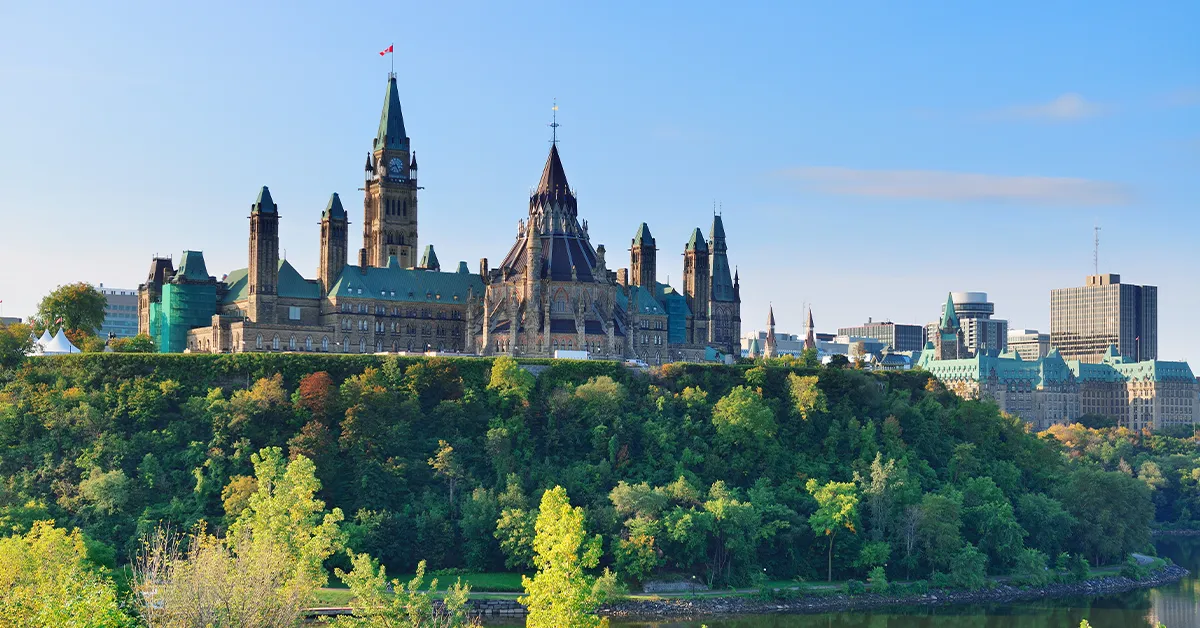
Ottawa is the capital ofCanada, lying in the south of the province ofOntario, at the confluence of the Ottawa River and the Rideau River. The city borders Gatineau in the province ofQuebec, and is the centre of the Ottawa – Gatineau census metropolitan area and the National Capital Region. With a city population of 1,017,449 and a metropolitan population of 1,488,307 at the 2021 Census, Ottawa is Canada’s 4th largest city and 4th largest metropolitan area.
Ottawa is Canada’s political centre and the seat of the Federal Government. The city is home to many foreign embassies, key architectural landmarks and central government institutions, including the Parliament of Canada, the Supreme Court, the Viceregal residence and the Office of the Prime Minister.
Message
Quick facts
- Other names:Ville d’Ottawa (French), Odàwàg (Algonquin)
- Nicknames: “O-town”
- Motto: “Advance – Ottawa – En Avant”
- Country: Canada
- Province: Ontario
- Coordinates: 45°25′29″B 75°41′42″T
- Founded:1826 (as Bytown)
- Incorporated: 1 January 2001
- Form of government:Single-tier municipality — Mayor and Council system
- Current mayor: Mark Sutcliffe
- City area: 2.790,31 km²
- Land area: 2.788,20 km²
- Urban area: 549,49 km²
- Metropolitan area: 8.046,99 km²
- Elevation: 70 m
- City population (2021):1,017,449 (ranked 4th)
- Population density:364.9 per km²
- Metropolitan population (2021):1,488,307 (ranked 4th)
- Demonym: Ottawan
- Time zone:UTC−05:00 (EST) / UTC−04:00 (EDT – summer)
- Postal code: K0A – K4C
- Telephone area code: 613, 343, 753
- Metropolitan GDP (2022):CA$88.0 billion
- GDP per capita (2022): CA$65.061
- Website: ottawa.ca
Considering a residency programme? The Prosperous Living Investment team assesses your profile free of charge and advises on the pathway that fits your goals.
History
A detailed article onThe history of Ottawa.
The pre-colonial period and early settlement
The Ottawa region was inhabited by Indigenous Algonquin people over many centuries, who used its rich river system for travel, fishing and trade. Europeans first explored the region in 1610, and by 1800 the first non-Indigenous settlement was established by Philemon Wright — a man from New England.
Wright pioneered the timber trade in the Ottawa Valley by floating timber down the river from the region to Quebec City, soon making logging the most important economic activity in the area.
Bytown and the birth of the Rideau Canal
In the 1820s, news of the British army’s project to build the Rideau Canal triggered a wave of land speculation in the region. By 1827, the town that had formed around the canal works was named after the military engineer Colonel John By — the man responsible for the entire Rideau waterway project. The Rideau Canal provided a safe route from Montreal to Kingston on Lake Ontario, bypassing the dangerous stretch of the St. Lawrence River adjoining New York State that had left supply ships bound for south-western Ontario vulnerable to attack in the War of 1812.
The canal works attracted thousands of workers from far and wide — Scottish stonemasons, Irish labourers, English engineers and forestry workers from the Ottawa Valley. More than 1,000 workers died during construction. Outside today’s Ottawa locks, a Celtic cross stands in memory of those who died for this historic work.
Becoming Canada’s capital
In 1857, Queen Victoria chose Ottawa as the joint capital of the Province of Canada — a decision representing a geographical compromise between Toronto and Montreal. Its position on the boundary between the English-speaking and French-speaking provinces, together with terrain naturally well suited to defence, made Ottawa the most appropriate choice both politically and strategically.
In 1855, Bytown was renamed Ottawa and formally incorporated as a city. This was the foundation of its transformation from a timber industry town into the political centre of a nation in the making.
The 20th century and modern development
The Hull–Ottawa fire of 1900 devastated 2/3 of the city of Hull and destroyed around 1/5 of Ottawa’s buildings from the Lebreton Flats area along Booth Street south to Dow’s Lake. Around 3,200 buildings were burnt down, causing damage estimated at CAD 300 million (in 2020 values), leaving 14% of Ottawa’s residents and 40% of Hull’s residents homeless.
The 20th century saw Ottawa gradually establish a dual identity: both Canada’s administrative capital and an emerging high-technology centre. Since the Second World War, the federal government has been the city’s largest employer. By the end of the 20th century, high technology played an increasingly important role and Ottawa earned the nickname Canada’s “Silicon Valley North”.
Geography
A detailed article onThe geography of Ottawa.
Location and terrain
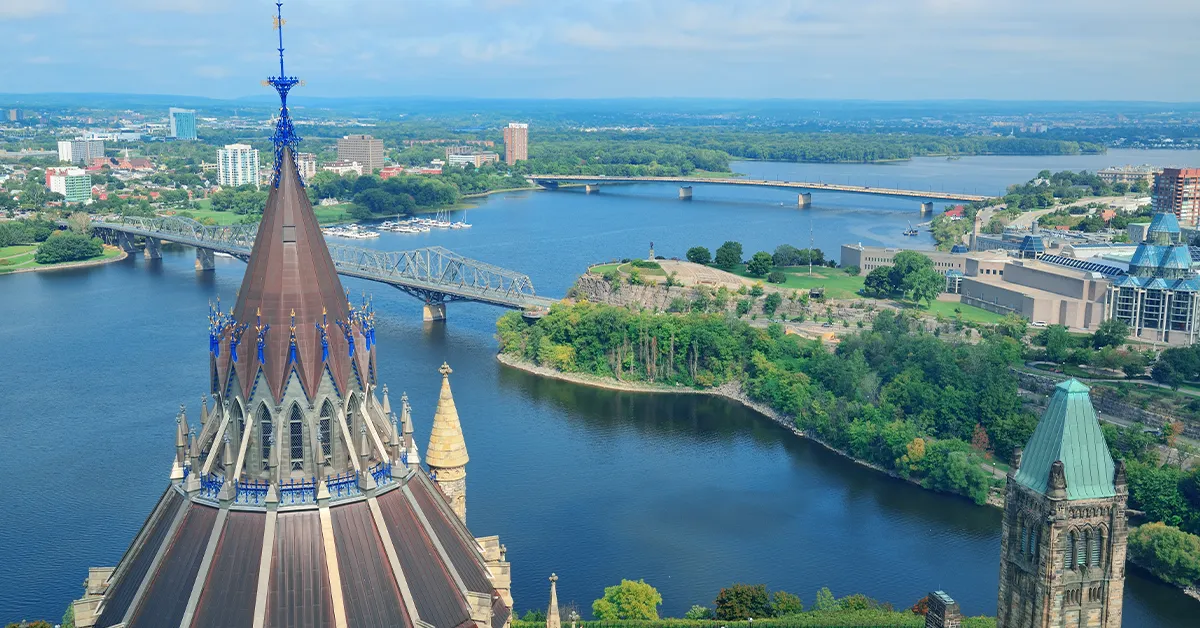
Ottawa lies on the south bank of the Ottawa River, at the confluence of 3 major rivers: the Ottawa, the Gatineau and the Rideau. The city spreads over an area of 2,790.30 km², lying around 200 km west of Montreal and around 365 km north-east of Toronto.
Ottawa sits at the meeting point of the Canadian Shield — an ancient Precambrian rock mass — and a fertile alluvial plain formed after the inland Champlain Sea receded. As a result the city is surrounded by farmland, rocky hills and forest, together with countless lakes, streams and major rivers.
Urban spatial structure
The Rideau Canal with its verdant banks divides the city into Upper Town to the west and Lower Town to the east. Historically, Upper Town was mainly an English-speaking Protestant community, while Lower Town was a French-speaking Catholic community.
On the other side of the Ottawa River, in Quebec territory, is the city of Gatineau — the result of merging the former Quebec cities of Hull and Aylmer. Although administratively 2 separate cities in 2 different provinces, Ottawa and Gatineau together with many neighbouring municipalities make up the National Capital Region, regarded as a single unified metropolitan area.
Climate
Ottawa’s climate is continental, with warm humid summers and cold winters usually with heavy snowfall. The average temperature in January is around –10°C, while in July the average reaches around 21°C. These 4 clearly distinct seasons not only shape residents’ way of life but also underpin many of the city’s characteristic festivals and outdoor activities.
Landscape and heritage
Parliament Hill and the central area
Parliament Hill is the seat of Canada’s federal government, overlooking the Ottawa River with its Gothic Revival granite Parliament buildings. The most distinctive of these is the Centre Block, housing the House of Commons with the 90 m Peace Tower. Facing the canal is the Château Laurier hotel — a historic 1912 building in the French Renaissance style.
The Rideau Canal — a UNESCO World Heritage Site
The Rideau Canal is a 202 km canal system linking the Ottawa River at Ottawa with the Cataraqui River and Lake Ontario at Kingston, Ontario. The canal opened to commercial shipping in 1832 and is the oldest continuously operating canal system in North America. On 29/06/2007, the Rideau Canal was designated a UNESCO World Heritage Site.
In winter, the canal surface within central Ottawa freezes and becomes a 7.8 km skating rink — recognised by the Guinness Book of Records as the world’s largest naturally frozen skating rink. The rink opens free of charge 24 hours a day from early January to early March and attracts an average of 1 million visits each season.
Economy
The public sector and the federal government
Ottawa’s economy rests on 3 pillars: the public sector, high-technology industry and tourism. The federal government has long been the city’s largest employer, and Ottawa has the highest per capita spending on research and development in Canada. Major research institutes based here include the National Research Council and Defence Research and Development Canada.
High technology
More than 1,500 high-technology companies, mostly in telecommunications, electronics and biotechnology, are based in the region and employ tens of thousands of workers. The Kanata area in the west of the city is regarded as the most important digital industry cluster, and was once home to Nortel Networks — Canada’s largest telecommunications corporation.
Tourism
Each year Ottawa welcomes around 11 million visitors, bringing CAD 2.3 billion into the local economy. Visitors come to see Parliament Hill, the National Gallery of Canada, the Canadian War Museum and many other historic sites.
Demographics
A detailed article onthe demographics of Ottawa.
Population
Ottawa was incorporated as a city in 1855, with a population at the 2021 Census of 1,017,449. The Ottawa-Gatineau metropolitan area was estimated at 1,466,000 in 2025, growing steadily year on year.
Language and bilingualism
The city provides municipal services in both of Canada’s official languages — English and French. There are 367,035 people, equivalent to 36.45% of Ottawa’s population, able to use both languages. It is the largest city in Canada where municipal services are provided in both English and French. Those with English as their mother tongue account for 58.18%, while French as a mother tongue accounts for 12.52%. In addition, 23.06% of the population have another mother tongue, including Arabic, Chinese, Spanish and Italian.
Immigrant communities
Ottawa is becoming one of Canada’s important immigrant reception centres. Immigrants coming to Ottawa are usually drawn by high-paying professional jobs or opportunities for post-secondary study. They generally have higher levels of education, higher incomes and higher employment rates than immigrants settling in other cities. Ottawa also receives the highest proportion of refugees and family-class immigrants among Canada’s major urban centres.
The largest ethnic minority groups are Black Canadians (8.5%), Arab Canadians (5.8%), South Asian Canadians (5.8%) and Chinese Canadians (4.6%).
Culture
A detailed article onThe culture of Ottawa.
The national museum system
Ottawa is home to 7 of Canada’s 9 national museums. The most prominent of these is the National Gallery of Canada — founded in 1880, holding the most comprehensive collection of Canadian art with 12,400 m² of exhibition space. The Canadian War Museum preserves military history through artefacts, personal stories and interactive material. The Canada Aviation and Space Museum is also a destination appealing to all ages with flight simulators and real cockpits.
The performing arts
Since 1969, Ottawa has been home to the National Arts Centre — a major performing arts centre with 4 stages, home to the National Arts Centre Orchestra. The city also has the Ottawa Little Theatre — the city’s oldest community theatre company, founded in 1913.
Festivals
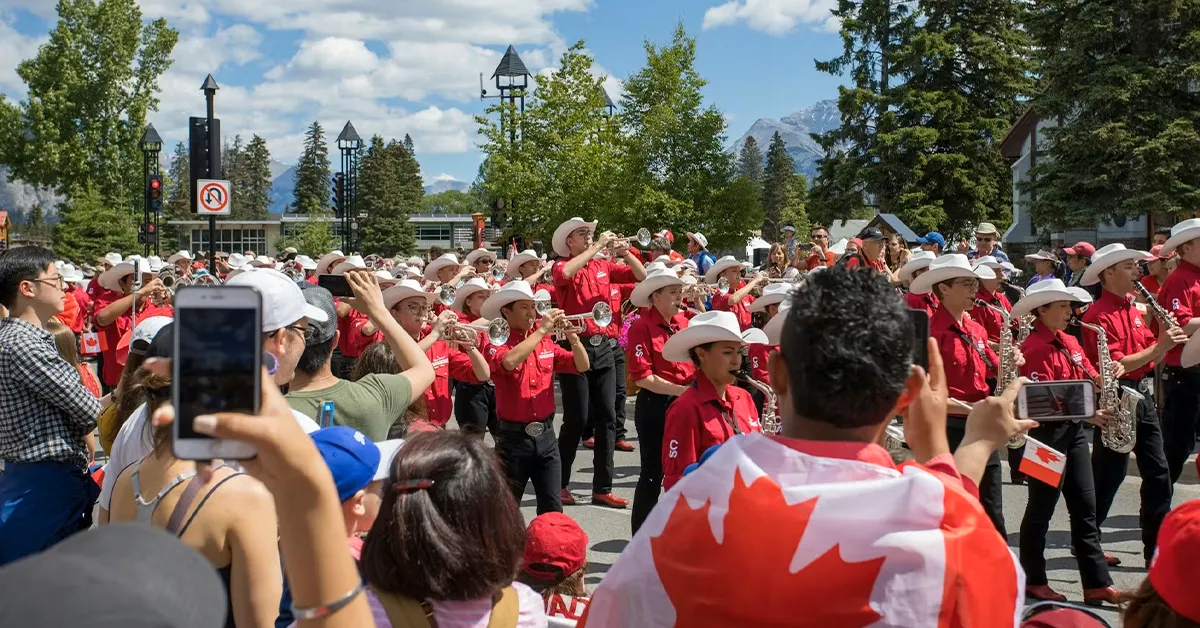
Ottawa has a rich festival calendar year round. Each February, the Winterlude winter festival runs over 3 weekends with skating and ice and snow sculpture on the Rideau Canal and in Confederation Park. May brings the Canadian Tulip Festival with more than 1 million tulips in bloom across the city. Canada Day on 01/07 is the biggest event of the year in Ottawa with a series of concerts, fireworks and large-scale celebrations on Parliament Hill, attracting millions of attendees.
Education
Ottawa is known as Canada’s most highly educated city, with more than 50% of the population holding a college or university qualification. The city has 2 major public universities.
The University of Ottawa, founded in 1848, is a bilingual institution, teaching in both English and French. Carleton University was founded in 1942, initially to meet the training needs of veterans returning after the Second World War. In addition, Algonquin College awards diplomas and certificates in technical and applied fields.
As at 2007, Ottawa was recorded as having the highest number of engineers, scientists and doctorate holders per capita in Canada.
Sport
Ottawa has a diverse professional sports scene. The Ottawa Redblacks are a professional football team competing in the Canadian Football League. The football club Atlético Ottawa competes in the Canadian Premier League — a team founded by the Spanish club Atlético Madrid. The Ottawa Black Bears compete in the National Lacrosse League.
Ottawa is also home to the NHL hockey team the Ottawa Senators — playing at the Canadian Tire Centre in the Kanata area — together with the minor league hockey team the Ottawa 67’s.
Transport
Ottawa has multimodal transport infrastructure that continues to expand. From October 2001, a pilot light rail line began operating, known as the O-Train, connecting central Ottawa with southern areas via Carleton University. The O-Train system was then significantly expanded during the 2020s with new electrified lines, forming an increasingly complete public transport network for the city.
Macdonald-Cartier International Airport is the city’s main aviation gateway, connecting Ottawa with major cities inside and outside Canada. On roads, Ottawa lies on the Toronto–Montreal corridor — Canada’s 2 largest cities — making trade and travel convenient in both directions.
Accompanying you on your journey in residency investment
The Prosperous Living Investment team advises on pathways, assesses profiles and manages investments transparently for every residency, citizenship and international property objective.
Free profile assessmentWhere life gets prosperous