


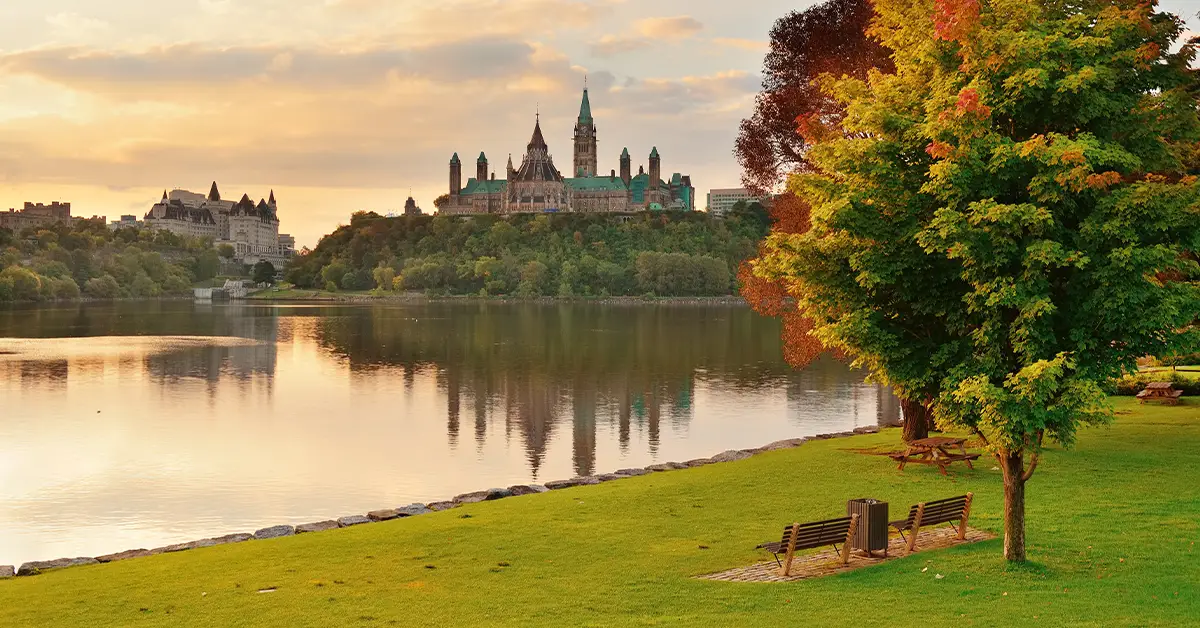
Ottawa’s history stretches back nearly two centuries, from a stopping point for loggers on the bank of the Ottawa River in the early 19th century to its position as the capital of one of the world’s leading developed nations.
The city’s story is bound up with the building of the Rideau Canal, the contentious selection of 1857, the birth of the Canadian Confederation in 1867, the fire disaster of 1916 and the large-scale amalgamation of 2001.
This article sets out in detail the main stages of development in Ottawa’s history, from the pre-colonial period with the presence of the Indigenous Algonquin people, through the decisive turning points of the 19th century, to its transformation into a modern interprovincial metropolis in the 21st century.
Message
The pre-colonial period and the Indigenous inhabitants
Before Europeans set foot here, the Ottawa Valley had long been home to Indigenous peoples of the Algonquin language group. Archaeological evidence records a human presence in this area from around 8,000 to 8,500 years ago, in the form of stone spear points.
Around 6,000 years ago, trade and communication networks had clearly formed between communities along the Ottawa River. By around 3,000 – 3,500 years ago, there is evidence of regular settlements at the mouth of the Gatineau River – the area now in central Ottawa – with hearths and heavy tools.
The Algonquin called the Ottawa River “Kitchissippi”, meaning “Great River”. This river was the main trade route, and also the link between the Great Lakes region and the St. Lawrence valley. In fact, the name “Ottawa” itself derives from “Odawa” – an Indigenous people specialising in trade in the region.
The French explorer Samuel de Champlain was one of the first Europeans to travel along the Ottawa River, in 1613. However, for nearly two centuries afterwards, the area served mainly as a fur transport route, with no permanent European settlement.
Considering a residency programme? The Prosperous Living Investment team assesses your profile free of charge and advises on the pathway that fits your goals.
The formation of Bytown (1800 – 1855)
The first European settlement in the area of present-day Ottawa was established in 1800, when Philemon Wright – a settler from Massachusetts – founded a farm on the north bank of the Ottawa River, at what later became the city of Hull (now part of Gatineau).
The building of the Rideau Canal
The decisive turning point in Ottawa’s formation was the building of the Rideau Canal. In 1826, Colonel John By of the British Royal Engineers arrived on the south bank of the Ottawa River, commanding the works to build a canal linking the Ottawa River with Lake Ontario at Kingston.
The canal’s original purpose was military. After the War of 1812 between Britain and the United States, the British colonial authorities recognised that the only waterway between Montreal and Lake Ontario – the St. Lawrence River – ran too close to the United States border and could easily be blockaded in the event of war. The Rideau Canal was built as a safer alternative route.
The works were carried out from 1826 to 1832, with thousands of workers taking part, mainly Irish and French. The settlement that formed around the works was named Bytown, in honour of Colonel By. This is regarded as the moment today’s city of Ottawa began.
The timber industry
After the Rideau Canal was completed in 1832, Bytown quickly transformed from a construction site into a timber trading centre. The Ottawa Valley was a region rich in white pine – a timber of high value to the British shipbuilding industry of the day.
Major timber companies appeared, with enormous rafts of logs lashed together and floated down the Ottawa River to Montreal and on to the port of Quebec. The timber industry turned Bytown into a lively but also chaotic industrial town, with a boisterous tavern culture and frequent brawls between Irish and French workers – the period known as the “Shiners’ War” in the 1830s and 1840s.
From Bytown to Ottawa
On 01/01/1855, Bytown was formally elevated to city status and renamed Ottawa – after the river and the Indigenous Odawa people. At that time the city’s population was around 7,800, with timber the main source of income.
That same year, the Bytown and Prescott Railway began operating, connecting Ottawa with the St. Lawrence River. This was an important infrastructure advance, and later became one of the reasons the city was chosen as capital.
Chosen as Canada’s capital (1857)
By the mid-1850s, the United Province of Canada – comprising the two colonies of Upper Canada (now Ontario) and Lower Canada (now Quebec) – was in a political crisis over choosing a permanent capital. Since 1841, the province’s capital had moved continuously between Kingston, Montreal, Toronto and Quebec.
Political deadlock
In 1856, the Attorney General of Canada proposed choosing a fixed capital. Members were entitled to vote between Toronto, Hamilton, Quebec, Montreal, Kingston and the newly renamed Ottawa. Over several rounds of voting, Quebec City won by 64–56, but the Legislative Council (the equivalent of today’s Senate) refused to grant the £50,000 budget for building the seat of government.
The deadlock continued into 1857. Over several rounds of voting, Ottawa received only 11 votes out of 130 members, but no city achieved a majority. The only solution was to ask Queen Victoria to decide.
Queen Victoria’s decision
On 24/03/1857, the Legislative Council of the Province of Canada passed a resolution submitted to Queen Victoria asking her to choose the capital. Sir Richard Scott – an Ottawa politician and former mayor of Bytown – drafted the “Memorial of Ottawa”, together with a map showing the city’s central position within the Province of Canada, for submission to the British Crown.
After consulting her advisers, Queen Victoria gave her decision on 31/12/1857: Ottawa would be the permanent capital of the Province of Canada. According to documents from theGovernment of Canada, the reasons for choosing Ottawa were threefold: its position far from the United States border reducing military risk, its clifftop terrain being easy to defend, and its intermediate position between the English-speaking and French-speaking regions helping balance the interests of the two communities.
This decision shocked the whole of Canada. One Toronto newspaper called Ottawa “a sub-Arctic lumber village”. The opposition led by George Brown submitted a petition asking the Queen to reconsider, and this petition was passed by the House of Assembly by 64–50 in July 1858. However, the Conservative government of John A. Macdonald and George-Étienne Cartier resigned in protest, and the Queen’s decision was ultimately upheld.
Building Parliament Hill (1859 – 1876)
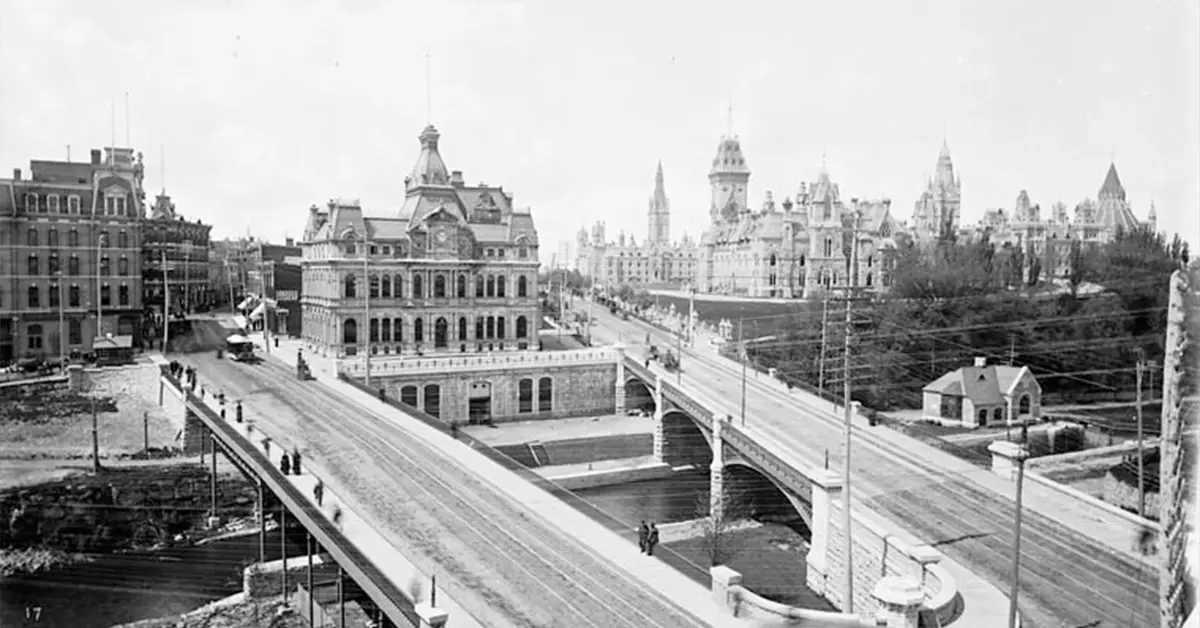
Construction of the Parliament buildings on Barrack Hill – now Parliament Hill – began in 1859. Three main buildings were designed in the Gothic Revival style, the official architectural style of the British Empire at the time. The design by Thomas Fuller and Chilion Jones was chosen after an international architectural competition.
The Barrack Hill site is a high limestone cliff overlooking the Ottawa River, and had been a British military barracks since the late 18th century. This site was chosen for its symbolism and defensibility, and because it lay close to the Rideau Canal and the old Bytown urban area.
Construction faced many difficulties, including a major financial scandal in the early 1860s that pushed costs to three times the original estimate. Even so, the main buildings were essentially completed in 1866, in time for the Confederation of 1867. The Library of Parliament, Thomas Fuller’s distinctive 16-sided design, was the last to be completed, in 1876.
The birth of the Canadian Confederation (1867)
On 01/07/1867, the British North America Act took effect, giving birth to the Dominion of Canada – the Canadian Confederation. The four original colonies – Ontario, Quebec, New Brunswick and Nova Scotia – united into a self-governing nation within the Commonwealth.
Ottawa formally became the capital of the new country. The first sitting of the Parliament of Canada took place in the Centre Block on 06/11/1867. This event cemented Ottawa’s position as the country’s political and administrative centre.
Over the following decades, the Confederation expanded rapidly: Manitoba and the Northwest Territories joined in 1870, British Columbia in 1871, Prince Edward Island in 1873, and Alberta and Saskatchewan in 1905. Each expansion brought a need for more space and administrative machinery in Ottawa, leaving the original Parliament buildings – once regarded as too large for a sparsely populated nation – cramped.
The great Parliament Hill fire (1916)
One of the most tragic events in Ottawa’s history occurred on the evening of Thursday 03/02/1916. At 8.37 pm, during a sitting of the House of Commons, fire broke out in the Reading Room of the Centre Block – where members habitually smoked despite the prohibition.
The fire spread very quickly because of the piles of paper and strong winds. Within minutes, the whole Centre Block was engulfed in flames. According to material fromGovernment of Canada, members and staff had to crawl through thick smoke or link hands to find a way out. Prime Minister Sir Robert Borden and his secretary also had to crawl on their hands and knees to escape the building.
By the early hours of 04/02/1916, the Centre Block was nothing but smouldering ruins. The Victoria Tower – the building’s emblem – had collapsed into the blaze. The House of Commons and Senate chambers together with countless documents, works of art and historic artefacts were completely destroyed. Seven people died in the disaster.
The one miracle was that the Library of Parliament was saved. A member of staff managed to close the heavy iron door between the Library and the rest of the building in time, saving the entire book collection and the 16-sided white pine architecture. To this day, the Library of Parliament remains the only part of the original 1866 building still standing.
The official inquiry concluded that the cause was accidental, most likely a cigar left in a waste paper bin. However, many Canadians – including some members – believed it was an act of sabotage by German agents, as the event took place in the middle of the First World War.
Reconstruction and the Peace Tower
Reconstruction of the Centre Block began immediately after the fire, under the direction of the architects John A. Pearson and Jean-Omer Marchand. The new building kept the Gothic Revival style but on a larger scale, its focal point being the 92.2 m Peace Tower – replacing the old Victoria Tower.
The Peace Tower was inaugurated in 1927 in memory of the Canadians who died in the First World War. The tower holds a carillon of 53 bells, and has become the most recognisable emblem of Ottawa and of Canada.
The Gréber Plan and modernisation (1945 – 1970)
After the Second World War, the Canadian government recognised that Ottawa – as the capital – needed planning worthy of the nation. Prime Minister William Lyon Mackenzie King invited the French architect Jacques Gréber to Ottawa to draw up a comprehensive plan.
The Gréber Plan was adopted in 1950, proposing major measures:
- Moving the railway system out of the city centre
- Building wide boulevards and a system of riverside parks
- Establishing a Greenbelt around the urban area to limit unplanned development
- Moving many government bodies to the north bank of the Ottawa River (Hull, now Gatineau), laying the foundations for a bilingual National Capital Region
This plan changed the face of Ottawa over the following three decades, transforming the city from an old industrial town into a clearly planned capital with extensive green space and dignified administrative architecture.
Modern historical events
The Constitution Act 1982
On 17/04/1982, Queen Elizabeth II signed the Constitution Act on Parliament Hill, formally patriating the Canadian Constitution from Britain. This event marked Canada’s complete legal independence from the legislative authority of the British Parliament, and was one of the most important moments in the country’s modern history.
The amalgamation of 2001
On 01/01/2001, the Government of Ontario carried out a large-scale amalgamation: the old city of Ottawa merged with 11 other municipalities of the Regional Municipality of Ottawa–Carleton. The result was a single new City of Ottawa, with an area of 2,790 km² and a population at the time of more than 750,000.
The amalgamation made Ottawa one of the largest cities in Canada by area, covering both the central urban area and the many surrounding rural, forest and agricultural areas. This is the city’s current administrative framework.
The Parliament Hill rehabilitation project
Since 2002, a large-scale rehabilitation and restoration project worth CAD 3 billion has been under way across the whole Parliament Hill complex. The project is expected to be completed after 2028, and includes structural strengthening, upgrading building services, conserving the original Gothic Revival architectural details and building modern support facilities underground.
Conclusion
Ottawa’s history is the story of a city continuously reinventing itself – from a chaotic timber outpost to an unexpected national capital by the decision of a queen thousands of kilometres away; from the ruins left by the great fire of 1916 rebuilt into North America’s most memorable Gothic Revival architectural emblem; and from an old industrial town into one of the world’s greenest capitals thanks to the Gréber Plan.
Understanding Ottawa’s history is the foundation for grasping why the city has such a distinctive administrative layout, such deep bilingual culture and such a particular role in Canadian political and social life. For Vietnamese readers interested inCanadian citizenshipor consideringsettling in Canada, this is useful background when looking into the province ofOntarioand the country’s capital.
Readers may also consult the overview article on the city ofOttawato learn about other aspects such as geography, the economy, education and investment opportunities in Canada’s capital.
Accompanying you on your journey in residency investment
The Prosperous Living Investment team advises on pathways, assesses profiles and manages investments transparently for every residency, citizenship and international property objective.
Free profile assessmentWhere life gets prosperous