


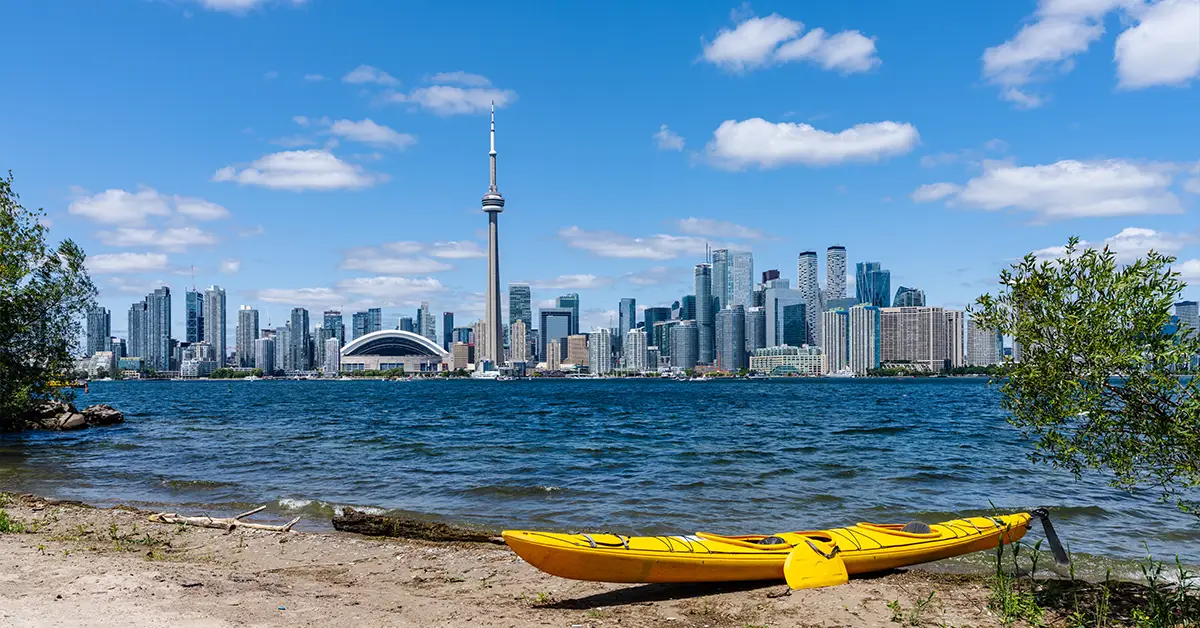
Canada is a country in North America, with an area of 9,984,670 km² — the second largest in the world after only Russia. The country stretches from the Atlantic Ocean in the east to the Pacific Ocean in the west, and up to the Arctic Ocean in the north, with ten provinces and three territories.
The land border between here and the United States runs 8,893 km — the world’s longest international border, while its coastline also holds the record as the world’s longest.
The capital isOttawa, and the largest city is Toronto — the country’s financial and economic centre. On the fourth-quarter 2025 estimate from theGovernment of Canada, the population reached 41,575,585, with a density of only 4.2 per km² — among the lowest in the world.
The country has two official languages, English and French, and ranks very highly on international indices for quality of life, education, government transparency and human rights.
Message
The name Canada and its meaning
The name Canada derives from kanata in the St. Lawrence Iroquoian language, meaning “village” or “settlement”. In 1535, Indigenous people living in the area of present-day Quebec City used this word to direct the French explorer Jacques Cartier to the village of Stadacona. Cartier then used the word kanata to refer to the whole area under the rule of Donnacona — the chief of Stadacona. By 1545, European books and maps had begun calling the land along the Saint Lawrence River Canada.
From the 16th century to the early 18th century, the name was used for the part of New France lying along the Saint Lawrence River. After Britain conquered New France, the area was called the Province of Quebec from 1763 to 1791, then split into the two colonies of Upper Canada and Lower Canada. In 1841, the two colonies merged into the Province of Canada. The Confederation was formally founded in 1867 by the British North America Act, establishing the country’s present name.
The official motto is “A mari usque ad mare” — Latin for “From sea to sea”. The national anthem is “O Canada”. The national day on 01/07 each year is called Canada Day, and before 1982 was named Dominion Day. The official currency is the Canadian dollar (CAD), and the ISO country code is CA.
Considering a residency programme? The Prosperous Living Investment team assesses your profile free of charge and advises on the pathway that fits your goals.
The history of Canada
A detailed article onThe history of Canada.
The first inhabitants migrated from Siberia across the Bering land bridge at least 14,000 years ago. Indigenous peoples — including the First Nations, Inuit and Métis — built many cultures with permanent settlements, agriculture, complex social structures and extensive trade networks. Estimates of the Indigenous population before Europeans arrived range from 200,000 to 2 million, with the figure of 500,000 formally recorded by the Royal Commission on Aboriginal Peoples.
The first European explorer to reach the east coast was the Viking Leif Erikson around the year 1000, who built a settlement at L’Anse aux Meadows on the northern tip of Newfoundland. There was then no further European exploration until 1497, when John Cabot claimed the Atlantic coast for King Henry VII of England. In 1534, the French explorer Jacques Cartier explored the Gulf of Saint Lawrence and, in the name of King Francis I of France, claimed the land of New France.
Samuel de Champlain laid the foundations for the first permanent European settlements at Port Royal in 1605 and Quebec City in 1608. New France expanded across the whole Saint Lawrence River valley, the Great Lakes, Hudson Bay and the Mississippi basin. Four wars between Britain and France broke out in North America in the period 1689–1763, ending with the Seven Years’ War. The Treaty of Paris 1763 transferred most New France territory to Britain.
After the American Revolution, the Constitutional Act 1791 divided the Province of Quebec into Upper Canada (English-speaking, nowOntario) and Lower Canada (French-speaking, nowQuebec). The War of 1812 between Britain and the United States was fought largely in this area but ended without any change of border. From 1815 to 1850, more than 960,000 English, Irish and Scottish people migrated to this land, fundamentally changing the population structure.
The Confederation was formally founded on 01/07/1867 by the British North America Act, initially comprising four provinces: Ontario, Quebec, Nova Scotia and New Brunswick. Manitoba (1870), British Columbia (1871), Prince Edward Island (1873), Yukon (1898), Alberta and Saskatchewan (1905) joined in turn. Newfoundland and Labrador was the last province to join, in 1949, and Nunavut became the third territory in 1999.
The country fought in the First World War with a prominent role at the Battle of Vimy Ridge. The Statute of Westminster 1931 formally recognised the country’s independence in foreign affairs. In the Second World War, more than 1 million troops served, playing an important role at Normandy and in the liberation of the Netherlands. The Canada Act 1982 ended all remaining legal dependence on the British Parliament, and enacted the Canadian Charter of Rights and Freedoms — marking complete legal independence.
The geography of Canada
A detailed article onThe geography of Canada.
The country spans six time zones from UTC-3.5 to UTC-8, with a total area of 9,984,670 km². The terrain is diverse, comprising vast boreal forest, Arctic tundra, the mighty Rocky Mountains, the fertile Prairie plains, and an Atlantic region full of islands. Most of the territory lies in the north, but around 80% of the population lives within 150 km of the United States border — because the northern climate and terrain are too harsh for permanent settlement.
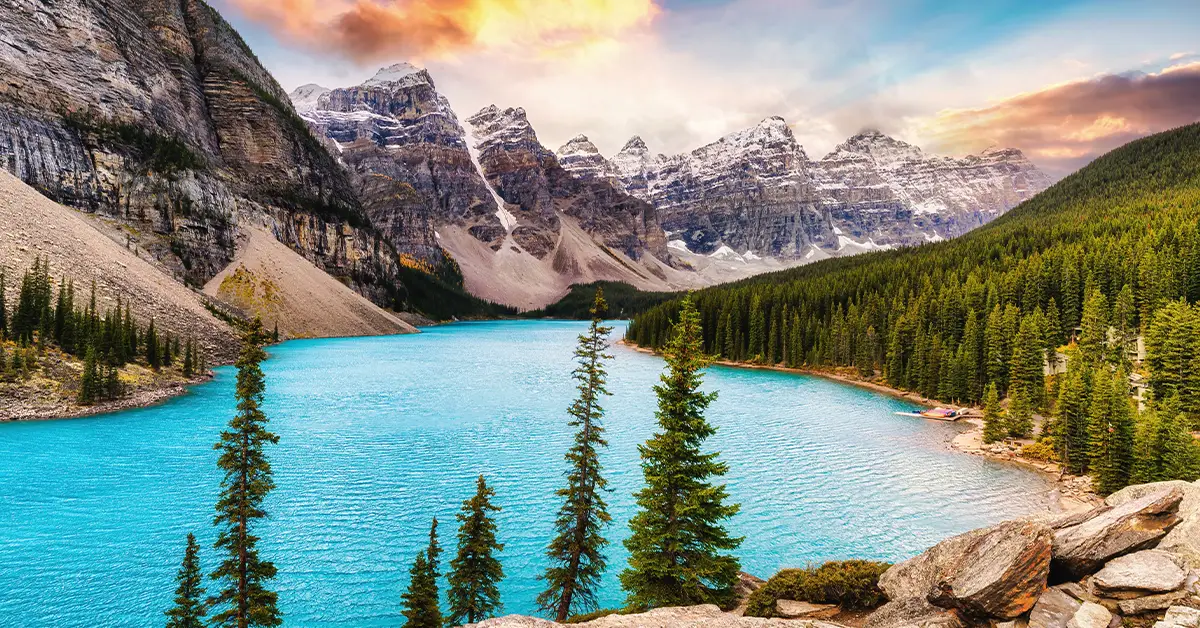
The country has the world’s longest coastline, at 202,080 km — longer than all other countries combined. The Rocky Mountains run along the western border between Alberta and British Columbia, with many famous national parks such as Banff, Jasper and Yoho. The Mackenzie River is the country’s longest at 4,241 km, flowing into the Arctic Ocean. Great Slave Lake and Great Bear Lake are two of the world’s largest lakes.
The climate varies enormously, from subtropical in the Okanagan Valley in British Columbia to polar cold in Nunavut. Southern Ontario and Quebec have a humid continental temperate climate with four distinct seasons. The Atlantic provinces have a humid maritime climate. The Prairie region (Manitoba, Saskatchewan, Alberta) has short hot summers and long, severely cold winters. The west coast of British Columbia has a mild oceanic climate with wet winters.
Natural resources are abundant. The country is one of the world’s largest producers of oil, gas, timber, uranium, nickel, zinc, gold and hydroelectric potential. Alberta has the world’s third largest oil sands reserves after Venezuela and Saudi Arabia. British Columbia and Quebec are two major aluminium production centres thanks to cheap hydroelectricity.
The politics of Canada
A detailed article onThe politics of Canada.
Canada is a federal parliamentary constitutional monarchy on the Westminster model. The head of state is King Charles III, represented by the Governor General, currently Mary Simon. The head of government is the Prime Minister, currently Mark Carney. The country is a member of the Commonwealth Realm.
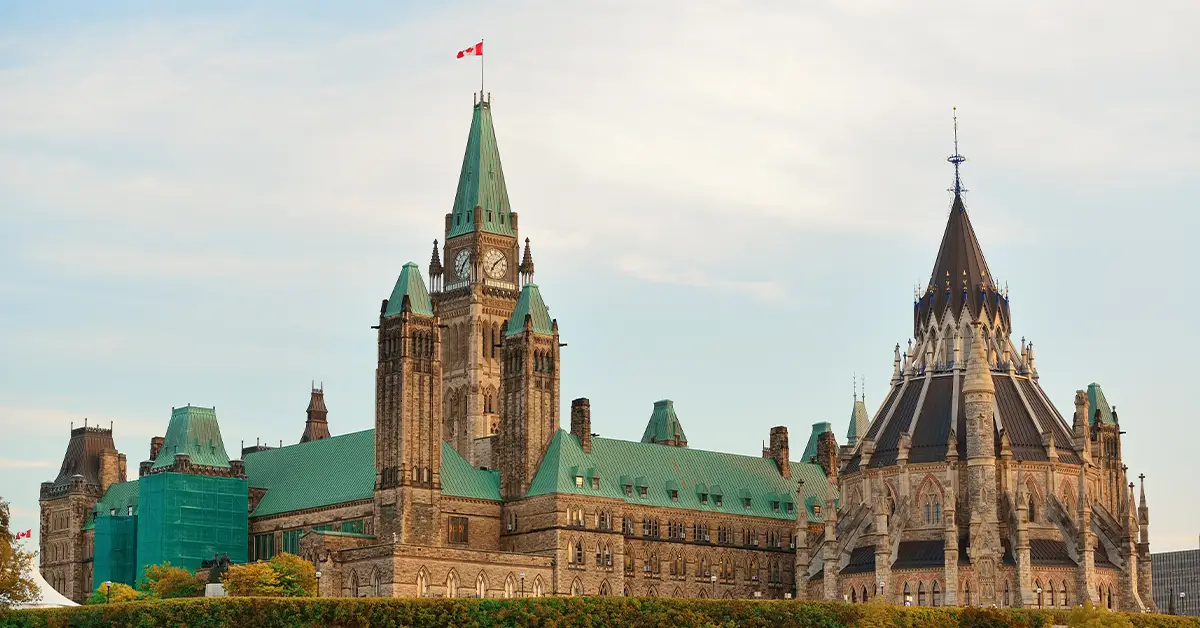
The Parliament of Canada, sitting in Ottawa, has two chambers: the Senate with 105 seats appointed by the Governor General on the Prime Minister’s recommendation, and the House of Commons with 343 directly elected seats. The major political parties are the Liberal Party, the Conservative Party, the New Democratic Party (NDP), the Bloc Québécois and the Green Party.
The federal system divides power between the central government and the 10 provinces (Alberta, British Columbia, Manitoba, New Brunswick, Newfoundland and Labrador, Nova Scotia, Ontario, Prince Edward Island, Quebec, Saskatchewan) together with 3 territories (Northwest Territories, Nunavut, Yukon). Each province has its own Legislative Assembly, Premier and Lieutenant Governor. Provinces have competence in health, education, natural resources and immigration (in co-ordination with the federal government through the provincial nominee programmes).
Immigration, Refugees and Citizenship Canada (IRCC)is the body administering the whole immigration system, including study permits, work permits, permanent residence and citizenship. The Canadian Charter of Rights and Freedoms (1982) is the foundational instrument protecting the basic rights of citizens and permanent residents, including freedom of expression, religion, movement, and the right to equality.
The economy of Canada
A detailed article onThe economy of Canada.
Canada has a highly developed economy, ranking 10th in the world by nominal GDP in 2025 at USD 2.284 trillion, and 16th by GDP at purchasing power parity (PPP) at USD 2.723 trillion. Nominal GDP per capita is USD 54,935, ranking 23rd in the world. The Human Development Index (HDI) in 2023 was 0.939 — in the “very high” group, ranking 16th globally. The Gini coefficient in 2024 was 29.2 — a low level of inequality.
The country is a member of the G7, G20, OECD, NAFTA (now USMCA), the WTO and many other international economic bodies. The economy is built on abundant natural resources combined with a well-developed international trade network. The United States is its largest trading partner, accounting for around 75% of exports. China, the European Union, Japan and Mexico are other important partners.
Services account for the largest share of GDP at around 70%, including finance, insurance, property, health, education, technology and tourism. Toronto is the national financial centre, with the Toronto Stock Exchange (TSX) ranking 9th in the world by capitalisation. Montreal is a centre for technology, aerospace and artificial intelligence. Vancouver is the trade gateway to Asia.
The main manufacturing sectors are cars (concentrated in Ontario), aircraft (Bombardier in Quebec), steel, chemicals and food processing. Agriculture is mainly in the Prairies and southern Ontario, with wheat, canola, barley, beef and milk the leading products. The energy sector is very important, with Alberta leading on oil and gas, while Quebec and British Columbia lead on hydroelectricity.
The demographics of Canada
A detailed article onThe demographics of Canada.
The population reached 41,575,585 on Statistics Canada’s fourth-quarter 2025 estimate, up from 36,991,981 at the 2021 census. Average population density of 4.2 per km² is among the lowest in the world. Around 95% of the population lives south of latitude 55°N, and 80% live within 150 km of the United States border. More than 80% of residents live in urban centres.
The three largest metropolitan areas are the Greater Toronto Area (GTA) with more than 6.2 million inhabitants, Greater Montreal with around 4.3 million, and Metro Vancouver with more than 2.6 million. The Quebec City – Windsor corridor in southern Ontario and Quebec is the most densely populated area, home to more than 18 million people — around 44% of the total population. Other major cities are Calgary, Edmonton, Ottawa-Gatineau, Winnipeg, Quebec City and Hamilton.
The country is one of the most multicultural and multi-ethnic societies in the world. At the 2021 census, around 23% of the population was born abroad — the highest proportion of any G7 country. The largest ethnic groups by ancestry are English, Scottish, Irish, French, German, Chinese, Indian, Italian, Filipino and Ukrainian. An official multiculturalism policy has been in place since 1971 — the first country in the world to make multiculturalism state policy.
English and French are the two official languages at federal level under the Official Languages Act 1969. Around 75% of the population speaks English as a mother tongue or main language, and 22% speaks French (mainly in Quebec). New Brunswick is the only officially bilingual province. Common heritage languages are Mandarin, Cantonese, Punjabi, Spanish, Tagalog, Arabic, Italian, German and Portuguese. Indigenous languages such as Cree, Inuktitut and Ojibwe are also recognised in some territories.
Education in Canada
A detailed article onEducation in Canada.
The education system is administered at provincial level, with no federal ministry of education, so there are certain differences between provinces. Public education is free from kindergarten to grade 12, usually divided into primary (K-6 or K-8), middle (7-9) and secondary (9-12). High school completion rates are among the highest in the OECD.
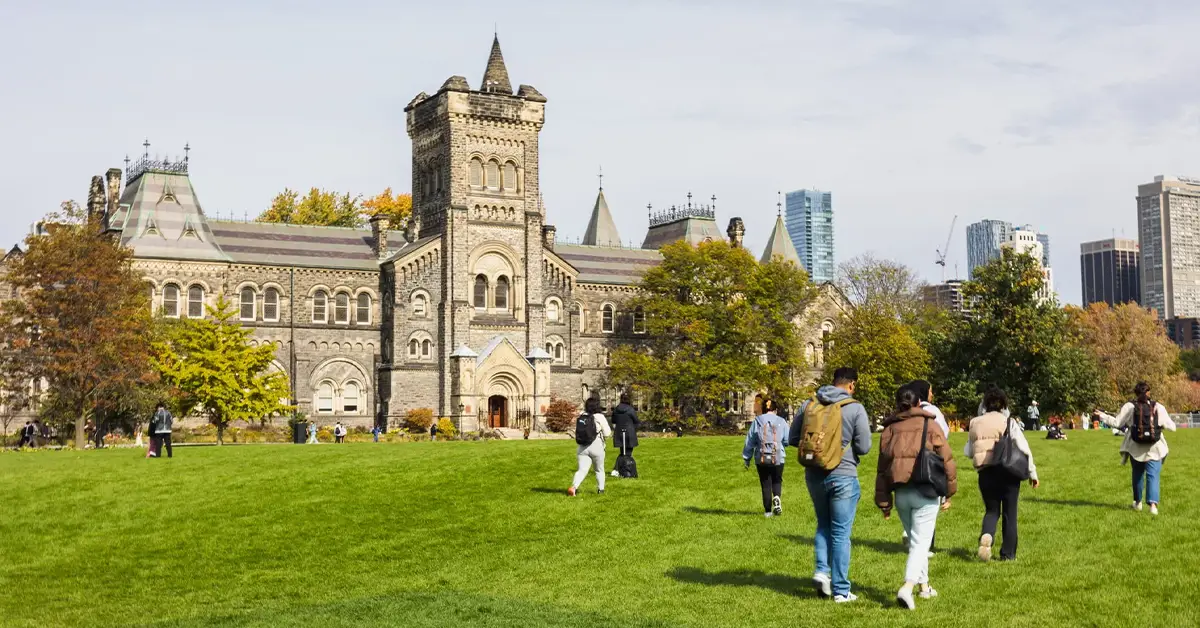
The country has more than 100 public universities and nearly 200 colleges, officially listed among thedesignated learning institutions in Canada (DLI). The leading universities, regularly in the global top 100, are the University of Toronto, McGill University, the University of British Columbia, the University of Waterloo, McMaster University and the Université de Montréal. Reasonable study costs compared with the United States and the United Kingdom, combined with high-quality education, make the country a popular study destination.
International students wishing to study need to apply for aStudy Permitand hold a validLetter of Acceptance (LOA) from a DLI. After graduating from an eligible programme, students may obtain aPost-Graduation Work Permit (PGWP)of up to 3 years, opening the way to permanent residence through Express Entry or aprovincial nominee programme (PNP).
The “study – work – permanent residence” route is a popular immigration path, particularly for young people from Vietnam and other Asian countries. International students contribute significantly to the economy, estimated at more than CAD 22 billion a year through tuition fees, living expenses and part-time work.
The culture of Canada
A detailed article onThe culture of Canada.
The culture is shaped by the combination of First Nations Indigenous heritage, French-British colonial traditions and decades of diverse immigration from around the world. The official multiculturalism policy (1971) recognises and encourages ethnic diversity as a core part of national identity — differing from the United States “melting pot” model. National symbols include the maple leaf (on the flag since 1965), the beaver, the Canadian horse and the Canada Goose.
The emblematic sport is ice hockey — the official winter sport. The NHL has 7 teams in the country: the Montreal Canadiens, the Toronto Maple Leafs, the Vancouver Canucks, the Ottawa Senators, the Calgary Flames, the Edmonton Oilers and the Winnipeg Jets. Lacrosse is the official summer sport. Canadian football, played to its own rules, is popular through the Canadian Football League (CFL). The Toronto Blue Jays are the country’s only baseball team in MLB.
Art and literature are notable for many international names. Famous writers include Margaret Atwood, Alice Munro (Nobel Prize in Literature 2013), Michael Ondaatje, Yann Martel and Mordecai Richler. In music there are Celine Dion, Bryan Adams, Shania Twain, Justin Bieber, Drake, The Weeknd and Michael Bublé. The country’s cinema has produced many names such as James Cameron, Denis Villeneuve, David Cronenberg, Xavier Dolan, Ryan Reynolds, Ryan Gosling and Keanu Reeves.
The cuisine reflects this multiculturalism with signature dishes such as poutine (chips with cheese curds and gravy), tourtière (Quebec meat pie), butter tarts, Nanaimo bars, and Montreal smoked meat. The rich cultural festival calendar includes the Calgary Stampede, the Toronto International Film Festival, the Montreal Jazz Festival and the Festival d’été de Québec. Canada Day (01/07) and Thanksgiving (the second Monday in October) are two important national holidays.
Settlement and immigration in Canada
A detailed article onSettling in Canada.
The country is one of the world’s leading immigration destinations, with a target of welcoming 485,000 to 500,000 new permanent residents a year under the Immigration Levels Plan for 2025–2027.Settling in Canadamay be pursued through a number of different routes, suiting each applicant’s profile and objectives.
Express Entryis the electronic application management system for three federal skilled immigration programmes: the Federal Skilled Worker Program, the Federal Skilled Trades Program and the Canadian Experience Class. Applications are ranked using theComprehensive Ranking System (CRS)based on age, education, work experience, language ability and other factors. IRCC publishes results periodically, inviting the highest-scoring candidates to apply for permanent residence. Candidates need to obtain anEducational Credential Assessment (ECA)for foreign qualifications and achieve the minimum English/French level under the CLB.
The Provincial Nominee Program (PNP)allows each province to select immigrants matching local economic needs. Each province has its own streams — for example the OINP in Ontario, the BC PNP in British Columbia, the AAIP in Alberta and the SINP in Saskatchewan. Quebec has an immigration programme independent of the federal system (Arrima, PEQ, QSWP) because of its cultural and linguistic privileges. Candidates nominated by a province receive an additional 600 CRS points where they already have a profile in Express Entry.
Other routes includeresidence by investment in Canada(the Start-up Visa, Self-Employed Persons, and provincial entrepreneur programmes), family sponsorship (spouse, children, parents/grandparents through the PGP programme), skilled worker programmes through an LMIA, and pilot programmes such as the RCIP (rural) and FCIP (Francophone communities). After becoming permanent residents, immigrants may apply forCanadian citizenshipafter 3 years of residence (1,095 days out of 5 years).
Tourism in Canada
A detailed article onTourism in Canada.
Canada welcomed more than 22 million international tourist visits a year before the pandemic, with the United States, the United Kingdom, France, China and Germany the largest source markets. The tourism industry contributes around 2% of GDP and employs more than 1.8 million people. The notable destinations are the Rocky Mountains with Banff and Jasper parks, Niagara Falls, Old Quebec (a UNESCO World Heritage Site), and the cities of Toronto, Vancouver and Montreal.
In the east, Toronto offers a multicultural urban experience with the CN Tower, the Royal Ontario Museum and the Distillery District. Ottawa has the Parliament buildings, the Museum of Civilization and the Rideau Canal. Montreal combines European architecture with a vibrant culture in Old Montreal and Mount Royal. Quebec City is the only walled city in North America north of Mexico.
The west attracts visitors with its magnificent nature. Vancouver is one of the world’s most liveable cities, with Stanley Park, Granville Island and Grouse Mountain. Whistler is a leading ski resort, which hosted the 2010 Winter Olympics. Banff and Jasper have Lake Louise, Moraine Lake and the Icefields Parkway — one of the world’s most beautiful drives. Niagara Falls is the most popular tourism icon, drawing around 14 million visitors a year.
The north offers unique experiences with the Northern Lights at Yellowknife and Whitehorse, Inuit culture in Nunavut, and the Parc national de la Gaspésie in Quebec. The Atlantic provinces are notable for the Cabot Trail in Nova Scotia, Gros Morne National Park in Newfoundland (a UNESCO World Heritage Site) and Prince Edward Island — the home of Anne of Green Gables.
Canadian transport infrastructure
The country has an extensive transport network serving a nation of enormous area and low population density. The road system runs more than 1.4 million km — the 7th longest in the world, of which the Trans-Canada Highway runs 7,821 km linking the Atlantic and the Pacific, passing through all 10 provinces. Private car ownership is high, particularly outside the major cities.
Air travel is the common means of long-distance travel because of the great distances. Air Canada and WestJet are the two largest airlines. Toronto Pearson International Airport (YYZ) is the country’s busiest airport with more than 50 million passengers a year, followed by Vancouver International Airport (YVR), Montréal–Pierre Elliott Trudeau International Airport (YUL) and Calgary International Airport (YYC).
VIA Rail Canada provides passenger rail services, the most notable routes being The Canadian (Toronto – Vancouver, 4 nights) and the Ocean (Montreal – Halifax). Freight rail operated by Canadian National Railway (CN) and Canadian Pacific Railway (CPKC) is the country’s commercial artery. Urban public transport is most developed in Toronto (TTC), Montreal (STM) and Vancouver (TransLink), with subway, bus and commuter rail systems.
Accompanying you on your journey in residency investment
The Prosperous Living Investment team advises on pathways, assesses profiles and manages investments transparently for every residency, citizenship and international property objective.
Free profile assessmentWhere life gets prosperous