


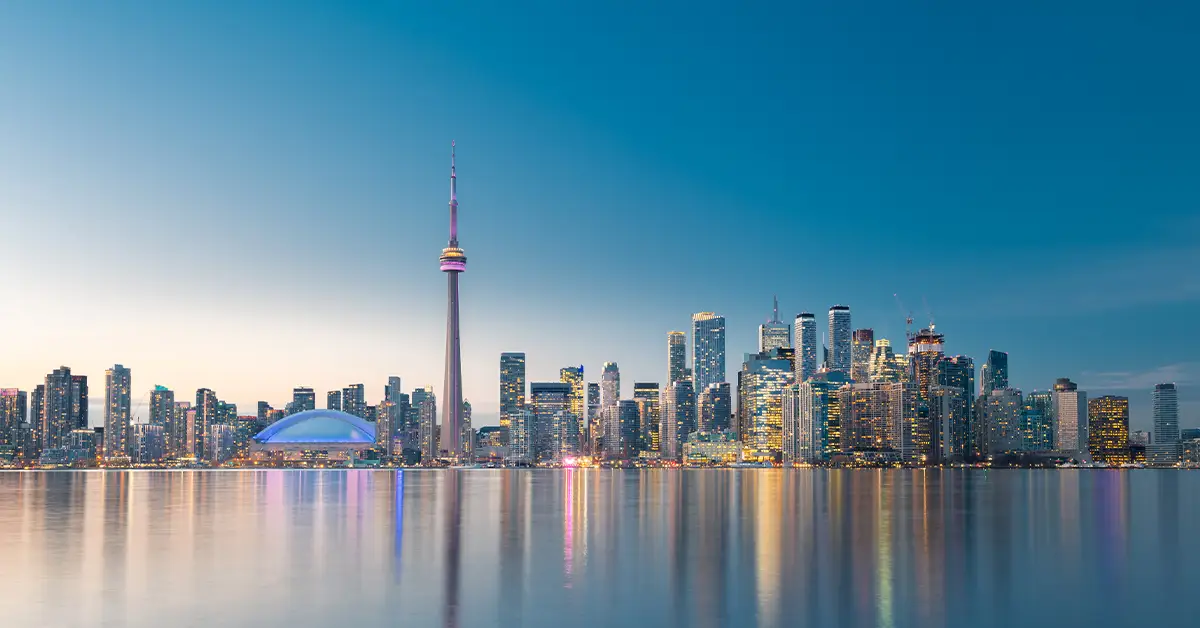
Ontario is Canada’s most populous province and has its largest economy, lying in Central Canada. The province’s capital is Toronto — also the country’s largest city — and it contains the federal capital, Ottawa. According to theGovernment of Ontario, Ontario has an area of more than 1 million km², larger than France and Spain combined, stretching from Hudson Bay in the north to the Saint Lawrence River and the Great Lakes in the south.
With a population estimated at 16.19 million in the fourth quarter of 2025 — more than 38% of Canada’s total population — the province plays the role of the country’s economic, political and cultural centre. The province’s GDP reached CAD 1,178.092 billion in 2024, the highest in Canada. It is also the leading destination for new immigrants to Canada, particularly through programmes such as theExpress EntryandOntario Immigrant Nominee Program (OINP).
Message
The name and symbols of Ontario
The name Ontario is thought to be of Indigenous origin, with two main explanations. In Huron (Wyandot), Ontarí:io means “great lake”. Another explanation holds that the name derives from skanadario in the Iroquoian languages, meaning “beautiful water” or “sparkling water”. Both readings fit the region’s geography — the province has around 250,000 freshwater lakes.
The name first appeared in 1641, referring to the land on the northern shore of the easternmost part of the Great Lakes. When the Canadian Confederation was formed in 1867, the name was formally chosen for the new province. Before that, the area had borne other names such as Upper Canada (1791–1841) and Canada West (1841–1867).
The province’s official motto in Latin is “Ut Incepit Fidelis Sic Permanet”, translated as “Loyal she began, loyal she remains” — reflecting the history of loyalty to the British Empire of the United Empire Loyalists who settled here after the American Revolution. The province’s symbols include the white trillium, the Eastern white pine and the common loon.
Considering a residency programme? The Prosperous Living Investment team assesses your profile free of charge and advises on the pathway that fits your goals.
The history of Ontario
A detailed article onThe history of Ontario.
The history of this land stretches back around 11,000 years, beginning with the arrival of Paleo-Indian Indigenous peoples after crossing the Bering land bridge from Asia to North America. In ancient times, hunter-gatherer communities and later Iroquoian nations such as the Neutral Confederacy, the Erie and the Wendat (Huron) settled in the south, while Algonquian nations such as the Ojibwe predominated in the north.
The first Europeans to set foot in the region were the French explorer Étienne Brûlé in 1610–1612. Samuel de Champlain reached Lake Huron in 1615. The French called the area Pays d’en Haut (the Upper Country) and allied with most of the Indigenous nations to trade furs. In 1611, the English explorer Henry Hudson claimed Hudson Bay for England, and the area was later known as Rupert’s Land.
In the Seven Years’ War (1754–1763), the British defeated the French and their Indigenous allies. The Treaty of Paris 1763 transferred most French North American territory to Britain. The Quebec Act reorganised the area into the Province of Quebec. After the American Revolution, around 5,000 United Empire Loyalists migrated to this land in the period 1782–1784. The Constitutional Act 1791 divided Quebec into Upper Canada (today’s province) and Lower Canada (today’s Quebec).
In the War of 1812, American forces invaded Upper Canada but were repelled by British troops, Canadian militia and First Nations warriors. After the war, waves of immigration from Europe — mainly from Britain and Ireland — replaced the flow of immigration from the United States. The 1837 rebellions led by William Lyon Mackenzie led to important political reform: responsible government was established in 1848.
The British North America Act took effect on 01/07/1867, founding the Canadian Confederation with four original provinces: Nova Scotia, New Brunswick, Quebec and Ontario. The Province of Canada was divided in two so that each language group had its own province. Toronto formally became the provincial capital. Under Premier Oliver Mowat (1872–1896), the province rose to become Canada’s economic centre, with manufacturing and railways developing strongly.
The 20th century saw a boom in the motor industry (Ford Canada 1904, General Motors Canada 1907), mineral extraction in the north and rapid urbanisation. After the Second World War, it became the main destination for European immigrants, and from the 1970s for diverse immigration from Asia, Latin America and Africa. Toronto overtook Montreal to become Canada’s largest city after the Parti Québécois won power in Quebec in 1976, prompting many businesses and English speakers to move to the province.
The geography of Ontario
A detailed article onThe geography of Ontario.
Located in Central Canada, it is the second largest province by area after Quebec, with a total area of 1,076,395 km². The province borders Manitoba to the west, Hudson Bay and James Bay to the north, and Quebec to the east and north-east. To the south, it borders the United States states of Minnesota, Michigan, Ohio, Pennsylvania (across Lake Erie) and New York, with a total border of around 2,700 km — almost all of it along rivers and lakes.
The province’s terrain divides into three main regions. The Canadian Shield covers more than half the area in the north-west and centre, a sparsely populated region with extensive forest and lakes and rich in minerals. The Hudson Bay Lowlands in the far north are mainly wetland, with almost no population. The Great Lakes – Saint Lawrence Valley in the south is a fertile temperate region, home to 94% of the population and most of the agriculture, industry and urban development.
The province’s highest point is Ishpatina Ridge in Temagami, in the North-East, at 693 m. Niagara Falls — one of the world’s most famous waterfalls — lies on the boundary between the province and New York State, and is part of the Niagara Escarpment. The Saint Lawrence Seaway system allows ocean-going ships to travel from the Atlantic deep inland as far as Thunder Bay in the North-West.
The province’s climate varies considerably by region. The south has a humid continental temperate climate, with warm to hot summers and cold winters. Toronto has average July temperatures of 27°C/18°C and January temperatures of 0°C/-7°C. The north has a subarctic climate with long, severely cold winters, where temperatures may fall to -40°C. Windsor in the South-West has the most lightning strikes in Canada, averaging 33 thunderstorm days a year. The province also has the most tornadoes in Canada, averaging 11 a year.
The ecosystems are diverse, with Carolinian forest in the South-West, Great Lakes lowland forest in the east, and Central and Mid-West Canadian Shield forest. Point Pelee National Park is the southernmost point of mainland Canada, at latitude 41°54’N — south of California’s northern border.
The politics of Ontario
A detailed article onThe politics of Ontario.
The province has a parliamentary constitutional monarchy, like Canada’s other provinces. The nominal head is the Lieutenant Governor, representing the Sovereign of Canada in the province, currently Edith Dumont. The actual head of the executive is the Premier, currently Doug Ford of the Progressive Conservative Party.
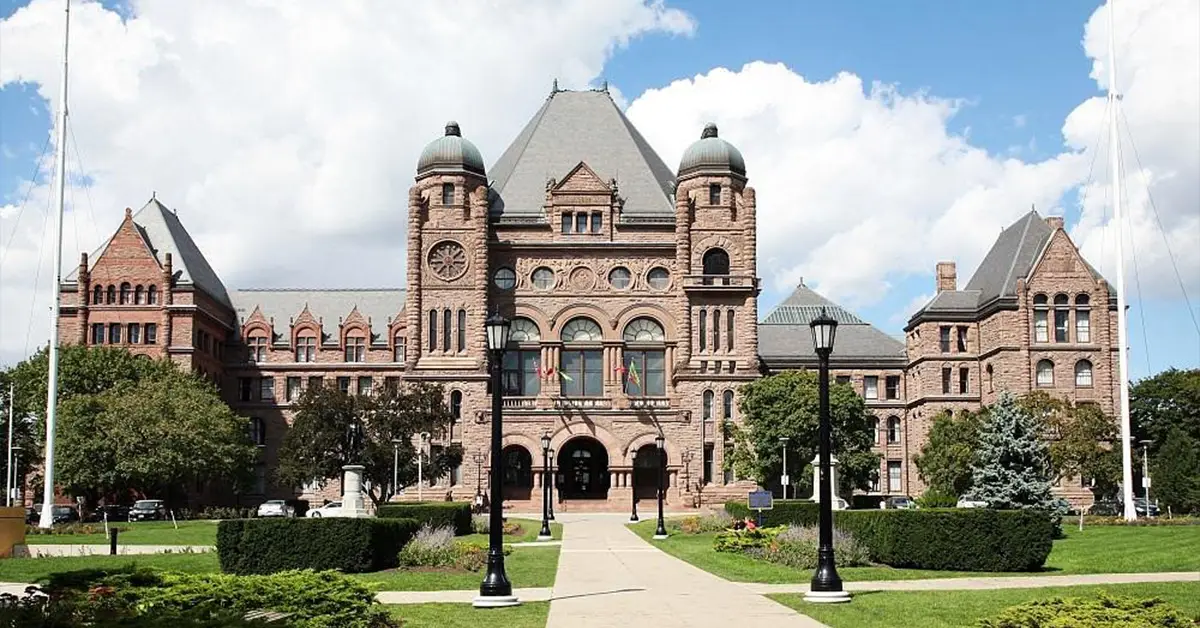
The legislature is the Legislative Assembly of Ontario, sitting at the Queen’s Park building in Toronto. The Assembly has 124 seats, directly elected by voters for 4-year terms. The main political parties are the Progressive Conservative Party, the Liberal Party, the New Democratic Party (NDP) and the Green Party.
At federal level, the province holds 122 of the 343 seats in the Canadian House of Commons — equivalent to 35.6%, the highest proportion of any province. It also has 24 of the 105 Senate seats. Because of its large population and economy, federal election results here usually determine which government holds power in Ottawa.
The federal capitalOttawalies in the east of the province, on the bank of the Ottawa River opposite Gatineau, Quebec. It is home to the Parliament of Canada building, foreign embassies, the headquarters ofImmigration, Refugees and Citizenship Canada (IRCC)and many other federal government bodies.
The economy of Ontario
A detailed article onThe economy of Ontario.
Ontario has Canada’s largest economy, with GDP of CAD 1,178.092 billion in 2024. GDP per capita is CAD 73,064, ranking 8th among the provinces. The province accounts for around 38% of Canada’s total GDP and is the country’s main economic driver. Its economy has moved from traditional agriculture and manufacturing to a diverse, services-led structure.
Services account for the largest share of GDP, including finance, insurance, property, trade, law, health, education, information technology and tourism. Toronto is Canada’s largest financial centre, home to the Toronto Stock Exchange (TSX) — the world’s 9th largest stock exchange by market capitalisation. The Bay Street financial district is the country’s banking centre.
Manufacturing is the second industrial pillar, employing around 830,000 workers. The province is the second largest car manufacturing region in North America, after only Michigan. Major manufacturers such as Ford, General Motors, Stellantis, Toyota and Honda all have plants here, concentrated in the cities of Windsor, Oakville, Oshawa and Cambridge. The cleantech sector leads Canada on employment, exports and GDP contribution, having attracted nearly CAD 50 billion of new investment since 2020.
Agriculture remains an important sector despite its small share. The province holds more than half of Canada’s highest-quality (Class 1) farmland, concentrated in the South-West. The main agricultural products are maize, soybeans, milk, beef, poultry, wine (the Niagara region) and soft fruit. Mining plays an important role in the north, with Sudbury a global nickel centre, Timmins a gold centre, and the Ring of Fire region being developed for chromite, zinc and copper extraction.
The demographics of Ontario
A detailed article onThe demographics of Ontario.
According to the 2021 Canadian census, Ontario had 14,223,942 inhabitants, living in 5,491,201 households. The fourth-quarter 2025 estimate is 16,191,372, growth of 5.8% on 2016. Average population density is 15.94 per km², but the distribution is very uneven — 94% of the population is concentrated in the south, although that area accounts for only 13% of the province’s area.
The largest population centres are Toronto (the provincial capital), Ottawa (the federal capital), Hamilton, London, Kitchener-Waterloo, Windsor and Mississauga. The Greater Toronto Area (GTA) is Canada’s largest metropolitan area with more than 6.2 million inhabitants. The Golden Horseshoe around the western end of Lake Ontario is the most developed urban region, with more than 9 million inhabitants.
This province is Canada’s most multicultural. At the 2021 census, around 30% of the population was born abroad — the highest proportion of any province. The largest ethnic groups are English, Scottish, Irish, French Canadian, Italian, German, Chinese, Indian, Filipino and Jamaican. Toronto is one of the most diverse cities in the world, with more than 50% of its population born abroad and more than 200 ethnic groups.
The official language is English, but there is a significant French-speaking community here (around 4.7% of the population), protected under the French Language Services Act 1989. The largest Francophone communities are in the east of the province (Ottawa, Cornwall) and the north-east (Sudbury, Timmins). Beyond English and French, other widely spoken languages include Mandarin, Cantonese, Punjabi, Italian, Portuguese, Tagalog and Arabic.
Education in Ontario
A detailed article onEducation in Ontario.
The education system here is regarded as one of the highest-quality in Canada and the world. Public education is free for children from kindergarten to grade 12, with a parallel system of secular public schools and Catholic schools guaranteed by the Canadian Constitution. There is also a French-language school system serving the Francophone community.
The province has 23 public universities and 24 colleges, listed among thedesignated learning institutions in Canada (DLI). The leading universities are the University of Toronto (usually ranked in the world’s top 25), McMaster University, Western University, Queen’s University, the University of Waterloo (renowned for engineering and technology), and the University of Ottawa. International students may find out more in the articlestudying in Ontario – Canada.
The province’s college system (Ontario Colleges) offers hands-on applied programmes with shorter durations and lower costs than university. Seneca, George Brown, Humber, Centennial, Sheridan and Conestoga are the largest, offering programmes from short certificates through to applied bachelor’s degrees. International students graduating from eligible programmes may obtain aPost-Graduation Work Permit (PGWP), opening the way to settlement through Express Entry or the OINP.
The province invests heavily in research and innovation. The Toronto-Waterloo corridor is regarded as North America’s second “Silicon Valley”, with a strongly developed technology start-up ecosystem. The MaRS Discovery District in Toronto is North America’s largest innovation centre focused on biotechnology, clean energy and artificial intelligence.
The culture of Ontario
A detailed article onThe culture of Ontario.
The culture here reflects the province’s ethnic diversity and complex history. As Canada’s main immigration gateway for more than a century, it combines the Anglo-French traditions of the colonial period with First Nations Indigenous cultures and dozens of immigrant communities from around the world. Toronto has been recognised by UNESCO as the “world’s most multicultural city” by population diversity.
Art and literature flourish here. The Royal Ontario Museum and the Art Gallery of Ontario in Toronto are the country’s two largest museums. The National Gallery of Canada in Ottawa displays the national art collection. The Toronto International Film Festival (TIFF) — held annually in September — is one of the world’s most prestigious film festivals, and is often seen as a stepping stone to the Oscars. Famous writers born in the province include Margaret Atwood, Alice Munro (Nobel Prize in Literature 2013) and Michael Ondaatje.
Sport is an important part of life here. The province has six major professional sports teams: the Toronto Maple Leafs (NHL), the Toronto Raptors (NBA — the only Canadian team), the Toronto Blue Jays (MLB — the only Canadian team), Toronto FC (MLS), the Toronto Argonauts and the Hamilton Tiger-Cats (CFL). Ice hockey is the emblematic sport, with the Hockey Hall of Fame located in Toronto. Other major events include the Canadian Grand Prix (Formula 1 in neighbouring Montreal), the Honda Indy Toronto and the Canadian Open (tennis).
The food here is diverse thanks to influences from many cultures. Signature dishes include the peameal bacon sandwich (Toronto), butter tarts, poutine (shared with Quebec) and Canadian bacon. Kensington Market and Chinatown in Toronto, Little Italy and the ByWard Market in Ottawa, together with the Niagara wine region famous for Icewine, are the standout food destinations.
Settlement and immigration in Ontario
This province has been the number one destination for immigrants to Canada for decades, receiving around 45% of all new permanent residents each year. The main routes to settling here are federalExpress Entry, the Ontario Immigrant Nominee Program (OINP), family sponsorship, and special pilot programmes.
Ontario Immigrant Nominee Program (OINP)is the province’s most important tool for selecting immigrants matching local economic needs. The OINP has many different streams, including streams for skilled workers, graduates, entrepreneurs and investors. Interested candidates need to register through theOntario Expression of Interest (EOI) systembefore receiving an invitation to apply.
The popular OINP streams are Ontario’s Human Capital Priorities Stream (targeting Express Entry candidates with outstanding profiles), the Ontario Employer Job Offer: Foreign Worker Stream (for those with a job offer), the Ontario Masters Graduate Stream and the Ontario PhD Graduate Stream (for master’s and doctoral graduates of the province’s universities), and Ontario’s French-Speaking Skilled Worker Stream (prioritising French speakers).
Alongside the OINP, Express Entry remains the most popular route for skilled worker immigration. Applications are assessed through theComprehensive Ranking System (CRS)based on factors such as age, education, work experience, language ability and a job offer. Candidates need to obtain anEducational Credential Assessment (ECA)for foreign qualifications.
Tourism in Ontario
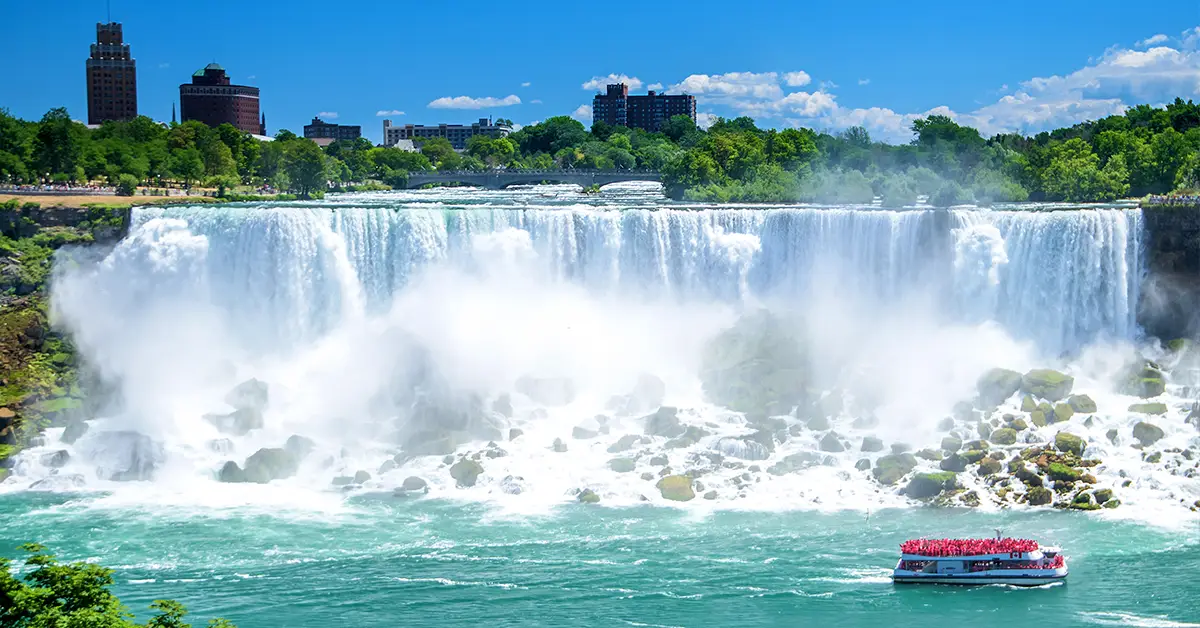
The province is one of Canada’s leading tourist destinations, attracting around 140 million visits a year (domestic and international) before the pandemic. Niagara Falls is the most famous attraction, drawing around 14 million visitors a year, with activities from viewing the falls and the Maid of the Mist boat trip through to casinos and theme parks.
Toronto offers many urban experiences, including the CN Tower (once the world’s tallest building), the Royal Ontario Museum, the Art Gallery of Ontario, Ripley’s Aquarium, the Distillery District and the Entertainment District. Outside Toronto is Canada’s Wonderland — Canada’s largest theme park. Ottawa attracts visitors with the Parliament of Canada, the Museum of Civilization, the ByWard Market, the Rideau Canal (a UNESCO World Heritage Site) and the spring Tulip Festival.
The notable natural areas include Algonquin Provincial Park (the oldest and most famous provincial park), Thousand Islands National Park on the Saint Lawrence River, Point Pelee National Park, Pukaskwa National Park along the shore of Lake Superior, and the Muskoka region with its thousands of lakes for holiday tourism. The Niagara wine region and Prince Edward County are leading destinations for food tourism.
Ontario infrastructure and transport
The province’s transport system is Canada’s most developed network. Toronto Pearson International Airport (YYZ) is the country’s largest airport, serving more than 50 million passengers a year and the main hub for Air Canada and WestJet. Ottawa Macdonald-Cartier International Airport (YOW) and Hamilton airport provide additional domestic and international routes.
The road network includes Highway 401 (the Macdonald-Cartier Freeway) — one of the busiest motorways in North America, with the section through Toronto averaging more than 400,000 vehicles a day. Other highways such as the 400, 403, 404, 407 (a toll road), and the QEW (Queen Elizabeth Way) form the transport backbone of the south of the province. The Trans-Canada Highway passes through here on two branches, linking eastern and western Canada.
Urban public transport is the most developed in North America after New York City. The Toronto Transit Commission (TTC) operates the subway, streetcar and bus system serving more than 500 million passenger journeys a year. GO Transit provides commuter rail and bus services across the Greater Toronto and Hamilton area. VIA Rail Canada operates the Quebec City-Windsor Corridor rail line — Canada’s most densely populated corridor — with main stations at Toronto, Ottawa, Kingston, London and Windsor.
Frequently asked questions about Ontario
At the 2021 census, Ontario had 14,223,942 inhabitants. The fourth-quarter 2025 estimate is 16,191,372 — more than 38% of Canada’s total population.
Ontario’s capital is Toronto — also Canada’s largest city. Canada’s capital, however, is Ottawa, which is also in Ontario.
Ontario’s official language is English. However, the French Language Services Act 1989 guarantees French-language services for communities with large numbers of French speakers.
The OINP (Ontario Immigrant Nominee Program) is the Ontario provincial nominee programme — the main tool by which Ontario selects immigrants matching the province’s economic needs.
Ontario has a humid continental temperate climate in the south (warm to hot summers, cold winters) and a subarctic climate in the north (very cold winters, where temperatures may fall to -40°C).
The main sectors are services (finance, insurance, health, education, technology), manufacturing (particularly cars), mining (nickel, gold), agriculture and tourism.
The main routes are federal Express Entry, the Ontario Immigrant Nominee Program (OINP), family sponsorship, studying and then moving to PR, and the Start-up Visa entrepreneur programme.
Ontario has 23 public universities and 24 colleges, with many ranked among the world’s best such as the University of Toronto, the University of Waterloo and McMaster University.
Accompanying you on your journey in residency investment
The Prosperous Living Investment team advises on pathways, assesses profiles and manages investments transparently for every residency, citizenship and international property objective.
Free profile assessmentWhere life gets prosperous