


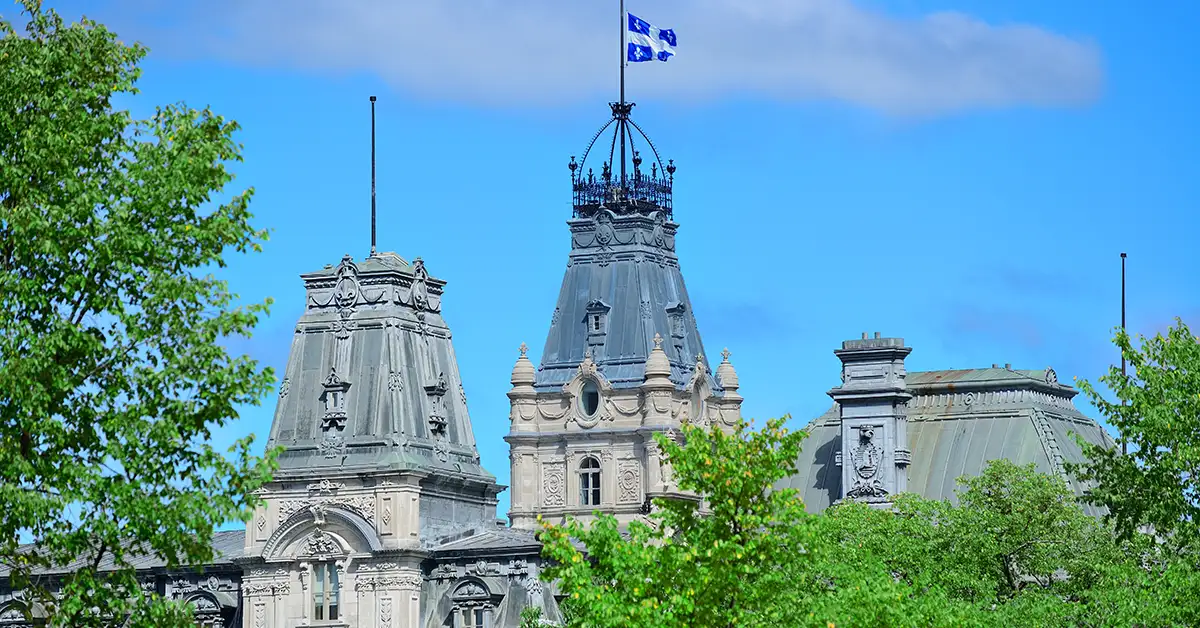
Quebec (French: Québec) is Canada’s largest province by area and the only province with a French-speaking majority, where Quebec French is used as the sole official language. It is not merely an administrative unit on the map — Quebec is a distinct cultural, linguistic and historical entity, with far-reaching influence on Canada’s national identity.
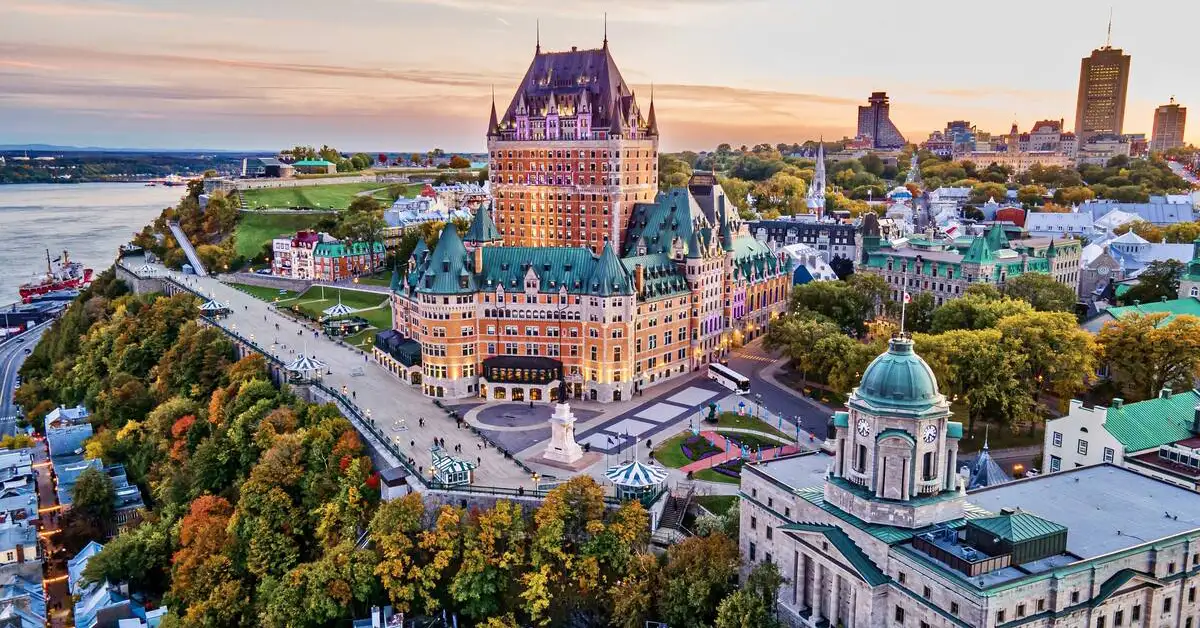
The name Quebec, first given to the city in 1608, derives from an Algonquian word meaning “where the river narrows”, evoking the image of the mighty St. Lawrence River at the point where it passes the Quebec promontory and the cliff of Cape Diamant. With a population of around 8.9 million, Quebec is Canada’s 2nd most populous province, after Ontario. Quebec City is the provincial capital and Montreal is the economic and cultural centre — home to more than half the province’s population.
Message
Overview
| Information | Details |
|---|---|
| Full name | Province of Quebec / Province de Québec |
| Capital | Quebec City |
| Largest city | Montreal |
| Official language | French |
| Area | 1,542,056 km² (the largest in Canada) |
| Population (2026 estimate) | 8.96 million (2nd in Canada) |
| Joined confederation | 1 July 1867 |
| Provincial GDP | 19% of Canada’s national GDP |
| GDP per capita | USD 50,000 (at purchasing power parity, 2022) |
| Website | quebec.ca |
Considering a residency programme? The Prosperous Living Investment team assesses your profile free of charge and advises on the pathway that fits your goals.
History
A detailed article onThe history of Quebec.
The New France period and the British conquest
In the period from 1534 to 1763, the territory that is now Quebec was a French colony named Canada and the most developed colony in the whole New France empire. The French explorer Samuel de Champlain laid the first foundations when he established a settlement in 1608 at the site of what is now Quebec City. From there, the French gradually expanded the fur trading network and built settled communities along the St. Lawrence River for more than 150 years.
After the Seven Years’ War, Quebec became a colony of the British Empire. The province was successively named: the Province of Quebec (1763–1791), Lower Canada (1791–1841) and Canada East (1841–1867) after the Lower Canada Rebellion. Throughout the British colonial period, tensions between the French-speaking and English-speaking communities deeply shaped the political identity of this land.
The Quebec Act of 1774 — enacted by the British Parliament — allowed Quebec to restore French civil law in judicial matters, while also recognising the Catholic Church’s right to collect tithes. This was an important concession that helped preserve French culture and language in Quebec under British rule.
Joining confederation and the 19th century
Quebec joined confederation together with Ontario, Nova Scotia and New Brunswick in 1867, marking the birth of the Dominion of Canada. The Province of Quebec was formed on the former boundaries of Lower Canada, and the capital Quebec City became the administrative centre of the new province.
During the 19th century, economic insecurity drove hundreds of thousands of Quebecers to leave their homeland. From 1840 to the 1930s, around 900,000 Quebec residents — nearly 1/3 of the population — emigrated permanently to the New England region of the United States, where textile mills were booming and needed cheap labour. They settled together in neighbourhoods known as “Little Canadas” and gradually integrated into English-speaking society while maintaining their Catholic faith.
The Quiet Revolution and the sovereignty movement
The two terms of Premier Maurice Duplessis (1936–1939 and 1944–1959) are usually regarded as the final phase of traditional Quebec, where the Catholic Church controlled much of social life. Duplessis’s death in 1959 opened the way for a more liberal government to take power, launching a series of far-reaching social and economic reforms known as the Révolution tranquille — the Quiet Revolution.
The Quiet Revolution was a period of intense modernisation, secularisation and social reform, in which French Canadians expressed strong dissatisfaction with their inferior socio-economic position. This period led to the formation of the modern Québécois identity and Quebec nationalism. The government of Premier Jean Lesage comprehensively restructured Quebec’s institutions, building a modern welfare state through new ministries of education, social welfare and economic development.
The Parti Québécois was founded in 1968 and came to power in 1976. In 1980, the party held a province-wide referendum on the separatist movement, but Quebec voters ultimately voted to stay in Canada. A second referendum in 1995 was far closer — the separatist movement failed by a margin of under 1%. Since then, the separatist movement has gradually declined in public support in Quebec.
Geography
A detailed article onThe geography of Quebec.
Size and location
Quebec is Canada’s largest province with an area of 1,542,056 km², nearly 1/6 of Canada’s total territory — equivalent to nearly 3 times the area of France or the United States state of Texas. The province lies in east-central Canada, bordering Ontario to the west, Newfoundland and Labrador to the north-east, New Brunswick to the south-east, and the United States states of New York, Vermont, New Hampshire and Maine to the south.
The main geographical regions
Quebec’s territory comprises 3 major geographical regions: the St. Lawrence Lowlands, the Appalachian Uplands and the Canadian Shield. Each region is a store of distinctive natural and human resources, giving rise to different forms of exploitation and settlement over the centuries.
The St. Lawrence Lowlands are the most fertile and most populous region, stretching from Quebec City to Montreal along both banks of the St. Lawrence River. This is the province’s richest agricultural land, and also the centre of the urban network and the growing industrial economy. To the north and west is the Canadian Shield — a vast Precambrian rock region, sparsely populated but extremely rich in mineral resources and hydroelectric energy.
Climate
Quebec has a diverse climate corresponding to the geographical differences between its regions. The climate of the province of Quebec varies with the terrain: the south has a continental climate with warm humid summers and cold winters with heavy snow, while the far north has a subarctic climate with long winters and severe frost. The Montreal and Quebec City regions usually have winter temperatures ranging from –10°C to –20°C and summers reaching 25°C–30°C, with 4 clearly distinct seasons.
Politics
A detailed article onThe politics of Quebec.
The Government of Quebec operates on the Westminster model — both a liberal democracy and a constitutional monarchy. The Premier of Quebec is the head of the provincial government. Quebec’s political system has clearly distinctive features: debate about the relationship with federal Canada and the question of provincial autonomy is present in every election.
Nationalism plays a large role in Quebec politics, and all 3 major provincial political parties support granting Quebec further autonomy as well as recognising the province’s special status. In the history of federal legislation, Quebec has frequently been the province negotiating and demanding different terms when entering federal agreements, particularly in the fields of language, culture and education.
Economy
A detailed article onThe economy of Quebec.
Overview
Quebec’s economy is supported mainly by a large-scale service sector and diverse industry. On exports, the province relies on key sectors including aerospace, hydroelectricity, mining, pharmaceuticals, aluminium, timber and paper. This is an economic structure balanced between traditional natural resource extraction and modern knowledge industries.
In 2022, Quebec’s GDP per capita reached USD 50,000 at purchasing power parity. Quebec’s economy ranks 46th in the world and 29th on GDP per capita. Quebec contributes 19% of Canada’s total GDP. The public debt-to-GDP ratio peaked at 51% in the period 2012–2013 and fell to 43% in 2021.
Hydroelectricity
Hydro-Québec — the province’s state hydroelectric corporation — is one of Quebec’s largest and most important economic assets. Quebec has a dense river network and hydroelectric potential among the largest in the world. Hydroelectricity not only meets domestic energy needs but is also a significant export to neighbouring United States states — particularly New York and New England.
The aerospace and technology industries
Montreal is one of the world’s 3 largest aerospace centres, alongside Seattle and Toulouse. Corporations such as Bombardier, CAE and Pratt & Whitney Canada have their headquarters or major production facilities here. The knowledge economy sector accounts for around 31% of Quebec’s GDP, and in 2011 Quebec increased spending on research and development faster than any other Canadian province.
Agriculture and signature products
Canada produces 70% of the world’s pure maple syrup, of which 90% comes from Quebec. Maple syrup has become a cultural and agricultural symbol of the province, and also a high-value food export.
Demographics
A detailed article onThe demographics of Quebec.
Population and language
Quebec’s population is estimated at 8.96 million in 2026. French is the official language and 94.6% of the province’s population is able to use French. Quebec is the only one of Canada’s 10 provinces with a French-speaking majority, at around 84.5%. French Quebecers account for at least 90% of Canada’s entire French-speaking population.
English-speaking Quebecers live mainly in the Montreal Metropolitan Area, where they have built a solid network of educational, social, economic and cultural institutions. However, the proportion of native English speakers fell considerably in the second half of the 20th century, from 13.8% in 1951 to around 8% by the early 21st century.
Immigrant and Indigenous communities
Around 16% of Quebec’s population belongs to a visible minority group according to the 2021 Canadian Census. Most minority communities live in or near Montreal. The largest communities include those of Haitian, Arab, Latin American and Asian origin.
On Indigenous peoples, the 2016 census recorded 359,430 people of North American Indigenous origin, comprising 289,610 First Nations people, 17,175 Métis and 61,260 Inuit. Quebec’s Indigenous groups belong to 2 main language families, Algonquian and Iroquoian.
Culture
A detailed article onThe culture of Quebec.
Quebec is famous for its distinctive comedy culture, and has helped make ice hockey one of Canada’s most popular sports. The province is also known for its distinct cultural identity: producing literature, music, film, television programmes, festivals and much more.
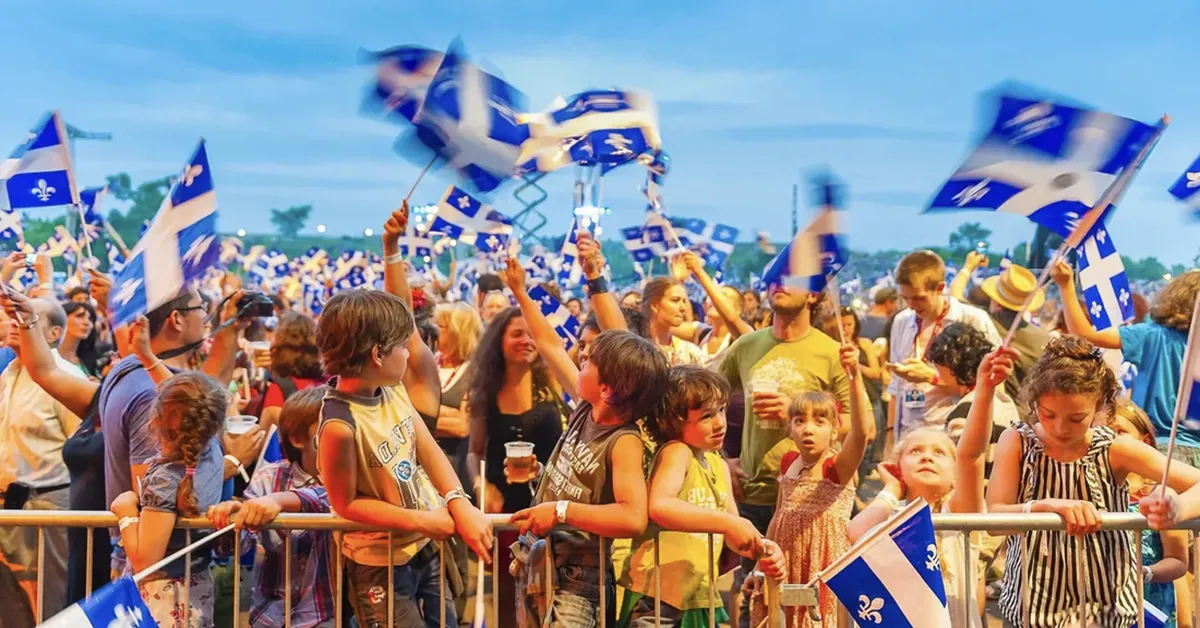
Montreal is Quebec’s cultural centre and is regarded as having one of the liveliest arts scenes in North America. The Montreal Jazz Festival and the Just For Laughs comedy festival are 2 of Canada’s largest cultural events, attracting millions of visitors each year. The Quebec Winter Carnival — held annually in Quebec City — is regarded as one of the largest winter festivals in the world.
Quebec cuisine also has an unmistakable identity of its own. Poutine — chips topped with cheese curds and gravy — originated in Quebec and is now a dish known across North America.
Education
A detailed article onEducation in Quebec.
Quebec’s education system is run by the Ministry of Education, Recreation and Sport (Ministère de l’Éducation, du Loisir et du Sport). Quebec has a well-developed university system with many world-class institutions. McGill University in Montreal — founded in 1821 — is regularly ranked among the world’s top 30 universities and is an important research centre in medicine, science and engineering.
In addition, Quebec operates the Cégep system (Collège d’enseignement général et professionnel) — an intermediate level between secondary school and university that does not exist in other Canadian provinces. This model provides vocational training or university preparation over 2 to 3 years, contributing considerably to the quality of the province’s workforce.
Sport
Ice hockey is the sport most deeply bound up with Quebec’s identity. Montreal is Quebec’s largest city and home to the legendary hockey club the Montreal Canadiens — the team with the most Stanley Cup titles in NHL history, with 24 championships. Quebec City is currently pursuing the goal of having its own NHL team again after the Nordiques left the city in 1995.
Alongside hockey, Quebec also has the football club CF Montréal competing in Major League Soccer, and winter sports such as skiing and figure skating also have a strong tradition here thanks to the province’s distinctive climate.
Infrastructure and transport
Montreal has a modern Metro system and a dense motorway network connecting the province’s major cities. Quebec City lies on an important international trade route along the St. Lawrence River, and the city enjoyed an economic golden age in the 19th century thanks to timber exports and sailing shipbuilding.
Montréal-Trudeau International Airport is the province’s main aviation gateway and one of Canada’s busiest airports, connecting Quebec with most major cities in North America, Europe and other international destinations. Quebec’s road system stretches across a vast and complex terrain, with many interprovincial motorways connecting Quebec with Ontario, New Brunswick and neighbouring United States states.
Accompanying you on your journey in residency investment
The Prosperous Living Investment team advises on pathways, assesses profiles and manages investments transparently for every residency, citizenship and international property objective.
Free profile assessmentWhere life gets prosperous