


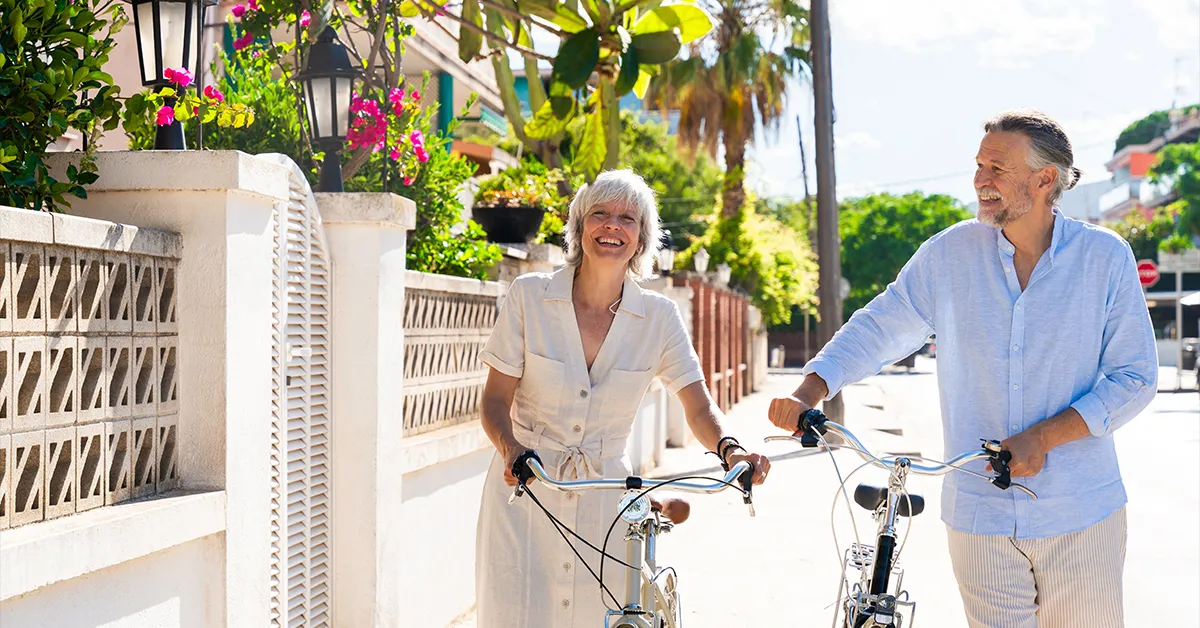
Retiring by a sunny coastline is many people’s dream, and Portugal is the ideal place to make that dream a reality. Retired life here offers ease and simplicity but is no less refined, with a beautiful coastline, welcoming people and a vibrant culture. Portugal is fast becoming a leading destination for retirees worldwide.
Beautiful architecture, a temperate climate and charming cities are compelling reasons to choosePortugalas a place to retire. Recent tax adjustments for retirees have also made retirement visa programmes more attractive, making it easier for foreign nationals to settle and save on international income tax.
A retired couple may live comfortably in villages and small towns on a budget of around USD 1,500-2,000 a month. Where a large city such as Lisbon or Porto is chosen, the monthly budget needs to rise to around USD 2,500-3,000.
Look up theQuality of Life Indexof other countries worldwide.
Message
The highlights of retiring in Portugal
Portugal offers an ideal environment for retiring abroad with many outstanding advantages. The cost of living is around 30% lower than in the United States and the lowest among Western European countries, making savings, social security or a pension stretch considerably further. A retired couple may live comfortably on USD 1,500-2,000 a month.
The new tax regime helps foreign nationals save on tax for 10 years. The infrastructure, public transport and health system are all very good. The crime rate is low and the weather sunny almost all year round. Most people speak English, particularly in coastal and urban areas.
An important note: budget for the initial costs such as a rental deposit, removal fees, legal fees, furniture, telephone and internet connections, as well as a contingency for emergencies.
Considering a residency programme? The Prosperous Living Investment team assesses your profile free of charge and advises on the pathway that fits your goals.
How to retire in Portugal: the visa and residence options
Portugal is a popular retirement destination thanks to its straightforward and accessible process. The Algarve region in southern Portugal is one of the most favoured retirement destinations, with an estimated more than 100,000 retirees living there.
EU citizens may retire in Portugal with minimal administrative formalities, registering their residence through the official immigration agency AIMA (Agência para a Integração, Migrações e Asilo).
Non-EU citizens need to apply for a residence visa at any Portuguese consulate with an application including a valid passport, evidence of income, evidence of health insurance and a clean police certificate. A temporary residence permit is usually valid for 5 years, after which long-term residence may be applied for.
The Portugal Golden Visa for non-EU retirees
TheThe Portugal Golden Visais a popular retirement option for non-EU citizens, introduced in 2012 to attract foreign investors.
Applicants must meet one of the following investment requirements: invest at least EUR 500,000 in a qualifying private equity or venture capital fund in Portugal; invest EUR 500,000 in a Portuguese business and create at least 5 full-time jobs; contribute EUR 250,000 to national cultural, artistic or historical heritage; or contribute EUR 500,000 to research and development activity in Portugal.
The benefits of the Golden Visa include the right to live and work in Portugal, free movement within the Schengen Area, bringing over a spouse, dependent children and parents, and the ability to apply for Portuguese citizenship after 5 years of lawful residence.
Tax rules on retiring in Portugal
Those staying more than 183 days a year in Portugal are treated as tax residents and must declare all worldwide income, including pensions. The new NHR regime (replacing the former version, which is no longer in force) continues to offer significant tax advantages for retirees in Portugal.
Portugal has signed double taxation treaties with many EU and non-EU countries, helping retirees avoid being taxed twice on pension income.
On transferring a pension to Portugal, EU citizens may transfer social security contributions from EU countries to Portugal and those contribution years count towards the state pension.
Non-EU citizens should check whether Portugal has a tax or pension treaty with their country. The official retirement age in Portugal is currently 66 years and 5 months for both men and women (as at 2022). A foreign pension may be taxed where the recipient lives and pays tax in Portugal, depending on the treaties in force.
Healthcare for retirees in Portugal
Portugal’s National Health Service (SNS) provides healthcare to all citizens and lawful residents. Many doctors speak English, and public hospitals are modern and well equipped. Healthcare is usually free, though some procedures may carry a small co-payment. Prescription and generic medicines are usually up to 75% cheaper than in the United States. Note that remote areas may lack healthcare facilities.
For EU citizens, retirees may receive free healthcare through the S1 form (formerly the E121) issued by the pension authority in their home country. Many EU retirees also take out private insurance for additional peace of mind.
For non-EU citizens and Americans, access to free public healthcare only begins after 5 years as a permanent resident. Before that point, retirees need private health insurance. After arriving in Portugal, they may switch to a Portuguese private health insurance plan, usually considerably cheaper than American insurance.
Private health insurance costs: those under 55 may pay from as little as EUR 4 a month; retirees over 65 range from EUR 100-300 a month. Companies such as Medis, Tranquilidade and Fidelidade/Multicare cover up to the age of 75 and do not cancel existing policies.
Inheritance tax in Portugal
Portugal has no inheritance tax on property. Parents, children and spouses are exempt from the flat 10% stamp duty. Inheritance is usually governed by the law of the deceased’s country. Where spouses hold different nationalities, Portuguese law may apply, so it is advisable to make clear wills in both the home country and Portugal with professional legal assistance.
The cost of living in Portugal for retirees
According to Numbeo data, the monthly cost of living in Lisbon for a couple ranges from EUR 2,600 to EUR 3,000, of which around 50% of the budget goes on housing. Monthly costs for a couple include rent in the city centre at around EUR 2,180-2,690 and outside the centre around EUR 1,880-2,590.
A detailed article onBuying a home in Portugal.
Food and cuisine
Food in Portugal is generally very reasonable. Lunch for 2 costs from EUR 15-25 and dinner for 2 from EUR 20-40 at full-service sit-down restaurants. Good-quality local wine starts at EUR 3 a bottle, beer around EUR 1-2 at local bars. An espresso (bica) is usually only EUR 1-2. Do not miss Pastéis de Nata — the layered custard tarts characteristic of Portuguese cuisine.
Internet and connectivity
Broadband and 4G/5G networks are widely available in urban and suburban areas. Fixed internet costs average around EUR 35-45 a month. Public Wi-Fi is available in most cafés, hotels and restaurants across the country.
Transport
In central Lisbon, Porto or Cascais, going without a car is entirely feasible thanks to the efficient public transport system. Petrol in 2026 costs around EUR 1.70 a litre and diesel around EUR 1.55 a litre. Monthly parking costs EUR 50-120 depending on the area. Car hire starts at EUR 25-30 a day. Tolls on the Porto – Lisbon route are around EUR 30.
Property when retiring in Portugal
According to Numbeo data for April 2026, property prices in Portugal vary widely by region. Buyers should note certain features of local property: many apartments have no central heating or air conditioning; kitchens are usually small and not open to the living room; parking in central Lisbon is hard to find, so accommodation with its own parking should be prioritised.
The reasons retirees should buy property in Portugal include below-average European property prices, good long-term investment potential, reduced monthly rental costs and protection against exchange rate fluctuations.
Lifestyle in Portugal
Portugal has a relaxed Mediterranean lifestyle — a slower pace of life, national holidays that are valued, mornings that start late and long afternoons. Local people are friendly, willing to help and respectful of the rules. Most people speak English, particularly in coastal and urban areas. Portugal is one of the safest countries in Europe with a low crime rate and a strong community spirit.
The ideal places to retire in Portugal
The Algarve is the leading coastal destination, regularly ranked by Forbes as the best place in Europe for retirees. The region has many English-speaking communities, a sunny climate, beautiful beaches, golf courses and a relaxed lifestyle. Towns such as Faro, Albufeira, Lagoa, Tavira, Silves and Alvor all offer both coastal and inland options, with a reasonable cost of living and good healthcare.
Cascais and Estoril are coastal towns just 30 minutes from Lisbon, combining beautiful scenery with convenience. Both are well connected to the capital and Lisbon airport, and have a growing expatriate community. Property prices are more reasonable than in Lisbon with steady long-term growth potential.
Lisbon is a vibrant capital blending the historic with modern conveniences, attracting digital workers, students and retirees alike. Favoured neighbourhoods include Chiado, Bairro Alto, Belém and Príncipe Real. Lisbon has several UNESCO World Heritage Sites, a rich arts and food scene, and is one of the lowest-cost capitals in Western Europe.
Porto is Portugal’s 2nd largest city with a strong local identity, famous for its riverside beauty, port wine culture and UNESCO-listed historic centre. The city is more traditional and quieter than Lisbon, and winters can be wet, but in return the cost of living is lower and property more accessible.
Frequently asked questions about retiring in Portugal
Yes. Portugal is one of Europe’s most popular retirement destinations thanks to its reasonable cost of living, pleasant climate, excellent health system and rich culture.
Yes. A retired couple may live comfortably in Portugal on USD 1,500-2,000 a month.
Absolutely. There are no restrictions on foreign nationals buying property in Portugal. The property market there is well developed and many foreign nationals have invested and settled there.
Where a person stays 183 days or more in a year, they are treated as a tax resident and must pay income tax on worldwide income, including salary, dividends, rental income and capital gains.
Portugal provides national healthcare through the SNS to all residents. Services are entirely free for children under 18 and older people over 65, and heavily subsidised for the remaining age groups.
The main difference between the 2 countries is the cost of living — Portugal costs less than Spain and has a more pleasant climate year round. Spain, on the other hand, has more flight routes and destinations, with vibrant cities and a rich culture.
The Portugal retirement visa, also known as the Passive Income Visa or the Portugal D7 Visa, allows retirees to use passive income to apply. Retirees may apply for Portuguese citizenship through the D7 Visa or the Portugal Golden Visa, depending on each applicant’s particular circumstances.
Accompanying you on your journey in residency investment
The Prosperous Living Investment team advises on pathways, assesses profiles and manages investments transparently for every residency, citizenship and international property objective.
Free profile assessmentWhere life gets prosperous