

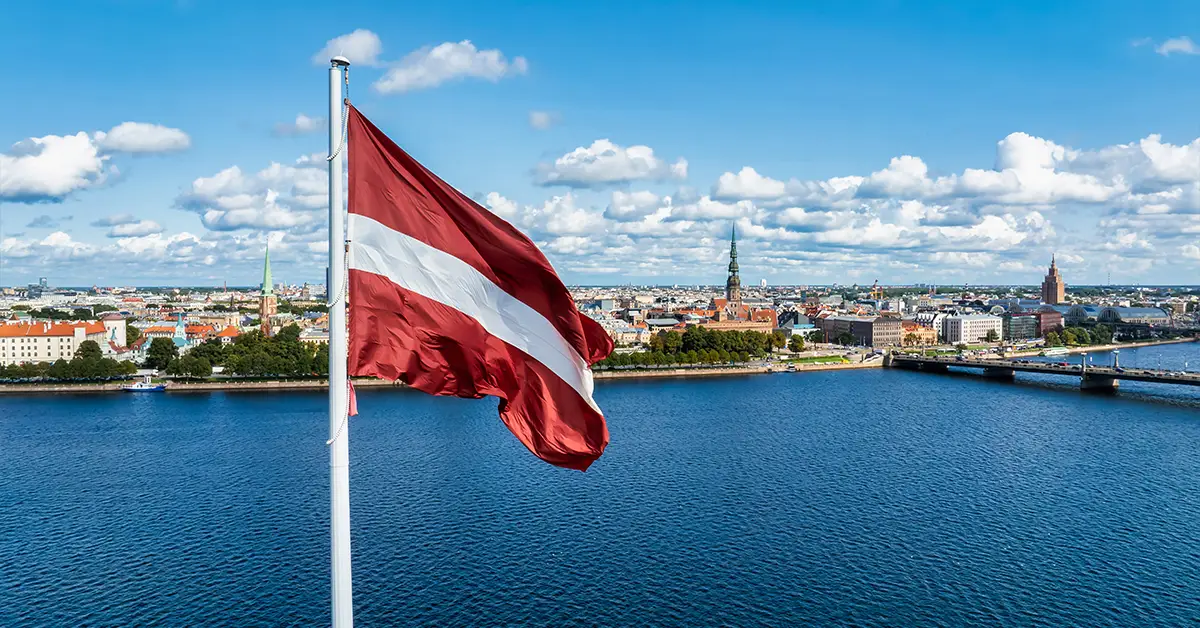
Latvia is a country in Northern Europe, on the shore of the Baltic Sea, and one of the three Baltic states alongside Estonia and Lithuania. With an area of around 64,573 km² and a population of nearly 1.84 million, Latvia is relatively small but holds an important geopolitical position between Western and Eastern Europe. The country is now a full member of the European Union, NATO, the OECD and the eurozone. This article provides an overview of Latvia from history, geography, politics and the economy to culture and international relations.
Message
The history of Latvia
Detailed article:The history of Latvia
The history of this Baltic land has passed through many centuries under the influence of major foreign powers. What is now Latvia was ruled by the German Teutonic Knights from the 13th century, and then successively belonged to the Polish-Lithuanian Commonwealth, the Swedish Empire and finally the Russian Empire after the Northern Wars of 1700–1795.
At the end of the 19th century, the Latvian National Awakening broke out as the indigenous peasantry moved to the cities and began to assert their own cultural identity and language. This movement laid the foundation for the people’s aspiration to independence in the decades that followed.
The Republic of Latvia formally declared independence on 18/11/1918, immediately after the fall of the Russian Empire. After a brief period of independence from 1918 to 1940, the country was occupied by the Soviet Union under the Molotov–Ribbentrop Pact of 1939. During the Second World War, the territory was occupied by Nazi Germany from 1941 to 1944, and then returned under Soviet control until 1991.
The country fully restored its independence on 21/08/1991, after the failed coup in Moscow. The Soviet Union recognised Latvian sovereignty on 06/09/1991, opening the way to United Nations membership. This is regarded as the historic turning point returning the Baltic nation to the Western international community after more than 50 years of occupation.
Considering a residency programme? The Prosperous Living Investment team assesses your profile free of charge and advises on the pathway that fits your goals.
Geography
Detailed article:The geography of Latvia
Latvia lies in Northern Europe, on the eastern shore of the Baltic Sea. The country borders Estonia to the north, Russia to the east, Belarus to the south-east and Lithuania to the south, and has a maritime border with Sweden to the west across the Baltic.
The country’s total area is 64,573 km², ranking 124th in the world. The terrain is mainly rolling plain, with lowlands interspersed with hills. The east is higher, notably the Vidzeme Upland with its highest point at Gaiziņkalns at 311.6 metres.
Latvia has a rich river system, of which the Daugava is the largest, flowing through the capital Riga and into the Gulf of Riga. The natural lake system is also extensive with more than 12,000 lakes large and small. Around 54% of the country is covered by forest, placing it among the most forested in Europe.
The climate here is temperate, transitional between maritime and continental. Summers are short and cool with average July temperatures of 16–17°C. Winters are long, cold and snowy, with January temperatures usually between -2 and -7°C. Average annual rainfall is around 600–700 mm, fairly evenly distributed through the year.
Politics
Detailed article:The politics of Latvia
Latvia is a multi-party parliamentary republic operating on the principles of representative democracy. The Constitution (called the Satversme) was adopted on 15/02/1922 and is one of the oldest constitutions in Europe still in force, having been restored in 1990.
The head of state is the President, elected by Parliament for a 4-year term and for a maximum of 2 consecutive terms. The President’s role is mainly ceremonial and representative, with the power to veto certain legislation and to appoint the Prime Minister and ambassadors.
The legislature is the Saeima — a unicameral parliament of 100 members, directly elected by proportional representation for 4-year terms. The Saeima has the power to pass laws, approve the budget, elect the President and oversee the government. Executive power rests with the Cabinet of Ministers headed by the Prime Minister, answerable to the Saeima.
The judiciary operates independently, comprising district courts, regional courts and the Supreme Court. In addition, the Constitutional Court has jurisdiction to review the constitutionality of legislation and other normative acts. On United Nations and OECD reports, Latvia is assessed as a country with a stable democracy and a high level of civil liberty in the Baltic region.
The economy
Detailed article:The economy of Latvia
Latvia has an open market economy, deeply integrated into the European Union, and has been a eurozone member since 01/01/2014. On figures fromInternational Monetary Fund (IMF), the country’s nominal GDP in 2025 reached around USD 48.6 billion, with GDP per capita of around USD 23,400. Real GDP growth is forecast at 2.2% for 2026 with inflation of around 2.6%.
The structure of the economy has shifted strongly from traditional manufacturing towards services, technology and logistics. Household consumption accounts for around 61% of GDP, while gross fixed capital formation contributes 23% and government spending 18%. Exports of goods and services account for 59% of GDP, reflecting the economy’s high degree of openness.
The main economic sectors comprise wood processing, food, textiles, pharmaceuticals, information technology and logistics. The country’s port system, particularly the ports of Riga, Ventspils and Liepāja, plays an important role in moving goods between Western Europe, Russia and Central Asia.
The banking and finance sector has been through several reforms since the global financial crisis of 2008–2009. Latvia was one of the worst affected countries in Europe during that period, forced to accept an IMF bailout and apply austerity policy. After the crisis, the economy recovered strongly and Latvia joined the OECD in 2016, marking deeper integration into the group of developed economies.
Unemployment is around 6.6%, slightly above the European average. Net foreign direct investment (FDI) was around 3.5% of GDP in 2024, reflecting the market’s appeal to international investors.
Demographics
Detailed article:The demographics of Latvia
Latvia’s population as at 2025 is estimated at around 1.84 million, considerably down from 2.67 million at the restoration of independence in 1991. Population density is around 28 per km², among the lowest in Europe. The prolonged population decline is the result of a low birth rate and waves of emigration, particularly after EU accession in 2004.
Latvians make up around 65.5% of the population as the main ethnic group. Russians are the largest minority at nearly 25%, concentrated mainly in Riga, Daugavpils and the eastern regions. The other minorities comprise Belarusians, Ukrainians, Poles and Lithuanians.
Latvian is the only official language, in the Baltic branch of the Indo-European family and closely related to Lithuanian. Around 37.7% of the population uses Russian as a mother tongue, although Russian’s role in state education and administration has fallen considerably since 2018 following language reforms.
Most of the population is Christian, with Lutherans the largest group, followed by Roman Catholics and Russian Orthodox. Life expectancy was 75.7 in 2025, above the global average but below the EU average. Around 68% of the population lives in urban areas, with nearly a third concentrated in the capital Riga.
Education
Detailed article:Education in Latvia
The education system is organised on the standard European model, with compulsory education from ages 5 to 16. The structure comprises 4 main levels — nursery, primary, secondary and higher education — with Latvian as the main language of instruction.
The country has around 60 higher education institutions, both public and private. The University of Latvia in Riga is the oldest and largest, founded in 1919. The other reputable universities comprise Riga Technical University, Stradiņš University and Daugavpils University. Many English-language programmes have been expanded to attract international students.
On World Bank data, literacy is almost universal at 99.9%, reflecting good basic education. The proportion of adults with a university degree or equivalent is also high at more than 35%, above the OECD average.
Since 2018, state secondary schools have moved gradually to teaching entirely in Latvian rather than Russian. This reform aims to strengthen the position of the national language and was completed in 2025.
Culture
Detailed article:Latvian culture
Latvian culture bears a strong Baltic imprint with long traditions of folk song, festivals and crafts. The Latvian Song and Dance Festival, held every 5 years, is one of the largest cultural festivals in the world with tens of thousands of performers taking part. It has been recognised by UNESCO as a Masterpiece of the Oral and Intangible Heritage of Humanity since 2003.
The Historic Centre of Riga was inscribed on the UNESCO World Heritage List in 1997 for its outstanding architectural value, particularly the ensemble of Art Nouveau (Jugendstil) buildings — more than 40% of the historic buildings in the city. Riga is known as the Art Nouveau capital of the world, with many buildings designed by local architects in the early 20th century.
Traditional cuisine reflects the Northern European climate and agricultural tradition, with rye, potatoes, pulses, sea fish and pork as the main ingredients. Rye bread (rupjmaize) is regarded as the emblem of the national cuisine. Cold beetroot soup (aukstā zupa), roast pork and craft beer are also familiar features.
Cinema, classical music and ballet have long traditions. The Latvian National Opera in Riga is one of the leading performing arts venues in the Baltic region. Riga was chosen as European Capital of Culture in 2014, confirming the country’s cultural standing within the EU community.
International relations
Detailed article:Latvia’s international relations
Latvia shapes its foreign policy on 4 main pillars: European integration, Baltic-Nordic cooperation, transatlantic relations with the United States, and collective security within NATO. According to theLatvian Ministry of Foreign Affairs, the country has established diplomatic relations with 158 states and maintains 44 diplomatic and consular missions abroad.
Latvia joined the United Nations in 1991 immediately after restoring independence. In 1999, the country became a member of the World Trade Organization (WTO). In 2004, it joined both the European Union and NATO, marking full integration into the Western political and security system. In 2007 it joined the Schengen area, allowing free movement with most EU countries.
Relations with Russia have been tense since the Ukraine conflict broke out in February 2022. In January 2023, the government withdrew its Ambassador from Moscow and expelled the Russian Ambassador in Riga, while imposing several restrictions on Russian citizens entering. It is also one of the strongest supporters of Ukraine as a share of GDP.
Within NATO, Latvia is one of the few members meeting and exceeding the 2% of GDP defence spending commitment. The country takes part in several NATO Centres of Excellence, and hosts the NATO Strategic Communications Centre of Excellence (NATO StratCom COE) in Riga.
Close cooperation with its two Baltic neighbours Estonia and Lithuania is maintained through several trilateral mechanisms on defence, energy and transport infrastructure. The Rail Baltica project linking Tallinn, Riga, Vilnius and Warsaw is emblematic of this level of regional integration. Latvia is also a member of the Council of the Baltic Sea States (CBSS) and the Nordic Investment Bank (NIB).
Sport
Sport in Latvia is strong in the traditional Northern European disciplines such as ice hockey, basketball, skiing and the winter sports. The national ice hockey team regularly appears at the world championships and is one of the country’s great sources of pride. Riga hosted the World Ice Hockey Championship in 2006 and 2021.
Basketball is the second most popular team sport, with the men’s national team winning gold at the European championship in 1935 — a historic title for the country’s basketball. The NBA player Kristaps Porziņģis is one of the best-known Latvian athletes internationally today.
Latvia also performs well in individual sports such as luge, bobsleigh and skeleton, athletics and archery. At the Winter Olympics, Latvian athletes regularly win medals in those sliding sports. The national sports infrastructure has been systematically developed, with many stadiums, arenas and multi-purpose complexes built or refurbished over the past two decades.
Transport
Latvia’s transport system is relatively well developed and plays an important role in the Baltic logistics network. The road network runs more than 70,000 km, connecting all the major cities and linking to the European motorways E22, E67 and E77.
Riga International Airport (RIX) is the largest airport in the Baltic region, connecting the country with more than 80 international destinations. It is the main hub of the national carrier airBaltic and was among the fastest-growing airports in Europe before the pandemic.
The port system comprises 3 main ports — Riga, Ventspils and Liepāja — with a combined capacity of tens of millions of tonnes of cargo a year. The railways currently run mainly on the 1,520 mm gauge of the former Soviet standard, but the Rail Baltica project on the European standard 1,435 mm gauge is under way to connect the Baltic states with Poland and Western Europe.
Summary
Latvia is a Baltic country with a rich history, a distinctive geopolitical position and deep integration into the Western institutional system. From a country that had only just restored its independence in 1991, it has risen to full membership of the EU, NATO, the OECD and the eurozone in little more than 2 decades.
An open economy, a stable legal system and a safe living environment place Latvia among the destinations worth considering for foreign nationals, particularly those seeking the chance to live and work in Europe.
The country continues to face the challenges of a falling population and geopolitical tension with Russia. However, Latvia is also one of the most active members in security and integration initiatives in Northern Europe, confirming its increasingly important role in the European geopolitical structure.
Accompanying you on your journey in residency investment
The Prosperous Living Investment team advises on pathways, assesses profiles and manages investments transparently for every residency, citizenship and international property objective.
Free profile assessmentWhere life gets prosperous