


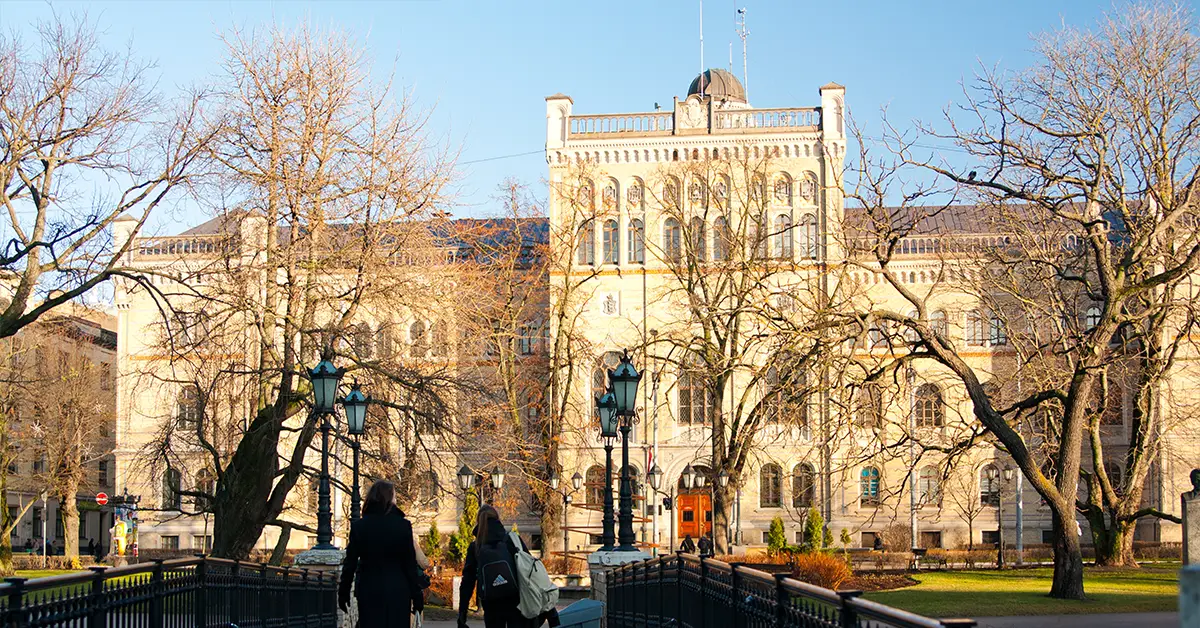
Latvian education is one of the more positively regarded education systems in the Baltic region, with near-universal literacy of 99.9% and public investment of around 5% of GDP — above the EU average. The countryLatviahas around 60 higher education institutions, nearly 200 English-language programmes for international students, and among the most reasonable tuition fees in the European Union.
This article analyses Latvian education systematically across 6 main aspects: an overview of the 4-level system, nursery to upper secondary, the university and postgraduate system, the leading universities, international students and English-language programmes, and the investment and quality indicators.
Message
An overview of the Latvian education system
The Latvian education system is organised on the standard European model, based on the Education Law of 1998 and its amendments. The structure comprises 4 main levels: nursery education, basic education (primary and lower secondary), upper secondary education, and higher education. The highest governing body is the Latvian Ministry of Education and Science (Izglītības un zinātnes ministrija, IZM), responsible for education policy, approving curricula and allocating the public budget.
Compulsory education applies from ages 5 to 16, comprising 1 compulsory nursery year and 9 years of basic education. This legal framework ensures every child in Latvia has access to free basic education. After year 9, pupils may choose to continue to upper secondary school (3 years) or follow vocational education and training (VET) programmes alongside.
The main language of instruction in Latvian education is Latvian, following the language reform of 2018–2025. Before that, a Latvian-Russian bilingual system existed for decades in minority schools. The current reform requires all state nursery and school teaching to be in Latvian from 01/09/2025. Minority pupils may still study their own language and cultural history through extracurricular programmes.
Quality assurance in the Latvian education system is carried out by the Academic Information Centre (Akadēmiskās informācijas centrs — AIKA). AIKA is an independent body responsible for accrediting higher education institutions, recognising international qualifications and assessing programme quality. AIKA’s accreditation decisions are recognised within the European Higher Education Area (EHEA).
The Latvian Ministry of Education and Science is responsible for working with stakeholders to reform education in line with international trends. Over 2020–2025, the reform priorities comprise modernising the curriculum on the Skola2030 (School 2030) model, digitising education, expanding STEM skills and moving teaching to Latvian. On OECD Education at a Glance, Latvia is among the countries with high public spending on education within Central and Eastern Europe.
Considering a residency programme? The Prosperous Living Investment team assesses your profile free of charge and advises on the pathway that fits your goals.
Nursery, primary and secondary in Latvian education
Nursery education (pirmsskolas izglītība) begins from ages 1.5 to 5 on a voluntary basis, and is compulsory for children aged 5 to 6. Compulsory nursery is fully funded from the public budget and free for every child. The main aim of the nursery stage is to prepare children in basic language, social and thinking skills before year 1. On CSB data, more than 95% of children aged 5–6 attend the compulsory nursery programme.
Basic education (pamatizglītība) runs 9 years, from year 1 to year 9, for children aged 7 to 16. This is the longest and most important stage in Latvian education, being the compulsory part of the basic education programme. It has 2 phases: primary school (sākumskola) years 1–6, and lower secondary school (pamatskola) years 7–9. On completing year 9, pupils receive the Certificate of Basic Education (Apliecība par vispārējo pamatizglītību) — a requirement for continuing to upper secondary or vocational school.
Upper secondary school (vidējā izglītība) runs 3 years from year 10 to year 12, for pupils aged 16–19. This stage is not compulsory but is publicly funded at state schools. Pupils may choose 1 of 4 main paths: general, science and technology (STEM), social sciences and humanities, or the arts. At the end of year 12, pupils sit the upper secondary examinations and receive the Atestāts par vispārējo vidējo izglītību (Certificate of General Secondary Education) — the requirement for entering university.
The vocational education system (arodskolas, profesionālās vidusskolas) runs alongside upper secondary school, for pupils wanting to learn a specific trade in engineering, services, agriculture, tourism, information technology or applied arts. The programme lasts 3–4 years, ending with both a vocational qualification and an upper secondary certificate — allowing pupils to work or continue to university. Latvia has more than 30 large vocational training centres in Riga, Daugavpils, Liepāja, Jelgava and other cities.
A notable feature of Latvian education is its relatively positive PISA results. On the OECD’s PISA 2022 assessment, Latvian 15-year-olds scored above the OECD average in reading and close to the average in mathematics and science. This is above the Central and Eastern European average and reflects the reliable quality of basic education. The early school leaving rate in Latvia is around 7%, below the EU average of 9% — an important achievement in reducing inequality of access to education.
The university and postgraduate system in Latvian education
Latvian higher education is organised on the 3-cycle Bologna structure, applied since 2002 when Latvia joined the Bologna Process. It comprises: bachelor’s (bakalaura grāds, 3–4 years), master’s (maģistra grāds, 1–2 years) and doctorate (doktora grāds, 3–4 years). Latvian qualifications are fully recognised within the European Higher Education Area, allowing students to continue their studies or work in any EU country.
The system has around 60 higher education institutions, comprising public and private institutions, comprehensive universities (universitātes), professional colleges (augstskolas) and postgraduate research institutes. Public institutions account for most of the student body and are partly funded by the state through the public budget. Each institution has a number of “budget” places free of tuition, allocated on the basis of upper secondary examination results and entrance tests.
The academic year in Latvian education runs from September to the following June, divided into 2 semesters. The first (rudens semestris) runs from September to January, the second (pavasara semestris) from February to June. Students usually take 4–5 subjects each semester, ending with final examinations and the defence of a paper. Assessment usually uses a 10-point scale, where 4 is a pass and 10 the maximum.
There are 2 main kinds of university programme in Latvian education. Academic programmes (akadēmiskā augstākā izglītība) focus on research and theory, leading to an academic bachelor’s and then a master’s and doctorate. Professional programmes (profesionālā augstākā izglītība) focus on practical skills, leading to a professional qualification named for a specific occupation such as engineer, accountant, nurse or teacher. Students may transfer between the two systems where they meet the additional conditions.
Higher education quality assurance is carried out by AIKA through 2 main processes: institutional accreditation and programme accreditation. Every university and every programme must be re-accredited after 6 years. This ensures the quality of qualifications and lays the basis for international recognition. Latvia takes part in the European Association for Quality Assurance in Higher Education (ENQA) and AIKA is listed on the European Quality Assurance Register (EQAR).
The leading universities in Latvian education
The University of Latvia (Latvijas Universitāte, LU) is the oldest and largest university in Latvian education, founded on 28/09/1919 immediately after the Republic of Latvia declared independence. It has around 14,000 students, 13 faculties and hundreds of programmes from bachelor’s to doctorate. On the QS World University Rankings 2025, LU is placed around 800th in the world — a position steady over several years. LU’s strengths comprise natural sciences, social sciences, linguistics, mathematics and information technology — representative of the depth of Latvian education.
Riga Technical University (Rīgas Tehniskā universitāte, RTU) is the oldest technical university in the Baltic region, founded in 1862 as the Riga Polytechnic. RTU now has around 14,000 students, of whom more than 5,000 are international students from more than 100 countries — the highest degree of internationalisation in Latvian education. The university focuses on engineering, computer science, architecture, economics and management.
RTU has many English-language programmes at both bachelor’s and master’s level, with fees from EUR 3,000 a year for Computer Science to EUR 5,000 a year for Entrepreneurship Management. It is one of the options international students favour when looking at Latvian education in engineering.
Rīga Stradiņš University (RSU) specialises in medicine and health sciences, founded in 1950 as the Riga Medical Institute and upgraded to a university in 1998. RSU is internationally known for its Medicine and Dentistry programmes taught in English, attracting students from Germany, Israel, the Nordic countries, India and many others.
More than 25% of RSU students are international — the highest proportion of any Latvian university. RSU fees range from EUR 3,200 a year for International Business to EUR 15,500 a year for Dentistry and Medicine, and up to EUR 20,000 a year for a doctorate in Public Health.
The Latvia University of Life Sciences and Technologies (Latvijas Biozinātņu un tehnoloģiju universitāte, LBTU) in Jelgava is the only higher education institution specialising in agricultural science, forestry, food technology and veterinary medicine. Founded in 1939, it is an important partner of Latvia’s agriculture and wood processing sectors. LBTU has around 3,845 students, of whom 123 are international. It is an important piece of specialist Latvian education.
Alongside the leading public institutions, the Latvian education system also has notable regional and private universities. Daugavpils University in Latgale serves the multicultural community of the east, while Liepāja University and Ventspils University of Applied Sciences in Kurzeme focus on information technology and science. The Stockholm School of Economics in Riga (SSE Riga) is the private branch of the renowned Stockholm School of Economics, teaching bachelor’s degrees in Economics and Business entirely in English to Nordic standards — with higher fees but impressive graduate outcomes.
International students and English-language programmes in Latvian education
International students are an important part of modern Latvian education, with around 10,000 students from more than 100 countries as at 2025 — equivalent to around 12% of all university students. Their numbers have grown considerably over the past decade, partly through policies attracting them and developing English-language programmes. According to theofficial Study in Latvia portal, the countries sending the most students comprise Germany, India, Uzbekistan, Sri Lanka, Finland, Russia, Ukraine and the African countries.
Latvia now has nearly 200 programmes taught entirely in English across all 3 Bologna cycles. The most popular fields in Latvian education are medicine, dentistry, business, information technology, engineering and the social sciences. In particular, RSU’s medical programmes have become a leading destination for European students unable to enter medical school at home because of limited places. Latvian medical qualifications are recognised across the EU and in many other countries, allowing graduates to practise widely.
Tuition fees for international students in Latvian education are among the most reasonable in the EU. On average, bachelor’s fees range from EUR 1,550–6,000 a year at public institutions, and up to EUR 15,000 a year for specialist fields such as Medicine and Dentistry. The Executive MBA — the most expensive — may reach EUR 25,600 a year at SSE Riga. The application fee is usually EUR 100. Students pay fees by semester. Compared with Western Europe (France, Germany, the Netherlands), Latvian fees are 30–50% lower for comparable quality.
Living costs for international students in Latvia are around EUR 450–700 a month, depending on lifestyle and housing choice. University halls cost from EUR 70–450 a month depending on quality. Renting a 2-room apartment in Riga usually costs around EUR 500 a month when shared with a flatmate. Riga is the main destination with more than 80% of international students, although other cities such as Jelgava, Liepāja, Ventspils and Daugavpils also have considerable international student communities.
International students from outside the EU/EEA need a student visa (fee EUR 60) and then a temporary residence permit after arriving in Latvia. The important scholarships for international students comprise the Latvian State Scholarships for citizens of more than 40 countries, bilateral scholarships under intergovernmental agreements, and individual institutions’ own scholarships. The EU’s Erasmus+ programme also creates opportunities for Latvian students to study on exchange in EU countries and vice versa. International students may work part-time for up to 20 hours a week during the academic year.
Public investment and quality indicators in Latvian education
Public investment in education is an important measure of the policy priorities of Latvian education. Public spending on education is around 5% of GDP — above the OECD average of 4.4% and the EU average of 4.8%. The annual education budget is allocated across 3 main headings: school education (60%), higher education and research (25%), and vocational and adult education (15%). Spending per university student is higher than in many Central and Eastern European countries, although still below the Nordic countries.
Literacy in Latvia is almost universal at 99.9% — reflecting good basic education and a long tradition of valuing learning. More than 90% of pupils complete upper secondary school, with around 70% going on to university. On World Bank data, the proportion of adults (aged 25–64) with a university degree or equivalent is around 35% — above the OECD average and an important achievement of Latvian education over the past 3 decades.
Education quality is measured across several international indices. On the OECD’s PISA assessment, Latvian 15-year-olds achieve consistently above the OECD average in reading and close to the average in mathematics and science. On the Times Higher Education and QS World University Rankings, no Latvian university has entered the top 500, but the University of Latvia, RTU and RSU are all within the world top 1,000 — a considerable position for a country of 1.86 million people.
One challenge for Latvian education is the “brain drain” since EU accession in 2004. Many outstanding graduates of domestic universities have sought work or postgraduate study in Britain, Germany, the Netherlands and the Nordic countries. On estimates, around 15% of Latvian university graduates are working abroad 5 years after graduating. In response, the government has introduced policies supporting startups, tax concessions for technology companies and a return programme for the diaspora.
The outlook for Latvian education over 2025–2030 focuses on 4 main priorities: digitising education with the e-Klase and Mācību platforma online learning platforms, expanding STEM and AI skills for the needs of Industry 4.0, strengthening English as a second language for pupils from primary school, and deepening links between universities and business through innovation centres. The European Recovery and Resilience Facility (RRF) provides around EUR 250 million for Latvian education reform over 2021–2027.
A summary of Latvian education
Latvian education is a system built firmly on an academic tradition dating from 1919, combined with modern European standards since EU accession and the Bologna Process. A 4-level model with 9 years of compulsory education, a 3-cycle Bologna university system and a network of nearly 60 institutions fully meets the educational needs of a developed society.
The standout features of Latvian education comprise near-universal literacy, public spending above the EU average, nearly 200 English-language programmes for international students, reasonable tuition fees and low living costs compared with Western Europe. The leading universities such as the University of Latvia, RTU and RSU have built a steady international standing, RSU particularly in medicine.
The long-term outlook for Latvian education depends on the ability to address the “brain drain” challenge, adapt to digital and AI transition, and maintain Latvian linguistic identity after the 2018–2025 reform. With EU budget support and the reforms under way, the Latvian education system has a firm foundation for continuing to develop as an attractive academic destination in the Baltic region.
Accompanying you on your journey in residency investment
The Prosperous Living Investment team advises on pathways, assesses profiles and manages investments transparently for every residency, citizenship and international property objective.
Free profile assessmentWhere life gets prosperous