

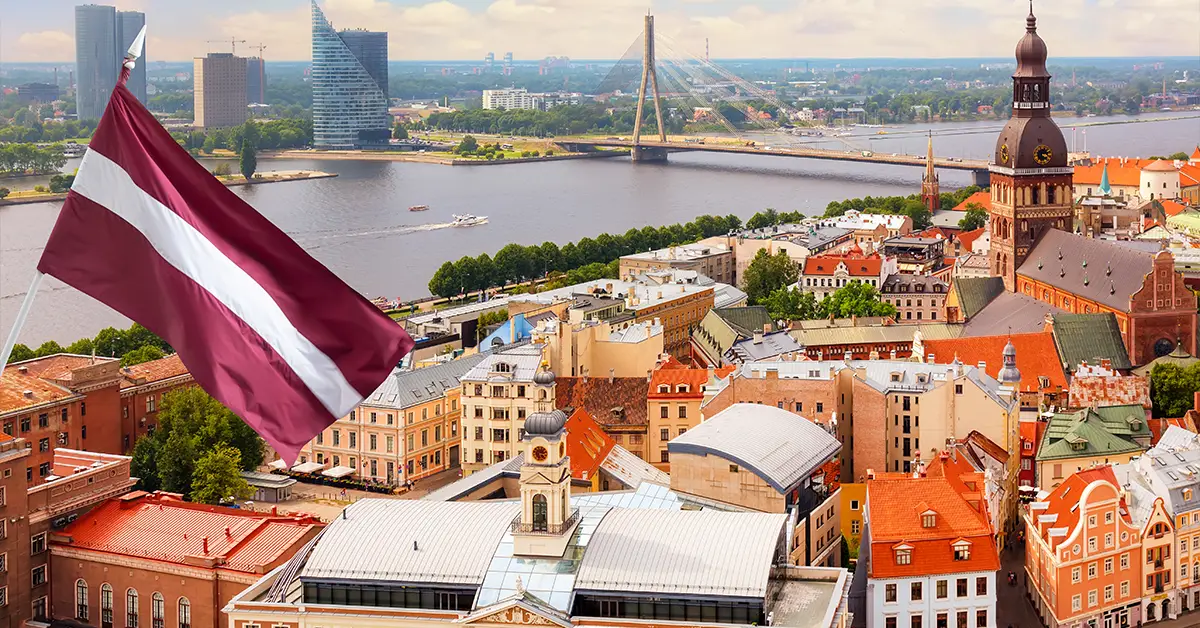
The Latvian economy is an open market economy within the high-income group in Europe, fully integrated into the European Union, the eurozone and the Organisation for Economic Co-operation and Development (OECD). The countryLatviaholds a strategic geographical position on the Northern-Eastern European trade axis, with a Baltic port system and a well-developed logistics network.
This article analyses the Latvian economy systematically across 6 main aspects: the macroeconomic overview and GDP growth, the economic structure and main sectors, international trade, foreign direct investment, the financial and banking system and the lessons of the 2008–2009 crisis, and the modern labour market.
Message
A macroeconomic overview of the Latvian economy
The Latvian economy has a nominal GDP of around USD 43 billion (EUR 39.7 billion) in 2024, on figures from the Official Statistics Portal of Latvia (CSB). GDP per capita is around USD 22,435, more than double the global average but still below the EU average. It is the world’s 99th largest economy by nominal size, although on the World Bank’s ease of doing business measure, Latvia ranks 14th globally — a considerable achievement for a country of only 1.84 million people.
Latvian economic growth has recovered markedly after the slowdown of 2023–2024. GDP in the fourth quarter of 2025 rose 2.9% year on year, on CSB and FocusEconomics data — the fastest since Q1 2023. The recovery in the Latvian economy has been driven by household consumption, public investment and a return to growth in services exports. The Latvian Ministry of the Economy (Ekonomikas ministrija) forecasts full-year 2025 growth of around 2.4–2.6%, while the European Commission is more cautious at 1.0% — a difference reflecting the uncertainty of the geopolitical environment.
Inflation has cooled considerably from its peak of 17.2% in 2022 (through the energy price shock after the Ukraine conflict) to only 1.3% on average in 2024. Over 2025–2026, inflation is forecast to return to 2–3% as the base effect from energy prices fades and pressure from service prices and wages returns. Harmonised inflation (HICP) in January 2026 stood at 2.9% year on year — above the eurozone average but still within control.
On public finances, the Latvian budget deficit rose from 2.1% of GDP in 2024 to a projected 3.2% in 2025, through personal income tax reform reducing revenue, rising defence spending and lower receipts from state-owned enterprises. Public debt was around 47.7% of GDP at the end of 2024, forecast to rise to 50–52% over 2025–2027 — still far below the Maastricht threshold of 60% and the eurozone average of 88%.
Considering a residency programme? The Prosperous Living Investment team assesses your profile free of charge and advises on the pathway that fits your goals.
The structure of the Latvian economy and its main sectors
The structure of the Latvian economy reflects a developed service economy combined with traditional manufacturing sectors. Services account for around 63% of GDP, manufacturing 12%, other industrial activity 21% and agriculture 4%. This distribution is similar to many high-income Nordic economies, although the slightly higher agricultural share reflects the traditions of the Zemgale and Latgale regions.
On the expenditure measure, household consumption accounts for around 61% of GDP and is the most important growth driver. Fixed investment contributes 23%, government spending 18%, exports of goods and services 59% while imports account for 62% — creating a trade deficit of around 3% of GDP. The high ratio of exports to GDP shows this is a small, open economy heavily dependent on external markets.
The main manufacturing sectors of the Latvian economy comprise wood and paper processing, food, textiles, pharmaceuticals, metals, machinery and electronic equipment. Wood processing is particularly important because 54% of Latvia is forest — supplying raw material for board, construction timber, furniture and pulp mills. Processed wood products account for around 20% of total goods export earnings.
Services in the Latvian economy range from finance and banking, transport and logistics and tourism to information technology and professional services. Information technology (IT) has become one of the brightest spots of the past decade, with the Riga startup ecosystem attracting international attention. Latvian technology companies such as Printful, Mintos and Lokalise have expanded globally, while international groups such as Accenture, Tieto and Visma have development centres in Riga.
Logistics is a strategic sector given Latvia’s geographical position. The port system comprising Riga, Ventspils and Liepāja has a combined capacity of tens of millions of tonnes of cargo a year. Before 2022, these ports served as an important transit route for Russian and Belarusian goods, but after the EU sanctions the sector within the Latvian economy has had to restructure and find new partners in Central Asia and Western Europe. Riga International Airport (RIX) is the largest in the Baltic region and the main hub of airBaltic.
Agriculture contributes 3.8% of GDP and employs 6.8% of the labour force. Dairy farming, cereal production (barley, wheat, rye, oats), sugar beet, potatoes and vegetables are the main activities. In 2024, cereal output reached 3.2 million tonnes, up 16.1% on 2023 thanks to favourable weather. Around 30% of the national land area is used for agriculture, with a structure of medium-sized private farms having entirely replaced the Soviet-era collective farm system.
International trade in the Latvian economy
International trade plays a vital role in the Latvian economy, with total trade in goods and services equivalent to around 121% of GDP — reflecting deep integration into global supply chains. After joining the European Union in 2004, Latvia shifted its trade strongly from Russia and the CIS to the EU markets, particularly the Baltic and Nordic countries.
The structure of the Latvian economy’s goods exports is relatively varied. In 2023, manufactured goods accounted for 56.4% of total export earnings, food 16.5%, agricultural raw materials 9.1%, mineral fuels 7.3%, and ores and metals 1.7%. The spearhead export items comprise timber and wood products, machinery and electrical equipment, chemical products, processed food, pharmaceuticals and vehicles.
The main export markets for the Latvian economy are its Baltic and Nordic neighbours. Lithuania, Estonia, Germany, Sweden, Finland and Britain are the 6 largest export partners. On imports, Lithuania accounted for 20.6%, Germany 11.6% and Poland 11.2% in 2024 — on United States Census Bureau data. The United States is Latvia’s 20th largest import partner, with the main items comprising aircraft, beverages, electrical machinery and petroleum.
Trade with Russia has fallen sharply since the Ukraine conflict of 2022. The share of exports to Russia fell from around 8% before the war to below 3% in 2024. EU sanctions and Latvia’s own decisions banning the import of many goods from Russia have fundamentally changed trade flows. The logistics sector has pivoted from moving Russia-EU goods to new north-south corridors, connecting Central Asia and the Middle East through Latvian ports.
Latvia benefits from the European single market of more than 450 million consumers and the 4 freedoms (goods, services, capital, labour). The country also takes part in all the EU’s free trade agreements with partners such as Canada (CETA), Japan (EPA), South Korea, Vietnam (EVFTA), Singapore and New Zealand. WTO membership since 1999 and the Government Procurement Agreement (GPA) ensure equal access to major public procurement markets worldwide.
Foreign direct investment and the business environment in the Latvian economy
Foreign direct investment (FDI) is an important growth pillar of the Latvian economy. Cumulative FDI to the end of 2024 reached around EUR 19 billion, equivalent to 47% of GDP. According to the Investment and Development Agency of Latvia (LIAA), net FDI in 2024 was around 3.5% of GDP — showing the market’s steady appeal to international investors.
The 5 largest FDI investors in Latvia comprise Sweden, Estonia, the Netherlands, Denmark and Cyprus. The sectors attracting most FDI are finance and banking, property, manufacturing, information technology and retail. The United States is Latvia’s 14th largest FDI investor, concentrated in IT, the defence industry and services. Vietnam has no significant FDI flow into Latvia as yet, although the possibility of cooperation in manufacturing and logistics is being explored.
The Latvian economy’s business environment is rated positively by several international bodies. Latvia ranked 14th in the world on the World Bank’s Ease of Doing Business index (the final assessment in 2020 before the index was discontinued). Setting up a business takes around 4 days, property registration is quick and straightforward, and the commercial courts work efficiently. According toInternational Monetary Fund, medium-term growth is forecast to average 2.5% a year on the back of investment and structural reform.
The investment incentive system comprises 4 Special Economic Zones: Riga Free Port, Ventspils Free Port, Liepāja Special Economic Zone and Latgale Special Economic Zone. Businesses investing in these zones receive corporate income tax reductions of up to 80%, property tax exemption and import duty concessions for re-exported goods. In addition, Latvia applies 0% corporate income tax on retained earnings — a model unique in the EU, taxing only when a company distributes dividends (at 20%).
Digital infrastructure is another notable strength. Latvia’s share of households with high-speed broadband is among the highest in the EU. e-Government is comprehensively developed, allowing tax filing, business registration and electronic contract signing through the eParaksts digital signature system. English is widely used in the business environment — more than 46% of adults are proficient in English, making things easier for foreign investors.
The financial and banking system and the lessons of the 2008–2009 crisis for the Latvian economy
The Latvian financial system learned costly lessons during the global financial crisis. Before 2008, Latvia was one of the fastest-growing economies in Europe, with double-digit GDP growth on the back of a credit and property boom. However, the current account deficit reached 22% of GDP in 2007 and inflation touched 10% — warning signs of an economic bubble.
The crisis broke at the end of 2008 with the collapse of Parex Bank — Latvia’s second largest — forcing the government into an emergency nationalisation. GDP fell nearly 18% in 2009 — the deepest recession in the EU at the time. Unemployment climbed to 23%, the highest in the European Union. The Nobel laureate economist Paul Krugman even compared Latvia to “the new Argentina of Europe” in the New York Times in December 2008.
Latvia received a bailout totalling EUR 7.5 billion from the IMF, the EU, the European Bank for Reconstruction and Development (EBRD) and the Nordic countries, in return for committing to maintain the lats-euro peg and apply austerity policy. Instead of devaluing as the IMF initially recommended, the government chose the path of “internal devaluation” — cutting public sector pay by 25%, cutting social benefits, raising taxes and laying off thousands of civil servants. This approach caused serious social pain but kept the path to the eurozone open.
Recovery came quickly from 2011 with growth of 5.5%, making Latvia a “success story” praised by Christine Lagarde, then the IMF’s Managing Director. GDP returned to its pre-crisis level in 2018. Latvia joined the eurozone on 01/01/2014 and the OECD in 2016, completing its standing among the developed economies. The main lesson for the Latvian economy is the importance of prudent macro supervision, credit control and a balanced current account.
The modern Latvian banking system comprises around 12 commercial banks, of which the Nordic banks (Swedbank, SEB, Luminor) hold around 80% of the market. The Bank of Latvia (Latvijas Banka) has been part of the Eurosystem since 2014, taking part in the common monetary policy of the European Central Bank (ECB). After the ABLV Bank scandal of 2018 (accused by the United States of money laundering and closed), Latvia tightened anti-money-laundering supervision and left the Financial Action Task Force (FATF) “grey list” in 2020 — strengthening international investor confidence.
The labour market and living standards in the Latvian economy
The labour market is an important measure of the health of the Latvian economy. Unemployment in 2024 was 6.9%, with around 65,300 people aged 15–74 out of work. Unemployment among women (5.8%) was lower than among men (8.0%). Youth unemployment stood at 13.6% — the lowest of the 3 Baltic states for the second year running, though still a policy concern. On European Commission forecasts, unemployment will fall slightly over 2025–2027 on rising labour demand and the economic recovery.
Average wages in the Latvian economy have risen considerably over the past decade. The average gross monthly wage in 2024 was around EUR 1,700, up 8.3% on the previous year. The minimum wage was raised to EUR 740 a month from 2025, applying to around 60,000 workers nationwide. Wage growth is forecast at 4% in 2025 and 3.5% in 2026, reflecting labour shortages in many sectors.
The labour composition in the Latvian economy has shifted markedly since EU accession in 2004. Hundreds of thousands of Latvians emigrated to Britain, Germany, Ireland and other Western European countries, leaving labour shortages in many sectors at home. Non-EU workers — particularly from Ukraine, Belarus and some Central Asian countries — have become an important supplementary source. After the Ukraine conflict of 2022, Latvia received more than 40,000 Ukrainian refugees, many of whom have entered the labour market.
The education and vocational training system is closely linked to market needs. Latvia has a relatively well-developed VET (Vocational Education and Training) system, with training centres in Riga, Daugavpils and Liepāja. The proportion of adults with a university degree or equivalent is around 35%, above the OECD average. However, skills mismatch in STEM, IT and engineering remains a major challenge for the Latvian economy during the digital transition.
The greatest long-term challenge for the labour market in the Latvian economy is an ageing and declining population. The working-age population is forecast to fall by around 15% over the next 20 years through low fertility and emigration. In response, the government is pressing ahead with policies to attract highly skilled workers, support childbearing, raise the retirement age (currently 65 for both men and women, expected to rise to 67 by 2032) and expand automation in manufacturing.
A summary of the Latvian economy
The Latvian economy is a story of successful transformation from a Soviet planned economy to a market economy fully integrated into the EU and the eurozone within 3 decades. GDP of USD 43 billion in 2024 and a recovery to 2.9% growth in Q4 2025 reflect the resilience of a small but flexible economy against geopolitical shocks and international crises.
The lessons of the 2008–2009 crisis are deeply embedded in current macro policy, with low public debt, a closely supervised banking system and a balanced current account. Membership of the eurozone and the OECD and the strong presence of the Nordic banks have created a stable and transparent financial environment.
The medium-term outlook for the Latvian economy depends on the ability to resolve 3 major challenges: a falling population and labour scarcity, digital and green energy transition, and restructuring trade against a fundamentally changed Russia-EU relationship. Investment in information technology, science and innovation, transport infrastructure such as the Rail Baltica project, and renewable energy are the leading policy priorities for 2026–2030.
Accompanying you on your journey in residency investment
The Prosperous Living Investment team advises on pathways, assesses profiles and manages investments transparently for every residency, citizenship and international property objective.
Free profile assessmentWhere life gets prosperous