


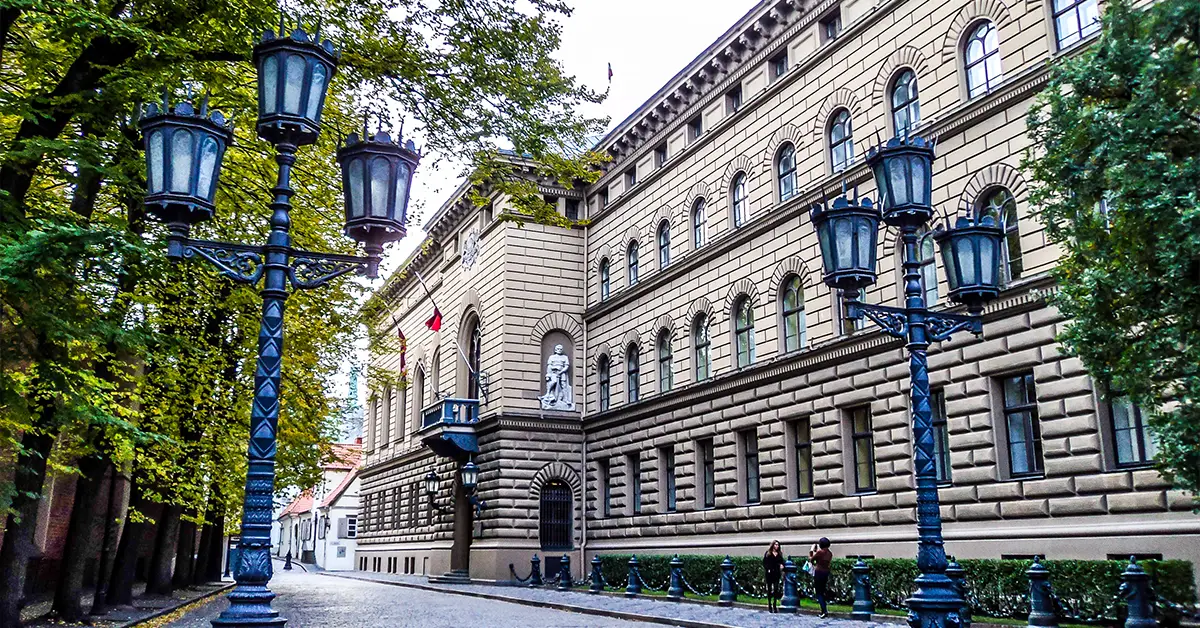
Latvian politics operates on a multi-party parliamentary republic model resting on the Satversme Constitution — one of the oldest constitutions in Europe still in force. The countryLatviahas built a stable democracy since restoring independence in 1991, with the 100-member Saeima as the central body of power.
This article analyses Latvian politics systematically across 6 aspects: an overview of the system, the Saeima, the President and the Cabinet of Ministers, the judiciary, the parties and the 2026 Saeima election, and local government after the 2021 administrative reform.
Message
An overview of the Latvian political system
Latvian politics is organised on the principles of representative democracy with a clear separation of the three branches of legislature, executive and judiciary. The Satversme Constitution — the foundational legal document — was adopted by the Constitutional Assembly on 15/02/1922 and took effect on 07/11/1922. After the period of Soviet occupation, it was fully restored on 06/07/1993 together with the first sitting of the 5th Saeima.
The Satversme is one of the shortest constitutions in the world with only 116 articles, although it has been amended several times to add fundamental citizens’ rights and adjust to European Union membership. The most important amendment was the addition of Chapter 8 on fundamental human rights in 1998. In 2014, a preamble was adopted, affirming Latvian identity as bound up with European heritage, Christian values and the Latvian language tradition.
The Latvian political model belongs to the pure parliamentary republic group, in which Parliament holds the central role. The President is elected by Parliament rather than directly, and real power is concentrated in the hands of the Prime Minister and Cabinet of Ministers. The current Latvian political system is similar to those of Germany, Estonia and Hungary, ensuring the political accountability of the executive to the body representing the electorate.
On the international democracy indices, Latvian politics is highly rated within Central and Eastern Europe. On the Bertelsmann Stiftung Transformation Index 2026, Latvia falls within the group of well-functioning democracies with an effective separation of powers. The V-Dem democracy index likewise places Latvia in the liberal democracy group, although the score has fluctuated slightly over the past decade in relation to the Russian-speaking community and local-level corruption.
Considering a residency programme? The Prosperous Living Investment team assesses your profile free of charge and advises on the pathway that fits your goals.
The Saeima — the Latvian Parliament
The Saeima is the sole legislative body in Latvian politics, a unicameral parliament of 100 members serving 4-year terms. The name “Saeima” comes from Old Latvian, meaning “assembly” or “gathering”. The first Saeima was elected in 1922 after the Satversme took effect; after the interruption of 1934–1993, the 5th Saeima was formally re-established in July 1993.
Saeima elections are held on the first Saturday of October every 4 years. The electoral system is proportional representation with open lists across 5 constituencies: Riga, Vidzeme, Latgale, Kurzeme and Zemgale. The seats allocated to each constituency are based on registered population, determined by the Central Election Commission 4 months before polling day.
Voters may mark a plus to support or cross out to oppose each candidate on a list, so that the order of election reflects the voters’ direct will rather than the party’s set order alone. This is a distinctive feature of Latvian politics, increasing internal competition within each party.
The electoral threshold is 5% of valid votes nationwide — a mechanism helping stabilise a fragmented multi-party system. The Sainte-Laguë method is used to allocate seats. Every Latvian citizen aged 18 has the right to vote, and those aged 21 may stand. Those who worked for the Soviet security service (KGB) or the intelligence services of other countries are barred from standing under the Saeima Election Law.
The Saeima’s internal structure comprises a 5-member Presidium — the Speaker, 2 Deputy Speakers, the Secretary and the Deputy Secretary — together with specialist committees such as the Legal Affairs Committee, the Foreign Affairs Committee and the Defence Committee. Members elected from the same list usually form a parliamentary group to work together; a member who leaves a group becomes “unaffiliated” and may not join another.
The Saeima’s powers in Latvian politics comprise passing legislation, amending the constitution, electing the President, approving the government, passing the national budget and ratifying international treaties.
The President and the Cabinet of Ministers in Latvian politics
The President is the head of state in the Latvian political system, elected by the Saeima for a 4-year term and for a maximum of 2 consecutive terms. The presidential election process changed considerably in 2019, when the Saeima moved from a secret ballot to an open one, increasing transparency and members’ political accountability. By convention, the successful candidate must resign from their party on taking office to maintain neutrality.
The current President is Edgars Rinkēvičs, who took office on 08/07/2023. He is the first openly gay President in the entire European Union — an important milestone reflecting the social change in modern Latvian politics. He previously served as Minister of Foreign Affairs from 2011 to 2023, the longest-serving holder of that office in Latvian history.
The President’s powers comprise: appointing the Prime Minister, signing legislation into law, returning legislation to the Saeima for a second reading (a limited veto), proposing legislation, issuing decrees in an emergency, representing the state in foreign affairs, serving as commander-in-chief of the armed forces and appointing ambassadors. The President may also dissolve the Saeima, but this proposal must be approved by referendum — where the voters reject it, the President is removed from office.
Executive power in practice rests with the Cabinet of Ministers headed by the Prime Minister. The current Prime Minister is Evika Siliņa of New Unity (Jaunā Vienotība), who took office on 15/09/2023. She leads a 3-party coalition comprising New Unity (centre-right), the Progressives (social democratic and green) and the Union of Greens and Farmers (ZZS). The Cabinet must have the Saeima’s confidence to govern and may be removed by a vote of no confidence. The current government structure comprises the Prime Minister and 13 ministers covering fields from finance, defence and foreign affairs to education, health and culture.
The judiciary and the Constitutional Court in Latvian politics
The judiciary is the third branch of Latvian politics, operating independently and protected by the principle of judicial inviolability under the Satversme. The ordinary court structure has 3 levels: district and city courts (rajona/pilsētas tiesa), regional courts (apgabaltiesa) and the Supreme Court (Augstākā tiesa). Each level hears civil, criminal and administrative cases within the jurisdiction the law prescribes.
The Constitutional Court of Latvia (Satversmes tiesa) is a distinctive institution in Latvian politics, established in 1996 with 7 judges serving 10-year terms. It has jurisdiction to review the constitutionality of legislation, government decrees, international treaties and senior administrative decisions. Its judgments are binding and final — they cannot be appealed. A typical example is the judgment of 01/06/2021 declaring the merger of Varakļāni district into Rēzekne district unconstitutional, obliging the Saeima to maintain Varakļāni as the 43rd administrative unit until 2025.
The Judicial Council (Tieslietu padome) is the judicial governance body, with the role of ensuring the independence of the court system in Latvian politics. It takes part in decisions on appointing and removing judges, assessing the quality of adjudication and proposing judicial reform. The prosecution service (Prokuratūra) operates independently of the government, headed by the Prosecutor General, with responsibility for criminal prosecution and overseeing the lawfulness of investigations.
Latvia participates fully in the international and European judicial systems. The country accepts the jurisdiction of the European Court of Human Rights (ECHR) in Strasbourg, the Court of Justice of the European Union (CJEU) in Luxembourg and the International Criminal Court (ICC). On the Bertelsmann Stiftung Transformation Index 2026, the Latvian judiciary is assessed as structurally independent but still facing challenges over the speed of case handling, the expertise of district judges and political pressure in sensitive cases.
The parties and the 2026 Saeima election in Latvian politics
The party system is a notable feature of Latvian politics, with a fragmented multi-party structure in which coalition government is the norm. No party in Latvia’s democratic history (after 1993) has ever won more than 32% of the vote. The highest was 32.4% for the “Latvian Way” party in the 1993 election. As a result, every government has been a coalition, usually of 3 or more parties, with negotiations focused on national security policy, the economy and relations with the Russian-speaking community.
The current governing coalition comprises 3 parties: New Unity (JV), a centre-right party in the European People’s Party (EPP) group; The Progressives (PRO), a social democratic and green party linked to the Greens/EFA group in the European Parliament; and the Union of Greens and Farmers (ZZS) — which despite the “Green” name is in practice an agrarian conservative party, different from the traditional Western European green parties. This coalition was formed after the 2022 Saeima election and has been led by Prime Minister Evika Siliņa since September 2023.
The main opposition parties comprise the National Alliance (Nacionālā apvienība, NA) — a national conservative party; Latvia First (Latvija pirmajā vietā, LPV) — a right-wing populist party; and Apvienotais saraksts (the United List) — a coalition of regional parties. In recent opinion polls before the 15th Saeima election on 03/10/2026, the National Alliance leads on around 15%, followed by Latvia First on 14% and New Unity on 11.5%. More than half of voters express a wish to change the current governing coalition. The Communist Party of Latvia is the only political party banned by law.
Theo the Central Election Commission of Latvia (CVK), turnout at recent Saeima elections has ranged from 55–65%. A distinctive feature of elections in Latvian politics is that voters may vote at any polling station in the country or at several polling stations abroad, convenient for the diaspora. The Riga constituency includes voters abroad. The 2026 Saeima election will be held on 03/10/2026 and the new Saeima will hold its first sitting on the first Tuesday of November 2026.
A long-running issue in Latvian politics is the position of “non-citizens” (nepilsoņi) — a legacy of the Soviet period. Around 175,000 long-term residents of Latvia (mainly of Russian origin) have not naturalised and cannot vote in Saeima elections, although they hold a special passport and most other civil rights. This continues to be a subject of debate over the inclusiveness of Latvian democracy, particularly against the geopolitical tension with Russia since 2022.
Local government in Latvian politics after the 2021 reform
The local government system has undergone its largest reform since the restoration of independence, in force from 01/07/2021. Under the Law on Administrative Territories and Populated Areas (Administratīvo teritoriju un apdzīvoto vietu likums) passed on 10/06/2020, the old system of 119 units (110 districts and 9 republican cities) was merged into 42 new units — 35 districts (novadi) and 7 state cities (valstspilsētas). This reform aimed to increase the economic scale of the basic administrative units and reduce administrative cost per head.
The 7 state cities after the reform comprise: Riga (the capital), Daugavpils, Liepāja, Jelgava, Jūrmala, Rēzekne and Ventspils. Three other large towns — Jēkabpils, Valmiera and Ogre — were merged into the districts of the same name rather than continuing as separate units. Riga, with nearly a third of the national population, has a special status and takes on more functions than the other state cities.
A notable detail concerns the Constitutional Court’s judgment of 01/06/2021 that merging Varakļāni district into Rēzekne district was unconstitutional. The Saeima had to maintain Varakļāni as the 43rd unit until July 2025, when the district was formally merged into Madona district after the 2025 local elections. This shows the Constitutional Court’s role in protecting local autonomy in Latvian politics.
Each basic administrative unit has a council (dome) directly elected for a 4-year term. The council elects a Council Chair (mērs) to head the local authority. The districts are further divided into 71 small towns (pilsētas) and 512 parishes (pagasti), forming a two-tier administrative structure below central government. Local authority powers comprise education from nursery to secondary level, social services, local public transport, waste management, building permits, local roads and regional economic development.
Alongside the formal administrative system, Latvia has 5 planning regions — Riga, Vidzeme, Kurzeme, Zemgale and Latgale — to coordinate spatial planning, regional development and EU fund allocation. However, these are not formal administrative units and have no directly elected government; the regional councils are elected indirectly by the district Council Chairs. The 5 cultural and historical regions (Vidzeme, Latgale, Kurzeme, Zemgale, Sēlija) are also recognised in law to protect local cultural identity, but have no administrative role.
A summary of Latvian politics
Latvian politics is a mature parliamentary democracy, formed by the Satversme Constitution of 1922 and consolidated over more than 3 decades since the restoration of independence. The parliamentary republic model with a 100-seat Saeima, a President elected by Parliament and multi-party coalitions as the norm has proved able to operate stably within a fragmented party system.
Accession to the European Union and NATO in 2004 placed Latvia within the European legal and institutional framework, with a judiciary participating in the ECHR and CJEU and elections assessed by the Council of Europe as meeting democratic standards. The challenges facing Latvian politics today comprise resolving the “non-citizen” question, maintaining judicial independence, balancing EU economic integration with security against Russia, and implementing the 2021 administrative reform effectively at local level.
The 15th Saeima election on 03/10/2026 will be an important test of Latvian democracy against a volatile European geopolitical background. The result will shape the country’s economic, security and social policies over 2026–2030, comprising defence spending, support for Ukraine, education reform and relations with the Russian-speaking community.
Accompanying you on your journey in residency investment
The Prosperous Living Investment team advises on pathways, assesses profiles and manages investments transparently for every residency, citizenship and international property objective.
Free profile assessmentWhere life gets prosperous