

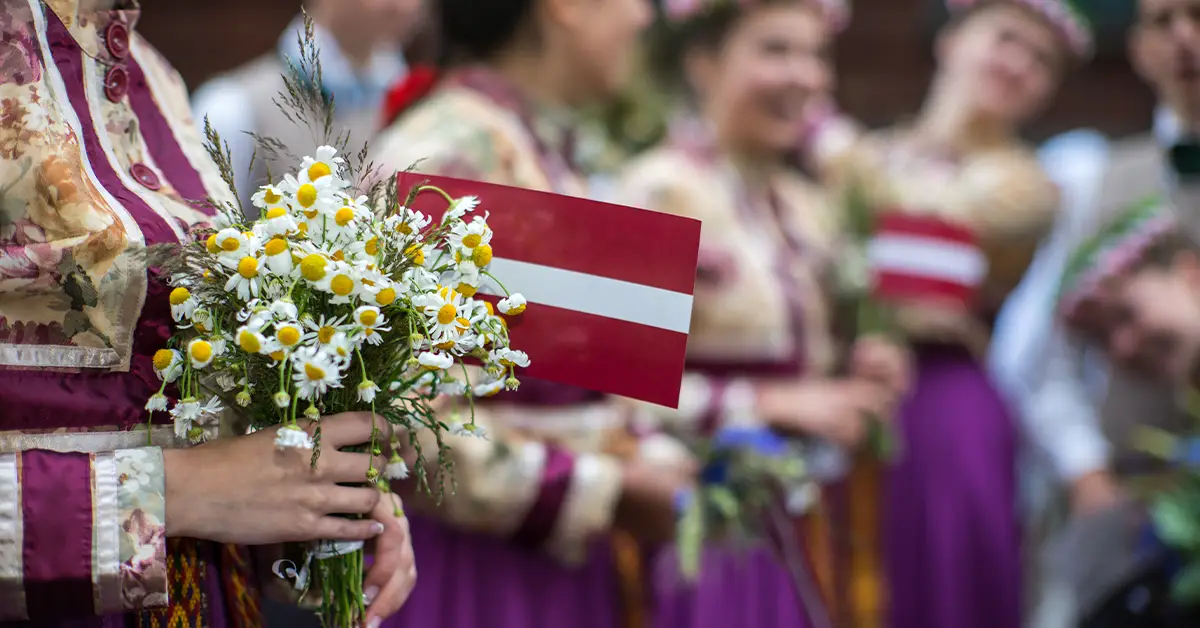
Latvian culture is a distinctive combination of a thousand-year Baltic heritage, Nordic, German and Russian influences across the centuries of foreign rule, and a national identity strongly reasserted after the restoration of independence in 1991. The countryLatviahas 2 important UNESCO listings — the Historic Centre of Riga (World Heritage 1997) and the Song and Dance Celebration (Intangible Cultural Heritage 2003), placing it among the countries with a particularly rich internationally recognised cultural heritage.
This article analyses Latvian culture systematically across 6 main aspects: an overview and Baltic identity, the Song and Dance Celebration, literature, music and theatre, Riga architecture and the UNESCO heritage, traditional food and drink, and the folk festivals and customs.
Message
An overview of Latvian culture and Baltic identity
Latvian culture took shape at the meeting point of Northern Europe, Eastern Europe and the Slavic world, creating a distinctive identity that overlaps with no other cultural region. At its core are an ancient Baltic language — one of the 2 surviving Baltic languages alongside Lithuanian — a traditional agricultural culture, folk beliefs bound up with nature, and an enduring national spirit forged through 7 centuries of foreign rule.
Latvian culture formed through several periods of influence. Before Christianity, the ancient Baltic tribes — the Latgalians, Selonians, Curonians and Semigallians — and the Finno-Ugric Livonians developed a polytheistic belief system with the gods Dievs (heaven), Māra (mother earth), Laima (fate) and Pērkons (thunder). These gods survive in folk song and custom to this day, though as symbols rather than practised religion.
From the 13th century, the arrival of the German knights and Christianity brought Western European cultural elements: Romanesque and Gothic architecture, the Latin alphabet, and Hanseatic urban culture. The Swedish period (1621–1721) brought Lutheranism and a spirit of mass education. The Russian Empire period (1721–1918) added Slavic and Orthodox influence, particularly in the Latgale region in the east.
Latvia is now divided into 5 cultural and historical regions with distinct identities: Vidzeme in the north with its Lutheran tradition and strong German-Swedish influence; Latgale in the east with its Catholic, Polish and Russian heritage; Kurzeme in the west with its fishing and craft traditions; Zemgale in the south-centre as a fertile agricultural region; and Sēlija — the smallest, between Zemgale and Latgale with a transitional identity. Each region has its own national dress, linguistic variants and culinary traditions, enriching the whole picture of Latvian culture.
A standout feature of modern Latvian culture is a high degree of secularisation combined with a celebration of folk tradition. On the Eurobarometer, only around 38% of Latvian citizens believe in God, yet 96% of families take part in the traditional Jāņi midsummer festival. This is a cultural paradox — Christian religion has declined while pre-Christian customs have been revived and treasured. The Latvian diaspora in the United States, Canada, Australia, Britain and Germany also plays an important role in maintaining Latvian culture abroad and transmitting it back home.
Considering a residency programme? The Prosperous Living Investment team assesses your profile free of charge and advises on the pathway that fits your goals.
The Song and Dance Celebration in Latvian culture
The Song and Dance Celebration (Vispārējie latviešu Dziesmu un Deju svētki) is the greatest cultural emblem of Latvian culture, held every 5 years since 1873 — 152 years of continuity with 27 celebrations held as at 2023. UNESCO recognised the Celebration as a Masterpiece of the Oral and Intangible Heritage of Humanity in 2003, together with the equivalent festivals of Estonia and Lithuania.
The Celebration’s origins lie in the rural choral movement of the first half of the 19th century, inspired by the German, Swiss and Austrian song festivals. In 1864, the Baltic German Lutheran pastor Juris Neikens organised the first gathering of Latvian male choirs in the village of Dikļi with 6 choirs and 120 singers.
In 1870, Jānis Bētiņš organised the Kurzeme Song Festival at Dobele with 400 singers and a 40-piece orchestra. By 1873, the first National Song Festival was held in Riga with 1,000 singers — 30 years before Latvia declared independence. The Dance element was added from 1948.
The scale of the modern Song and Dance Celebration makes it one of the largest cultural festivals in the world. At the XXVII celebration in 2023 — marking 150 years of the tradition — 40,560 people took part: 454 choirs with 15,870 singers, 695 dance groups with 16,879 dancers, 66 wind orchestras with 2,097 musicians, 508 other groups with 5,714 members, together with 88 diaspora groups with 2,587 members from 22 countries. Around 500,000 spectators attended the week’s events — equivalent to 27% of Latvia’s population.
The Mežaparks Great Bandstand (Lielā estrāde) is the emblematic venue of the Song and Dance Celebration and one of the most distinctive works of cultural architecture in Latvia. The first stage was built in 1955 with capacity for 10,000 singers on stage and 30,000 spectators in the stands.
In 2018, the structure was rebuilt and expanded to mark 100 years of Latvian independence, reopening in 2021 to a new design by the architects Juris Poga and Austris Mailītis. The new structure takes the form of a “Silver Birch Grove” 35.8 metres high with 510 acoustic panels — one of the most complex acoustic structures in Europe.
The Celebration’s political role in Latvian culture was confirmed during the Singing Revolution of 1987–1991. In the Soviet period, patriotic songs such as “Pūt, vējiņi!” (Blow, wind), “Gaismas pils” (Castle of Light) and “Saule, Pērkons, Daugava” (Sun, Thunder, Daugava) were restricted or banned, yet were still sung publicly at the Celebrations — turning choral art into a tool of non-violent resistance. The 1990 Celebration — the first after independence was restored — brought the national flag and anthem back to the stage after nearly 50 years of prohibition.
Literature, music and theatre in Latvian culture
Latvian literature rests firmly on the ancient treasury of folk song — the most important spiritual heritage of Latvian culture. Krišjānis Barons (1835–1923) — known as “the father of the Dainas” — collected and classified around 1.2 million Dainas (folk songs) over 39 years, stored in the Cabinet of Dainas (Dainu skapis) in Riga.
In 2001, the Cabinet was inscribed on UNESCO’s Memory of the World Register, confirming the global value of the heritage. Each Daina is a short 4-line verse, reflecting agricultural life, belief, family relationships and the ancient Latvian conception of the universe.
Modern Latvian literature began to flourish with the National Awakening of the 19th century. Rainis (Jānis Pliekšāns, 1865–1929) is the national poet and playwright, author of “Uguns un nakts” (Fire and Night) and “Jāzeps un viņa brāļi” (Joseph and His Brothers).
His wife, Aspazija (Elza Rozenberga, 1865–1943), was also a major poet who joined Rainis in the national movement and later went into exile in Switzerland. The 20th century produced Jānis Veselis and Anšlavs Eglītis, and since the restoration of independence, contemporary writers such as Nora Ikstena, Pauls Bankovskis and Inga Ābele have been translated into many languages.
Classical music has a particular place in Latvian culture, with many composers and performers of international standing. Pēteris Vasks (born 1946) is the best-known contemporary composer, with works for strings and choir inspired by Baltic nature. Andris Nelsons (born 1978) is an internationally renowned conductor, currently Music Director of the Boston Symphony Orchestra (United States) and the Gewandhaus Leipzig (Germany). The opera singers Elīna Garanča (mezzo-soprano) and Marina Rebeka (soprano) perform regularly at the world’s leading opera houses such as the Met, La Scala and the Vienna State Opera.
The Latvian National Opera (Latvijas Nacionālā opera) in Riga is one of the leading performing arts venues in the Baltic region, founded in 1919. The current building was built from 1860 in the Neoclassical style and has been refurbished several times, with 2 main stages seating 1,300. Besides opera, the house is home to the Latvian National Ballet. The other major theatres comprise the Latvian National Theatre (Latvijas Nacionālais teātris) founded in 1919 and the Dailes Theatre (Dailes teātris) founded in 1920.
Latvian cinema has a long tradition from the Soviet era through the Riga Film Studio, with well-known directors such as Juris Podnieks (1950–1992) — maker of the documentary “Vai viegli būt jaunam?” (Is It Easy To Be Young?) in 1986, which made an international impact. Contemporary directors such as Laila Pakalniņa, Dāvis Sīmanis and Edmunds Jansons have represented Latvian cinema at the Cannes, Berlin and Venice film festivals. “Dvēseļu putenis” (Blizzard of Souls) by Dzintars Dreibergs in 2019 — about the Latvian Riflemen in the First World War — is one of the highest-grossing films in the history of Latvian cinema and culture.
Riga architecture and the UNESCO heritage in Latvian culture
The Historic Centre of Riga (Vecrīga and the Centre district) was inscribed on the UNESCO World Heritage List in 1997 and is the most important internationally recognised element of Latvian cultural heritage. The area covers 438 hectares, comprising the Hanseatic Old Town and the 19th and 20th century Centre district. Its heritage value lies in the distinctive combination of architecture across several periods — from medieval Gothic and Swedish-era Baroque through Russian Imperial Neoclassicism to early 20th-century Art Nouveau.
Riga’s Old Town (Vecrīga) is the area founded in 1201 by Bishop Albert von Buxhoeveden. The notable buildings comprise St Peter’s Church (built 1209, with a 123-metre tower), Riga Dom (Riga Cathedral, 1211 — the largest Lutheran church in the Baltics), Riga Castle (1330, now the presidential residence), the historic Town Hall and the central square. The old city walls and part of the Hanseatic gates are still preserved. Riga was a member of the Hanseatic League from the 13th to the 17th century, and the Baltic German trading imprint remains clear in the old town’s architecture.
Riga is known as “the Art Nouveau Capital of the World” — a title within Latvian culture that few other countries can match. More than 800 Art Nouveau (Jugendstil in German) buildings are concentrated in Riga’s Centre district, around 40% of the city’s historic buildings — the highest proportion in the world. According toUNESCO World Heritage Centre, this style flourished over 1899–1914, coinciding with Riga’s period as the 5th largest city of the Russian Empire and the leading industrial and cultural centre of the Baltics.
Alberta iela is the best-known street for Riga Art Nouveau architecture. Eight of the buildings on it were designed by the architect Mikhail Eisenstein (1867–1921) — father of the famous film director Sergei Eisenstein — between 1901 and 1906. The other buildings on Elizabetes, Strēlnieku, Brīvības and Antonijas streets are likewise masterpieces by Latvian architects such as Konstantīns Pēkšēns, Eižens Laube and Aleksandrs Vanags. The Riga Art Nouveau Museum, in the architect Pēkšēns’s own apartment at 12 Alberta iela, is an important stop for lovers of architecture.
Riga was chosen as European Capital of Culture in 2014 — an important recognition of Latvian culture within the EU community. More than 200 major cultural events were held that year, from art exhibitions and concerts to film festivals. Besides Riga, other historic towns such as Cēsis, Kuldīga (with 17th and 18th century wooden architecture), Liepāja and Daugavpils are also working to preserve local architectural heritage. In 2023, the Old Town of Kuldīga was inscribed on the UNESCO World Heritage List — Latvia’s third UNESCO site.
Traditional food and drink in Latvian culture
Traditional cuisine is an important element of Latvian culture, reflecting the Northern European climate, agricultural traditions and the meeting of Nordic, German and Slavic influences over centuries. The basic ingredients comprise rye, wheat, potatoes, pulses, beetroot, sea and freshwater fish, pork and beef, dairy products (cheese, sour cream), wild mushrooms, berries (blueberries, currants, raspberries) and honey.
Rye bread (rupjmaize) is the emblem of the national cuisine and appears at almost every traditional Latvian meal. It has a hard crust and a dense crumb with a distinctive sourness from natural leaven, and is usually baked in a clay oven over a long period. Latvians have a saying, “Bread is life” (Maize ir dzīve), reflecting the central role of this staple in Latvian culture. Saldskābmaize (sweet-sour bread) and baltmaize (white bread) are other variants.
Some distinctive dishes in Latvian culture comprise: aukstā zupa (auksta) cold beetroot soup — its distinctive pink colour, served with boiled potatoes, a popular summer dish; pelēkie zirņi ar speķi — grey peas stewed with smoked pork, a traditional Christmas dish; pumpkin pie and smoked salmon; salted herring with potatoes and sour cream; siļķe ar biezpienu; Jāņi cheese (Jāņu siers) eaten at midsummer; and piparkūkas (Christmas spice biscuits) made with honey, ginger and cinnamon.
Traditional Latvian drinks are likewise varied and distinctive. Riga Black Balsam (Rīgas Melnais balzams) is the best-known product — a black herbal liqueur at 45% proof, made from 24 herbs, flowers and berries and aged in oak barrels.
On the official history, Black Balsam was created by the pharmacist Abraham Kunze in 1752, originally as a medicinal balsam. Legend has it that Empress Catherine the Great was cured of stomach pain by the Balsam while visiting Riga, and afterwards granted the maker exclusive production rights. Today, Latvijas balzams owns the brand and exports to more than 30 countries.
Craft beer (alus) is an indispensable part of Latvian food culture, with a home-brewing tradition dating from the 17th century. Large breweries such as Aldaris (founded 1865) and Cēsu Alus (1590 — one of the oldest breweries in Europe) produce lagers, dark ales and craft beers.
There is also mead (medus) — the traditional honey wine, kvass — a fermented bread drink, and sbiten — a warm drink with honey and herbs. Modern food culture in Riga is seeing a boom in the “New Nordic Cuisine” movement with many restaurants recommended by the Michelin Guide.
Folk festivals and customs in Latvian culture
The system of folk festivals is the liveliest expression of Latvian culture, with many customs originating before Christianity and still widely practised today. The Latvian festival calendar reflects the agricultural and astronomical cycle — divided by the important solstices and equinoxes of the year: the summer solstice (June), the autumn equinox (September), the winter solstice (December) and the spring equinox (March).
Jāņi (midsummer, the night of 23–24 June) is the largest and best-loved festival of the year — sometimes described as “the Latvian New Year” for its absolute universality within Latvian culture. Most Latvians leave the cities for the countryside or a summer house to keep the Jāņuguns bonfire burning all night, weave wreaths of wild flowers and oak leaves, eat Jāņi cheese, drink beer, sing Līgo songs (with the refrain “līgo, līgo”) and dance around the fire until dawn.
Men wear oak leaf wreaths (ozolzars) and women wreaths of wild flowers. Both 23 and 24 June are public holidays in Latvia, reflecting the importance of this festival to modern Latvian culture.
Mārtiņi (10 November) marks the end of the harvest and the start of winter. The traditions comprise eating roast goose and meat pies and sharing the autumn produce. The festival has its origins in the Christian feast of St Martin but has merged with ancient agricultural rites.
Ziemassvētki (Christmas, 24–26 December) combines Christian tradition with ancient winter solstice custom — most notably the practice of dragging the Bluķis log past the houses and then burning it, symbolising driving out the bad of the old year. The world’s first Christmas tree is said to have been raised in Riga’s Town Hall Square in 1510, on official Latvian cultural sources.
Among the political and historical festivals of Latvian culture, National Day on 18 November is the greatest, marking the declaration of independence in 1918. It comprises a military parade in Freedom Square, the laying of wreaths at the Freedom Monument in Riga, concerts and fireworks. 4 May is the Day of the Restoration of Independence, marking the Declaration of 1990. 14 June is the Day of Remembrance of the Victims of the Soviet Deportations of 1941, and 4 July the Day of Remembrance of the Victims of the Latvian Holocaust.
Traditional crafts play a central role in Latvian culture. National dress (tautas tērps) has more than 100 different designs by region and village, worn at the major festivals and the Song and Dance Celebration. Latvian craftspeople are known for hand-woven rugs, knitting, pottery, wood carving, hand embroidery and jewellery made from Baltic amber and silver. Each region has its own symbols and patterns — such as Lielvārde (Vidzeme), famous for the Lielvārdes josta pattern, an embroidered sash regarded as “the Latvian cosmic symbol”.
Mother’s Day (the second Sunday in May) and Father’s Day (the second Sunday in September) are also important occasions. Lieldienas (Easter) has the tradition of dyeing eggs with onion skins to give a natural reddish-brown colour, and swinging (šūpoles) — a custom believed to bring health and good fortune for the new year. Traditional wedding customs are still kept in many regions, particularly in Latgale, with rites lasting 3 days, national dress and the singing of Dainas written specially for weddings.
A summary of Latvian culture
Latvian culture is a distinctive interweaving of a thousand-year Baltic heritage with German, Swedish, Russian and Polish influences across the periods of foreign rule. The core identity — the Baltic language, folk beliefs bound up with nature, and the immense treasury of Dainas folk songs — was preserved through 7 centuries of foreign rule thanks to the persistence of the people and the role of the Song and Dance Celebration as an instrument for maintaining national identity.
UNESCO’s recognition of 3 elements of Latvian cultural heritage — the Historic Centre of Riga (1997), the Song and Dance Celebration (2003) and the Old Town of Kuldīga (2023) — together with the Cabinet of Dainas on the Memory of the World Register (2001) — has placed Latvian culture among the important heritages of humankind. Its position as the Art Nouveau Capital of the World with more than 800 buildings in Riga, together with its status as European Capital of Culture in 2014, has further strengthened the country’s cultural role.
The outlook for Latvian culture in the 21st century depends on the ability to balance preserving tradition with embracing contemporary creativity. The Youth Song and Dance Celebration of 2025 with 38,000 young participants is evidence of the successful handing on of the heritage. At the same time, the emergence of Latvian musicians, directors and writers on the international stage shows Latvian culture contributing actively to the European and global cultural space — not only as a keeper, but as a creator.
Accompanying you on your journey in residency investment
The Prosperous Living Investment team advises on pathways, assesses profiles and manages investments transparently for every residency, citizenship and international property objective.
Free profile assessmentWhere life gets prosperous