

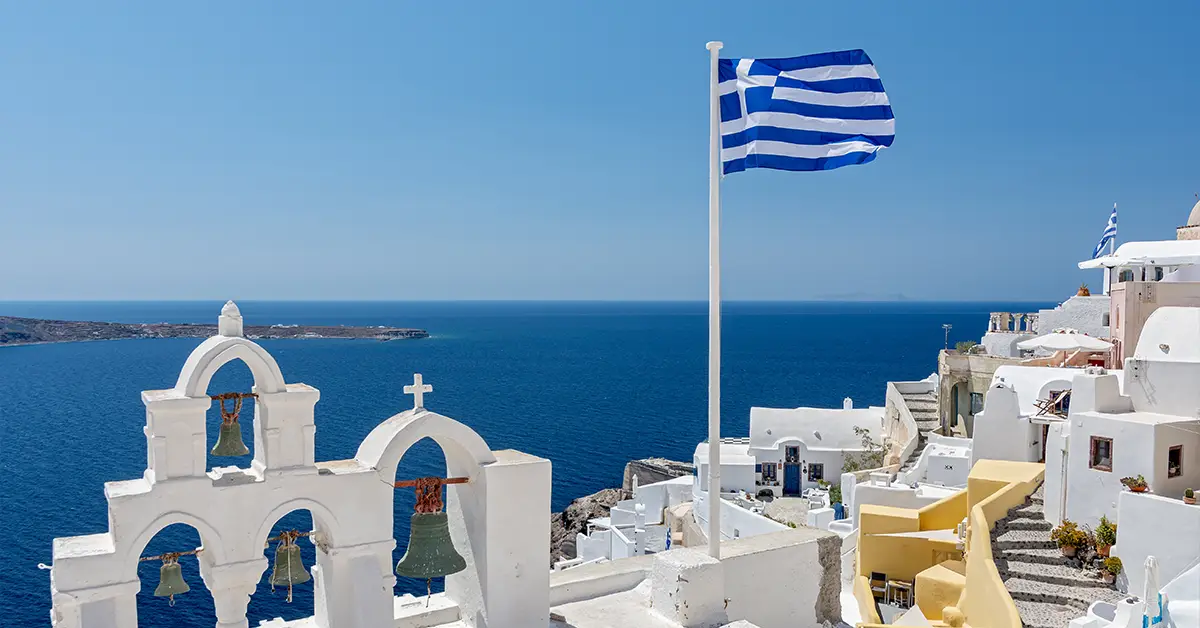
Greece (officially, in Greek, Ελληνική Δημοκρατία — the Hellenic Republic) lies in South-Eastern Europe, at the crossroads of Europe, Asia and Africa. Regarded as the cradle of Western civilisation, Greece is the birthplace of democracy, philosophy, science, mathematics, theatre and the Olympic Games.
With a population of around 10.4 million and an area of 131,957 km² (including thousands of islands scattered across the Aegean and Ionian seas), the country holds one of the richest cultural heritages in the world and an economy on an impressive path of recovery.
In recent years, Greece has attracted ever more international investors thanks to theGreece Golden Visaprogramme, a strongly growing property market and a favourable tax regime for new residents. This article provides a comprehensive view of Greece across history, geography, politics, the economy, demographics, education, culture, international relations, sport, transport, defence, the environment and health.
Message
History
A detailed article onThe history of Greece.
Greece has one of the longest and richest histories in the world. The Minoan civilisation on Crete (around 2700–1450 BC) and the Mycenaean civilisation (around 1600–1100 BC) laid the foundations of Greek culture. By the 5th century BC, Athens had become the centre of the world’s first democracy, while witnessing the brilliant flowering of philosophy (Socrates, Plato, Aristotle), drama (Sophocles, Euripides) and architecture (the Parthenon).
Alexander the Great (356–323 BC) extended the Greek empire from Egypt to India, spreading Greek culture across the ancient world during the Hellenistic period. Greece then became part of the Roman Empire (146 BC), and then the Byzantine Empire (AD 395–1453). In 1453, Constantinople fell to the Ottoman Empire, opening nearly 4 centuries of Greece under Ottoman rule.
The war of independence broke out in 1821 and by 1829 Greece had become one of the first countries in South-Eastern Europe to gain independence. The 20th century was marked by great upheaval: 2 World Wars, a civil war (1946–1949), a military dictatorship (1967–1974) and finally the restoration of democracy with the referendum of 1974 abolishing the monarchy. Greece joined the European Economic Community (now the EU) in 1981.
Considering a residency programme? The Prosperous Living Investment team assesses your profile free of charge and advises on the pathway that fits your goals.
Geography
A detailed article onThe geography of Greece.
Greece lies at the southern tip of the Balkan peninsula, bordered by the Aegean to the east, the Ionian to the west and the Mediterranean to the south. The country borders Albania, North Macedonia and Bulgaria to the north, and Turkey to the north-east. Its total area is 131,957 km², of which around 80% is hills and mountains, making Greece one of the most mountainous countries in Europe.
The most distinctive feature of Greek geography is its vast island system. The country has around 6,000 islands and islets, of which around 227 are inhabited. The famous island groups comprise the Cyclades (Santorini, Mykonos), the Dodecanese (Rhodes), the Ionian islands (Corfu, Zakynthos) and Crete — the largest island and the birthplace of the Minoan civilisation. The Greek coastline runs around 13,676 km, among the longest in the world.
The highest peak is Olympus (2,917 m), in Greek mythology the seat of the gods. Greece has a Mediterranean climate with hot dry summers and mild winters. Average summer temperatures range from 28°C to 35°C, while in winter the south rarely falls below 10°C. The islands and coastal areas receive more than 300 days of sunshine a year.
Politics
A detailed article onThe politics of Greece.
Greece is a parliamentary republic. The President is the ceremonial head of state, elected by Parliament for a 5-year term. The Prime Minister heads the government and holds real executive power, appointed by the President based on the election result. Parliament (the Vouli) is a unicameral legislature of 300 seats, with members elected for 4-year terms.
The Greek political system has been stable since democracy was restored in 1974. The current constitution was adopted in 1975 and last amended in 2019. The main parties comprise New Democracy (ND — centre-right), Syriza (left), PASOK-KINAL (centre-left) and several smaller parties. Greece is highly rated for political and civil freedom, although challenges over corruption and administrative bureaucracy remain.
The judiciary is independent, comprising the Supreme Court (Areios Pagos), the Court of Audit and the Council of State. Greece has been an EU member since 1981 and joined the eurozone in 2001.
The economy
A detailed article onThe economy of Greece.
A detailed article onTaxation in Greece.
The Greek economy has been through one of the most serious financial crises in modern European history. From 2008 to 2013, GDP fell by more than 25% and unemployment shot up to nearly 28%. Greece received 3 international bailout packages totalling around EUR 289 billion and only left financial surveillance in 2018.
However, the recovery since then has been remarkable. GDP grew 2.1% in 2025, reaching around EUR 248.4 billion (USD 280.6 billion), and is expected to grow 2.2% in 2026. GDP per capita reached around USD 29,696 (2026). Unemployment fell to 7.9% by the end of 2025 and start of 2026, the lowest in more than a decade, against a peak of 27.9% in 2013. The Economist ranked Greece the world’s best-performing economy in 2022 and 2023.
The main economic sectors comprise services (around 80% of GDP), shipping (Greece owns the world’s largest merchant fleet by tonnage), tourism (around 32 million visitors in 2023 — a record) and agriculture (cotton, olives, tobacco). Tourism contributes around 18% of GDP, making Greece one of the most tourism-dependent countries in Europe.
For foreign investors, Greece offers theGreece Golden Visaprogramme, allowing residence rights through property investment. In addition, the favourable tax regimes for high-net-worth individuals (a flat tax of EUR 100,000 a year), foreign retirees (a fixed rate of 7%) and new residents (a 50% income tax exemption) add further appeal.
Demographics
A detailed article onThe demographics of Greece.
Greece has a population of around 10.4 million. Average population density is around 79 per km², but the distribution is uneven — nearly a third of the population is concentrated in the Athens metropolitan area (around 3.1 million). Thessaloniki in the north is the second largest city with around 1.1 million in its metropolitan area.
Greek is the official language, a separate branch of the Indo-European family with a written history of more than 3,400 years. The Greek alphabet was the first alphabetic system to have both vowels and consonants, laying the foundation for the Latin and Cyrillic alphabets. Most of the population (around 81–90%) follows Greek Orthodoxy, which plays an important role in national cultural identity.
Life expectancy is around 81 years. Greece faces serious demographic challenges: a low birth rate (around 1.3 children per woman) and rapid population ageing. Around 22% of the population is over 65, among the highest in the EU. The emigration of young people during the economic crisis has also worsened the problem. However, in recent years the trend of Greeks returning home has grown thanks to the economic recovery and the favourable tax policies.
Education
A detailed article onEducation in Greece.
The Greek education system comprises 3 main stages: primary education (6 years, compulsory), lower secondary education (3 years, compulsory) and upper secondary education (3 years). Compulsory education runs from ages 6 to 15. All levels of state education are free, including university for Greek and EU citizens.
Greece has 24 public universities and 14 polytechnics. The notable institutions comprise the National University of Athens (founded 1837), the Aristotle University of Thessaloniki (the largest university in South-Eastern Europe) and the National Technical University of Athens. The Greek higher education system follows the Bologna Process, ensuring qualifications are recognised across the EU.
Literacy is around 98%. Education spending accounts for around 3.6% of GDP. Alongside the state system, Greece has many international schools in Athens and Thessaloniki teaching in English, French or German — a popular choice for foreign investor families. Greece is also a well-known study destination for archaeology, ancient history and Mediterranean studies.
Culture
A detailed article onGreek culture.
Greek culture has had a profound influence on the whole of Western civilisation. Greek mythology with its gods on Mount Olympus — Zeus, Athena, Apollo, Poseidon — remains present in modern literature, art and language. Ancient Greek philosophy (Socrates, Plato, Aristotle) laid the foundations of Western thought on logic, ethics and politics.
Ancient Greek architecture, with its Doric, Ionic and Corinthian columns, has influenced architecture worldwide for thousands of years. The Parthenon on the Acropolis in Athens is regarded as an emblem not only of Greece but of ancient civilisation as a whole. Greece has 19 UNESCO World Heritage Sites, comprising the Acropolis, Delphi, Olympia and the Meteora monasteries.
Greek cuisine is an important part of the Mediterranean diet — recognised by UNESCO as Intangible Cultural Heritage. Olive oil, feta cheese, yogurt, fresh vegetables, seafood and grilled meat are the foundations of Greek cooking. The distinctive dishes such as moussaka, souvlaki, gyros, spanakopita and baklava are famous worldwide.
Greek music combines Eastern and Western traditions. Rebetiko (often called “the Greek blues”) was recognised by UNESCO as Intangible Cultural Heritage in 2017. Dance is also an indispensable part of social life, with traditional dances such as the sirtaki, kalamatianos and hasapiko.
International relations
Greece is a founding member of the United Nations (1945) and NATO (1952), an EU member since 1981, a member of the eurozone (2001) and of the Schengen area (2000). The country is also a member of the Organisation for Economic Co-operation and Development (OECD), the Organization for Security and Co-operation in Europe (OSCE) and many other international bodies.
Relations between Greece and Turkey are the most complex matter in foreign policy, involving territorial disputes in the Aegean, the Cyprus question and resource extraction rights. However, both countries are NATO members and maintain diplomatic channels of dialogue.
Greece plays an important role in the Eastern Mediterranean and the Balkans, and is often seen as a bridge between the EU and the Middle East and North Africa. The country maintains strong economic relations with Germany, Italy, the United States, China and the Gulf states. Greece has held the Presidency of the Council of the EU several times, most recently in the first half of 2014.
Sport
Greece is the home of the Olympic Games, which began at ancient Olympia in 776 BC. Athens hosted the first modern Olympics in 1896 and the 2004 Summer Games. The Olympic flame is still lit at Olympia before each Games as a symbol linking past and present.
Football is the most popular sport, with major clubs such as Olympiacos, Panathinaikos and AEK Athens. The national team produced the greatest shock in European football history by winning Euro 2004. Basketball is also much loved — the national basketball team has won the European championship twice (1987, 2005) and Olympiacos has won the EuroLeague several times.
Greece also has a strong tradition in swimming, rowing, weightlifting, athletics and water polo (the men’s water polo team is among the world’s strongest). The islands are also ideal destinations for surfing, diving and sailing.
Transport
The Greek transport system comprises road, rail, air and sea. A modern motorway network links Athens with Thessaloniki (the Egnatia Odos), Patras and the other major cities. Athens has a modern Metro system, built for the 2004 Olympics, with many stations displaying archaeological finds uncovered during construction.
Eleftherios Venizelos International Airport in Athens is the main air gateway, serving more than 28 million passengers a year. The national carrier Aegean Airlines connects Greece with more than 150 destinations. In addition, dozens of regional airports serve the tourist islands, particularly in summer.
Sea transport is essential given the country’s many islands. The port of Piraeus (near Athens) is Europe’s largest passenger port and the largest container port in the Eastern Mediterranean, particularly since China’s COSCO group invested in upgrading it. The ferry network links hundreds of islands with the mainland, an indispensable means of travel in daily life.
Defence
The Greek armed forces comprise the Army, Navy and Air Force. Total standing strength is around 106,000, among the largest in NATO as a proportion of population. Defence spending accounts for around 3.5–4% of GDP, the highest among the European NATO members — largely because of the need to maintain defensive capability on the eastern border and the Aegean islands.
Compulsory military service still applies, with a 12-month term for men from the age of 18. Greece has been a NATO member since 1952 and takes an active part in international missions under NATO, EU and United Nations auspices. The Greek Navy plays an important strategic role in Eastern Mediterranean security.
The environment
A detailed article onLife in Greece.
Greece has rich biodiversity thanks to its distinctive geographical position and the diversity of its ecosystems — from mountain pine forests and coastal grasslands to wetlands and marine ecosystems. The country has 10 national parks, 2 national marine parks and many Natura 2000 conservation areas under EU rules.
As in many Mediterranean countries, wildfire is the greatest environmental challenge. The summer of 2023 saw the largest wildfire in EU history, severely affecting north-eastern Greece. The government has invested heavily in fire prevention systems and reforestation.
Greece has committed to carbon neutrality by 2050 under the European Green Deal. Renewable energy (particularly wind and solar) is growing quickly thanks to favourable climatic conditions. Islands such as Tilos have become pioneering models of fully renewable energy in Europe.
Health
A detailed article onHealthcare in Greece.
The Greek health system comprises the National Health System (ESY), providing healthcare to all lawful residents. Alongside it, the private health system operates strongly, particularly in Athens and Thessaloniki, with hospitals meeting international standards.
Life expectancy is around 81 years, reflecting the quality of life and the healthy Mediterranean diet. Health spending accounts for around 8% of GDP. Greece has one of the highest ratios of doctors per head in the EU, although the distribution between urban and rural areas — particularly on the islands — remains uneven.
Lawful residents, including those holding a residence permit through the Golden Visa programme, have access to the public health system. Many foreign nationals in Greece choose to combine this with private health insurance for a more complete healthcare experience, particularly where specialist services are needed or to reduce waiting times.
Frequently asked questions about Greece
Greece lies in South-Eastern Europe, at the southern end of the Balkan peninsula, surrounded by the Aegean (east), the Ionian (west) and the Mediterranean (south). The country borders Albania, North Macedonia and Bulgaria to the north and Turkey to the north-east.
Greece has used the euro (€) since joining the eurozone in 2001. Before that, the national currency was the drachma.
Greece has around 6,000 islands and islets, of which around 227 are inhabited. The most famous comprise Santorini, Mykonos, Crete, Rhodes, Corfu and Zakynthos.
Vietnamese citizens need a Schengen visa to enter Greece for short-term tourism (up to 90 days in 180). A Schengen visa allows free movement between the 29 Schengen member states.
Greece has theGolden Visaprogramme, allowing foreign nationals to obtain residence rights through property investment or other forms of investment. After 7 years of residence, investors may apply for Greek citizenship through naturalisation.
The cost of living in Greece is considerably lower than in Western European countries such as Germany, France or Britain. Athens and Thessaloniki cost more than the smaller towns and islands, but remain reasonable by EU standards overall. Food, eating out and public transport are affordably priced.
Greece has a Mediterranean climate with hot dry summers (28–35°C) and mild winters (10–15°C in the south). The country receives more than 300 days of sunshine a year, particularly on the southern islands.
Greece is rated a safe country with a low rate of violent crime. On the international rankings, Greece is among the safe countries in Europe, although visitors should be alert to petty crime (pickpocketing, theft) in crowded tourist areas.
Accompanying you on your journey in residency investment
The Prosperous Living Investment team advises on pathways, assesses profiles and manages investments transparently for every residency, citizenship and international property objective.
Free profile assessmentWhere life gets prosperous