

Greek healthcare operates on a universal coverage model, under which every lawful resident has access to basic health services through the National Health System (ESY) and the National Organisation for the Provision of Health Services (EOPYY). The system is supplemented by a network of private hospitals and clinics that has grown strongly in the major cities, forming the two-tier health structure typical of many Southern European countries.
This article analyses the organisation of the Greek health system, the insurance mechanism, the costs, the quality of service and the options for foreign nationals — comprising investors under theGreece Golden Visa, retirees and families weighing long-term settlement.
A detailed article onthe country of Greece.
Message
The overall structure of Greek healthcare
Greek healthcare has two parallel branches: the public sector run by the state and the private sector provided by private healthcare groups. The public sector is organised around the National Health System (Εθνικό Σύστημα Υγείας, abbreviated ESY), established in 1983 under Law 1282/1983. The ESY undertakes to provide free or low-cost healthcare to all lawful residents, on the principles of fairness and equal access.
The ESY comprises public general and specialist hospitals, primary health centres (kentra ygeias), local health units (TOMYs) and pre-hospital emergency services. The whole network comes under the Greek Ministry of Health, divided into seven Regional Health Authorities (YPE) corresponding to the geographical regions.
The second body with a key role in Greek healthcare is theNational Organisation for the Provision of Health Services (EOPYY), established in 2011 during the sovereign debt crisis. EOPYY merged all the previous compulsory health insurance funds into a single fund and acts as the single purchaser for all state-funded health services.
The private sector supplements the ESY, particularly in fields where the public system is overloaded such as diagnostic imaging, specialist testing, dentistry and less urgent surgical services. The large private hospitals are concentrated in Athens and Thessaloniki, with names such as Hygeia Group, Athens Medical Center, Metropolitan Hospital, Iatriko Kentro and HHG (Hellenic Healthcare Group).
Considering a residency programme? The Prosperous Living Investment team assesses your profile free of charge and advises on the pathway that fits your goals.
The ESY system and public health services
The ESY provides four main groups of services: pre-hospital emergency care, primary care, specialist outpatient care and inpatient care. Every resident with a social insurance number (AMKA) has access to the system. For EU citizens, the European Health Insurance Card (EHIC) allows free use of ESY services during a short stay.
Primary care is provided at health centres (kentra ygeias) in rural areas and local health units (TOMYs) in the cities. The TOMY model, rolled out from 2017, aims to establish a family doctor system based on registered lists (rostered primary care). Each TOMY usually comprises general practitioners, paediatricians, nurses, social workers and health records staff.
The ESY public hospital system comprises more than 120 hospitals, from district level up to university hospitals. The leading hospitals comprise: Evangelismos Athens (Greece’s largest public hospital), Laiko, Attikon, AHEPA Thessaloniki and Papageorgiou Hospital Thessaloniki. The university hospitals attached to medical schools can provide specialist treatment, including complex cardiac surgery, organ transplants and cancer care.
According to theState of Health in the EU: Greece Country Health Profile 2025report by the OECD and the European Commission, Greece is currently receiving EUR 1.5 billion from the EU Recovery and Resilience Facility to modernise its health system. The investment focuses on upgrading hospital infrastructure, digitising medical records and expanding preventive health services.
Greece’s electronic health records are delivered through the gov.gr platform. By 2024, around 38% of citizens had accessed their personal health information online. The electronic prescription system (e-prescription) is widespread, considerably reducing time at clinics and pharmacies.
EOPYY and the health insurance mechanism
EOPYY acts as the single health insurance fund for everyone in employment or receiving a pension in Greece. More than 98% of the population is covered by EOPYY, with contributions deducted from pay (employees contribute around 2.55% of salary and employers a further 4.55%).
Those registered with EOPYY have access to a unified package of health services (EKPY) comprising: primary care, diagnostics, specialist outpatient appointments, inpatient care, prescription medicines and medical devices. EOPYY maintains a network of contracted doctors (both public and private), where patients pay only a small co-payment of around 5–15 euros per appointment and 0–25% of medicine costs depending on the condition.
The Greek health financing model rests on three sources: compulsory social insurance contributions through EOPYY (around a third), state subsidy from the budget (around a third) and direct payment by patients or voluntary private insurance (more than a third). Greece’s share of direct payment at the point of use is high by EU standards, mainly because coverage of medicines and dentistry remains limited.
Greek health spending in 2022 was around 8.5% of GDP, slightly below the EU average of 8.7%. Spending per head was around USD 3,015 at purchasing power parity (PPP), below the OECD average of USD 4,986. Greek retail spending on medicines is relatively high at 586 euros per person in 2023, accounting for 27% of total health spending — double the EU average.
Healthcare quality and workforce
A particular strength of Greek healthcare is a density of doctors among the highest in Europe. On OECD figures, Greece has around 6.3 doctors per 1,000 people — the highest in the OECD. This is the result of a long medical tradition (Hippocratic medicine originated in ancient Greece) and medical training at universities such as the University of Athens, the Aristotle University of Thessaloniki (AUTH), the University of Patras and the University of Crete.
However, the density of nurses in Greece is below the EU average. This creates an overload of nursing staff, particularly at the large public hospitals in Athens. The government has rolled out several programmes to recruit more nurses and improve their pay and conditions over 2022–2026 to address this.
Treatment quality at ESY public hospitals is generally good for emergencies, cardiac surgery, organ transplants and cancer care. However, years of austerity policy during the sovereign debt crisis have left their mark: a shortage of modern medical equipment, long waits for some non-emergency procedures, and overcrowded facilities at some hospitals.
Life expectancy in Greece is around 81.3 (78.5 for men and 83.9 for women), among the higher figures in the EU. Greece has lower preventable mortality and treatable mortality rates than the EU average, showing that the health system works effectively in managing the common chronic conditions.
The private health sector
Private healthcare in Greece has grown strongly over the past two decades and now plays an important complementary role to the public sector. Hellenic Healthcare Group (HHG) is the largest private healthcare group, owning the leading hospitals Hygeia, Mitera, Leto and Metropolitan Hospital. Athens Medical Group also runs a system of high-quality general hospitals in Psychiko, Kifisia, Dafni, Marousi and Faliro.
In Thessaloniki, the notable private hospitals comprise the Interbalkan Medical Center, Euromedica and Biokliniki. In the other major cities such as Patras, Heraklion (Crete) and Larissa, each has at least one medium-sized private hospital serving the local community and visitors.
Costs at private hospitals are considerably higher than in the public system. A specialist appointment usually ranges from 50–150 euros, and a short inpatient stay may be 1,000–3,000 euros a day depending on the department. However, these costs are still far lower than in Western Europe or the United States, particularly for complex surgery and cancer treatment.
The private sector is particularly strong in diagnostic imaging (MRI, CT, ultrasound), laboratory testing, cosmetic dentistry, gynaecology, IVF and cosmetic surgery. Greece is emerging as a medical tourism destination for patients from Eastern Europe, the Balkans, the Gulf and, more recently, Western Europe, thanks to competitive prices.
Private health insurance and the options for foreign nationals
Around 10% of the Greek population holds voluntary private health insurance, usually for quick access to private services and premium rooms. The main insurers comprise Interamerican, NN Hellas, Eurolife ERB, Ethniki Asfalistiki and Allianz Hellas. Private insurance premiums for an adult usually range from 500–2,500 euros a year depending on the level of cover.
For foreign nationals settling in Greece on the basis of lawful employment, registering for an AMKA (Social Insurance Number) and joining EOPYY is compulsory. Once registered, they receive health services on the same terms as Greek citizens. AMKA registration can be done at a local KEP office or through the gov.gr platform once an AFM tax number is held.
Foreign nationals settling under the Golden Visa programme and other non-working residence categories in Greece are not automatically covered by EOPYY. Instead, they must hold comprehensive private health insurance when applying — a mandatory condition of the Greek Ministry of Migration. Most investors choose international packages from Cigna Global, Allianz Care, Bupa Global or premium domestic products.
For short-term visitors, standard Schengen travel insurance (with minimum medical cover of 30,000 euros) is enough. However, visitors from outside the EU are usually advised to raise the cover to 100,000 euros to avoid the risk of additional costs in a complex emergency.
Medicines and pharmacies in Greece
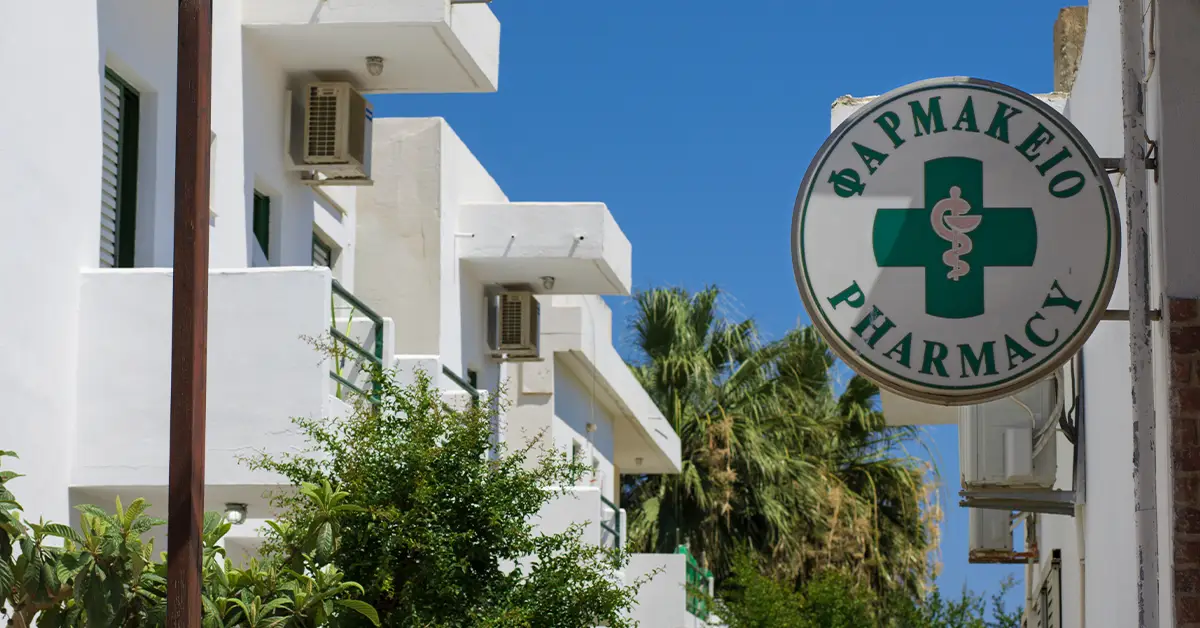
Greece’s pharmacy system (pharmakeia) is widespread, with around 10,500 pharmacies nationwide — one of the highest pharmacy-to-population ratios in the EU. Pharmacies usually open from 8:00–14:00 and 17:30–21:00 on weekdays, with a rota of overnight pharmacies (diamatyras) serving 24/7.
Prescription medicines in Greece are prescribed through the e-prescription system. Those registered with EOPYY receive 75–100% support with medicine costs depending on the condition and the medicine list. Medicines for chronic conditions such as diabetes, cardiovascular disease and cancer are usually covered in full. Pharmacists in Greece have an advisory role and sometimes sell certain over-the-counter medicines directly without a prescription.
Greece has a strong domestic pharmaceutical manufacturing sector, with companies such as Pharmaten, Elpen, Vianex and Uni-Pharma. Multinationals such as Pfizer, Novartis, Sanofi and Roche also have large-scale R&D and distribution operations in Athens.
What it means for investors and settlers
For those weighing settlement in Greece, the Greek health system offers several considerable advantages. First, private healthcare costs are far lower than in Western Europe, while treatment quality for complex cases meets EU standards. Second, the highest density of doctors in the OECD ensures patients can always reach a specialist when needed.
Third, Greece’s geographical position allows quick transfer to leading European medical centres such as Munich, Zürich and Milan where specialist treatment beyond domestic capability is needed. A flying time of 2–3 hours to most Western European capitals is a considerable advantage over more distant settlement destinations.
However, investors need to weigh several points. The public sector has long waits for some procedures, and the quality of facilities and the language may be barriers at smaller public hospitals. The common solution for foreign nationals is to combine a premium private insurance package with private hospitals having English-speaking doctors (mostly at HHG, Athens Medical and Metropolitan).
For families with young children, registering with a family paediatrician at a TOMY or a private hospital (Mitera, Iaso) is the first step to take as soon as an AMKA is obtained. For retirees, private insurance packages with home care provisions and regular health checks are the appropriate choice.
Summary
Greek healthcare is a two-tier universal system combining the public sector (ESY) with EOPYY as the single insurance fund and a private hospital network that has grown strongly in the major cities. With 6.3 doctors per 1,000 people, the highest in the OECD, health spending of 8.5% of GDP and life expectancy of 81.3, Greece provides EU-quality healthcare at competitive cost.
Investors and settlers need to understand clearly the difference between the public and private sectors, the AMKA – EOPYY registration mechanism and the compulsory insurance requirements when applying for a visa. See also the related articles onLife in GreeceandThe Greek citizenship testfor a fuller view of life and public services in Greece.
Accompanying you on your journey in residency investment
The Prosperous Living Investment team advises on pathways, assesses profiles and manages investments transparently for every residency, citizenship and international property objective.
Free profile assessmentWhere life gets prosperous