



Life in Greece has something for everyone, from affordable housing, friendly people and a warm climate year round to world-class cuisine and a rich history stretching back over the centuries.
Although some cities such as Athens are more expensive,Greecestill has one of the lowest costs of living in the European Union. In addition, the country has a high level of safety with a very low rate of serious crime.
Geographically, Greece is strategically located, allowing easy access to Asia, Africa and Europe, and is home to a large foreign population.
Greece joined the EU in 1981 and has developed continuously since. The temperate year-round climate allows people to enjoy beautiful beaches and a wealth of outdoor experiences.
Look up theQuality of Life Indexof other countries worldwide.
Message
The advantages and disadvantages of living in Greece
Greece is famous for its beautiful scenery, rich history and relaxed Mediterranean lifestyle. However, alongside its attractions, there are some drawbacks to living there.
The advantages of living in Greece:
- A relatively low cost of living, particularly compared with Canada, the United States and Western Europe.
- One of the warmest countries in Europe with wonderful weather year round.
- High-quality healthcare.
- Universal and affordable education.
- Rich and appealing Greek cuisine.
The disadvantages of living in Greece:
- Finding work is difficult, particularly without Greek.
- High costs when living near popular tourist spots and overcrowding in tourist cities.
- Greek needs to be learnt.
- Infrastructure is limited, and getting around the country may be difficult.
- The administrative system is slow and complex.
Considering a residency programme? The Prosperous Living Investment team assesses your profile free of charge and advises on the pathway that fits your goals.
The advantages of living in Greece in detail
1. The cost of living in Greece
One of the greatest advantages of living in Greece is the low cost of living. Americans’ essential day-to-day costs in Greece such as food, travel and much else are at least 20% lower than in the United States, while apartment rents may be up to 70% lower. The closer to popular tourist spots, the higher the costs, particularly upmarket accommodation, fine dining and entertainment. Living on lesser-known islands or in small inland towns costs far less than Athens or Santorini.
Rent and utilities: in Athens — Greece’s most expensive city — a 1-bedroom apartment in the centre costs around EUR 300-500 a month, and EUR 200-400 a month in the suburbs. A 3-bedroom apartment costs around EUR 500-1,000 a month in the centre and EUR 400-800 a month in the suburbs. Utility costs range from EUR 150 to EUR 300 a month depending on the size of the home, the season and consumption.
Food and groceries: at inexpensive restaurants, a meal costs from EUR 10 to EUR 18. Dinner for 2 at a mid-range restaurant is from EUR 35 to EUR 60. Greece is famous for agricultural products such as olive oil, wine, cheese and saffron. The table below shows prices for some essential grocery items:
| Item | Average price (EUR) |
|---|---|
| Milk (1 litre) | 1,26 |
| White bread (500 g) | 0,95 |
| White rice (1 kg) | 1,79 |
| Eggs (a dozen) | 3,15 |
| Local cheese (1 kg) | 8,82 |
| Chicken breast (1 kg) | 7,02 |
| Potatoes (1 kg) | 0,88 |
| Bottled water (1.5 litres) | 0,79 |
| Mid-range wine (1 bottle) | 6,00 |
| Marlboro cigarettes (a pack of 20) | 4,60 |
Transport: Greece has many ways of getting around both within cities and between them. Athens is known for its tram system connecting many areas. A single fare on public transport is around EUR 1.20, and a monthly pass around EUR 30.
| Mode | Price (EUR) |
|---|---|
| Single ticket (public transport) | 1,20 |
| Monthly pass | 30,00 |
| Taxi (starting fare) | 3,50 |
| Taxi (1 km) | 1,00 |
| Petrol (1 litre) | 2,14 |
2. Education in Greece
A detailed article onGreek education.
Greece has an excellent education system. Education is compulsory from ages 6 to 16, comprising 6 years of primary school, 3 years of lower secondary school and a non-compulsory upper secondary level on either a technical or an academic track.
On international schools, most foreign schools are concentrated in Athens and Thessaloniki, with teaching in many languages such as English, German, French and Japanese. Around 15 schools in Greece award the International Baccalaureate (IB) under the Swiss programme, allowing students to go on to university abroad after graduating.
3. The health system in Greece
A detailed article onGreek healthcare.
Greece has 2 main forms of healthcare: public and private. Greek citizens and residents have access to free or low-cost public healthcare through the unified ESY health system, funded by the EFKA social security organisation. The public health system covers services from public health surveillance, infectious disease control, specialist treatment and hospital admission through to subsidised medicines. The unemployed, EU citizens and lawfully resident foreign nationals are all eligible to join ESY.
Private healthcare has more modern facilities and medical staff who usually speak better English. Some private hospitals have partnership links with hospitals in the United States and other countries.
4. The climate in Greece
With a Mediterranean climate, Greece has warm dry summers and mild wet winters. Sunny days and pleasant evenings make Greece an ideal year-round destination for those wanting to enjoy nature and an outdoor lifestyle.
5. Greek cuisine
Greek cuisine is one of the compelling reasons to move here, with distinctive flavours, a rich history and a focus on fresh, healthy ingredients. From the famous souvlaki to rich moussaka and colourful Greek salad, the food scene here offers a rich and delicious experience. Living in Greece gives daily access to traditional tavernas, bustling local markets and the chance to learn traditional cooking methods.
The disadvantages of living in Greece
1. The Greek labour market
After the 2008 global economic crisis, the Greek economy has recovered gradually over the past decade. Thanks to a resilient workforce and government measures to attract investors — particularly theThe Greece Golden Visaprogramme — the country is steadily working through its economic problems.
The labour market is a major challenge for foreign nationals as few multinational corporations operate in English. However, the Greek government still encourages foreign nationals to work, particularly in international companies or the tourism industry. Many foreign nationals in Greece work as English teachers earning from EUR 1,200 to EUR 1,800 a month.
The minimum wage in Greece is EUR 758.33 a month. Average salaries range from EUR 1,428 to EUR 2,788 a month depending on the position and experience. The table below shows average salaries in some occupations:
| Occupation | Average salary a month (EUR) |
|---|---|
| Lawyer | 4,055 |
| Accountant | 1,794 |
| Bar manager | 2,668 |
| Computer technician | 1,994 |
| Hotel receptionist | 1,562 |
| Graphic designer | 1,853 |
| Hotel manager | 3,873 |
| Nurse | 2,388 |
2. The language barrier
In major cities and tourist areas, many people — particularly in the service industry — speak English, and signage is often in English too. However, learning Greek will make life considerably easier, particularly in small towns or rural areas. It is also a way of connecting more deeply with the local culture and building better relationships with the Greek community.
3. A complex administrative system
The administrative system is one of the weakest points of living in Greece. Processes usually require a great deal of paperwork, several levels of approval and visits to a number of different government offices. Delays in processing permits, qualifications and applications are common across all public sectors, including healthcare, education, property registration and tax. The government has made efforts to improve matters through online platforms but much remains to be done.
4. Infrastructure
The most prominent issue is the old and poorly maintained road network, leading to congestion and road safety problems. Public transport, though cheap, does not yet connect the whole territory, particularly rural areas. The railway system does not match other European countries for speed and reliability. Seaports are often overloaded with outdated facilities.
5. Overtourism
In peak season, Greece may be very crowded, particularly in Athens, Santorini and Mykonos, affecting daily life from sightseeing to transport and dining. To avoid this, living in rural areas or smaller cities is worth considering.
The visa options for moving to Greece
EU/EEA and Swiss citizens may move to Greece without a visa, simply registering their residence. Citizens outside the EU/EEA or Switzerland must apply for a long-stay visa (National Visa D) and a residence permit at the nearest Greek consulate or embassy.
The Financially Independent Person (FIP) visa
The Financially Independent Person (FIP) visa is a renewable residence visa for non-EU citizens with sufficient funds to cover their living costs in Greece without working. Salary and business income do not qualify — visa applicants need passive income such as a pension, long-term rental income, dividends or royalties.
The main applicant needs an income of at least EUR 2,000 a month, rising by 20% where accompanied by a spouse and by a further 15% for each child. Alternatively, this may be demonstrated with a minimum savings balance of EUR 48,000.
The Greece Golden Visa programme
A detailed article onThe Greece Golden Visa.
Greece has run the Golden Visa programme since 2013, allowing citizens outside the EU/EEA and Switzerland to obtain permanent residence in Greece through a minimum investment of EUR 250,000 in property or other investment routes such as government bonds and venture capital funds. The permanent residence permit is renewed every 5 years.
After 7 years of lawful residence in Greece, investors may be eligible to apply forGreek citizenshipby naturalisation, provided they meet the minimum residence and language requirements.
The Greece Digital Nomad Visa
This visa allows non-EU remote workers to work and live in Greece while working for companies or clients outside Greece. The basic requirement is to demonstrate self-employment or employment with a business outside Greece with sufficient funds to live on — usually from EUR 3,500. The visa is valid for 1 year and may be extended to 2 years. Holders of this visa may not seek employment within Greece.
Permanent residence in Greece
After 7 years of continuous lawful residence in Greece, residents may apply for a permanent residence permit, provided they have actually lived in Greece for at least 183 days a year and have a command of Greek. In addition, they may apply for Greek citizenship by naturalisation.
The most popular cities in Greece for foreign nationals
1. Athens
Athens is Greece’s largest city with nearly 4 million inhabitants, and is the choice of most foreign nationals for living. The city lies near the Saronic Gulf on the Aegean Sea, where the port of Piraeus is located. Although hit hard by the economic crisis, Athens has recovered steadily in recent years, particularly in property. Average incomes in Athens are higher than in the rest of Greece, and the city accounts for more than half the country’s total employment.
2. Thessaloniki
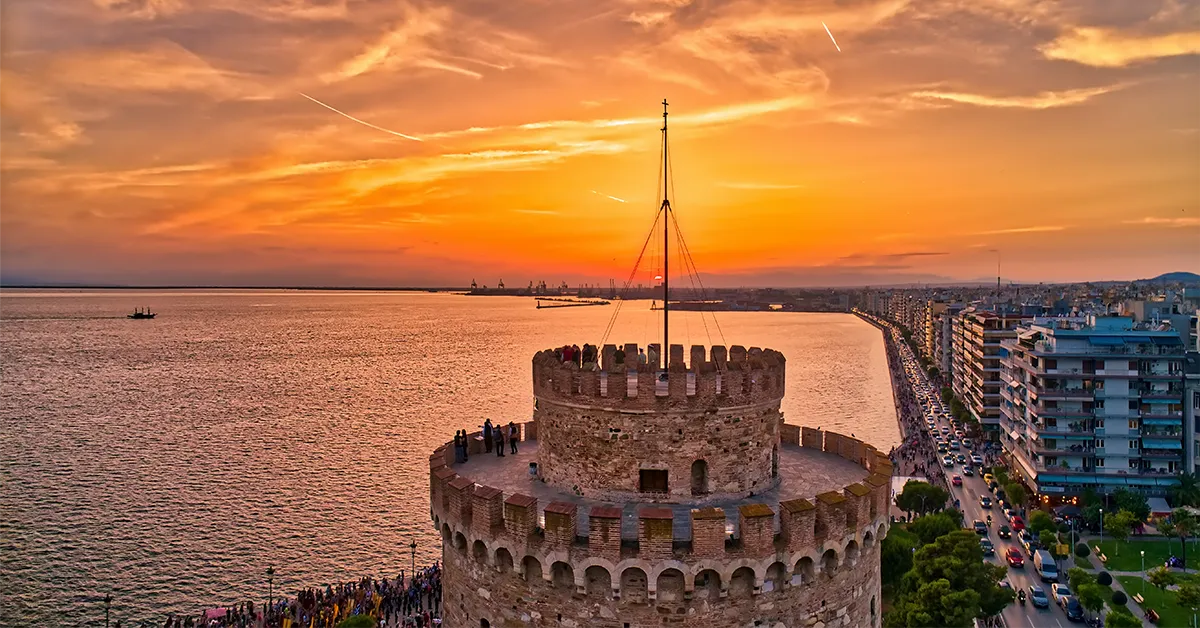
Thessaloniki is Greece’s 2nd largest city with nearly 800,000 inhabitants, founded in 315 BC. The city developed into an important industrial centre from the 1960s with petrochemical, refining and steel plants. Although it went through the 1978 earthquake and the 2008 economic crisis, Thessaloniki has recorded good growth in recent years, strengthening investor confidence.
Tax in Greece
A detailed article ontax in Greece.
Personal income tax in Greece ranges from 9% to 44%. Non-residents pay tax only on income arising within Greece, while all foreign income is exempt.
A person is liable to tax in Greece where they meet at least 1 of the following conditions: having stayed more than 183 days in Greece in a calendar year, having a permanent address in Greece, having a company or investment in Greece, or working or carrying on a profession in Greece.
Tax number: after moving to Greece and finding work, residents need to register for an AFM tax number (Arithmos Forologikou Mitroou) at the local tax office by completing Form M1 and producing their passport.
There are 4 main types of tax in Greece: personal income tax, capital gains tax (including lottery winnings, inheritance and property transfers), social security contributions and value added tax (VAT).
The tax table for income from salary, pensions, business and professions:
| Taxable income (EUR) | Tax rate |
|---|---|
| Up to EUR 10,000 | 9% |
| €10,000 – €20,000 | 22% on the amount above EUR 10,000 |
| €20,000 – €30,000 | 28% on the amount above EUR 20,000 |
| €30,000 – €40,000 | 36% on the amount above EUR 30,000 |
| Over EUR 40,000 | 44% on the whole amount above EUR 40,000 |
The tax table for income from property:
| Taxable income (EUR) | Tax rate |
|---|---|
| Up to EUR 12,000 | 15% |
| €12,000 – €35,000 | 35% on the amount above EUR 12,000 |
| Over EUR 35,000 | 45% on the whole amount above EUR 35,000 |
The tax table for income from capital:
| Type of income | Tax rate |
|---|---|
| Dividends | 10% |
| Deposit interest | 15% |
| Royalties | 20% |
The non-dom tax regime: from December 2019, Greece has operated a non-domiciled (non-dom) tax regime, allowing foreign nationals transferring their tax residence to Greece to be exempt from tax on foreign income by paying an annual flat charge of EUR 100,000. This exemption may be extended to a non-dom resident’s relatives at an additional charge of EUR 20,000 each.
Opening a bank account in Greece
After moving to Greece, opening a Greek bank account is very important for managing finances, receiving salary and qualifying for a residence permit. Simply attend any bank with your passport and AFM tax number. It is worth checking each bank’s list of required documents beforehand. The major banks in Greece are Eurobank, Alpha Bank, Piraeus Bank and the National Bank of Greece.
Frequently asked questions about life in Greece
For EU residents, moving to Greece is fairly straightforward thanks to freedom of movement within the EU. For citizens outside the EU/EEA and Switzerland, the level of difficulty depends on personal circumstances and finances. The Greece Golden Visa programme offers a direct route to permanent residence for those able to invest at least EUR 250,000 in property.
A budget of around EUR 2,000 a month is enough for a good standard of living, including ordinary bills and rent on a 1-bedroom apartment in central Athens.
Greece has tax treaties with 57 countries and territories, including Albania, Austria, Belgium, Bulgaria, Canada, China, Cyprus, the Czech Republic, Denmark, Egypt, Finland, France, Germany, Hungary, Iceland, India, Ireland, Israel, Italy, Kuwait, Luxembourg, Malta, Morocco, Mexico, the Netherlands, Norway, Poland, Portugal, Qatar, Romania, Russia, Saudi Arabia, Serbia, Slovakia, Slovenia, South Africa, Sweden, Spain, Switzerland, Turkey, Tunisia, Ukraine, the United Arab Emirates, the United Kingdom, the United States and Uzbekistan. Greece also has treaties on property, inheritance and gifts with Germany, Italy, Spain and the United States.
In small towns and rural areas, house prices start from around EUR 80,000. However, in popular destinations such as Mykonos, prices may reach several million Euros.
Buying property is one of the investment routes to permanent residence in Greece through the Golden Visa programme. The property value must be at least EUR 250,000, rising to EUR 500,000 for transactions in the northern and central provinces, the South Attica region, and the municipalities of Thessaloniki, Mykonos and Santorini.
The 7-year rule in Greece requires 7 years of continuous residence in the country to qualify for naturalisation, including actually living in Greece for at least 183 days a year and having a command of Greek.
American citizens may enter and stay in Greece without a visa for up to 90 days in any 180 days for tourism or business. To live, work or stay longer, a residence permit is needed.
Greece is famous for its beautiful natural scenery, rich history and vibrant culture, attracting many foreign nationals and retirees. The cost of living is relatively low, including food, eating out and public transport. It is also regarded as one of the safest countries in Europe, with many people feeling comfortable walking at night.
Accompanying you on your journey in residency investment
The Prosperous Living Investment team advises on pathways, assesses profiles and manages investments transparently for every residency, citizenship and international property objective.
Free profile assessmentWhere life gets prosperous