


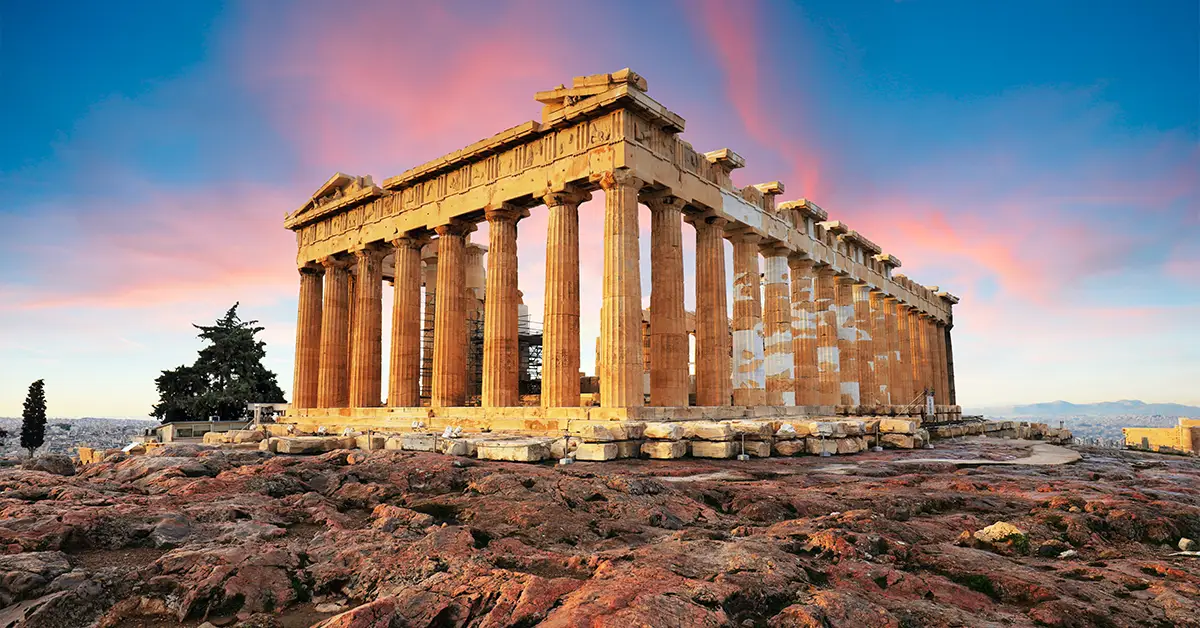
Greek history stretches over more than 5,000 years and is regarded as one of the richest continuous historical threads of humankind. This Mediterranean country is the cradle of democracy, Western philosophy, theatre, the Olympic Games and many of the foundational concepts of modern science and politics. This article gathers together the major periods of Greek history, from the Minoan civilisation to the modern Republic, helping readers form an overall picture before looking at the country in more depth.
For investors, settlers and those interested in Mediterranean culture, knowledge of Greek history is an important foundation for assessing the country’s current standing and prospects, particularly as programmes such as theGreece Golden Visaattract international capital strongly.
Message
The pre-classical period and the Aegean civilisations
Greek history begins in the Palaeolithic, with traces of human habitation at Petralona and Theopetra dating back at least 300,000 years. However, the first civilisation to take shape came from Crete with the Minoan civilisation, which flourished from around 2700 to 1450 BC.
The Minoan civilisation is regarded as the first urban civilisation in Europe, with large-scale palaces at Knossos, Phaistos, Mallia and Zakros. The Minoans developed their own writing system called Linear A — still not fully deciphered — and had a trade network across the Mediterranean. The civilisation declined around 1450 BC, possibly through the Thera (Santorini) volcanic catastrophe and the incursion of the Mycenaeans from the mainland.
The Minoans were followed by the Mycenaean civilisation (around 1600–1100 BC) on the Greek mainland, notable for the citadels of Mycenae, Tiryns and Pylos. This is the period Homer describes in the two epics the Iliad and the Odyssey. The Mycenaeans used Linear B — the oldest deciphered script of the Greek language. Around 1100 BC, Mycenaean civilisation collapsed amid the Late Bronze Age crisis that spread across the whole Eastern Mediterranean.
The period from 1100 to 800 BC is usually called the Greek “Dark Age”, with the loss of writing and a cultural decline. However, it was also the period in which the early city states (poleis) formed, preparing the way for the Classical period that followed.
Considering a residency programme? The Prosperous Living Investment team assesses your profile free of charge and advises on the pathway that fits your goals.
Classical and Hellenistic Greece
The most brilliant period in ancient Greek history is the Classical period (around 500–323 BC). The two city states dominating it were Athens and Sparta, with contrasting political and military models. Athens developed the world’s first direct democracy under Cleisthenes (508 BC) and Pericles (mid-5th century BC), laying the foundations of the modern concepts of citizenship and politics.
During this period the Greek city states defeated the Persian Empire in the two Greco-Persian Wars (499–449 BC), with the legendary battles of Marathon, Thermopylae and Salamis. This victory opened the way to the “Golden Age” of Athens, with architectural works such as the Parthenon on the Acropolis, the drama of Aeschylus, Sophocles and Euripides, the philosophy of Socrates, Plato and Aristotle, and the medicine of Hippocrates.
However, the Peloponnesian War (431–404 BC) between Athens and Sparta weakened the whole Greek world. The 4th century BC saw the rise of Macedonia under Philip II and, above all, Alexander the Great (336–323 BC). Alexander’s campaigns of conquest extended Greek influence to Egypt, Persia and as far as India, beginning the Hellenistic period.
The Hellenistic period (323–31 BC) saw Greek language, culture, art and science spread across the ancient world. This was the era of Alexandria, the Great Library, the mathematicians Euclid and Archimedes, and the astronomers Aristarchus and Hipparchus. The period ended with the annexation of Ptolemaic Egypt by Rome after the Battle of Actium in 31 BC.
The Roman period and the Byzantine Empire
Greece formally became part of the Roman Empire in 146 BC when the legions of Lucius Mummius destroyed Corinth. Under Rome, Greece lost political independence but kept its role as a cultural and educational centre. The Romans adopted the Greek education system, philosophy, art and religion, creating the “Greco-Roman” culture that laid the foundations of Western civilisation as a whole.
In 330, the emperor Constantine the Great moved the capital of the Roman Empire to Constantinople (Byzantium, today’s Istanbul), making the region a new centre of power. After the Western Roman Empire fell in 476, the Eastern Roman (Byzantine) Empire continued for a further millennium with Greece at its core in language, culture and religion.
The Byzantine Empire preserved the heritage of ancient Greece, spread Eastern Orthodoxy across Eastern Europe and the Balkans, and served as a shield between Europe and invasions from the east. The empire’s official language from the 7th century was Greek, replacing Latin. This was the period in which modern Greek identity took shape: the combination of the classical heritage, Orthodox Christianity and the Greek language.
The Byzantine Empire went through several periods of prosperity and decline. After the Fourth Crusade in 1204, Constantinople was occupied and the empire broke into several successor states. Although partly restored in 1261, the empire could not avoid a long decline under pressure from the Ottoman Turks.
The Ottoman period and the Revolution of 1821
Constantinople fell to the Ottomans under Mehmed II in 1453, ending more than 1,100 years of Byzantine history. Most of Greece gradually fell to the Ottomans during the 15th century, with the last areas — Crete and the Ionian islands — coming under their control in the 17th and 18th centuries.
Nearly 400 years of Ottoman rule (1453–1821) was a distinctive period in Greek history. Under the Ottoman “millet” system, the Greek Orthodox community was permitted to maintain its religion, language and a degree of internal self-government. The Greek Orthodox Church, particularly the Patriarchate of Constantinople, played a key role in preserving Greek national identity throughout this period.
The Greek merchant class (the Phanariotes and the diaspora) flourished in the trading ports of the Ottoman Empire and in European centres such as Odessa, Vienna, Trieste and Marseille. It was this class that brought nationalist and revolutionary ideas from Europe back to Greece. In 1814, the secret Filiki Eteria (Society of Friends) was founded in Odessa to prepare an uprising.
The Greek Revolution of 1821 broke out in March 1821, with 25/03/1821 chosen as Greece’s national day. The war lasted 9 years, through three stages: initial victories (1821–1824), internal crisis and Ottoman-Egyptian intervention (1824–1827), and the intervention of the European Great Powers (1827–1829). The British, French and Russian fleets defeated the Ottoman-Egyptian navy at the Battle of Navarino in 1827, opening the way to independence.
Greek independence was formally recognised by the Treaty of Constantinople signed in July 1832. Greece became the first nation within the Ottoman Empire to gain independence and be recognised as a sovereign state, marking a major milestone in the history of the Balkans.
The Kingdom of Greece and the two World Wars
After independence, Greece initially established a Republic under President Ioannis Kapodistrias (1828–1831), but after his assassination the European Great Powers chose a monarchy. In 1832, Otto of Bavaria became the first king of the Kingdom of Greece. According toEurydice – the European Commission, Greece maintained a monarchy with interruptions from 1832 to 1974.
The second half of the 19th century and the early 20th were a period of Greek territorial expansion. Through the annexation of the Ionian islands (1864), Thessaly (1881) and the Balkan Wars (1912–1913), Greece annexed most of Macedonia, Epirus, Crete and the northern Aegean islands. After the First World War, the territory expanded further under the Treaty of Sèvres of 1920.
However, defeat in the Greco-Turkish War (1919–1922) reversed many of these gains. Under the Treaty of Lausanne of 1923, nearly 1.5 million Greeks from Asia Minor were compelled to be exchanged for around 500,000 Muslims from Greece moving to Turkey. This exchange was one of the greatest humanitarian catastrophes in modern Greek history.
The Second World War left severe consequences. Greece was attacked by Fascist Italy in October 1940 but repelled the assault. However, Nazi Germany occupied Greece from April 1941 to October 1944, causing the Athens famine and destroying almost the entire Jewish community. Immediately after liberation, Greece fell into civil war (1946–1949) between government forces backed by Britain and the United States and the communist forces.
Dictatorship, democratic transition and the Third Republic
The period after the civil war was a difficult one for Greece: economic reconstruction, political instability and pressure from the Cold War. On 21/04/1967, a group of army officers staged a coup establishing a military dictatorship — commonly called the Regime of the Colonels. It lasted until July 1974, when failure over Cyprus (leading to the Turkish invasion of Cyprus) brought the military government down.
24/07/1974 is regarded as the day democracy was restored in Greece. The former Prime Minister Konstantinos Karamanlis returned from Paris to lead a transitional government. The referendum of 08/12/1974 abolished the monarchy with 69% in favour, beginning the “Metapolitefsi” — the political transition to the Third Hellenic Republic. A new Constitution was adopted on 09/06/1975, establishing the modern parliamentary republic.
The Third Hellenic Republic is the first long-term stable republic in modern Greek history. A two-party political system between New Democracy (centre-right) and PASOK (centre-left) shaped the political landscape from 1974 until the crisis of 2009–2010. The 1975 Constitution has been amended four times, in 1986, 2001, 2008 and 2019.
European integration and the sovereign debt crisis
Greece formally joined the European Community (EEC, the forerunner of the EU) on 01/01/1981, becoming its 10th member. This was an important milestone confirming the country’s democratic and Western orientation after the dictatorship. Greece joined the Schengen area in 2000 and formally adopted the euro in place of the drachma on 01/01/2001.
The 1990s and early 2000s were a period of strong economic growth. Greece successfully hosted the Athens Olympic Games in 2004, a memorable international achievement. However, economic development in this period carried the seeds of risk: swelling public debt, hidden budget deficits and an inefficient administrative structure.
The Greek sovereign debt crisis broke out in late 2009, when the government disclosed that the true budget deficit was many times the published figure. From 2010 to 2018, Greece received three international bailouts from the European Union, the European Central Bank (ECB) and the International Monetary Fund (IMF), totalling around 289 billion euros. In return, the country had to accept strict austerity measures: cutting pensions, reducing public spending and raising taxes.
On 20/08/2018, Greece formally exited the bailout programme and returned to normal international borrowing markets. The country entered a period of slow but steady economic recovery. The Mitsotakis government (from 2019) has pressed ahead with tax reform, administrative digitisation, and attracting foreign investment through the Golden Visa programme and favourable tax arrangements for retirees and foreign investors.
Cultural heritage and current international standing
Greek history has left the country an immense cultural heritage recognised by UNESCO. According toUNESCO World Heritage Centre, Greece has 19 World Heritage Sites, comprising the Acropolis of Athens, Delphi, Olympia, Meteora, Mount Athos, the medieval city of Rhodes, Mystras, the island of Delos, and many others. This heritage plays an important role in tourism, with Greece receiving around 30–35 million international visitors a year before the COVID-19 pandemic.
Greece is now a member of the important international organisations: the United Nations (1945), NATO (1952), the Council of Europe (1949), the OECD (1961), the EU (1981), the eurozone (2001) and Schengen (2000). Greece’s geopolitical role has grown over the past decade thanks to its position as the gateway to the Eastern Mediterranean, energy cooperation with Cyprus, Israel and Egypt, and defence spending above 3% of GDP.
For investors and settlers, Greek history offers three important lessons. First, this is a country with democratic institutional foundations tested over 50 stable years of the Third Republic. Second, Greece has come through modern Europe’s greatest sovereign debt crisis and shown its capacity to recover. Third, its cultural heritage and strategic position bring long-term value to property and tourism business.
Summary
Greek history is a journey of more than 5 millennia, from the Minoan civilisation on Crete, through the Classical period with Athenian democracy and the conquests of Alexander the Great, followed by the Byzantine Empire, 400 years of Ottoman rule, the Revolution of 1821 and the modern Third Republic from 1974. Each period has left a deep mark, creating the distinctive identity of this Mediterranean country.
Understanding Greek history clearly not only helps readers appreciate the cultural heritage but provides important context for assessing investment and settlement prospects. Readers may also consult the related articles onLife in GreeceandThe Greek citizenship testfor a fuller picture before making a decision.
Accompanying you on your journey in residency investment
The Prosperous Living Investment team advises on pathways, assesses profiles and manages investments transparently for every residency, citizenship and international property objective.
Free profile assessmentWhere life gets prosperous