


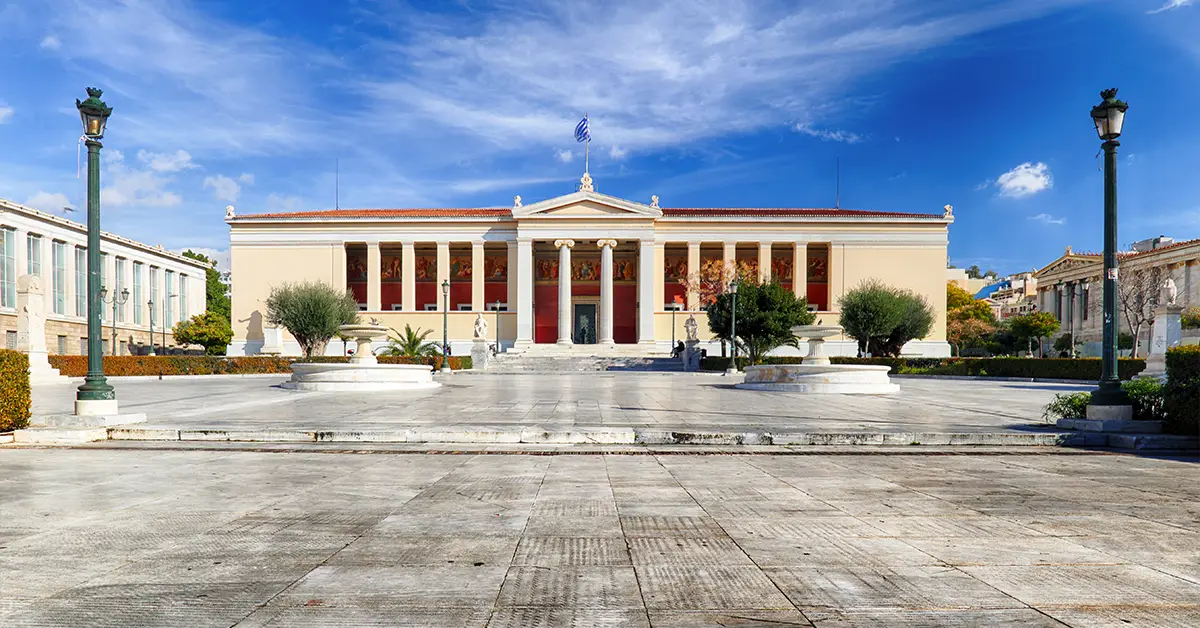
The Greek education system from nursery to university: free, compulsory from ages 4–15, international schools and the options for investor families.
A detailed article onthe country of Greece.
Message
Greek education carries a great intellectual heritage — from Plato’s Academy and Aristotle’s Lyceum more than 2,400 years ago through to today’s modern education system. Greece provides compulsory free education for children from 4 to 15, with the state school system run by the Ministry of Education, Religious Affairs and Sports. Alongside it, a network of private and international schools in Athens and Thessaloniki offers further options for foreign families.
For investors considering theGreece Golden Visaprogramme or other forms of residence, understanding the education system clearly is an important factor in planning for their children’s future. This article provides a comprehensive view of Greek education from nursery to university, together with the options specifically for foreign families.
An overview of the Greek education system
The Greek education system divides into 3 main levels: primary education (comprising nursery and primary school), secondary education (lower and upper secondary school) and higher education. Compulsory education runs from ages 4 to 15, comprising 2 compulsory years of kindergarten, 6 years of primary school and 3 years of lower secondary school.
All state education in Greece is free, from kindergarten to university. Textbooks are also provided free at state schools. Around 93% of pupils attend state schools, while the remaining 7% attend private schools, mainly concentrated in the major cities.
The school year begins on 11/09 and ends on 15/06. The summer holiday runs around 16.8 weeks (counting all holidays), longer than the OECD average of 13.5 weeks. The school day begins at 08:15 and ends at 13:15 at most schools, although many primary schools have extended to a full-day programme to support families where both parents work.
Education spending in Greece accounts for around 3.9% of GDP, below the OECD average of 4.7%. Average spending is around USD 6,420 per pupil from primary to upper secondary, at the lower end of the OECD group.
Considering a residency programme? The Prosperous Living Investment team assesses your profile free of charge and advises on the pathway that fits your goals.
Greek nursery education
Nursery education (Nipiagogeio) in Greece is for children aged 4 to 6, the last 2 years of which have been compulsory since 2018. It is an important step helping children develop social, language and thinking skills before starting primary school.
The nursery curriculum focuses on 4 main areas: communication and language (including information technology), the child in relation to self and society, science, and creativity and expression through the body. Notably, English has been brought into the nursery curriculum as part of the education reforms, giving children early exposure to a foreign language. To enrol a child in a state kindergarten, parents must submit an application form, birth certificate, vaccination record, a dental certificate and proof of address. All documents must be translated into Greek.
Greek primary education
Primary education (Dimotiko) lasts 6 years, for children from 6 to 12. Progression each year is automatic, although additional support measures are provided for pupils who need extra help.
The curriculum comprises modern Greek, mathematics, environmental studies, natural sciences, history, geography, civic education, religious education, information technology, physical education and the arts. English is the compulsory first foreign language, taught from the first year of primary school. A second foreign language (usually German or French) is introduced from the fifth year.
Since the 2016/2017 school year, all primary schools have offered an optional full-day programme extending to 16:00, comprising supplementary activities such as sport, art and robotics. Since the 2024/2025 school year, the “Active Citizen Action” programme has been rolled out at all levels, integrating the United Nations’ 17 Sustainable Development Goals into teaching.
On completing primary school, pupils move up automatically to lower secondary school without an entrance examination.
Greek secondary education
Secondary education in Greece divides into 2 stages: lower secondary school (Gymnasio, 3 years, compulsory) and upper secondary school (Lykeio, 3 years, not compulsory).
Lower secondary school (Gymnasio)
The Gymnasio is for pupils from 12 to 15, the final stage of compulsory education. Pupils study around 15 different subjects, comprising modern and ancient Greek, literature, mathematics, physics, chemistry, biology, history, geography, civic education, English (compulsory), a second foreign language (German, French or Italian), information technology, physical education and the arts. During this stage, teachers, pupils and parents together decide the appropriate path for upper secondary school.
Upper secondary school (Lykeio)
The Lykeio is for pupils from 15 to 18 and offers 2 main paths:
The general Lykeio (Geniko Lykeio) follows an academic path, preparing pupils for the national university entrance examinations (the Panhellenic examinations — Panellinies). In the final year, pupils choose 1 of 3 specialist groups: humanities, sciences, or economics and information technology.
The vocational Lykeio (Epangelmatiko Lykeio — EPAL) combines general education with technical and vocational training. EPAL graduates receive both a school leaving certificate and a level 4 vocational qualification under the National Qualifications Framework.
The Panhellenic examinations are held at the beginning of June each year and are the main basis for admission to public universities. They are highly competitive, and in practice many Greek families spend considerably on extra tuition at private cramming centres (frontistiria). Exam tuition is estimated to cost around EUR 1.8–2.2 billion a year nationwide, equivalent to 12–18% of average household income.
Greek higher education
The Greek higher education system comprises 24 public universities and 16 technological education institutions (TEI). Public higher education is free for Greek and EU citizens, while around 25% of postgraduate programmes charge fees.
The notable universities comprise the National and Kapodistrian University of Athens (founded 1837, the oldest university in the Eastern Mediterranean), the Aristotle University of Thessaloniki (the largest university in South-Eastern Europe by student numbers), the National Technical University of Athens, the Athens University of Economics and Business, and the University of Crete.
Bachelor’s programmes last 4 years for most subjects, 5 years for engineering and architecture, and 6 years for medicine. Master’s programmes last 1–2 years. The Greek higher education system follows the Bologna Process, ensuring qualifications are recognised across the EU.
According to the OECD, around 44.5% of young Greeks (aged 25–34) have completed a university degree — above the OECD average. However, the on-time completion rate is only around 24%, reflecting challenges in the quality and efficiency of the system.
Notably, since the 2025–2026 academic year, the first 6 private universities have been approved to operate in Greece, in partnership with reputable foreign universities. This is a historic change in a country where higher education was previously confined to the public system. In addition, the International Baccalaureate (IB Diploma) in English will be rolled out at certain state schools from the 2026–2027 school year.
International and private schools
Greece has a varied network of international and private schools, particularly concentrated in Athens and Thessaloniki. These are a popular choice for foreign families, including investors under the Golden Visa programme.
The well-known international schools in Athens comprise St. Catherine’s British School (British curriculum), the Lycée Franco-Hellénique Eugène Delacroix (French curriculum), the German School of Athens, the American Community Schools of Athens (ACS Athens) and Campion School (British/IB). These schools teach in English, French or German, with international curricula such as A-Levels, the International Baccalaureate (IB) or the American programme.
Private and international school fees vary widely. Greek private schools charge from EUR 400 to 500 a month from primary to secondary level. International schools usually charge more, from EUR 8,000 to 18,000 a year depending on the stage and programme.
The advantages of international schools comprise teaching in a familiar language (particularly English), small class sizes, plenty of extracurricular activities and internationally recognised qualifications. However, families planning to integrate into Greek society long-term should consider sending their children to a state school or a Greek private school to develop their language skills and cultural integration.
Foreign children with a lawful residence permit all have the right to enrol at a Greek state school free of charge, in the same way as Greek children.
Recent changes and reforms in Greek education
The Greek education system is undergoing several notable reforms aimed at modernisation and raising quality.
On technology in education, many schools have been equipped with interactive whiteboards, robotics laboratories and digital learning platforms. The Ministry of Education’s “Digital School” programme provides free online lesson content for pupils at every level.
On private higher education, as mentioned, the first 6 private universities have been approved to operate from the 2025–2026 academic year. This reform aims to reduce the number of Greek students going abroad to study (currently around 40,000 a year) and to attract international students.
On vocational education, Law 5082/2024 reformed the vocational education and training (VET) system, strengthening the link between training and labour market needs, particularly in tourism, construction and technology.
However, challenges remain. The 2025–2026 school year saw more than 750 schools close for lack of pupils, 88% of them in rural areas. This is a consequence of population ageing and rural-to-urban migration.
Frequently asked questions about Greek education
Compulsory education in Greece runs from ages 4 to 15, comprising 2 years of kindergarten, 6 years of primary school and 3 years of lower secondary school (Gymnasio). That is 11 years of compulsory education in total.
Yes. Every level of state education in Greece is free, from kindergarten to university (for Greek and EU citizens). Textbooks are also provided free. Around 25% of postgraduate programmes charge fees.
Yes. Children with a lawful residence permit (including through the Golden Visa programme) all have the right to enrol at a Greek state school free of charge, in the same way as Greek children.
There are many international schools teaching in English in Athens and Thessaloniki, comprising ACS Athens, Campion School, St. Catherine’s British School and others. These schools offer A-Levels, the International Baccalaureate (IB) or the American programme.
International school fees range from EUR 8,000 to 18,000 a year depending on the stage and programme. Greek private schools charge less, from EUR 400 to 500 a month.
Yes. The Greek university system follows the Bologna Process, ensuring qualifications are recognised across the European Union and in many other countries worldwide.
The main language of instruction at state schools is Greek. English is the compulsory first foreign language, taught from kindergarten. A second foreign language (German, French or Italian) is introduced from the fifth year of primary school.
Greek state schools have limited language support programmes for foreign pupils. For children who do not yet speak Greek, families usually consider an international school for the first period, or Greek language courses alongside. Children under 8 usually pick up the language considerably faster than older children.
Accompanying you on your journey in residency investment
The Prosperous Living Investment team advises on pathways, assesses profiles and manages investments transparently for every residency, citizenship and international property objective.
Free profile assessmentWhere life gets prosperous