


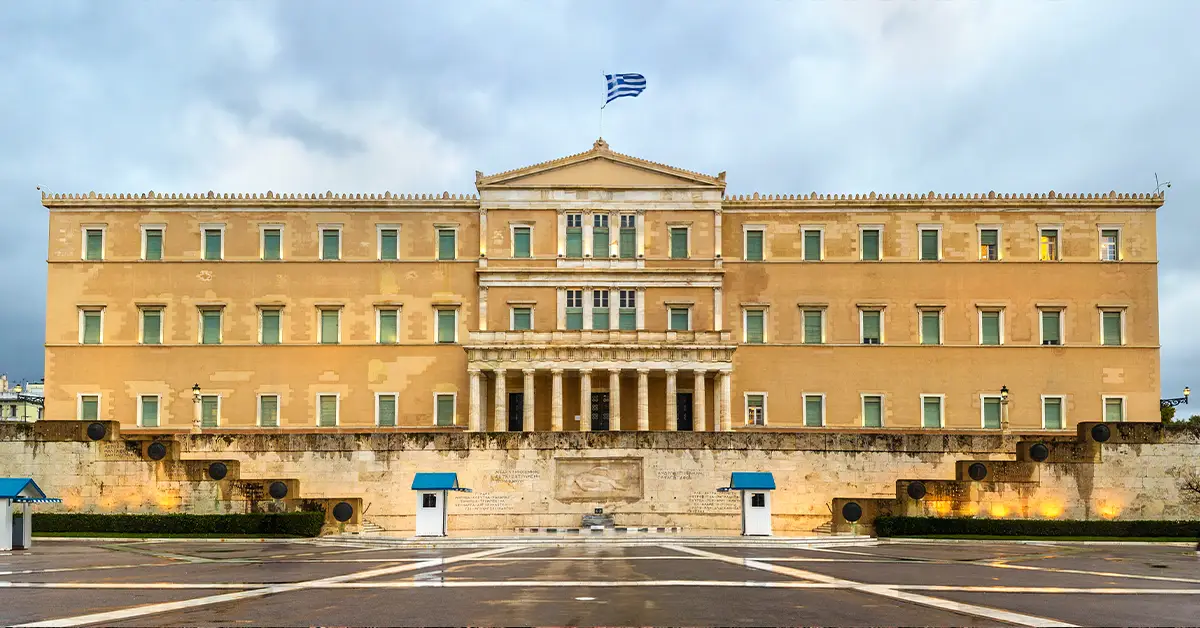
Greek politics operates on the foundation of a democratic parliamentary republic, with the President as head of state and the Prime Minister as head of government. This article analyses the power structure, the electoral mechanism, the party system and the administrative tiers of Greece based on the 1975 Constitution and its most recent amendments, updated to the beginning of 2026.
Understanding Greek politics correctly is useful not only for researchers but is an important factor for international investors, settlers under theGreece Golden Visaprogramme, and organisations weighing an expansion into the Southern European market.
Message
The institutional and constitutional foundation of Greek politics
Greece is a representative democratic parliamentary republic, where the President serves as head of state and the Prime Minister as head of government within a multi-party system. Legislative power is vested in both the government and the unicameral Parliament, while executive power is exercised by the President together with the government.
The legal foundation of Greek politics is the Constitution of 09/06/1975, promulgated after the country moved from monarchy to republic following the referendum of 08/12/1974. This Constitution has undergone important amendments in 1986, 2001, 2008 and most recently 2019, the 2019 amendment having considerably changed the rules for electing the President.
The 1975 Constitution sets out three major aims: protecting religious freedom, defining the social rights of citizens, and setting the operating structure of the Greek state. The document establishes a clear separation of powers between the legislative, executive and judicial branches, while guaranteeing the independence of the courts.
A notable point in the Constitution is Article 105, recognising the special autonomous status of the Orthodox monastic community on Mount Athos in Chalkidiki. This is one of the rare cases of a religious autonomous area surviving within a modern European Union member state.
Considering a residency programme? The Prosperous Living Investment team assesses your profile free of charge and advises on the pathway that fits your goals.
The President and the presidential election mechanism
The President of Greece is the head of state, elected indirectly by Parliament in a special sitting held at least a month before the incumbent’s term ends. Under Article 32 of the Constitution, the President serves a 5-year term and may be re-elected once.
The election process requires a supermajority. In the first and second rounds, the candidate must reach 200 votes out of 300 seats. Where that is not reached, the third round lowers the threshold to 180. After the 2019 constitutional amendment, where the third round fails there is a fourth round with a progressively lower threshold under the new rules, instead of the previous requirement to dissolve Parliament.
The most recent presidential election was held in early 2025. Konstantinos Tasoulas, the former Speaker of Parliament nominated by Prime Minister Mitsotakis, was elected in the fourth round on 12/02/2025 with 160 votes out of 300. He formally succeeded Katerina Sakellaropoulou, who had become Greece’s first woman President after the 2020 election.
The President’s powers are mainly ceremonial and supervisory. The President appoints the Prime Minister (the leader of the party holding a majority in Parliament) and may dissolve Parliament in a few narrow cases: where the process of forming a government fails, where a government that has won a confidence vote proposes dissolution to resolve a matter of particular importance, or where Parliament fails to elect a President after the first three rounds.
The Prime Minister, the Cabinet and the executive branch
Within the Greek political structure, the Prime Minister is the highest executive authority. As described by theOffice of the Prime Minister of Greece, the Prime Minister chairs the Cabinet, ensures the unity of government and directs the public services in implementing policy within the framework of the Constitution and the law.
The Prime Minister also chairs several important specialised government bodies, including the Government Council on Foreign Affairs and Defence (KYSEA). KYSEA is the national security policy-making body, with a central role in decisions on relations with Turkey, the Cyprus question and defence cooperation within NATO.
The current Prime Minister is Kyriakos Mitsotakis, leader of New Democracy. He first took office on 07/07/2019 and was re-elected in the general election of June 2023, beginning a second 4-year term. His Cabinet comprises the key ministers for finance, foreign affairs, defence, the interior, justice, education, health and the economy.
The current Greek Cabinet maintains a centre-right orientation, prioritising three policy areas: fiscal stability after the sovereign debt crisis, attracting foreign investment through programmes such as the Golden Visa, and strengthening cooperation with the EU and NATO. The government has also pressed ahead with digitising public administration through the gov.gr platform, regarded as one of the standout reforms of the 2019–2023 term.
The Greek Parliament and the electoral system
The Greek Parliament (Vouli ton Ellinon) is a unicameral legislature of 300 seats. According to theEU Committee of the Regions portal, members are directly elected through an open-list proportional representation system. Of the 300 seats, 285 are elected in multi-member constituencies and 15 in a single nationwide constituency.
Parliament’s term is 4 years. The minimum threshold for a party to win seats is 3% of the national vote. The electoral law also maintains a “majority bonus” so that the winning party can more easily form a single-party majority government.
Voting is compulsory for Greek citizens aged 17 and over, with voter registration carried out automatically. However, the legal sanctions against those who do not vote have hardly been applied in practice. The most recent parliamentary election was held on 25/06/2023, in which New Democracy won 40.55% of the vote and 158 seats, securing an absolute majority for the Mitsotakis government for the 2023–2027 term.
The next parliamentary election is expected to be held before 25/07/2027. In the meantime, the opposition parties are preparing for a coalition scenario: after New Democracy’s standing fell at the 2024 European Parliament elections (down to 28% from nearly 41% in 2023), SYRIZA and PASOK have proposed a common front.
The Greek political party system
The party picture in Greek politics has changed considerably since the sovereign debt crisis of 2010–2018. The two traditional parties, New Democracy (centre-right) and PASOK (centre-left), which dominated politics for decades, saw a rebalancing as new parties emerged after the crisis.
New Democracy is currently the governing party, centre-right in orientation, supporting the market economy, EU integration and NATO. It has governed in several periods since 1974 and is a member of the European People’s Party (EPP) in the European Parliament.
SYRIZA (the Coalition of the Radical Left) has been the main opposition party since 2015. It rose to power over 2015–2019 under Alexis Tsipras during the debt crisis, but lost considerable ground in the 2023 election, falling from 86 to 47 seats.
PASOK–KINAL (the Panhellenic Socialist Movement – Movement for Change) is the traditional centre-left party, currently rebuilding its standing after a period of decline. The KKE (Communist Party of Greece) is one of the oldest communist parties in Europe, maintaining a steady 7–8% of the vote.
In addition, the Greek political spectrum includes smaller parties such as Greek Solution (far-right, populist), Course of Freedom led by Zoe Konstantopoulou, Niki (religious conservative) and Mera25 (a left-wing party opposing EU fiscal austerity) founded by the former Finance Minister Yanis Varoufakis.
The judiciary and constitutional review
The Greek judiciary is independent of the legislative and executive branches. Under the Constitution, the courts give judgment in the name of the Greek people and operate independently of the other political bodies.
The judicial structure comprises three main court systems: the civil and criminal courts, the administrative courts and the audit court. Each is headed by a corresponding supreme court: the Areios Pagos (the Court of Cassation, the highest court in civil and criminal matters), the Council of State (Symvoulio tis Epikrateias, the supreme administrative court) and the Court of Audit.
Unlike many countries, Greece has no dedicated Constitutional Court. Instead, the power to review the constitutionality of legislation is given to every court on a “diffuse review” principle. The Special Supreme Court (Anotato Eidiko Dikastirio) is convened only temporarily to resolve particular disputes such as election results, declaring a party unconstitutional, or interpreting constitutional provisions where the supreme courts conflict.
The prosecution service is independent, coming under the Ministry of Justice but with independent authority in criminal prosecution. Since 2022, Greece has joined the European Public Prosecutor’s Office (EPPO), an important institution in prosecuting offences involving the EU budget in the country.
Administrative tiers and local government
From 01/01/2011, the Kallikratis reform programme comprehensively restructured local government. The current structure of Greek administration comprises three tiers: 7 decentralised administrations (Apokentroménes Dioikíseis), 13 regions (Periféreies) and 325 municipalities (Dímoi).
The seven decentralised administrations are an extension of central government at regional level, headed by officials appointed from Athens. These units coordinate state public services in their area but are not elected self-governing authorities.
The thirteen regions are the second tier of self-government, with regional governors and regional councils directly elected for 4-year terms. The regions are responsible for planning, regional economic development, environmental policy and regional public services. The Attica region containing the capital Athens is the most populous, while Central Macedonia is the largest in area at around 19,000 km².
At the lowest tier, 325 municipalities carry out the local functions closest to residents: town planning, waste management, social services and local business licensing. Between the regional and municipal tiers there are also 74 regional units (perifereiakés enótites), largely coinciding with the old prefecture system abolished in 2011.
This system matters particularly to property investors, because most building permit procedures, business licences and local taxes come under the regional and municipal authorities. Investors on the Golden Visa programme need to deal with the municipal authority where the asset is located to complete the registration.
Foreign policy orientation and international standing
Greece is a founding member of several important international organisations: the United Nations since 1945, NATO since 1952, the European Union since 1981 (then the EEC) and the Schengen area since 2000. The country has used the euro since 2001.
The foreign policy priorities of Greek politics focus on three axes: bilateral relations with Turkey (particularly the Cyprus question and maritime disputes in the Aegean), deeper EU integration, and maintaining NATO defence commitments. Relations with Israel, Egypt and the Gulf states have also been strengthened over the past decade through the Eastern Mediterranean energy forums.
Greece’s role in the EU has grown considerably since the post-crisis reconstruction. The country has become an important bridge for the EU on the Balkans, Mediterranean migration and cooperation with South-Eastern Europe. Since 2024, Greece has been one of the countries pushing defence spending above 3% of GDP, among the leaders in NATO.
What it means for investors and settlers
For international investors and those interested in settling in Greece, a firm grasp of the Greek political picture helps in assessing risk and long-term prospects. Several points are worth noting: the current government maintains a market orientation and a stable policy towards foreign investors to at least 2027; and the Golden Visa programme sits within a relatively stable legal framework with some year-by-year adjustments to the investment thresholds.
In addition, the three-tier administrative structure means property formalities depend on local authorities. Investors need to work with advisers whose network understands the particular features of each region, especially in Attica and Central Macedonia, where most transactions are concentrated.
On legal reform, the 2023–2027 government term continues to press ahead with digitising public administration. The gov.gr platform now allows hundreds of administrative procedures to be carried out online, considerably shortening processing times for both citizens and foreign nationals. This is a positive factor for investors and settlers on the Golden Visa route.
Summary
Greek politics is a stable parliamentary republic model, resting on the 1975 Constitution, a 300-seat Parliament with proportional representation, and a three-tier administrative structure following the Kallikratis reform of 2011. Prime Minister Kyriakos Mitsotakis is in his second 4-year term running to 2027, while President Konstantinos Tasoulas took office in February 2025.
Understanding the structure and direction of Greek politics is an important step for anyone weighing investment or settlement in the country. Readers may also consult the article onLife in GreeceandThe Greek citizenship testfor a fuller view before making a decision.
Accompanying you on your journey in residency investment
The Prosperous Living Investment team advises on pathways, assesses profiles and manages investments transparently for every residency, citizenship and international property objective.
Free profile assessmentWhere life gets prosperous