


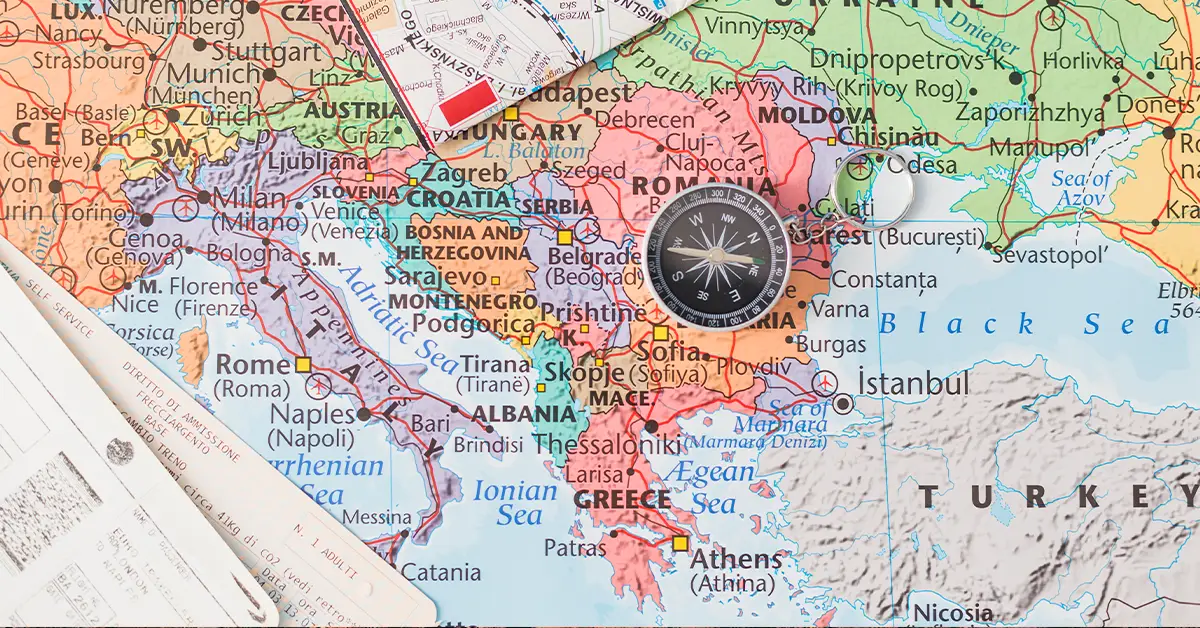
Greek geography has several rare characteristics: the southernmost country of continental Europe, at the southern tip of the Balkan peninsula, with the longest coastline in the Mediterranean and one of the most mountainous landscapes in Europe. Its area of 131,957 km² is surrounded on three sides by the Aegean, Ionian and Mediterranean seas, creating a distinctive territorial structure with more than 2,000 scattered islands.
This article gathers together the important geographical information about Greece based on data from the CIA World Factbook and other authoritative sources, for readers interested in tourism, property investment or settlement in the country.
Message
Position and boundaries in the picture of Greek geography
Greece lies in Southern Europe, at the southern tip of the Balkan peninsula, bordered by the Aegean to the east, the Ionian to the west and the Mediterranean to the south. The country’s geographical coordinates are 39° North and 22° East, according toCIA World Factbook. This is a strategic position commanding the Aegean and the southern approach to the Turkish Straits.
On land, Greece has a total border length of 1,110 km, shared with four neighbours: Albania (212 km), Bulgaria (472 km), North Macedonia (234 km) and Turkey (192 km). Although the land borders are not especially long, they lie in areas of great geopolitical significance, particularly the stretch bordering Turkey in Thrace.
At sea, Greece claims territorial waters of 6 nautical miles and continental shelf sovereignty to a depth of 200 m or to the depth of exploitation. The country has several complex maritime disputes with Turkey in the Aegean, while participating fully in the international conventions on the law of the sea and the environment.
Its position at the southern tip of continental Europe and as a bridge between Europe, Asia and Africa has shaped the whole of Greece’s history and economy. This position also explains why Greece has become a key member state of the European Union and NATO in monitoring the Eastern Mediterranean and the Balkans.
Considering a residency programme? The Prosperous Living Investment team assesses your profile free of charge and advises on the pathway that fits your goals.
Area and terrain
On CIA World Factbook figures, Greece’s total area is 131,957 km², of which the land area is 130,647 km² and the water area 1,310 km². By comparison, Greece is slightly smaller than the state of Alabama in the United States.
Around 80% of Greek territory is hills and mountains, placing the country among the most mountainous in Europe. The Pindus range is the country’s backbone, running north-west to south-east, with a highest point of 2,637 m. Its extension spreads through the Peloponnese peninsula and continues underwater beneath the Aegean, forming many islands including Crete, before linking to the Taurus range in southern Turkey.
The highest point in all of Greece is the Mytikas peak on Mount Olympus, 2,918 m above sea level. It is also the second highest peak in the Balkans after Musala in Bulgaria. Mount Olympus separates Thessaly from Macedonia and in ancient mythology was regarded as the home of the Greek gods. The country as a whole has around 4,144 named mountains.
Central and western Greece have many high, steep peaks interspersed with gorges and karst terrain. The Vikos Gorge in Epirus is one of the most famous features of Greek geography: more than 1,100 m deep, it is regarded as the deepest gorge in the world by depth-to-width ratio. The Meteora area is also notable for its vertical rock pillars hundreds of metres high, on which Orthodox monasteries have been built since the 14th century.
Greece’s plains are small and scattered, usually lying along the coast or within folds in the mountains. Although modest in area, some plains such as those of Thessaly, Macedonia, Thrace and Mesara (Crete) have particularly fertile soil and serve as the country’s agricultural heartlands.
The main geographical regions
Greek geography is usually divided into three large regions with markedly different characteristics. The first is the mainland, stretching from the Pindus range in the north down to the head of the Peloponnese peninsula. It comprises the traditional areas: Sterea (Central Greece), Thessaly (east central), Epirus (north-west), Macedonia (north) and Thrace (north-east).
The second is the Peloponnese peninsula, south of the mainland and connected to it only by a narrow isthmus. Today, two bridges — at the Corinth Canal and the Rio–Antirrio cable-stayed bridge — link the Peloponnese to the mainland. The Peloponnese has high mountain terrain cut by fertile plains, pine forests and rocky hills, and holds many important archaeological sites such as Mycenae, ancient Olympia and Sparta.
The third is the Greek island system, scattered across the three seas around the country. The islands are grouped into several clusters: the Ionian (west), the North Aegean, the Sporades (near the coast of Euboea), the Cyclades (central Aegean), the Dodecanese (between Turkey and Crete), the Saronic and the East Aegean. The Ionian group is marked by a humid climate, many olive trees and greener vegetation than the eastern islands.
Besides the three large regions, the Attica region around the capital Athens has its own character: it is the most densely populated urban region of Greece, stretching like a peninsula south-eastward into the Aegean, with a coastline of many bays and small harbours. Around a third of the Greek population lives in the Athens metropolitan area.
The coastline and the Greek island system
Greece’s coastline runs 13,676 km, the longest in the Mediterranean and among the longest in Europe. The highly indented character of the coast, with countless bays, inlets, headlands and small peninsulas, gives Greece one of the highest ratios of coastline length to land area in the world.
The island system is the most striking feature of Greek geography. The number of islands varies between sources: the Greek National Tourism Organisation gives around 6,000 islands with 227 inhabited, while travel guides usually cite 1,425 islands with 166 permanently inhabited. Whichever figure is used, Greece remains the most important archipelagic nation of the Mediterranean.
Crete is the largest Greek island at 8,262 km², and the fifth largest in the whole Mediterranean after Sicily, Sardinia, Cyprus and Corsica. Crete stretches 260 km east to west and up to 60 km north to south. The island has the Psiloreitis (Ida) peak at 2,456 m, the second highest in Greece. After Crete, the other large islands comprise Euboea (adjoining the mainland), Lesvos, Rhodes, Chios, Kefalonia, Corfu and Samos.
The Cyclades group in the central Aegean comprises around 220 islands, notably Mykonos, Santorini (Thira), Naxos, Paros and Ios. The Dodecanese group in the south-eastern Aegean has such well-known islands as Rhodes, Kos, Patmos, Symi and Leros. These islands have particularly attracted international tourists and property investors over recent decades.
Many Greek islands are volcanic in origin, Santorini most notably. Santorini is listed by the International Association of Volcanology and Chemistry of the Earth’s Interior as a “Decade Volcano” because of its history of explosive eruptions and its proximity to a populated area. The other volcanic sites active in historical times comprise Methana and Nisyros.
The climate of Greece
Greece’s dominant climate is the classic Mediterranean type, marked by mild wet winters and hot dry summers. This climate covers most of the coast, the Peloponnese peninsula and the island system. Summer temperatures in Athens usually range from 28–35°C, while in winter they rarely fall below 5–8°C.
Besides the Mediterranean climate, Greece has other distinct climate types because of its varied terrain. The mountains of the north-west and the Pindus range have an alpine climate, with cold winters and heavy snowfall and cool summers. Northern Macedonia and Thrace are more continental in influence, with a wider gap between winter and summer temperatures.
The southern islands such as Crete and Karpathos have a drier climate, bordering on the subtropical influence of North Africa. Average annual rainfall varies widely: from 400 mm on some eastern Aegean islands to more than 1,200 mm in the mountains of Epirus in the west. The warm sunny climate is an important factor in making tourism the country’s leading economic sector.
Over the past decade, climate change has visibly affected Greece. Heatwaves above 40°C last longer and occur more often, with a rising risk of wildfire in summer, particularly in Attica, the Peloponnese and the islands. The government has rolled out several response measures, including early warning systems and a restructuring of the fire service.
Rivers, lakes and natural resources
Greece’s rivers are relatively short because of the broken terrain and small territory. The longest river lying entirely within Greece is the Aliakmon (297 km), flowing through Macedonia. The other notable rivers comprise the Pineios in Thessaly, the Axios (Vardar) flowing from North Macedonia into Greece, the Evros (Maritsa) forming the natural border with Turkey, and the Nestos forming part of the border with Bulgaria.
Greece’s large freshwater lakes are concentrated in the north and west. Lake Prespa lies on the border of Greece, Albania and North Macedonia, and is regarded as one of the oldest lakes in Europe. The others, such as Trichonida, Volvi, Vegoritida and Doiran, also have important local ecological and economic roles.
On mineral resources, Greece has considerable reserves of bauxite (the main raw material for aluminium), lignite, magnesite, marble and limestone. Greece is a world-leading marble producer, with famous quarries on Thasos, at Penteli and on Naxos. Oil and gas have been found on the continental shelf of the northern Aegean and exploration is being extended.
On land use, according toEuropean Commission Eurostat, around 63.4% of Greece is agricultural land, 30.5% forest and scrub, and the remainder urban and other land. Of the agricultural land, around 19.7% is arable, 8.9% permanent crops (olives, vines, citrus) and 34.8% grazing pasture.
What the geography means for investment and settlement
Greece’s geography brings many opportunities for property investors and settlers. First, the long coastline and island system create abundant supply of holiday and holiday-let property. Areas such as the Athens Riviera, Crete, Rhodes, Mykonos, Santorini and Corfu are consistently among the destinations of greatest interest to international investors.
Second, its strategic position between three continents makes Greece a natural gateway for business between the EU, the Middle East and North Africa. The port of Piraeus near Athens is now one of the busiest container ports in the Mediterranean, attracting strong investment from China, Germany and the Gulf.
Third, the mild year-round climate together with a variety of living environments (city, beach, island) is particularly attractive to retirees and families with young children. This is also why theGreece Golden Visaprogramme attracts investors from many countries, including Vietnam.
Investors should note several natural risks connected with Greek geography. The country lies in a seismically active zone and experiences frequent earthquakes, although most are mild to moderate. Some islands have a history of volcanic activity. The risk of summer wildfire in pine forest areas near towns is also a factor to weigh when choosing a property location.
Summary
Greek geography is a distinctive combination of a strategic Southern European position, mountainous terrain covering 80% of the country, the longest coastline in the Mediterranean at 13,676 km, and a system of more than 2,000 islands spread across the Aegean, Ionian and Mediterranean seas. An area of 131,957 km² with its highest point at Mytikas (2,918 m) on Mount Olympus and its largest island Crete has created a country of great variety in landscape and microclimate.
These geographical features are not only the foundation of ancient Greek civilisation but a key factor shaping the country’s modern economy, particularly tourism, shipping and property. Readers may also consult the related articles onLife in GreeceandThe Greek citizenship testfor a full picture before deciding on investment or settlement.
Accompanying you on your journey in residency investment
The Prosperous Living Investment team advises on pathways, assesses profiles and manages investments transparently for every residency, citizenship and international property objective.
Free profile assessmentWhere life gets prosperous