


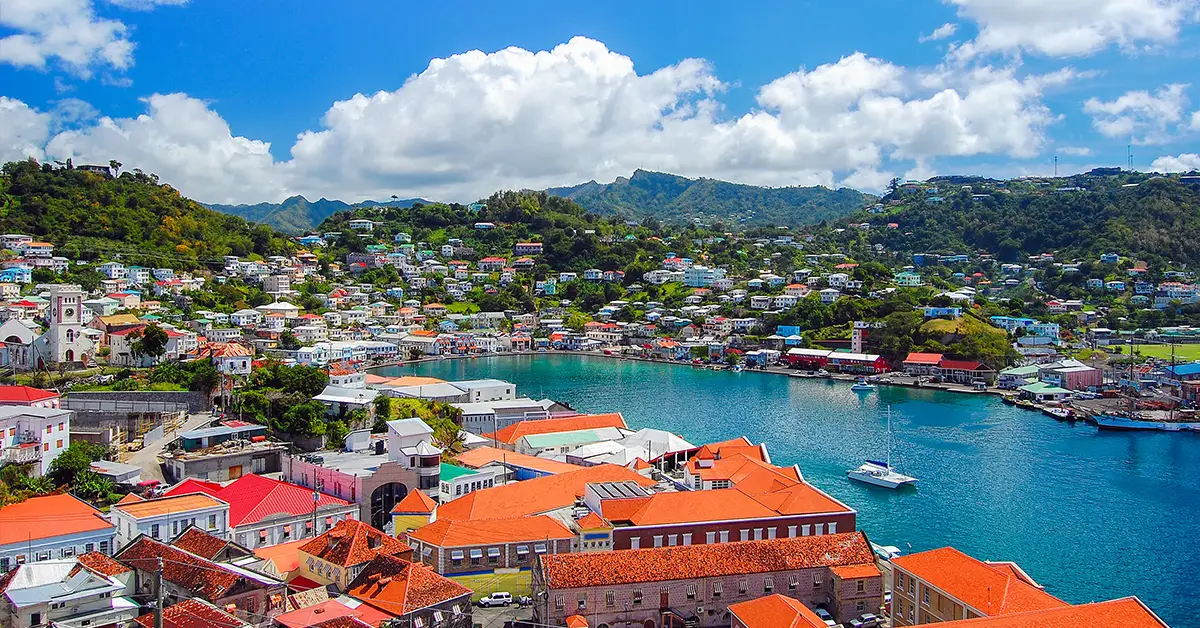
Grenada’s economy is one of the most stable and dynamic in the Eastern Caribbean over the period 2022-2025. As a small island nation with a population of around 125,000, Grenada has maintained real GDP growth above the regional average, thanks to a strong recovery in tourism after the pandemic, record revenue from the citizenship-by-investment (CBI) programme, and steady foreign direct investment inflows.
For investors consideringGrenadaas a destination forGrenada citizenship by investment, grasping the macroeconomic picture is a key factor. This article brings together the key indicators, sectoral structure, tax policy and growth prospects of the island nation based on the latest reports from the IMF, the United States Department of State and the relevant authorities.
Message
An overview of GDP and Grenada’s economic growth
Grenada’s nominal GDP in 2024 was estimated at around USD 1.3 billion. This is a small economy by international standards but GDP per capita is relatively high, at around USD 10,500-11,000, placing Grenada in the upper middle income group under the World Bank’s classification.
Theo IMF, Grenada’s economy grew 4.4% in 2023 and an estimated 3.9% in 2024 — growth above the average for the Eastern Caribbean countries. Growth in 2025 is forecast to remain at 3.9%, despite the damage caused by Hurricane Beryl in July 2024.
Inflation has remained stable. The consumer price index (CPI) fell from 2.7% to 2.2% by the end of 2023, thanks to easing global food and fuel prices. Inflation in 2025-2026 is forecast to hover around 2%, meeting the price stability target of the Eastern Caribbean Central Bank (ECCB).
A notable bright spot is the fiscal position. Thanks to a surge in CBI revenue, Grenada achieved a primary budget surplus of 8% of GDP in 2023. Public debt fell to 75% of GDP, above the 60% ceiling set in the Fiscal Responsibility Act but gradually returning to sustainable levels. Government deposits at the ECCB have risen sharply, creating a large financial buffer.
Considering a residency programme? The Prosperous Living Investment team assesses your profile free of charge and advises on the pathway that fits your goals.
The structure of the economy: three pillars
Grenada’s economy rests on three main pillars: tourism, financial services (including CBI) and spice agriculture. This is the characteristic structure of Caribbean island nations with limited natural resources but clear competitive advantages in particular fields.
Tourism — the growth engine
Tourism contributes around 40% of Grenada’s GDP and is the country’s largest employer. According to the Grenada Tourism Authority (GTA), 2023 saw 178,020 overnight visitors — up 34% on 2022 and 9% above the pre-pandemic level of 2019. Cruise tourism welcomed 305,627 visitors in 2023, up 64% on the previous year.
Grenada’s main source markets are the United States (49.6% of total visitors), the United Kingdom (13.1%), Canada and other Caribbean countries. 2024 saw 26 consecutive months of tourism growth since September 2022, with both average spend per visitor and length of stay rising.
Luxury hotel projects such as Six Senses La Sagesse, Silversands Beach House and Kimpton Kawana Bay are raising Grenada’s standing as an upmarket destination on the Caribbean tourism map. Maurice Bishop International Airport with direct flights from New York, Miami, Toronto and London ensures reliable international connections.
The citizenship-by-investment (CBI) programme
Grenada’s CBI programme, launched in 2013 and renamed the Investment Migration Agency in March 2024, has become one of the country’s most important sources of fiscal revenue. In 2024, the programme generated record revenue of around EC$1.116 billion — equivalent to more than 10% of GDP. The total number of applications approved in 2024 was 1,583, with 5,443 new citizens granted citizenship.
Theo the United States Department of State, in the first half of 2023, CBI revenue rose 213% on the same period in 2022. Candidates have two main investment routes: a non-refundable contribution to the National Transformation Fund, or the purchase of government-approved property. During 2024, 57% of candidates chose the property route, reflecting a preference for tangible assets.
A particular attraction of Grenadian citizenship is that the passport gives visa-free access to more than 145 countries including the United Kingdom, the EU Schengen bloc and China. In addition, Grenada is one of the Caribbean countries with an E-2 trade treaty with the United States, opening the way for its citizens to apply for an E-2 investor visa to the United States — a privilege no other CBI programme in the region offers.
Spice agriculture and processing
Although its share of GDP is gradually declining, agriculture still contributes around 10% of GDP and provides jobs for rural communities. Grenada is the world’s second largest producer of nutmeg, accounting for around 25% of global supply, after only Indonesia. Annual agricultural export value exceeds USD 25 million, comprising mainly:
- Nutmeg and mace
- Cocoa (including the Grenada Chocolate Company brand producing bean-to-bar chocolate)
- Cinnamon, cloves and ginger
- Bananas, mangoes, avocados and tropical fruit
The Grenada Co-operative Nutmeg Association acts as the central purchasing and export body, connecting thousands of smallholder farmers with international markets. The government is encouraging investment in value-added agricultural processing such as spice essential oils, teas and speciality food products.
Currency and the financial system
Grenada uses the Eastern Caribbean Dollar (XCD or EC$) — the common currency of the Eastern Caribbean Currency Union (ECCU). The exchange rate has been pegged to the United States dollar at USD 1 = EC$2.70 since 1976, providing monetary stability and removing exchange rate risk for investors holding USD.
The Eastern Caribbean Central Bank (ECCB), based in Saint Kitts, is responsible for issuing currency and managing monetary policy for the whole bloc. The ECCU comprises 8 countries and territories: Antigua and Barbuda, Dominica, Grenada, Saint Kitts and Nevis, Saint Lucia, Saint Vincent and the Grenadines, Anguilla, and Montserrat.
Grenada’s commercial banking system comprises major international banks such as Republic Bank (of Trinidadian origin), RBC Royal Bank (Canada) and CIBC FirstCaribbean, together with domestic banks such as the Grenada Co-operative Bank. The IMF assesses Grenada’s banking system as stable, with high liquidity ratios and low non-performing loans.
Foreign direct investment (FDI) in Grenada’s economy
FDI into Grenada is directed mainly at three areas: CBI-linked holiday property, hotels and tourism infrastructure, and renewable energy. CBI capital flows into property rose sharply from EC$151 million in 2020 to EC$465.2 million in just the first three quarters of 2024.
Foreign investors enjoy a range of incentives:
- Exemption from import duty on machinery and materials for approved projects
- Exemption from corporate income tax for up to 15 years (a tax holiday) for major projects
- Deduction of investment costs
- No limits on foreign ownership in most sectors
- No exchange controls
The body responsible for investment promotion is the Grenada Industrial Development Corporation (GIDC). The priority sectors for attracting investment are tourism, high-technology agriculture, education, health and wellness, information technology, and renewable energy (particularly geothermal and solar).
The tax system
Grenada’s tax system is based on the principle of territorial taxation, meaning only income arising domestically is taxed. The notable features of Grenada’s tax policy:
- No income tax on foreign income (foreign income)
- No capital gains tax (capital gains tax)
- No wealth tax (wealth tax)
- No inheritance tax (inheritance tax)
- No gift tax (gift tax)
- Personal income tax: progressive from 10% to 28%
- Corporate income tax: 28% (the standard rate), with many incentives for priority sectors
- Value added tax (VAT): 15% (the standard rate), 10% for hotels and tourism services
- Property tax: 0.2-0.8% annually on market value
This tax policy places Grenada among the countries friendly to international investors and high-net-worth individuals (HNWIs). Combined with the CBI programme, it is an important lever for attracting foreign capital.
The impact of Hurricane Beryl 2024 and reconstruction
In July 2024, category 4 Hurricane Beryl swept across Grenada, devastating the islands of Carriacou and Petite Martinique in particular. The IMF estimates the damage at more than 16% of GDP, concentrated mainly on housing, infrastructure and agriculture on the two dependent islands. The main island of Grenada suffered lighter damage — the tourism facilities at Saint George’s and Grand Anse continued operating normally.
The government responded quickly with a fiscal response package, including suspending the Fiscal Responsibility Act to allow deficit spending on reconstruction. Reconstruction costs are estimated at 13.5% of GDP spread across the period 2024-2026. The Caribbean Catastrophe Risk Insurance Facility (CCRIF) paid out insurance covering a significant part of this.
The IMF, in its 2025 Article IV report (published in January 2026), assesses Grenada’s economy as maintaining a strong recovery, with GDP forecast to grow 3.9% in 2025. The main tourism industry — the economy’s engine — was not seriously disrupted because the tourism infrastructure lies mainly on the main island.
The labour market and wages
Grenada’s labour market is small with around 55,000-60,000 economically active workers. Unemployment has fallen considerably from double-digit levels in the late 2010s to around 11-13% in 2023-2024, thanks to the boom in tourism and CBI construction. Young workers (aged 15-24) still have above-average unemployment, an issue to be addressed through vocational training programmes.
The largest employing sectors are tourism and hospitality, the public sector — including education and health, trade and retail, construction and agriculture. The statutory minimum wage in 2025 ranges from EC$4-6 an hour depending on the occupation, reviewed periodically by the Government in consultation with the social partners.
The quality of the workforce is rated relatively good by regional standards. Literacy is above 98%, with free English-language education through to the end of secondary school. St. George’s University Medical School trains international doctors, while technical and vocational schools supply labour for the service and construction industries.
International trade and the balance of payments
Grenada is an open economy with a trade-to-GDP ratio exceeding 100%. Goods exports in 2023 reached around USD 45 million, mainly nutmeg, cocoa, cinnamon and other agricultural products. Imports reached around USD 450 million, comprising fuel, machinery, processed food, consumer goods and vehicles.
The goods trade balance is heavily in deficit, but is offset by a services surplus — mainly tourism — and remittance inflows. The overall current account remains in deficit, previously around 10-15% of GDP, and has narrowed over 2023-2024 thanks to CBI revenue and tourism.
Grenada’s main trading partners are the United States, Trinidad and Tobago, the United Kingdom, and the CARICOM countries. Grenada is a member of the CARICOM Single Market and Economy, allowing free movement of goods with other Caribbean countries.
Long-term prospects and challenges
The IMF warns of several medium-term risks to Grenada’s economy:
- Dependence on volatile CBI revenue: CBI revenue is hard to predict, depending on global investment migration demand. CBI revenue is forecast to normalise from 2025 onwards, not sustaining the record levels of 2023-2024.
- Pressure on tourism capacity: the island’s small scale limits infrastructure, environment and workforce.
- Climate change and more intense hurricanes: Hurricane Beryl is evidence of increasing natural disaster risk, requiring investment in climate resilience.
- Dependence on imported fossil fuels: high energy costs affect competitiveness.
The policy priorities are: improving CBI revenue management through a stabilisation fund, restraining growth in recurrent spending, investing in geothermal energy (harnessing the Kick ’em Jenny submarine volcanic source and geothermal fields on the main island), and diversifying the economy through new sectors such as information technology, education and the creative economy.
Conclusion — the strategic position of Grenada’s economy
Grenada’s economy has shown outstanding resilience through the post-COVID period and after natural disaster. Combining continuously growing upmarket tourism, the Caribbean’s leading CBI programme and a traditional spice agriculture base, this island nation has built a relatively diverse and sustainable development model. Monetary stability thanks to the USD peg, a friendly tax system, and comprehensive investment incentives continue to be clear competitive advantages.
For individual investors seeking a citizenship-by-investment opportunity together with a stable business environment, Grenada offers a distinctive value proposition: citizenship with a strong passport, access to the United States through the E-2 visa, and an economy growing at around 4% a year. A CBI-linked property investment is not merely a naturalisation formality but also an appreciating asset in a lively tourism property market.
Accompanying you on your journey in residency investment
The Prosperous Living Investment team advises on pathways, assesses profiles and manages investments transparently for every residency, citizenship and international property objective.
Free profile assessmentWhere life gets prosperous