


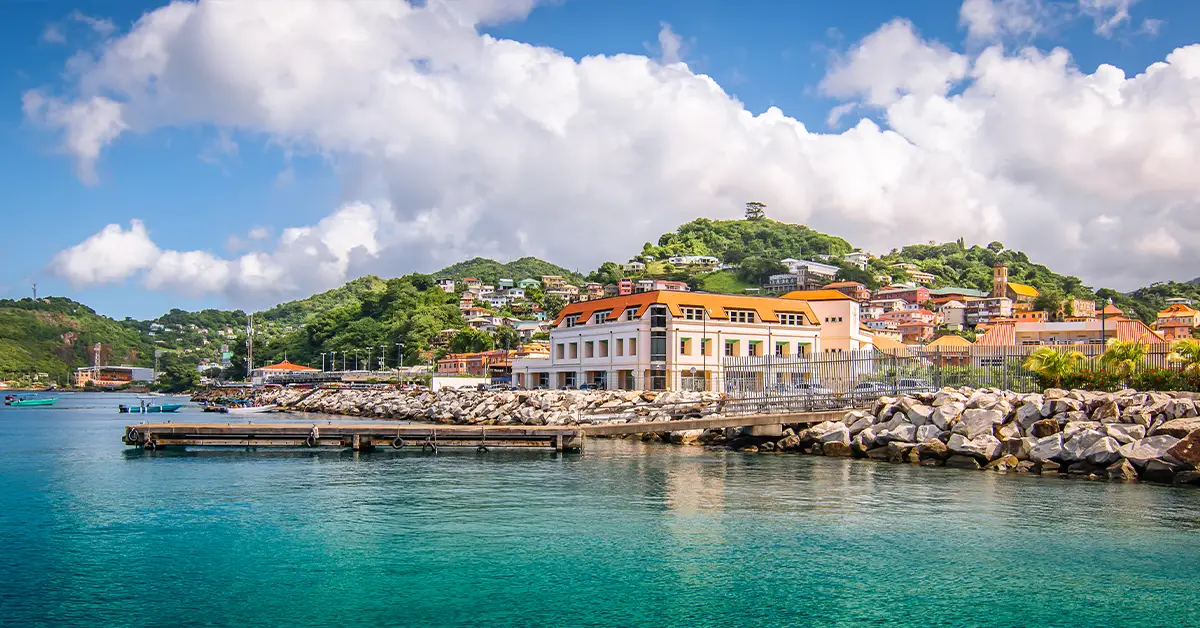
Grenada’s politics operate within the framework of a parliamentary representative democracy, on the British Westminster model. As a sovereign state within the Commonwealth since 1974, Grenada maintains a constitutional monarchy with King Charles III as head of state, represented locally by a Governor-General. The Prime Minister holds actual executive power as head of Government.
For investors consideringGrenadathrough theGrenada citizenship by investmentprogramme, understanding the political system is essential. This island nation’s institutional stability, legal transparency and democratic tradition are factors directly affecting investment safety and the value of its citizenship. This article sets out in detail Grenada’s government structure, constitutional bodies and contemporary political context.
Message
The 1974 Constitution and the legal framework
Grenada’s Constitution took effect on 7/2/1974, at the moment of independence from Britain, and was formally promulgated on 19/12/1975. This instrument shapes the entire structure of government, the rights and duties of citizens, and the relationship between the branches of power.
During Maurice Bishop’s People’s Revolutionary Government (PRG) from 1979 to 1983, the Constitution was suspended and replaced by rule through a Political Bureau together with parish councils. After the United States military intervention of October 1983 and the restoration of democratic order, the 1974 Constitution was fully restored in 1984, marking the return of the constitutional framework that remains in place today.
The Constitution guarantees fundamental freedoms: freedom of expression, of the press, of religion, of assembly and of association. According to theGovernment of Grenada, citizens have the right to change their government peacefully through regular, free and fair elections, on the principle of universal suffrage.
Every Grenadian citizen aged 18 or over has the right to vote. Civil and political rights are protected by an independent judiciary and by the Privy Council in London as the final court of appeal for constitutional matters.
Considering a residency programme? The Prosperous Living Investment team assesses your profile free of charge and advises on the pathway that fits your goals.
Constitutional monarchy and the role of the Governor-General
Grenada is a Commonwealth Realm, meaning the King or Queen of the United Kingdom is at the same time head of state of Grenada. After Queen Elizabeth II died in September 2022, King Charles III became the new head of state.
In practice, the head of state’s powers are exercised in Grenada by the Governor-General. The Governor-General is appointed by the King on the Prime Minister’s recommendation, and mainly performs ceremonial and constitutional functions. The specific duties include: summoning and dissolving Parliament, granting Royal Assent to legislation, appointing the Prime Minister and Cabinet, and representing the country at official events.
The incumbent Governor-General is Dame Cécile La Grenade, in office since May 2013 — the first female Governor-General in Grenada’s history. During the change of government in June 2022, it was she who presided over the swearing-in of Prime Minister Dickon Mitchell.
It should be emphasised that although the Governor-General holds considerable constitutional power, they exercise almost all of it on the advice of the Prime Minister and Cabinet, following Westminster convention. The Governor-General’s role in Grenadian politics is mainly symbolic and one of safeguarding the Constitution in times of crisis.
The Prime Minister and Cabinet: the executive branch
Executive power in Grenada lies with the Prime Minister and Cabinet, on the principle of parliamentary government. The Prime Minister is appointed by the Governor-General from among the leaders of the party winning a majority in the House of Representatives. The Cabinet comprises ministers nominated by the Prime Minister, collectively responsible to Parliament.
The incumbent Prime Minister is Dickon Amiss Thomas Mitchell, born on 8/10/1978 in Saint David parish, of the National Democratic Congress (NDC). He was sworn in as Grenada’s ninth Prime Minister on 24/6/2022, becoming the youngest ever to hold the office in the country’s history.
Beyond his role as Prime Minister, Dickon Mitchell also holds several important portfolios: Minister for National Security, Public Administration, Home Affairs, Information and Disaster Management; Minister for Infrastructure and Physical Development, Public Utilities, Civil Aviation and Transport. He also created a Ministry of Mobilisation, Implementation and Transformation — a new body to drive administrative reform.
Grenada’s Cabinet comprises around 15 ministries and equivalent bodies, including the Ministry of Finance, the Ministry of Foreign Affairs, the Ministry of Health, the Ministry of Education, the Ministry of Agriculture, the Ministry of Tourism, and other specialist ministries. Ministers are responsible for overseeing sectoral policy and implementing the national development plan.
The bicameral Parliament: the Senate and the House of Representatives
The Parliament of Grenadais a bicameral legislature, comprising the Sovereign (represented by the Governor-General), the Senate and the House of Representatives. The whole body sits in the New Houses of Parliament building at Mt. Wheldale, Saint George’s, opened in 2018 to replace the old York House destroyed by Hurricane Ivan in 2004.
The House of Representativeshas 16 members, of whom 15 seats are directly elected from 15 constituencies for 5-year terms, together with 1 Speaker. The House uses the first-past-the-post electoral system. It is the dominant chamber in the parliamentary system, where the Government is formed and where important bills begin their passage.
After the general election of June 2022, the National Democratic Congress (NDC) won 9 of the 15 seats, with the New National Party (NNP) holding 6. The current position (updated for 2025-2026) shows the NDC holding 10 seats, the NNP 4, and 1 independent seat held by a former NNP member.
The Senatehas 13 members, all appointed by the Governor-General. The allocation of seats is usually: 10 on the Prime Minister’s recommendation and 3 on the recommendation of the Leader of the Opposition. The Senate has constitutional powers equivalent to the House of Representatives over most bills, but may not initiate or amend money bills to increase or reduce sums.
Every bill must be passed by both chambers and receive Royal Assent from the Governor-General before becoming law. The Senate has the power to reject a bill and may delay its passage for up to 6 months. This mechanism ensures a balance of power between the two chambers and between Government and opposition.
The party system in Grenadian politics
Grenadian politics since 1984 has been a multi-party democracy, although in practice it usually centres on two main parties:
- The New National Party (NNP): founded in 1984, moderate conservative in outlook, supporting a market economy and close relations with the West. Under Keith Mitchell’s leadership from 1989 to 2024 this party dominated politics for more than two decades, holding the premiership in two periods, 1995-2008 and 2013-2022. The current leader is Emmalin Pierre, an education specialist, who succeeded him in 2024.
- The National Democratic Congress (NDC): founded in 1987, originating in the merger of several centre-left political groups, including some former New Jewel Movement members. It is the governing party today, under Prime Minister Dickon Mitchell.
- The Grenada United Labour Party (GULP): the oldest party, founded by Eric Gairy, which dominated politics before 1979 but now plays only a peripheral role.
Other small parties such as the People’s Labour Movement (PLM) and newly formed parties do not usually win significant numbers of seats at elections. One of the system’s notable features is its capacity for peaceful transfers of power, as demonstrated at the elections of 1984, 1990, 1995, 2003, 2008, 2013 and 2022.
The judiciary and the court system
Grenada’s judiciary is independent of both the executive and the legislature, and follows English common law. The tiers of court are:
- Magistrates’ Courts: handling small civil matters and less serious criminal offences.
- The Eastern Caribbean Supreme Court: comprising the High Court and the Court of Appeal, serving 9 Eastern Caribbean countries and territories including Grenada.
- The Privy Councilin London: the final court of appeal for Grenada and the Caribbean Commonwealth realms that have not moved to the Caribbean Court of Justice (CCJ).
The question of moving from the Privy Council to the Caribbean Court of Justice (CCJ) is a subject of political debate in Grenada. At referendums in November 2016 and again in 2018, Grenadian voters rejected the proposal to move to the CCJ. To date, the Privy Council remains the final court of appeal.
Security and public order
National security is provided by the Royal Grenada Police Force (RGPF) with around 650 members. This force includes a paramilitary Special Services Unit (SSU) with around 80 members, and the Royal Grenada Coast Guard with around 30 members.
Grenada has no standing independent army. The United States provides periodic training and equipment support to the SSU and the coast guard. At the same time, Grenada is an active member of the Regional Security System (RSS) — the security co-operation mechanism between the Eastern Caribbean states.
Grenada’s modern security policy focuses on three priorities: combating trans-Caribbean drug trafficking, disaster response and maritime rescue, and protecting the tourism industry — the economy’s main source of revenue.
Local government and administration
Grenada is divided into 6 parishes and 1 dependency:
- Saint George(containing the capital Saint George’s)
- Saint John
- Saint Mark
- Saint Patrick
- Saint Andrew
- Saint David
- Carriacou and Petite Martinique(a dependency)
Unlike many other countries, Grenada has no full local government system at parish level. Public services are provided directly by the central ministries, co-ordinated through parish-level representatives. This reflects the country’s small scale and the efficiency of centralised administration.
Carriacou and Petite Martinique have their own Minister in Cabinet — the Minister for Carriacou and Petite Martinique Affairs — with special responsibility for the dependent islands.
Grenada’s contemporary political context 2025-2026
Contemporary Grenadian politics is in a period of generational change and reform. Prime Minister Dickon Mitchell, on taking office, committed to a comprehensive reform programme, including: ending nepotism, reforming the electoral system, modernising public administration, and considering the possibility of moving Grenada from a constitutional monarchy to a republic.
In 2024, Grenada marked 50 years of independence with a series of national events. On that occasion, Prime Minister Dickon Mitchell reaffirmed his vision of the country becoming a republic — a step that would end King Charles III’s role as head of state. However, this process requires constitutional amendment and a referendum, so progress remains cautious.
In February 2025, Keith Mitchell — Grenada’s longest-serving Prime Minister with more than 22 years in office — formally resigned as Leader of the Opposition, handing the position to Emmalin Pierre. This marked the end of a political era and opened a new period with younger figures and a stronger reform orientation.
Internationally, Dickon Mitchell’s government pursues a multilateral foreign policy, maintaining close relations with the United States, Britain, Canada and the CARICOM countries, while expanding co-operation with China, Cuba and the Latin American countries. In January 2025, he met Chinese President Xi Jinping in Beijing to discuss economic and infrastructure co-operation.
Conclusion — institutional stability and Grenada’s political prospects
Grenadian politics is a story of democratic resilience after a turbulent period of revolution and military intervention. From 1984 to the present, the country has maintained a tradition of free elections, peaceful transfers of power and a balance of power between the branches of government. The 1974 Constitution continues to shape its institutions, with the Westminster model providing stability proven over many successive elections.
For investors, the most important thing is the stability and predictability of the political environment. Grenada meets that test: transparent law based on English common law, an independent judiciary with the London Privy Council as the final court of appeal, and clear commitments to the Commonwealth and international institutions. The reforms Prime Minister Dickon Mitchell is pursuing — where successful — will continue to modernise governance without disturbing that foundation of stability.
Accompanying you on your journey in residency investment
The Prosperous Living Investment team advises on pathways, assesses profiles and manages investments transparently for every residency, citizenship and international property objective.
Free profile assessmentWhere life gets prosperous