


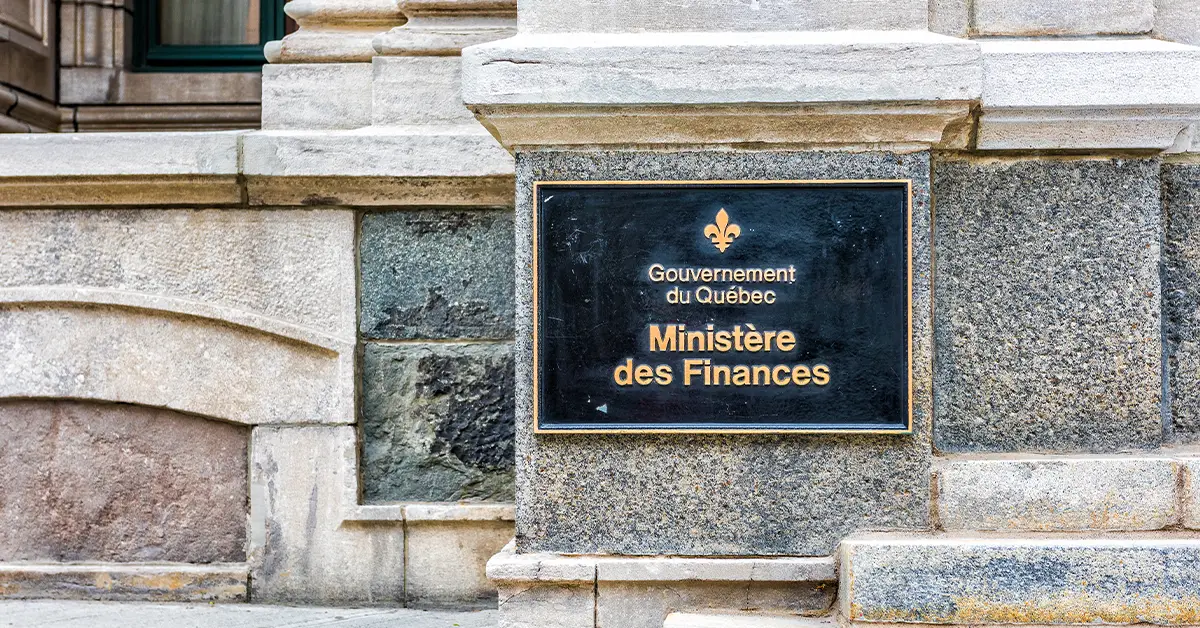
Quebec’s economy is Canada’s second largest after Ontario, accounting for around 19% of national GDP at a scale of around CAD 600 billion.Quebechas a distinctive economic structure: combining a dynamic private sector with a deep state presence through large public corporations such as Hydro-Québec, a world-leading hydroelectric tradition, the world’s third largest aerospace cluster, and a strongly growing artificial intelligence ecosystem in Montreal.
This article gives a panorama of Quebec’s economy across 8 main aspects: scale and growth, sector structure, the key sectors, international trade, labour and unemployment, economic policy, the impact of United States tariffs and future prospects. This is foundational information for investors, entrepreneurs and those intending to settle in Quebec.
Message
Economic scale and growth
Quebec’s economy grew in real GDP terms by 1.7% in 2024, above the 1.4% forecast in the 2025–2026 Budget and above the Canadian average. According to material from theMinistère des Finances du Québec, this was impressive growth against a difficult global economic backdrop and the new tariff policy from the Trump administration.
Quebec’s GDP reached around CAD 600 billion in 2024, equivalent to 19% of national GDP. At purchasing power parity (PPP), Quebec’s economy is comparable in size to countries such as Norway or Austria, and much larger than Denmark or Finland.
Quebec’s GDP per capita was around CAD 65,000 in 2024, some 10.2% below Ontario and 13.6% below the Canadian average. However, this gap has narrowed considerably since 2018 (when it was 15.9% and 20.2% respectively), thanks to Quebec’s economy growing faster than other provinces over the past six years.
A positive feature of Quebec’s economy is the highest household savings rate in Canada – 8.3% in 2024, against 4.1% in Ontario and 5.0% nationally. This reflects Quebecers’ culture of financial prudence and provides a solid foundation for withstanding economic shocks.
Considering a residency programme? The Prosperous Living Investment team assesses your profile free of charge and advises on the pathway that fits your goals.
The structure of the economy by sector
Quebec’s economy has a diverse structure with three main sectors:
The service sector (around 70% of GDP)
The service sector accounts for most of Quebec’s economy, including:
- Wholesale and retail trade
- Financial services and insurance (the National Bank of Canada and Desjardins Group are headquartered in Montreal and Lévis)
- Professional, scientific and technical services
- Public and private education
- Health and social services
- Transport and warehousing
- Tourism and hospitality
The manufacturing sector (around 24% of GDP)
Manufacturing is an important pillar of Quebec’s economy, accounting for nearly a quarter of GDP with total production value exceeding CAD 137 billion. The main sub-sectors:
- Transport equipment (aircraft, railways, electric vehicles)
- Food and drink
- Paper and paper products
- Basic metals (aluminium, iron and steel)
- Chemicals and pharmaceuticals
- Refined petroleum products
The primary sector (around 3% of GDP)
This includes mining, forestry, agriculture and fishing. Although its share of GDP is not high, this sector contributes significantly to exports and creates jobs in rural areas.
The key economic sectors
Hydroelectricity and energy
Hydroelectricity is the emblem of Quebec’s economy and the foundation for many other industries. The public corporation Hydro-Québec – 100% owned by the provincial government – is one of the largest public electricity companies in North America, producing around 96% of Quebec’s electricity from renewable hydro sources.
Quebec exports electricity to the north-eastern United States (New York, New England) and the province of Ontario, generating billions of dollars in steady revenue each year. The Quebec government has announced plans to add 60 terawatt-hours of capacity by 2035, equivalent to a 30% increase in current output to meet the demands of the green transition.
In 2024, Quebec signed a historic agreement with Newfoundland and Labrador on the 9,190 MW Churchill Falls hydroelectric plant, securing a stable electricity supply for the province for decades to come.
The aerospace industry
Montreal is one of the world’s three largest aerospace capitals, alongside Seattle and Toulouse. Quebec’s aerospace cluster employs more than 36,000 workers and accounts for 55% of Canada’s total aerospace output.
The key companies are:
- Bombardier: a private manufacturer of aircraft and trains, headquartered in Montreal
- CAE: the world’s leading manufacturer of flight simulators
- Pratt & Whitney Canada: aircraft engines
- Bell Textron Canada: helicopters
- Héroux-Devtek: aerospace components
Quebec’s aerospace industry invests more than CAD 700 million in R&D annually, accounting for 70% of Canada’s aerospace R&D spending. Montreal is also home to the International Civil Aviation Organization (ICAO) and many other international aviation bodies.
The aluminium industry
Quebec is the world’s third largest producer of primary aluminium, accounting for nearly 80% of Canadian output and an important supplier to the United States market. Quebec’s aluminium industry benefits from Hydro-Québec’s cheap, clean electricity, producing aluminium with the world’s lowest carbon footprint.
The major companies are Rio Tinto, Alcoa and Aluminerie Alouette. Saguenay–Lac-Saint-Jean is the region where the aluminium industry is concentrated, with several large-scale smelters.
Theo Statistics Canada, Canadian aluminium exports reached CAD 13.4 billion in 2024, of which nearly 80% came from Quebec and more than 94% went to the United States. After the United States imposed a 25% tariff from March 2025, rising to 50% from June 2025, Canadian aluminium exports fell more than 24% against the 2024 average.
Mining
Quebec is one of Canada’s most important mining centres, extracting around 30 different minerals. The main minerals are iron, gold, nickel, titanium, niobium, zinc, copper and silver.
Quebec is:
- The world’s second largest producer of niobium
- The world’s third largest producer of titanium dioxide
- Canada’s largest producer of zinc in 2010
- Canada’s second largest producer of gold and iron
The province has 27 operating mines, around 200 exploration companies and 12 primary processing plants. Mineral exports are worth billions of dollars a year.
Amid the green transition, Quebec is investing heavily in battery minerals such as lithium and graphite, with the Nemaska Lithium and Nouveau Monde Graphite projects. The province also aims to integrate into the North American electric vehicle battery supply chain.
Information technology and artificial intelligence
Montreal is one of the world’s leading AI centres, thanks to the presence of major research laboratories:
- Mila (Quebec AI Institute): a leading AI research institute, founded by Professor Yoshua Bengio (winner of the 2018 Turing Award)
- Google AI Lab Montreal
- Microsoft Research Montreal
- Facebook/Meta AI Research (FAIR)
Beyond AI, Montreal is also known for video games (Ubisoft Montreal, Electronic Arts, Warner Bros. Games), fintech and visual effects technology. The region attracts international talent thanks to a lower cost of living than Toronto and Vancouver together with generous government tax support.
Forestry and paper
With a forest area of 760,000 km² – nearly 50% of the province’s territory – Quebec is a major Canadian producer of wood and paper products. The forest products industry provides jobs for tens of thousands of workers in rural northern Quebec, particularly in Saguenay, Abitibi and Mauricie. Quebec is also the world’s largest producer of maple syrup, accounting for 72% of global output.
Agriculture and food
Although its share of GDP is modest, Quebec agriculture plays an important cultural and food security role. The main products:
- Milk and dairy products (Quebec produces nearly half of Canada’s milk output)
- Pork, beef and poultry
- Cereals and soybeans
- Fruit (apples, blueberries, cranberries)
- Vegetables (potatoes, carrots, cabbage)
Quebec has a strict supply management system for dairy, egg and poultry products, protecting domestic farmers through quotas and high import tariffs.
International trade
Quebec’s economy is closely tied to the United States market. In 2023, Quebec exported CAD 87.3 billion of goods to the United States, more than 70% of the province’s total international exports. The main exports to the United States are:
- Aircraft and aerospace equipment: products of Bombardier and Pratt & Whitney
- Aluminium: an input for the United States motor and construction industries
- Timber and forest products: particularly softwood lumber
- Paper and pulp
- Oil, gas and refined fuels
- Electricity and hydroelectric products
- Iron, steel and other metals
- Pharmaceuticals and medical products
After the United States, Quebec’s other important trading partners are China, France, Germany, Japan, the United Kingdom and Mexico. Quebec is actively diversifying its markets to reduce dependence on the United States amid an unstable trade policy environment.
Labour and unemployment
Quebec’s labour force reached around 4.5 million in 2024. The unemployment rate has hovered around 5–6%, considerably below the Canadian average in recent years. However, the Quebec labour market has several notable features:
- A serious labour shortage because of population ageing and a low birth rate
- High demand in health, education, information technology, construction and services
- Average wages lower than Ontario and British Columbia but with a correspondingly lower cost of living
- Strong unionisation, particularly in the public sector (a union rate of around 37%, the highest in Canada)
Montreal had an unemployment rate around 1–2 percentage points above the provincial average in 2025, reflecting the city’s greater sensitivity to the economic cycle because of its many cyclical industries such as technology and manufacturing.
Economic policy
Quebec’s economy operates on a “dirigiste” model – with the state strongly involved in steering development. This is a legacy of the Quiet Revolution of the 1960s, when the Quebec government took over many economic sectors from the private sector and the Church.
Quebec’s major Crown Corporations:
- Hydro-Québec: electricity
- Loto-Québec: lotteries and gaming
- Société des alcools du Québec (SAQ): alcohol distribution
- Caisse de dépôt et placement du Québec (CDPQ): the public pension fund, managing more than CAD 450 billion
The CDPQ is one of the world’s largest public investment funds, investing at home and abroad in property, infrastructure, equities and bonds. It is Quebec’s strategic tool for maintaining control of the local economy and exerting international influence.
The Quebec government’s 2024–2025 Budget added CAD 1.9 billion over 5 years for regional economic development, focusing on:
- Innovation zones and industrial laboratories
- Developing the aerospace and aluminium industries
- Digital technology and digital transformation
- Start-ups and business succession
- The economic integration of immigrants
The impact of United States tariffs in 2025
2025 was a year of major challenge for Quebec’s economy because of the Trump administration’s new tariff policy. The main tariffs:
- A 25% tariff on Canadian aluminium from 12/03/2025, rising to 50% from 04/06/2025
- Tariffs on steel, forest products and many other goods
- No exemption under the Canada–United States–Mexico Agreement (CUSMA)
The specific impacts:
- Canadian aluminium exports fell more than 24% in the months from April to August 2025
- The aerospace industry was affected as Canadian aircraft became more expensive in the United States
- The timber and paper industries faced major challenges
- The textile and dairy farming industries were also affected
The Quebec government responded with support measures:
- A CAD 50 million loan programme for affected businesses
- Encouraging diversification of export markets
- Support for business restructuring
- Investment in technological innovation and reducing dependence on the United States
Economic prospects
The Quebec government’s New Economic Vision 2025–2026 focuses on four main pillars:
- Energy sovereignty: doubling electricity output by 2050, developing hydroelectricity and renewable energy
- Market diversification: taking advantage of international opportunities to reduce dependence on the United States
- Productivity and innovation: investing in R&D, digital transformation and green technology
- Simplifying administration: cutting red tape and supporting strategic projects through a “fast-track” process
The major projects under way include the electric vehicle battery plan with Nemaska Lithium and Nouveau Monde Graphite, expanding the aerospace industry, developing AI in Montreal, and new hydroelectric projects. The cumulative impact on Quebec’s GDP is estimated at CAD 127 billion by 2050.
For foreign investors and entrepreneurs, Quebec is expanding its investment attraction programmes through Investissement Québec and offering significant tax incentives for strategic projects in energy, technology, battery minerals and R&D.
Conclusion
Quebec’s economy is Canada’s second largest at CAD 600 billion, world-leading in renewable hydroelectricity, among the world’s top 3 aerospace centres, and an important North American AI hub in Montreal. Its diverse structure combining a dominant service sector, high-technology manufacturing and abundant natural resources provides a stable foundation for long-term development. Although it faces challenges from the United States tariffs of 2025 and an ageing population, Quebec has enduring competitive advantages: cheap clean electricity, a skilled workforce, a strong education system and a dynamic innovation environment.
Understanding Quebec’s economy helps identify opportunities for investment, settlement and business in the Canadian province with the most independent economic policy. For Vietnamese readers interested inCanadian citizenshipor consideringsettling in Canada, Quebec offers a stable business environment, a reasonable cost of living, and opportunities in strategic sectors such as technology, aerospace, battery minerals and renewable energy.
Accompanying you on your journey in residency investment
The Prosperous Living Investment team advises on pathways, assesses profiles and manages investments transparently for every residency, citizenship and international property objective.
Free profile assessmentWhere life gets prosperous