

Quebec’s culture is one of the most distinctive regional identities in North America. Built over more than four centuries since the days of New France, shaped by waves of migration, two military conquests and the profound modernisation of the 20th century, Quebec holds firm as the largest Francophone territory outside Europe. From language, literature, music, cinema, theatre and food through to architectural heritage, every element reflects its people’s unceasing efforts to assert an identity of their own on an English-speaking continent.
For investors, professionals and families consideringsettling in Canadathrough the programmes ofQuebec, understanding the local culture is not only a matter of integration but also preparation for a high quality of life on a distinctly European social foundation.
Message
Language and Quebec’s Francophone identity
French is the backbone of Quebec culture. It is the only Canadian province with French as the sole official language at provincial level. According to the Institut de la statistique du Québec, in 2024 around 56% of Quebecers aged 15 and over used only French when talking with family, and around 73% of workers used mainly French in the formal working environment.
Quebec has developed its own variety of French, usually called Quebec French (français québécois). This variety differs markedly from the standard French of Paris in pronunciation, vocabulary and some grammatical structures. The differences are not a degradation but the product of four centuries of parallel development, contact with North American English, and the preservation of many archaic features of 17th-century French.
Protecting French has been a central policy of the Quebec government from the 1970s to the present. The Charter of the French Language (Bill 101), enacted in 1977, together with the amendments made by Bill 96 in 2022, has shaped the linguistic landscape of the whole province. French is not only the language of everyday communication but also a political symbol and the vehicle of national identity.
Notably, according toGovernment of Canada, around 84.1% of those whose first official language is French in Canada live in Quebec. This makes Quebec the centre of Francophone North America, where Francophone culture exists not as a minority but as an overwhelming majority identity.
Considering a residency programme? The Prosperous Living Investment team assesses your profile free of charge and advises on the pathway that fits your goals.
Quebec literature: from folk tradition to the modern day
Quebec literature has come a long way from the folk songs of the 17th-century settlers to a modern literature of international standing. The colonial period produced mainly travel journals, letters and religious chronicles. But by the 19th century, Quebec began to have native writers with voices of their own.
By the 20th century, Quebec literature flourished alongside the Quiet Revolution, marking the most brilliant period of development in modern Quebec culture. Gabrielle Roy, with Bonheur d’occasion (1945), laid the foundations for urban realist literature, portraying the lives of the Francophone working class in Montreal’s Saint-Henri district. It was one of the first novels to depict modern Quebec with strong social criticism.
Anne Hébert brought profound psychological and symbolic dimensions through the novels Kamouraska (1970) and Les Fous de Bassan (1982). She is the only Quebec writer to have won France’s Prix Femina, marking international recognition for Quebec literature.
Michel Tremblay, with the Chroniques du Plateau Mont-Royal series and particularly the play Les Belles-sœurs (1968), revolutionised Quebec literature by bringing joual — the working-class vernacular of Montreal — into literary writing. His work asserted that the voice of ordinary people is fully capable of carrying serious literature.
Alongside them, a generation of contemporary writers such as Dany Laferrière, Nancy Huston and Kim Thúy continue to extend the boundaries of Quebec literature into the world, particularly along the axis of migrant writing. Kim Thúy, of Vietnamese origin, whose novel Ru has been translated into more than 20 languages, brought the Vietnamese boat people experience into the current of Quebec literature.
Quebec music: from the chansonnier to the international stage
Music is the field in which Quebec culture has had its strongest global influence. The chansonnier tradition — singer-songwriters writing in French with often socially engaged content — emerged in the 1960s and became an emblem of modern Quebec culture.
Gilles Vigneault, Félix Leclerc and Jean-Pierre Ferland are the three names that shaped the chansonnier tradition. Vigneault’s song Mon pays, with its opening line “Mon pays ce n’est pas un pays, c’est l’hiver” (My country is not a country, it is winter), became the unofficial anthem of the Quebec nationalist movement.
Quebec is also the home of global music superstars. Céline Dion, born in 1968 in Charlemagne, Quebec, is the best-selling Francophone female singer in history with more than 250 million albums sold worldwide. Arcade Fire, the indie rock band based in Montreal, won the Grammy for Album of the Year in 2011 with The Suburbs.
Leonard Cohen, the poet and songwriter born in Montreal in 1934, wrote in English but was deeply bound to Quebec throughout his life. Classics such as Suzanne, Hallelujah and Famous Blue Raincoat all bear the mark of Montreal and the distinctive Catholic religious atmosphere of Quebec.
The Festival de Jazz de Montréal, held since 1980, is the world’s largest jazz festival with more than two million spectators a year. The Festival d’été de Québec, held in Quebec City each July, brings together leading international artists and is one of Canada’s largest music festivals.
Quebec cinema: a Francophone voice on the international screen
Quebec cinema holds a distinctive place on the North American film map, and is an important gateway carrying Quebec culture to the world. Unlike Hollywood, Quebec cinema is produced mainly in French for a local audience, but at the same time has produced directors of world stature.
Denys Arcand was the first name to put Quebec cinema on the world map. The film Le Déclin de l’empire américain (1986) and its sequel Les Invasions barbares (2003) — winner of the Oscar for Best Foreign Language Film in 2004 — established that Quebec cinema has a philosophical and social voice as sharp as any in European cinema.
Denis Villeneuve, born in 1967 in Bécancour, Quebec, is the Quebec director with the greatest influence in contemporary Hollywood cinema. From early Francophone works such as Incendies (2010) to Hollywood blockbusters such as Arrival (2016), Blade Runner 2049 (2017) and the Dune films (2021, 2024), Villeneuve represents a generation of Quebec directors succeeding on a global scale while keeping a distinctly European cinematic sensibility.
Xavier Dolan, Quebec cinema’s prodigy, released his debut feature J’ai tué ma mère in 2009 at the age of just 20 and was immediately honoured at the Cannes Film Festival. Subsequent works such as Mommy (2014) and Juste la fin du monde (2016) both won prestigious prizes at Cannes, making Dolan an emblem of the new generation of Quebec directors.
The Quebec film industry is strongly supported by the Société de développement des entreprises culturelles (SODEC) and Telefilm Canada. Major film festivals such as the Festival du nouveau cinéma Montréal and the Toronto International Film Festival play an important role in promoting Quebec cinema internationally.
Theatre and circus: Cirque du Soleil and Quebec’s legacy
No emblem of contemporary Quebec culture has travelled further or become more world-famous than Cirque du Soleil. Founded in 1984 in Baie-Saint-Paul by Guy Laliberté and Gilles Ste-Croix, Cirque du Soleil began as a group of street performers with a pocket circus. Four decades later, it is one of the world’s largest entertainment groups.
Cirque du Soleil revolutionised the modern circus. Removing animals, removing the traditional ringmaster, and bringing narrative, original music, stage design and drama into the circus, Cirque du Soleil created a new genre: contemporary circus art. Shows such as Mystère, “O”, KÀ and Michael Jackson ONE hold long-running residencies in Las Vegas, while the world tours have played to more than 200 million spectators worldwide.
In theatre, the Théâtre du Nouveau Monde (TNM) and the Théâtre d’Aujourd’hui are two of the most important institutions. Robert Lepage, the Quebec director, playwright and actor, is regarded as one of the most influential theatre figures in the world. Multimedia works such as The Seven Streams of the River Ota and The Far Side of the Moon have been staged at the most prestigious venues in Europe and Asia.
The Festival Juste pour rire (Just for Laughs), launched in 1983 in Montreal, is the world’s largest comedy festival. The festival brings together leading comedians from North America and Europe and launches a stream of new talent each year.
Festivals and community life
Quebec is the Canadian province with the densest festival calendar. Festivals in Quebec are not merely entertainment events but a means of sustaining and spreading Quebec culture, and an important economic sector too.
The Carnaval de Québec, held each February in Quebec City, is the world’s largest winter festival, drawing nearly a million visitors each season. The emblem Bonhomme Carnaval — a large snowman in a red coat with an arrow sash — has become a globally recognised cultural symbol.
The Festival International de Jazz de Montréal, the Festival d’été de Québec, the Festival Juste pour rire, the Festival des films du monde de Montréal, the Festival western de Saint-Tite and Festival Osheaga make up a dense festival calendar throughout the year. The city of Montreal hosts on average more than 100 festivals a year, from film, music and comedy through to food and ethnic culture.
Food — a pillar of Quebec culture
Quebec cuisine is the distinctive product of a harsh continental climate, French agricultural tradition and the creativity of generations of settlers. It is a warming, rich cuisine, relying heavily on meat, potatoes and forest products.
Poutine is perhaps Quebec’s most famous dish. Originating in the Centre-du-Québec region in the late 1950s, poutine consists of chips, fresh cheddar cheese curds and piping hot gravy. From a humble dish it has become a national culinary emblem, appearing on the menus of upmarket restaurants and fast-food chains alike.
Tourtière is a traditional meat pie, usually eaten at Christmas and New Year. Each region has its own recipe: tourtière du Lac-Saint-Jean is made with a stew of several meats including pork, beef and venison, while Montreal tourtière usually uses only finely minced pork.
Maple syrup is Quebec’s emblematic product. The province produces around 72% of total global maple syrup output. In spring, people go to sugar shacks (cabanes à sucre) — rural eating houses serving traditional meals featuring maple syrup, in the maple woods where the sap has just been harvested.
Other specialities such as fèves au lard (baked beans with pork), cretons (pork liver pâté), pouding chômeur (the unemployed man’s pudding, invented in the Great Depression) and queues de castor (beaver tail pastries) complete a cuisine rich in the character of a cold country.
Sport: hockey as a civil religion
In Quebec life, ice hockey is not merely a sport. It is a form of civil religion, a space in which Quebec’s collective identity is reaffirmed each season. The Montreal Canadiens club, founded in 1909, is the oldest hockey team still playing in the National Hockey League (NHL).
With 24 Stanley Cup titles — the most in NHL history — the Canadiens are the pride of the Francophone community of North America. The Bell Centre in Montreal holds more than 21,000 people and is regularly sold out throughout the season. Legends such as Maurice Richard, Jean Béliveau and Guy Lafleur are regarded as national symbols, ranking alongside politicians and writers in the community’s consciousness.
Beyond hockey, curling — the ice sport of Scottish origin — is also popular in Quebec, particularly in rural areas. Winter sports such as skiing, snowboarding and snowmobiling are an indispensable part of Quebec life, reflecting the close relationship between the people and their climate.
Heritage and architecture: Vieux-Québec and Vieux-Montréal
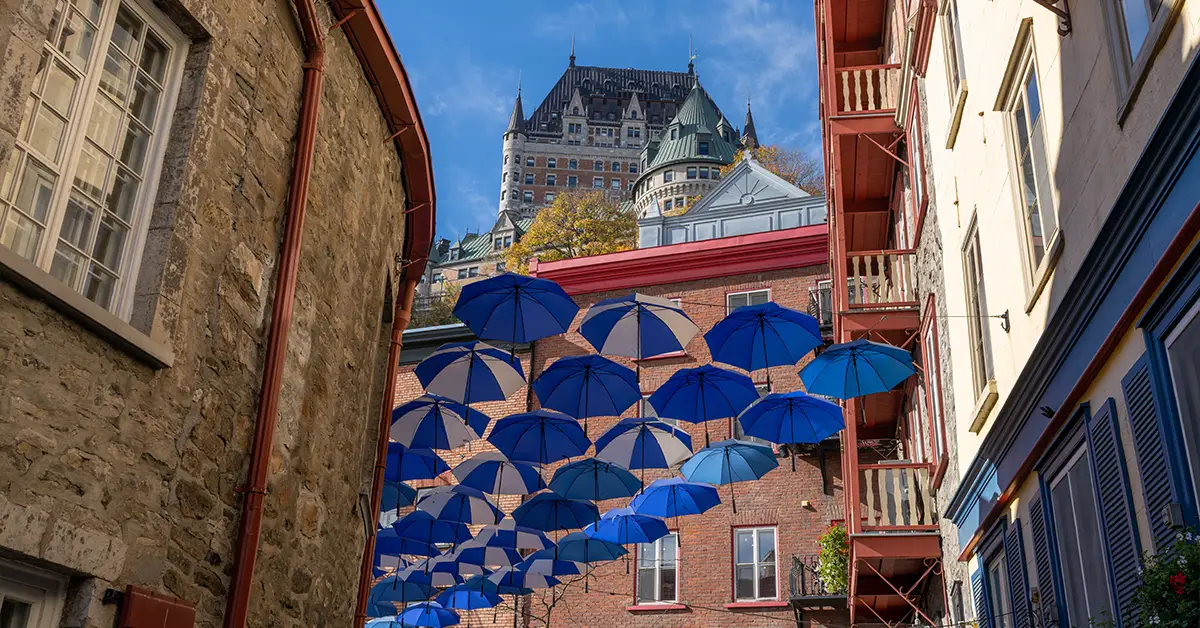
Quebec’s architecture and urban heritage are vivid evidence of the province’s four centuries of history. Vieux-Québec (Old Quebec) was designated byUNESCOa World Heritage Site on 3/12/1985, and is the only city in North America north of Mexico still retaining its complete system of walls.
The Vieux-Québec heritage district covers 135 hectares, comprising Upper Town (Haute-Ville) on the clifftop with its religious and administrative buildings, and Lower Town (Basse-Ville) at the foot of the cliff with its narrow old streets. The Château Frontenac — a hotel built in the late 19th century in the French Renaissance château style — is one of the most photographed buildings in the world.
Vieux-Montréal (Old Montreal) is Montreal’s historic quarter, preserving buildings from the 17th to the 19th centuries. The Notre-Dame Basilica of Montreal, built in 1824 in the Gothic Revival style, is one of the most beautiful churches in North America.
Quebec’s rural architecture also has its own identity in the traditional curved-roof houses (maison québécoise) — steeply pitched roofs with a characteristic curved eave to shed snow easily, and thick stone walls to retain warmth through the long winter.
Media and the cultural industries
Francophone media in Quebec are strong and independent. Radio-Canada, the French-language arm of the Canadian Broadcasting Corporation, is the region’s largest public television and radio broadcaster. Private channels such as TVA and Télé-Québec serve the domestic audience with content produced almost entirely in French.
In print, La Presse — a daily dating from 1884 and now moved to a free digital model — and Le Devoir — a daily founded in 1910 by the journalist Henri Bourassa, with a tradition of criticism and independence — are the two most respected newspapers. Le Journal de Montréal, Quebec’s largest popular newspaper, has the highest circulation of any French-language newspaper outside France.
Quebec’s cultural industries — including film, television, music, books, video games and the performing arts — contribute significantly to the province’s GDP and create tens of thousands of high-quality jobs. International video game companies such as Ubisoft, Electronic Arts and Warner Bros. Games all have large studios in Montreal and Quebec City, making the region one of the world’s leading game development centres.
Conclusion
Quebec culture is the crystallisation of more than four centuries of Francophone history in North America. This culture has been nourished by a harsh climate, political and social movements and the continuous creative energy of the local community.
From Quebec French with its distinctive features, to the literature of Tremblay and Roy, the music of Dion and Leonard Cohen, the cinema of Villeneuve and Dolan, the circus of Cirque du Soleil, the food of poutine and maple syrup, through to the UNESCO-listed architectural heritage of Vieux-Québec — all combine into a culture of exceptional standing. Quebec has not dissolved into the English-speaking current of North America but has kept a strong character of its own.
For those considering migrating, investing or simply learning about Quebec, grasping the local culture is an essential first step. Life in Quebec means entering a many-layered society: a combination of European style and North American openness, of Roman Catholic tradition and modern secularism, of conservative French and global creativity.
Accompanying you on your journey in residency investment
The Prosperous Living Investment team advises on pathways, assesses profiles and manages investments transparently for every residency, citizenship and international property objective.
Free profile assessmentWhere life gets prosperous