

Quebec’s politics are the most distinctive in Canada, where the British Westminster parliamentary system operates in French with a political identity no other province has. As the only French-speaking province in North America,Quebechas developed a distinctive multi-party system in which the key question dividing the parties is not left versus right in the traditional sense, but sovereignty versus federalism.
This article sets out in detail the structure of the Quebec government, the 125-seat National Assembly, the multi-party system with its four main forces, the historical sovereignty movement, and the current political context heading into the general election of 05/10/2026 – an election regarded as capable of reshaping the province’s politics for years to come.
Message
The system of government and legal standing
Quebec is a province of Canada, operating within a federal system with considerable autonomy. The province operates as a constitutional monarchy and parliamentary democracy, inheriting the Westminster model from the United Kingdom but applying it in French with the French civil law tradition.
The constitutional head of state is King Charles III – the Sovereign of Canada, represented in Quebec by the Lieutenant Governor. The Lieutenant Governor performs formal ceremonial functions such as granting royal assent to legislation and appointing the Premier, but actual power lies with the elected government.
Quebec has two distinctive legal features compared with the other provinces:
- French civil law: Quebec is the only province applying a Civil Code (the Code civil du Québec) in the Roman-French tradition, while the other provinces use English common law. Criminal law still follows the common federal system.
- Recognition of national identity: in 2006, the Parliament of Canada passed a resolution recognising that “the Québécois form a nation within a united Canada”.
Considering a residency programme? The Prosperous Living Investment team assesses your profile free of charge and advises on the pathway that fits your goals.
The National Assembly of Quebec
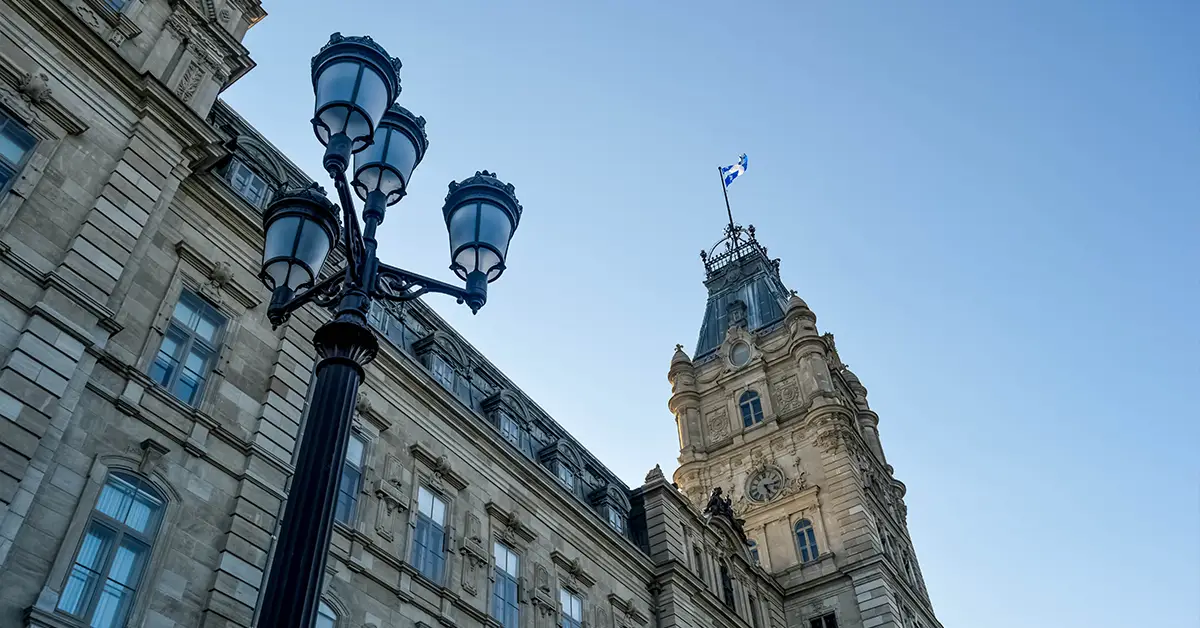
The National Assembly of Quebec (Assemblée nationale du Québec) is the province’s sole legislative body, sitting in the Parliament Building in Quebec City. It is one of the few unicameral legislatures in Canada – the Quebec Legislative Council was abolished in 1968.
Structure
The National Assembly of Quebec has 125 seats, whose holders are called Members of the National Assembly (MNAs, or Députés). Each MNA represents an electoral district (circonscription électorale) under the first-past-the-post system.
The Assembly’s maximum term is 5 years. Under the Quebec Election Act as amended in 2013, ordinary elections take place on the first Monday in October, four years after the previous election.
Powers
The National Assembly of Quebec has legislative competence in the areas the Canadian Constitution assigns to the provinces, including:
- Education (the whole system from primary to university)
- Health and social services
- Civil law and civil justice
- Natural resources and land
- Municipal government
- Language (French as the official language)
- Culture and heritage
- Immigration (under a separate agreement with the federal government)
The National Assembly of Quebec also has a special power compared with other provinces: immigration policy is managed under the Canada–Quebec Accord on Immigration of 1991, allowing Quebec to select most economic immigration candidates itself through theQuebec Selection Certificate (CSQ).
The government and the Premier
The Government of Quebec is headed by the Premier (Premier ministre du Québec). The Premier is usually the leader of the party holding a majority of seats in the National Assembly, appointed by the Lieutenant Governor after each election.
The Quebec Cabinet (Conseil des ministres) comprises ministers the Premier selects from the governing party’s MNAs. The main ministries are Finance, Education and Higher Education, Health and Social Services, Justice, Economy and Innovation, Immigration and Francisation, and Culture.
The current Premier
As at April 2026, the Premier of Quebec is Christine Fréchette of the Coalition Avenir Québec (CAQ). She is the second female Premier in Quebec’s history and won the CAQ leadership election held from 07 to 12/04/2026 with more than 57% of the vote, defeating her rival Bernard Drainville.
Ms Fréchette succeeded François Legault – who founded the CAQ in 2011 and led the party to two consecutive majority victories in 2018 and 2022. Mr Legault announced his resignation on 14/01/2026 after a sharp fall in support, ahead of the general election in October 2026.
The four main parties in the National Assembly
Quebec’s political system currently has four main parties with seats in the National Assembly, each representing a different ideological tendency.
Coalition Avenir Québec (CAQ)
The Coalition Avenir Québec is the current governing party, founded in 2011 by François Legault. The CAQ positions itself as a moderate nationalist and autonomist party, supporting greater powers for Quebec within the Confederation but not seeking to separate from Canada.
On economic ideology, the CAQ leans centre-right – supporting a market economy, lower taxes and a smaller administrative machine. Socially, the CAQ leans culturally conservative, supporting strong policies to protect French and limits on immigration.
The CAQ’s greatest achievements under Legault include Bill 21 (banning religious symbols in the public sector) and Bill 96 (strengthening the Charter of the French Language). However, since late 2023, CAQ support has fallen sharply because of controversies over public services, the SAAQclic affair and the failure of the Northvolt project.
The CAQ currently holds around 79 of the 125 seats in the National Assembly (down from 90 seats in 2022).
Parti Québécois (PQ)
The Parti Québécois is the most important historic party in Quebec’s sovereignty movement. Founded in 1968 by René Lévesque, the PQ advocates Quebec’s independence from Canada.
The PQ has governed Quebec three times (1976–1985, 1994–2003, 2012–2014) and held two referendums on sovereignty in 1980 and 1995 – both narrowly lost.
On the economy, the PQ leans centre-left – supporting a strong welfare state, a large public sector and economic intervention. Culturally, the PQ strongly defends the French language and Quebec identity.
The PQ is currently led by Paul St-Pierre Plamondon, and on polls in early 2026 the PQ leads on support and has a strong chance of winning the October 2026 election.
The Quebec Liberal Party (PLQ)
The Quebec Liberal Party (Parti libéral du Québec – PLQ) is Quebec’s oldest party, with origins in the 19th century. The PLQ is federalist, supporting Quebec remaining within Canada.
The PLQ has governed for many terms in its history, particularly under Jean Lesage (1960–1966) – who launched the Quiet Revolution – and under Jean Charest (2003–2012) and Philippe Couillard (2014–2018). The PLQ has a strong base in urban Montreal and in the English-speaking community.
However, the PLQ has been through a period of record weakness: at the 2022 election, the party received only 14.4% of the popular vote – the lowest in its history. The party currently holds around 19 seats and is in a period of leadership restructuring.
Québec Solidaire (QS)
Québec Solidaire, founded in 2006, is the only radical left party in the National Assembly of Quebec. QS is democratic socialist, feminist and environmentalist, and supports independence for Quebec.
A distinctive feature of QS is its model of two co-spokespersons rather than a single leader – reflecting its commitment to gender equality. Its support base is mainly urban young people, intellectuals and Montreal districts.
QS currently has around 11 seats in the National Assembly, with a strong base in central Montreal.
Parti conservateur du Québec (PCQ)
Beyond the four main parties above, the Conservative Party of Quebec (Parti conservateur du Québec – PCQ) rose significantly at the 2022 election with 12.9% of the popular vote although it won no seats. The party is populist conservative and economically liberal, led by Éric Duhaime.
The national question and the sovereignty movement
The National Question (Question nationale) has been the central theme running through Quebec politics for more than half a century. It is the debate over Quebec’s future standing: should it stay within Canada with broader autonomy, or become an independent country?
Quebec’s political parties are usually divided by this question rather than along a left-right axis:
- Sovereigntist parties: the Parti Québécois, Québec Solidaire
- Autonomist parties: the Coalition Avenir Québec
- Federalist parties: the Quebec Liberal Party, the Parti conservateur du Québec
According to material fromThe Canadian Encyclopedia, the sovereignty movement has held two formal referendums:
- The 1980 referendum: the “No” side won with 59.56%, the “Yes” side received only 40.44%
- The 1995 referendum: the “No” side won narrowly with 50.58%, the “Yes” side received 49.42%, a margin of fewer than 55,000 votes
After 1995, the sovereignty movement declined considerably. Recent polls show support for independence ranging from 30% to 40%, not enough for the PQ or QS to hold a new referendum in the near future. However, the national question remains the key factor shaping Quebec politics.
Distinctive laws and policies
Quebec has passed many distinctive laws reflecting its own political identity:
The Charter of the French Language (Bill 101)
Passed in 1977 under Premier René Lévesque, Bill 101 – the Charter of the French Language – made French the sole official language of administration, the courts, commerce, education and the workplace in Quebec. The Act was substantially amended in 2022 by Bill 96, extending the requirement to use French across more fields.
Bill 21 on secularism
Passed in 2019 under Premier Legault, Bill 21 on the Laicity of the State prohibits public officials in positions of authority (judges, police officers, teachers, prosecutors and so on) from wearing religious symbols at work. The Act has been highly controversial because it affects Muslim women wearing the hijab, Sikhs wearing the turban and Jews wearing the kippah.
In April 2026, the CAQ government passed Bill 9, extending the scope of Bill 21. Both Acts invoke the “notwithstanding clause” of the Canadian Constitution to avoid legal challenge under the Canadian Charter of Rights and Freedoms.
Powers over immigration
Under the Canada–Quebec Accord on Immigration of 1991, Quebec is the only province with the power to select most economic immigration candidates itself. The province runs theQuebec entrepreneur programme, the Quebec Skilled Worker Program (PRTQ) and many other programmes independently of the federal Express Entry system.
Local administration
Quebec has three administrative levels:
- Provincial level: the National Assembly and the Government of Quebec
- Regional level: 17 administrative regions (régions administratives) with no government of their own – serving statistical and planning purposes only
- Local level: around 1,100 municipalities and cities
Major cities have their own city government with a directly elected mayor (maire) and city council. Montreal is the largest city with more than 1.7 million inhabitants, divided into 19 boroughs (arrondissements) with a degree of self-government.
The 2026 general election
The next Quebec general election takes place on 05/10/2026. This election is regarded as a turning point for several reasons:
- It is the first election since Legault’s resignation, with the CAQ under a new leader (Christine Fréchette)
- Polls in early 2026 show the PQ leading with the possibility of forming a majority government – for the first time in more than 20 years
- CAQ support has fallen to only 8–10% on several polls
- Where the PQ wins, there may be a third referendum on sovereignty – although PQ leader Paul St-Pierre Plamondon has repeatedly been cautious on this
The election will focus on three main themes: the economy and the cost of living, immigration and identity, and the future of Quebec’s public health and education systems.
Conclusion
Quebec’s politics are a distinctive combination of the British Westminster parliamentary system and a French-Catholic political tradition, with an identity of its own no other Canadian province has. The multi-party system revolves around a sovereignty-federalism axis rather than a purely left-right one, with four main parties — the Coalition Avenir Québec, the Parti Québécois, the Quebec Liberal Party and Québec Solidaire — together with several smaller parties. The 125-seat National Assembly in Quebec City is a legislature with broad powers, particularly in language, education, health and immigration.
Understanding Quebec’s politics helps grasp why the province has its own civil law system, an immigration policy shared with the federal government, and cultural and linguistic characteristics protected by special legislation. For Vietnamese readers interested inCanadian citizenshipor consideringsettling in Canada, understanding Quebec politics is an important basis for assessing the living environment, the distinctive immigration policy and the economic and social opportunities in this exceptional province.
Accompanying you on your journey in residency investment
The Prosperous Living Investment team advises on pathways, assesses profiles and manages investments transparently for every residency, citizenship and international property objective.
Free profile assessmentWhere life gets prosperous