


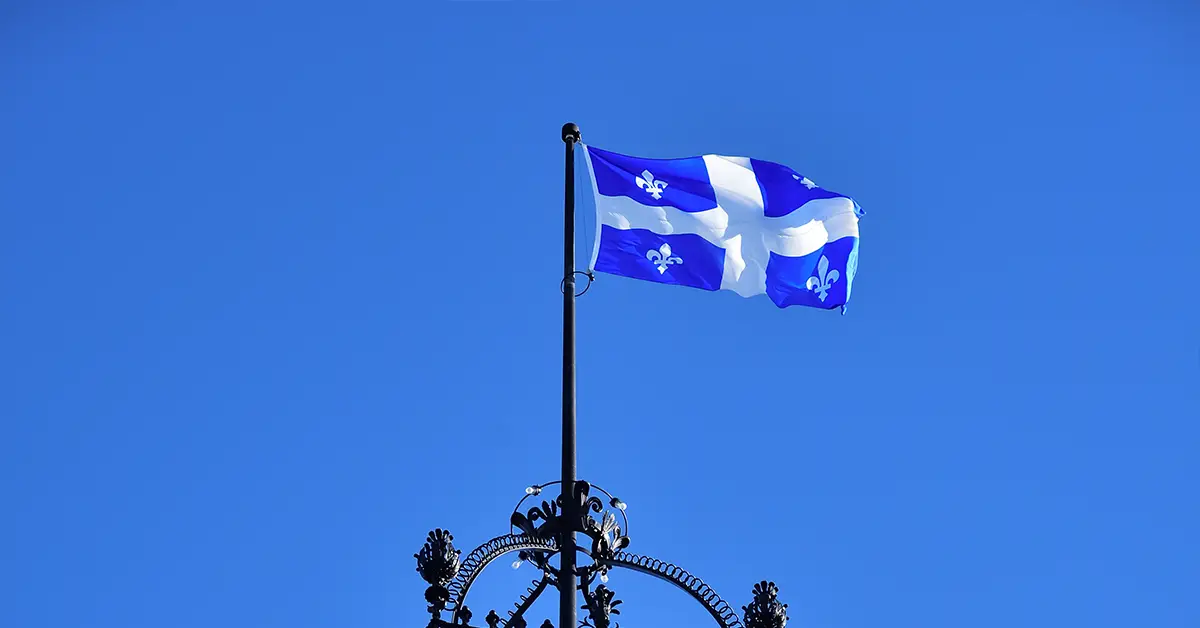
Quebec’s history stretches back more than four centuries, since Samuel de Champlain founded Quebec City in 1608, making it the first permanent French settlement in North America. From the vibrant colony of New France through the British conquest of 1763, to the Quiet Revolution of the 1960s and the two independence referendums of 1980 and 1995, Quebec has always held a special place in Canada’s development.
This article sets out in detail the main stages of development in Quebec’s history, from the pre-colonial period with its First Nation inhabitants to the profound changes of the 20th century, helping readers better understand the distinctive identity of Canada’s only French-speaking province.
A detailed article onthe province of Quebec.
Message
The pre-colonial period
Before Europeans arrived, the land that is nowQuebechad long been home to many First Nation Indigenous peoples. The largest groups were the Algonquin, Huron, Montagnais (Innu), Mi’kmaq and Iroquois, each with its own territory, language and culture.
These peoples had developed extensive trade networks along the St. Lawrence valley and the Great Lakes region thousands of years before Europeans appeared. The St. Lawrence River – called “Magtogoek” by Indigenous people – was the region’s main transport and economic artery.
The French explorer Jacques Cartier was one of the first Europeans to explore this land. He made three voyages, in 1534, 1535–1536 and 1541–1542, travelling deep up the St. Lawrence River and making contact with the Indigenous villages of Stadacona (now Quebec City) and Hochelaga (now Montreal). Cartier was the first to give this land the name “Canada”, from the Iroquois word “kanata”, meaning “village”.
However, French attempts to establish permanent settlements in the 16th century all failed because of the harsh climate, disease and conflict with Indigenous people. It was not until the early 17th century that France truly laid the foundations for a colony in North America.
Considering a residency programme? The Prosperous Living Investment team assesses your profile free of charge and advises on the pathway that fits your goals.
The founding of Quebec City and New France (1608–1663)
On 03/07/1608, the French explorer Samuel de Champlain arrived at the foot of Cap Diamant on the St. Lawrence River and founded a trading settlement of 28 people. The settlement was named “Quebec” – from the Algonquin word “kebec” meaning “where the river narrows”.
Theo The Canadian Encyclopedia, Champlain is known as the “Father of New France” for his important role in establishing and governing the colony from 1603 until his death in 1635. Beyond founding Quebec City, Champlain also established a settlement at Trois-Rivières in 1634 and built alliances with the Algonquin, Huron and Montagnais Indigenous peoples.
The first winter at Quebec was extremely harsh. Of the 28 people who arrived initially, only 9 survived the winter because of scurvy and cold. However, relief parties continued to arrive in the summer of 1609, and the colony gradually grew.
By 1630, New France had only 103 inhabitants. This rose to 355 by 1640, but population growth was slow because of the harsh living conditions, epidemics and conflict with the Iroquois. The city of Montreal was founded in 1642 under the name Ville-Marie, becoming a second commercial and missionary centre.
During this period, the main economy was the fur trade – particularly beaver fur for the European market. Indigenous peoples played a key role in trapping and transporting furs to the French trading posts.
A royal colony and expansion (1663–1763)
In 1663, King Louis XIV of France transformed New France from a colony run by a private company into a royal colony under the Crown. This decision marked an important turning point in the colony’s expansion and consolidation.
Jean Talon – the first intendant of New France from 1665 to 1672 – pursued a policy of encouraging large-scale immigration. The “Filles du Roi” (King’s Daughters) programme brought around 800 young women from France to New France between 1663 and 1673 to marry the settlers, helping the colony’s population grow quickly.
The seigneurial system was established, dividing land along the St. Lawrence River into narrow, long strips so that every holding fronted onto the river – the main means of transport. This system lasted until 1854 and left its mark on Quebec’s land use patterns to this day.
New France’s population rose from around 3,000 in 1663 to around 70,000 by 1760. Although still modest compared with Britain’s 13 colonies to the south (1.5 million), New France controlled a vast territory stretching from Hudson Bay to the Gulf of Mexico, through the St. Lawrence valley, the Great Lakes region and the Mississippi valley.
The British conquest (1759–1763)
The 18th century saw continuous wars between Britain and France in North America. The culmination was the Seven Years’ War (1756–1763), in which the decisive engagement was the Battle of the Plains of Abraham on 13/09/1759.
In this battle, the British army under the command of General James Wolfe defeated the French under the Marquis de Montcalm on the outskirts of Quebec City. Both generals died in this battle, which lasted less than an hour. After the battle, the British took Quebec City.
In 1760, Montreal fell, and France lost all of New France. The Treaty of Paris of 1763 formally transferred Canada (including today’s Quebec) from France to Britain. Around 70,000 French-descended inhabitants – later known as the Canadiens – suddenly became subjects of the British Empire.
The Quebec Act 1774 and the British period (1763–1867)
Initially, the British authorities sought to assimilate the French-descended population through the Royal Proclamation of 1763. However, under pressure from the revolutions emerging in the 13 colonies to the south, Britain changed strategy.
The Quebec Act of 1774 was a landmark piece of legislation. This Act recognised:
- Freedom of religion for Catholics (the majority in Quebec)
- The continued application of French civil law alongside English criminal law
- The maintenance of the seigneurial system
- The extension of Quebec’s territory to the Great Lakes and the Ohio valley
The Quebec Act helped the British authorities keep the loyalty of the French-descended population when the American Revolution broke out in 1776. Quebec did not join the United States and remained loyal to the British Empire.
After the American Revolution, around 40,000 Loyalists (loyal to Britain) fled from the United States to Canada, many of them settling in Quebec. This led to the Constitutional Act of 1791, dividing Quebec into Upper Canada (now Ontario, mainly English-speaking) and Lower Canada (now Quebec, mainly French-speaking), each with its own legislative assembly.
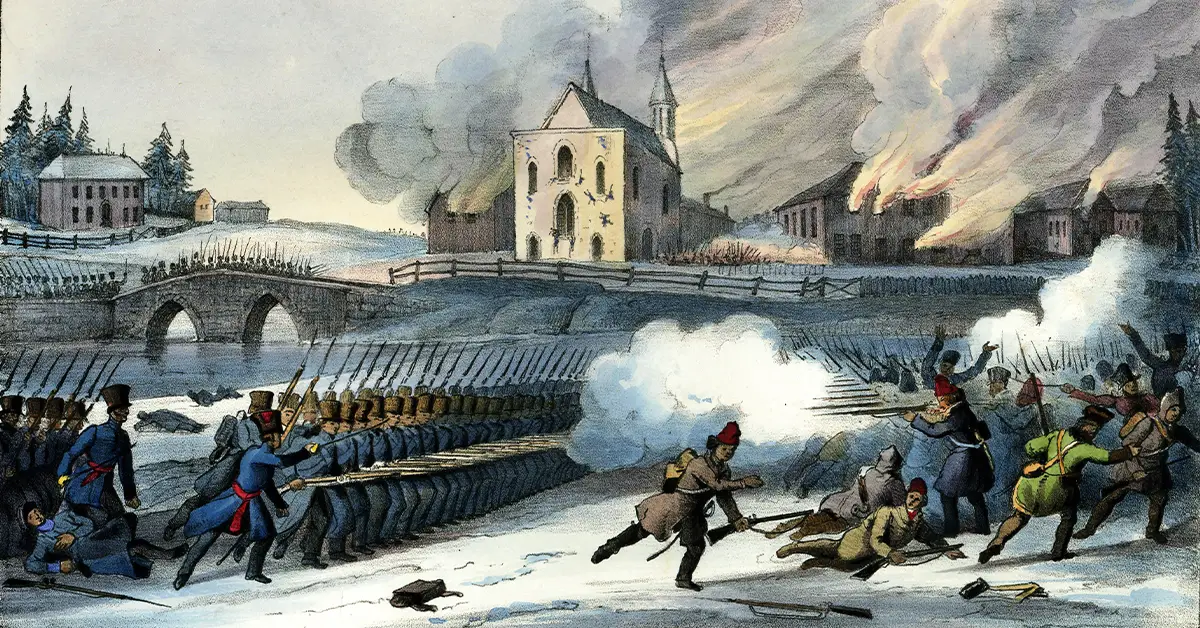
The rebellions of 1837–1838 in Lower Canada under the leadership of Louis-Joseph Papineau reflected the grievances of the French-descended population against the British colonial administration. The rebellions were suppressed, but led to the Durham Report of 1839 and ultimately to the Act of Union of 1840 merging Upper and Lower Canada into the Province of Canada.
The Canadian Confederation and the 19th century (1867–1900)
On 01/07/1867, the British North America Act took effect, giving birth to the Dominion of Canada. Quebec became one of the four founding provinces of the Canadian Confederation, together with Ontario, New Brunswick and Nova Scotia.
The federal system guaranteed Quebec autonomy in key areas such as education, culture, civil justice and language. This helped Quebec maintain a French-Catholic identity distinct from the rest of Canada over the following century.
In the late 19th and early 20th centuries, Quebec underwent rapid industrialisation, particularly in Montreal – then Canada’s largest economic city. The textile, tobacco, food and footwear industries grew quickly, drawing rural workers into the cities.
However, economic control lay mainly in the hands of the English-speaking community, while the French-descended majority worked in the factories on lower wages. This linguistic and economic divide laid the foundations for social tensions in the 20th century.
Maurice Duplessis and the Great Darkness (1936–1959)
From 1936 to 1959 (with a break from 1939 to 1944), Quebec was dominated by Maurice Duplessis and his Union Nationale party. This period is known as the “Great Darkness” (Grande Noirceur) because of its conservative, authoritarian policies and the excessive dominance of the Catholic Church over education, health and social life.
Duplessis fostered close relations with the Church, suppressed union and opposition movements, and refused to co-operate with the federal government on many programmes. During this period, illiteracy in Quebec was considerably higher than in Ontario, the education system was outdated and the economy dependent on foreign investment.
Duplessis’s death in 1959 opened the way to an entirely new period in Quebec’s history.
The Quiet Revolution (1960–1970)
The Quiet Revolution (Révolution tranquille) was the most profound period of transformation in modern Quebec history. Beginning in 1960 when the Quebec Liberal Party under Jean Lesage won the election with the slogan “Maîtres chez nous” (Masters in our own house), this period ran to around 1970 and transformed Quebec from a traditional, conservative Catholic society into a modern, secular one.
The major changes of the Quiet Revolution were:
- The secularisation of society: the Catholic Church lost control of education, health and social services. The provincial government took over schools, hospitals and welfare institutions.
- The modernisation of education: the creation of a Ministry of Education in 1964, the building of the CEGEP system (Collège d’enseignement général et professionnel) and the expansion of the Université du Québec.
- The nationalisation of electricity: the merger of private electricity companies into Hydro-Québec in 1963, making it one of the largest public electricity companies in North America.
- Reform of employment law and social welfare: the recognition of union rights and the creation of the Quebec Pension Plan (RRQ).
- The assertion of French culture: promoting the use of French in administration, education and public life.
The Quiet Revolution also created the conditions for the rise of modern Quebec nationalism and the independence movement.
The sovereignty movement and the 1980 referendum
In October 1970, Quebec fell into the October Crisis, when the Front de libération du Québec (FLQ) – an armed group seeking independence – kidnapped the British trade commissioner James Cross and Quebec Labour Minister Pierre Laporte. Laporte was murdered. Federal Prime Minister Pierre Elliott Trudeau invoked the War Measures Act, deployed troops in Quebec and detained hundreds of people.
This crisis pushed the independence movement towards moderate democratic means. In 1968, René Lévesque – a former minister in the Lesage government – founded the Parti Québécois (PQ) with the aim of achieving independence for Quebec through the ballot box.
The Parti Québécois won the election in 1976, making Lévesque Premier. The very next year, the PQ enacted Bill 101 – the Charter of the French Language – making French the official language of administration, the courts, commerce, the workplace and education in Quebec. This Bill restricted the right to attend English schools and limited the use of English on public signage.
On 20/05/1980, Quebec held its first referendum on sovereignty-association with Canada. The question put to voters was whether to give the PQ government a mandate to negotiate a new agreement with Canada on a model of two states with linked economic relations.
The result: the “No” side won with 59.56% of the vote, while the “Yes” side received only 40.44%. Federal Prime Minister Pierre Trudeau and Quebec Liberal leader Claude Ryan, who led the opposing campaign, successfully persuaded a majority of Quebecers to stay within Canada.
The Constitution Act 1982 and the 1995 referendum
After the independence side’s defeat in 1980, Prime Minister Pierre Trudeau pressed ahead with patriating the Canadian Constitution from Britain. The Constitution Act of 1982 was passed with the Canadian Charter of Rights and Freedoms. However, Quebec – the only province not to sign the Constitution Act – held that the province had been excluded from that negotiating process.
Attempts at reconciliation included the Meech Lake Accord (1987–1990) and the Charlottetown Accord (1992). Both failed, with Charlottetown rejected in a national referendum by 55–45.
In October 1995, the Parti Québécois under Jacques Parizeau held a second referendum on sovereignty. The question this time was more direct, proposing that Quebec become an independent country with an optional economic and political partnership with Canada.
The result: the “No” side won only narrowly with 50.58% of the vote, while the “Yes” side received 49.42%. Turnout reached 93.52% – the highest in Quebec electoral history. A margin of fewer than 55,000 votes out of nearly 5 million voters left Canada on the brink of breaking up.
After the referendum, the federal government passed the Clarity Act in 2000, providing that any future secession referendum must have a clear question and a clear majority to be recognised.

Quebec in the 21st century
From 1995 to the present, the Quebec independence movement has declined considerably, although it remains an important part of local politics. The Parti Québécois has lost its dominant position to emerging parties such as the Coalition Avenir Québec (CAQ) – a nationalist but non-separatist party led by François Legault.
The Parliament of Canada in 2006 passed a resolution recognising that “the Québécois form a nation within a united Canada”, acknowledging Quebec’s distinct identity without opening the way to secession.
Quebec continues to maintain policies protecting the French language and its own culture, including Bill 21 of 2019 (restricting religious symbols in the public sector) and Bill 96 of 2022 (strengthening the position of French). These policies remain a subject of debate inside and outside the province.
On the economy, Quebec is now Canada’s second largest economy after Ontario, with GDP of more than CAD 500 billion. Montreal has become an important North American centre for technology, aerospace, artificial intelligence and video games.
Conclusion
Quebec’s history is the story of a people continuously asserting its identity – from the small colony of New France under Louis XIV, through the British conquest and survival as a linguistic and cultural minority for nearly two centuries, to the Quiet Revolution that turned the province into a modern self-governing society, and finally two knife-edge referendums on the nation’s future. Throughout this journey, Quebec has always held firm to a distinctive French-Catholic-North American identity found nowhere else in the world.
Accompanying you on your journey in residency investment
The Prosperous Living Investment team advises on pathways, assesses profiles and manages investments transparently for every residency, citizenship and international property objective.
Free profile assessmentWhere life gets prosperous