

Swiss politics

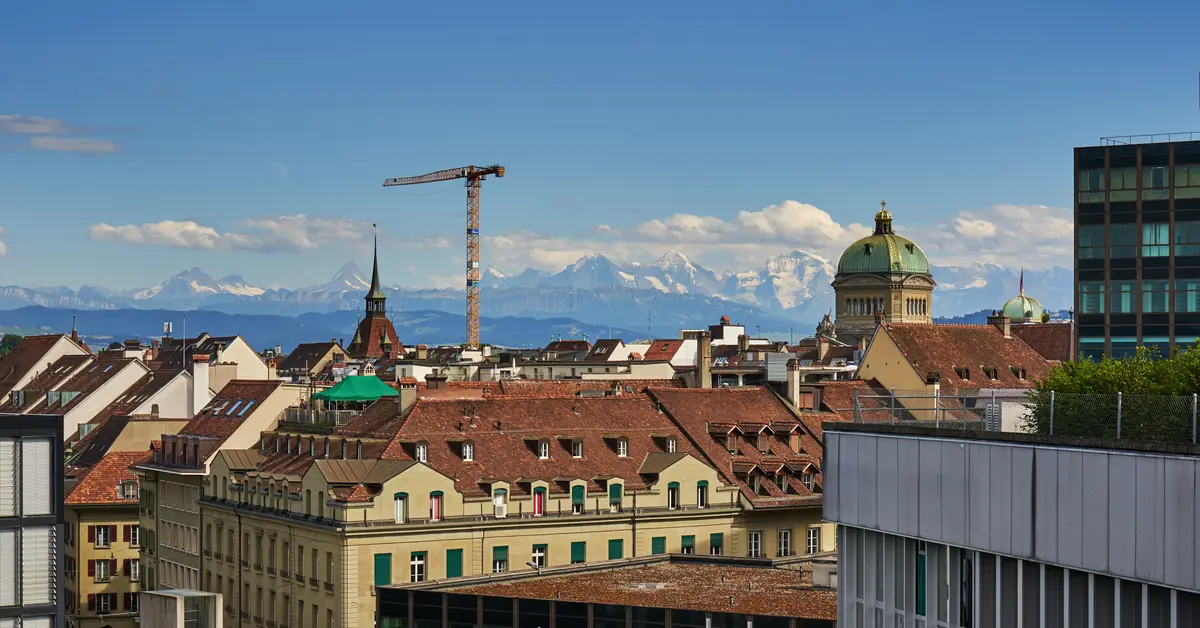
Swiss politics is built on a rare model: a federal state comprising 26 highly autonomous cantons, combining direct democracy with a seven-member collective executive. This article objectively outlines the institutional structure of the nation whose capital is Bern (Berne), where power is decentralised both vertically and horizontally.
Contents
Overview of Swiss politics
When discussing Swiss politics, the most obvious feature is the decentralisation of power. Rather than concentrating in a single individual or centre, the system is designed to share power across multiple levels and bodies. This reflects the country’s long historical emergence from an alliance of self-governing communities.
The Swiss state is a confederation (Confoederatio Helvetica, abbreviated as CH). Its official name in Latin explains why the country’s number plates and national code use CH. The federal model is based on the principle that the cantons retain most of the authority, while the central government handles only those areas entrusted to it by the Constitution.
Alongside the federal structure, two other features defining the system’s identity are direct democracy and the consensus principle. Citizens can participate in deciding many issues through voting, while decisions at the top level are typically sought through broad compromise among political forces and linguistic regions.
To fully understand the context of this system, it can be viewed within the broader framework of Switzerland with its landlocked geography, multilingualism and long tradition of neutrality. These factors have shaped how power is organised and operated.
Considering a residency programme? The Prosperous Living Investment team assesses your profile free of charge and advises on the pathway that fits your goals.
The federal state and 26 autonomous cantons
Switzerland consists of 26 cantons, called Kanton in German and canton in French. Each canton has its own constitution, parliament, government and courts, provided they do not conflict with the Federal Constitution. The degree of cantonal autonomy is considered high compared to many other federations around the world.
The fundamental principle is that default authority rests with the cantons. The federal government only exercises powers explicitly granted by the Constitution, such as foreign policy, defence, currency and customs. Areas not specified fall under cantonal jurisdiction, adhering to strict decentralisation.
As a result, many areas directly affecting daily life, such as healthcare, policing, certain taxes and especially education, are managed primarily at the cantonal level. This is why policies can vary significantly between cantons, from tax rates to administrative regulations.
Below the cantonal level are the municipalities (commune, Gemeinde), the basic units of local government. Municipalities also enjoy considerable self-governance within their jurisdiction. Thus, the Swiss state machinery operates across three levels: federal, cantonal and municipal, with relatively clear division of authority among levels.
This vertical model of decentralisation has deep roots in Swiss history, as the nation gradually formed from alliances of self-governing communities and territories over centuries. That tradition remains preserved in the modern structure.
Direct democracy: referendum and popular initiative
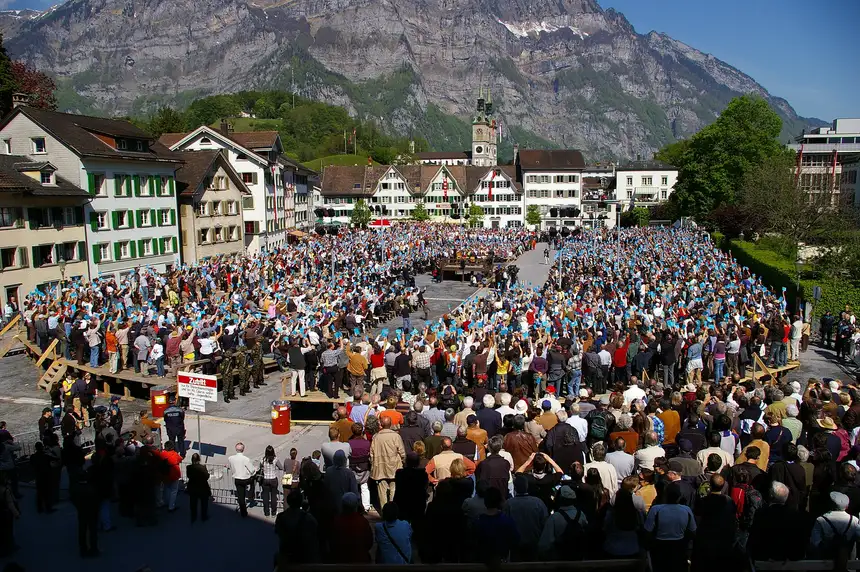
The feature that makes Swiss politics most widely discussed is direct democracy. Besides electing representatives, citizens also have the right to decide specific issues directly through popular votes held regularly several times a year. This represents a level of direct participation rarely seen in standard representative democracies.
The first tool is the referendum. Certain major changes, such as constitutional amendments or joining select international organisations, must be submitted to a mandatory referendum. There is also the optional referendum: if a group of citizens gathers enough signatures within the prescribed period, a law passed by Parliament can be put to a nationwide vote.
The second tool is the popular initiative. Through an initiative, citizens can propose amendments to the Federal Constitution. If the initiating group collects enough valid signatures within the statutory deadline, the proposal will be put to a national vote, regardless of whether the government and Parliament support it.
To be passed in votes concerning the Constitution, many proposals must meet the double majority rule: winning both a majority of voters nationwide and a majority of cantons. This mechanism ensures that small and sparsely populated cantons maintain a balanced voice compared to populous ones.
The consequence of direct democracy is that decision-making is often slow and cautious, requiring a broad consensus. In return, decisions once passed carry high legitimacy as they have undergone voter scrutiny. Citizens are thus accustomed to voting regularly on a wide variety of topics.
- Mandatory referendum: applies to constitutional amendments and key national issues.
- Optional referendum: voters can demand a vote on a law if sufficient signatures are collected.
- Popular initiative: allows citizens to propose amendments to the Federal Constitution.
- Double majority: many constitutional issues require both a majority of nationwide voters and a majority of cantons.
The Federal Council: collective executive body
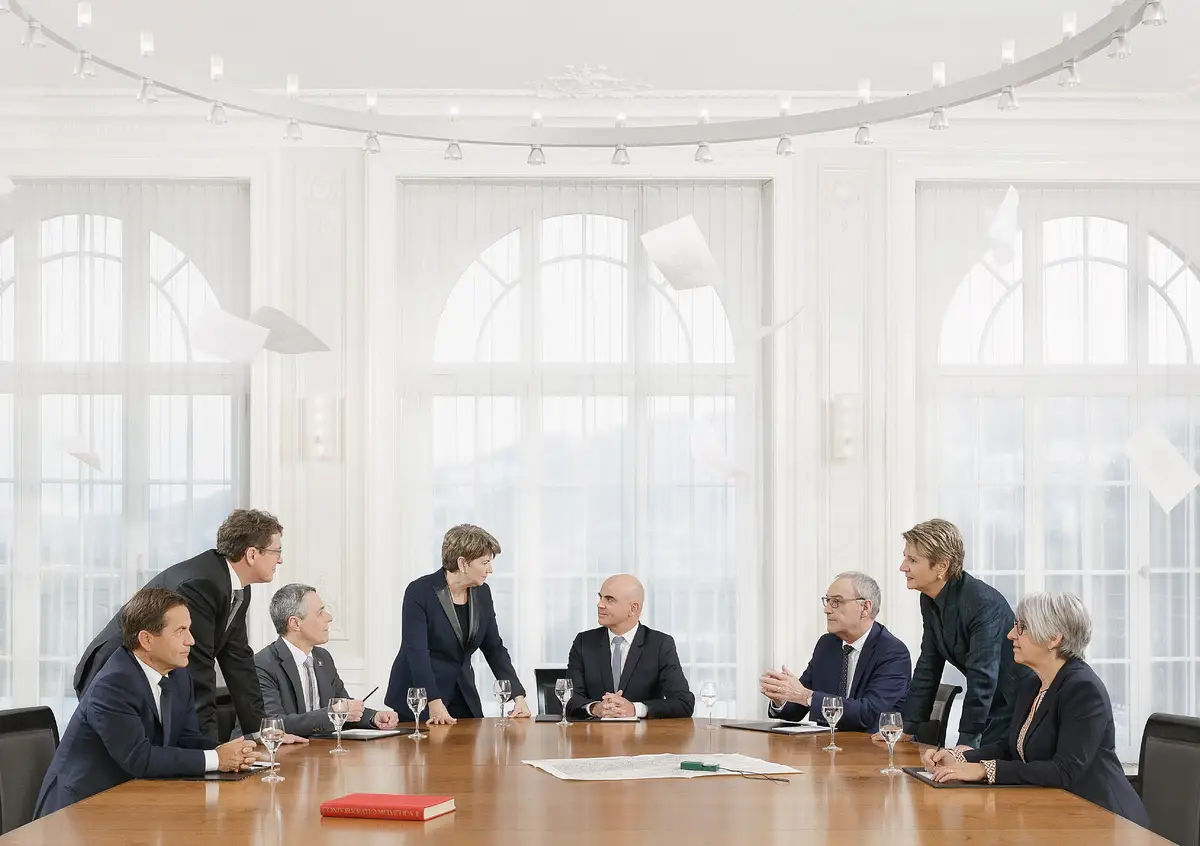
The highest federal executive body is the Federal Council (German: Bundesrat, French: Conseil fédéral). This is a council of seven members who collectively govern the country. There is no prime minister or president holding supreme executive power as in other countries.
The seven members are elected by Parliament, with each heading a department of the federal government. Although managing their respective fields, key government decisions are made collectively. This principle is closely linked to a culture of consensus, in which members share responsibility for the overall executive direction.
The composition of the Federal Council typically reflects a balance among major political parties as well as linguistic regions and geographical areas. Allocating seats to reconcile multiple forces is considered part of Swiss political tradition to ensure broad representation.
The collective organisation of the executive helps minimise the concentration of power in a single individual. It also fosters stability and continuity in governance, as general policy relies less on the fortunes of one person and more on agreement among several members.
The ceremonial rotating presidency
A common point of confusion for foreigners is the post of President of the Confederation. Unlike in many countries, the Swiss President is not a head of state with overarching power, but rather one of the seven members of the Federal Council chosen to act as presiding officer for one year.
The position rotates annually among the council members. The individual holding the presidency is considered the nominal head, presiding over Federal Council meetings and representing the country on certain ceremonial and foreign occasions. This role is often described as first among equals.
Crucially, the President has no additional substantive power compared to the remaining six members regarding government decisions. The President’s vote remains equal to those of colleagues. Therefore, the annual change of title has virtually no impact on the overall direction of governance.
The ceremonial, rotating presidency aligns with the spirit of decentralised power. It emphasises that executive power rests with a collective of seven individuals rather than a single person, thereby reinforcing the stability and consensus of the system.
Switzerland’s bicameral Parliament
The federal legislative body is the Federal Assembly, organised on a bicameral model. The two chambers hold equal status and jointly participate in the legislative process. This structure reflects a balance between representation based on population and representation based on cantons.
The first chamber is the National Council (National Council; Nationalrat, Conseil national), representing the entire population. Seats are allocated to the cantons in proportion to population, so more populous cantons have more representatives. This chamber directly reflects the population size of each region.
The second chamber is the Council of States (Council of States; Ständerat, Conseil des États), representing the cantons. In principle, each canton has an equal number of representatives regardless of population, whilst some half-cantons historically have only half the number of seats. This mechanism ensures that smaller cantons retain a balanced weight.
A bill must usually be passed by both chambers with identical text to come into effect. When the two chambers disagree, a reconciliation procedure resolves the differences between them. This bicameral system of equal powers helps compel the parties to negotiate and seek compromise.
When meeting jointly, the two chambers form the Federal Assembly to carry out specific duties, such as electing members of the Federal Council and the President. Detailed information on the organisation and activities of Parliament is published by the Swiss Federal Parliament.
The judicial system and Federal Constitution
The legal foundation for the entire system is the Federal Constitution. This document defines the state structure, divides powers between the federal government and the cantons, guarantees fundamental rights of citizens, and regulates direct democracy mechanisms. The current constitution inherits the constitutional tradition from the mid-19th century and has been amended and updated over time.
All constitutional amendments must pass a national referendum under the principle of a double majority. This ties the Constitution closely to the will of voters and the cantons, whilst highlighting the central role of citizens in shaping the country’s highest legal framework.
Judicially, the highest judicial body at the federal level is the Federal Supreme Court, alongside several other specialised courts. Most day-to-day judicial activity takes place at the cantonal level, as each canton has its own court system. This is another manifestation of the principle of devolution.
An overview of the federal state apparatus, official bodies, and documents is presented on the portal of the Swiss Federal Administration. This is the official reference source on the organisation and operation of the system.
Tradition of neutrality in foreign policy
A prominent pillar of Switzerland’s foreign policy orientation is its policy of neutrality. Neutrality means the country does not join military alliances and maintains a non-aligned stance in armed conflicts between other nations. This is a long-standing tradition.
Neutrality is understood primarily in military terms and does not mean staying out of international affairs. Switzerland participates in numerous multilateral organisations and activities, and hosts headquarters for many international bodies. The city of Geneva is recognised as an important diplomatic and humanitarian hub.
The tradition of neutrality is closely linked to Switzerland’s image as a trusted mediator and a venue for negotiations. This policy also influences how the country positions itself in economic and trade relations with partners around the world.
Neutrality and political stability are frequently cited as foundational elements for the growth environment of the Swiss economy. Policy predictability is a feature valued by many parties when assessing the country.
Distinctive features of Swiss politics compared to other models
In summary, Swiss politics is notable for combining multiple principles simultaneously: strong federal decentralisation, direct democracy, collective executive leadership, and a culture of consensus. This combination creates a governance model distinct from both presidential and purely parliamentary systems.
In this model, power is decentralised along two dimensions. Vertically, power is shared between the confederation, cantons, and municipalities. Horizontally, power is shared between branches and among members of the collective executive. No single institution or individual can easily consolidate power.
This characteristic provides stability and continuity, but also often makes decision-making processes lengthy and dependent on compromise. For observers, the essential logic to grasp is one based on consensus and public participation, rather than the prominence of any specific leader.
Because the system closely reflects voter will through regular votes, citizens play a central role in political life. This is the defining feature of Switzerland’s system and the key to understanding how the country is organised and governed.
Accompanying you on your journey in residency investment
The Prosperous Living Investment team advises on pathways, assesses profiles and manages investments transparently for every residency, citizenship and international property objective.
Free profile assessmentWhere life gets prosperous