

History of Switzerland

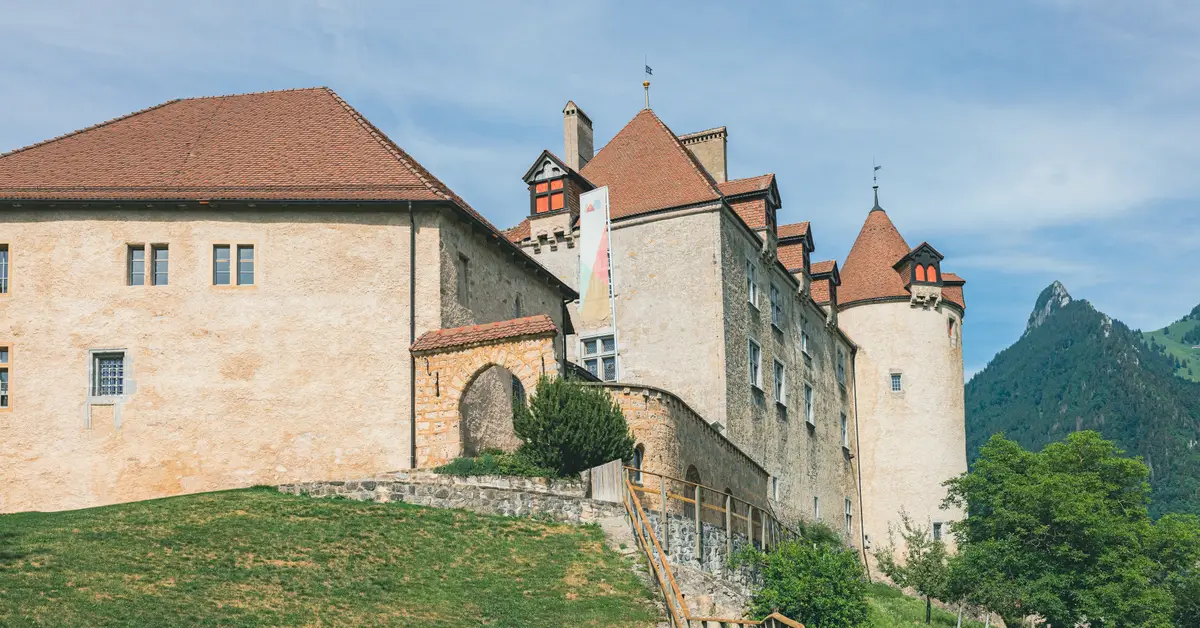
The history of Switzerland spans thousands of years, from ancient Helvetian tribes and Roman rule to a confederation of cantons that gradually unified into a modern federal state with Bern as its capital. It is also a narrative of local autonomy, cultural diversity, and an enduring tradition of neutrality.
Contents
Origins: the Helvetii and the Roman period
The territory corresponding to modern-day Switzerland has been inhabited since very early times. Before the Common Era, the region was home to many tribes, most notably the Helvetii, a Celtic group. It is from this name that the Latin name Helvetia was later formed, a symbol still used to refer to Switzerland to this day.
In the first century BCE, the Helvetii attempted to migrate westward but were intercepted by Roman forces led by Julius Caesar and forced to return to their homeland. Subsequently, the region gradually fell into the orbit of the Roman Empire. The Romans established settlements, roads, and trading posts, laying the foundations for the first urban network in the region.
Under Roman rule, many ancient cities were founded and developed, connecting this land to Mediterranean civilisation. As the Roman Empire weakened, Germanic tribes such as the Alemanni and the Burgundians migrated into the area, laying the foundation for the later linguistic divide between German-speaking regions and those influenced by Latin. This is one of the deepest historical layers in Swiss history.

Considering a residency programme? The Prosperous Living Investment team assesses your profile free of charge and advises on the pathway that fits your goals.
The Middle Ages and the formation of the Confederation in 1291
During the Middle Ages, the Swiss territory lay within the Holy Roman Empire. Local power was dispersed among various lords, monasteries, and autonomous towns. The mountain valleys, with their rugged terrain and insular community life, gradually developed a strong sense of self-governance.
The symbolic starting point of the Swiss state is 1291, when three communities around Lake Lucerne – Uri, Schwyz, and Unterwalden – are said to have formed a defensive alliance to protect their autonomy and support one another. This document is commonly known as the Federal Charter, and the name of the canton of Schwyz later became the root of the name Switzerland.
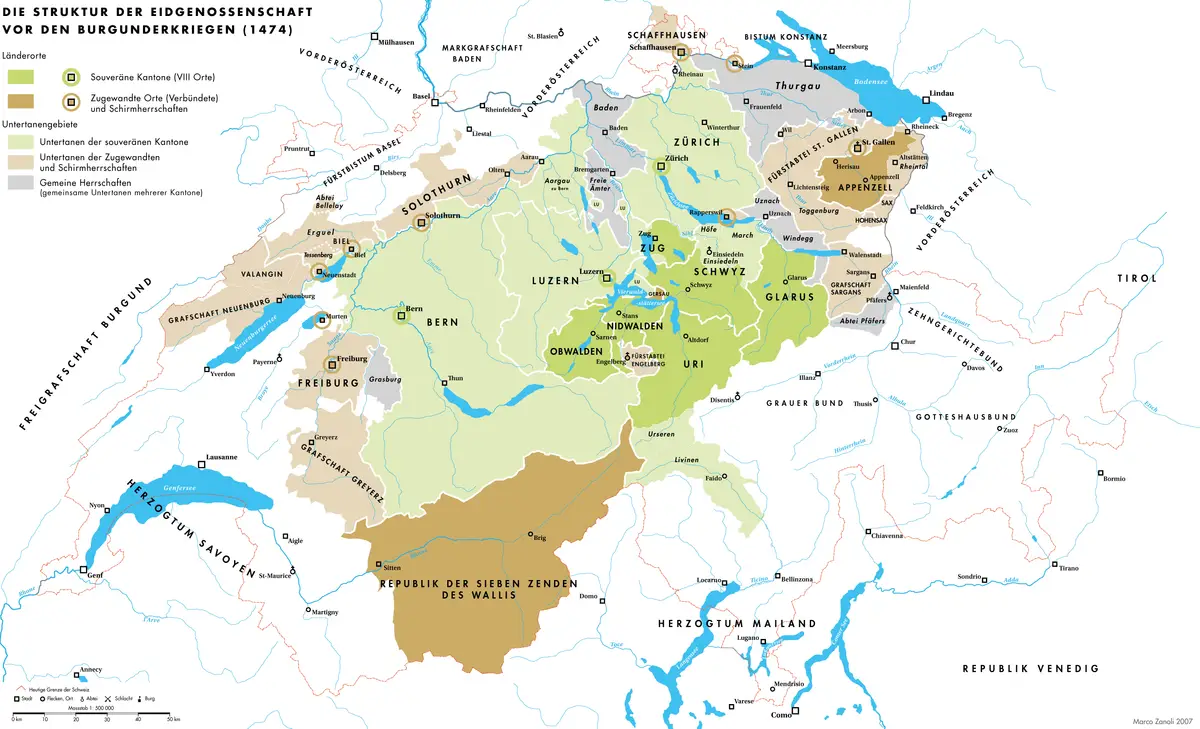
The initial alliance was defensive, binding communities together to resist pressure from external powers, including the House of Habsburg. Over time, the alliance did not dissolve but was strengthened through successive agreements. This was the nucleus of what later became the Old Swiss Confederacy.
Expansion of the Old Swiss Confederacy
From the original three cantons, the Old Swiss Confederacy gradually expanded as other cantons and cities joined. Important urban centres such as Lucerne, Zürich, and Bern joined in turn, bringing the alliance both the strength of the mountain rural areas and the economic and commercial potential of the cities. Bern, the modern-day capital, was one of the most influential members.
In the following centuries, the confederacy’s militia forces gained a reputation for their combat ability in numerous battles to defend their autonomy. This military fame made Swiss mercenaries highly sought after in many European courts, a legacy that remains today in the Swiss Guard at the Vatican.
However, expansion also brought internal tension. The Reformation in the 16th century divided the confederacy into Protestant and Catholic cantons, causing many conflicts. Nevertheless, the loose structure of the alliance persisted, demonstrating the resilience of the model of cooperation between cantons in Swiss history.
Recognition of independence in 1648 and the tradition of neutrality
In reality, the Swiss Confederacy had operated independently of the central authority of the Holy Roman Empire long before the 17th century. However, this independence was only officially recognised legally in 1648, under the Peace of Westphalia, which ended the Thirty Years’ War in Europe.
The events of 1648 marked the recognition of Switzerland’s separation from the Empire, becoming an independent entity on the political map of Europe. This is a foundational milestone, often cited as the moment Switzerland officially stepped out of the framework of the old empire.
Alongside independence, the tradition of neutrality gradually took shape. After experiences of conflict both within and outside the confederacy, the cantons increasingly leaned towards a policy of non-involvement in wars between neighbouring powers. This spirit of neutrality later became one of the most prominent features of the nation’s foreign policy, closely tied to its national identity.
The Napoleonic era and the Helvetic Republic
Entering the late 18th century, the influence of the French Revolution reached the Swiss territory. In 1798, French troops advanced, and the old loose confederacy model was abolished, replaced by a centralised state in the French style called the Helvetic Republic.
The Helvetic Republic imposed a centralised structure, which ran counter to the strong tradition of autonomy of the cantons. This model quickly met with resistance and disorder, as it did not fit the diverse and decentralised reality deeply rooted in Swiss society. This period is viewed as a volatile institutional experiment.
To resolve the deadlock, in 1803, Napoleon Bonaparte issued the Act of Mediation, restoring partial autonomy to the cantons and returning to a federal structure closer to the old tradition. After the Napoleonic era ended, the international community at the Congress of Vienna in 1815 reaffirmed the perpetual neutrality of Switzerland, a recognition with long-lasting significance.
The Federal Constitution of 1848 and the modern state
The first half of the 19th century saw tension between cantons favouring centralisation and those wishing to maintain the loose confederacy model. This conflict reached its peak in a brief internal struggle, paving the way for a profound reform of the state apparatus.
In 1848, Switzerland adopted its first Federal Constitution, laying the foundation for the modern federal state. This document transformed the loose confederacy of cantons into a more unified federation, with a central authority possessing real power while still respecting the high level of autonomy of each canton. Bern was chosen as the seat of the federal authorities.
The 1848 Constitution established a collective executive and a bicameral parliament, while creating the foundation for the direct democratic institutions that would develop later. The constitution was comprehensively revised in the following decades, yet the federal state framework born in 1848 remains a key turning point. This is one of the central milestones of modern Swiss history.
During this same period, Switzerland also affirmed its international humanitarian role when the International Committee of the Red Cross was founded in Geneva, linked to the country’s spirit of neutrality and tradition of reconciliation. This element contributed to shaping the nation’s image on the international stage, a prominent aspect of its identity. Swiss culture.
Neutrality during the two World Wars
When the First World War broke out, Switzerland persisted in maintaining the neutrality that had been recognised since the previous century. Situated between the warring powers, the nation maintained a defensive army and did not participate in the conflict, while acting as a humanitarian intermediary for the parties involved.
During the Second World War, Switzerland continued to pursue a policy of armed neutrality, strengthening its defences in the rugged mountain terrain to deter the threat of invasion. The country was almost entirely surrounded by warring powers, yet it maintained its independence and was not drawn into direct large-scale hostilities.
Its neutral status helped Switzerland become the headquarters for many international organisations and a location for diplomatic and humanitarian activities. However, the country’s role during the war, particularly regarding financial and refugee issues, has since been subject to serious re-examination. Nevertheless, neutrality remains the consistent axis of its foreign policy.
Post-war prosperity and accession to the United Nations in 2002
After the Second World War, Switzerland entered a period of stable development and prosperity. An economy based on banking, precision industry, pharmaceuticals, and high-quality services helped the country rise to become one of the wealthiest nations in the world. A high standard of living and political stability became familiar characteristics.
A notable feature is that Switzerland maintains a cautious attitude towards joining supranational organisations, partly due to its tradition of neutrality and the direct democratic mechanism that requires voter consensus. For many decades, the nation remained outside the full membership of the United Nations, even though it hosted many of the organisation’s agencies in Geneva.
The turning point occurred in 2002, when Swiss voters approved joining the United Nations as a full member in a referendum. This was a highly symbolic event, demonstrating that the long-standing neutral nation was ready to engage more deeply in international life without abandoning its identity.
Switzerland’s integration process with the rest of Europe continues to unfold in its own way, through bilateral agreements rather than full membership in political blocs. This cautious approach, which respects the will of the voters, reflects a spirit Swiss politics that has been shaped over many centuries of history.
Swiss historical heritage and national identity
Looking back at the entire journey, Swiss history is the process of a collection of autonomous communities gradually forming a stable, multilingual, and multicultural federal state. This cohesion does not stem from a single ethnicity or language, but from the will to live together and shared power-sharing institutions.
The tradition of neutrality, the spirit of local self-governance, and the mechanism of direct democracy are the three threads that run throughout. They explain why a small, landlocked nation has been able to maintain its independence and stability through the major upheavals of Europe. That identity has been forged gradually over many centuries.
Many traces of historical periods are still present in the old towns, structures, and preserved landscapes, including sites recognized on the international list of world heritage. According to the United Nations Educational, Scientific and Cultural Organization (UNESCO), the world heritage sites in Switzerland reflect the historical, natural, and cultural depth of this nation.
Understanding history also helps explain the present: the federal structure, regional diversity, and unique foreign policy style of Switzerland are all rooted in the past. It is a living heritage that continues to shape how this nation operates and perceives itself in the world today.
Accompanying you on your journey in residency investment
The Prosperous Living Investment team advises on pathways, assesses profiles and manages investments transparently for every residency, citizenship and international property objective.
Free profile assessmentWhere life gets prosperous